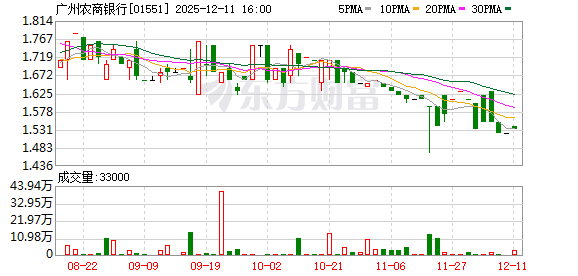
GRCB(01551)

Search documents
资产规模持续提升 农商行集聚效应凸显
Xin Lang Cai Jing· 2026-01-16 19:05
Core Insights - Rural financial institutions are transitioning from a "blooming" phase to a "concentration of leading players" phase, with five rural commercial banks exceeding one trillion yuan in assets, accounting for over 11% of total assets in the sector [1][3] - The emergence of provincial-level unified legal person rural commercial banks with assets over 500 billion yuan indicates a trend towards further concentration in the rural financial sector [1][3] - The competitive landscape is shifting from individual institutions to a focus on systemic capabilities, with an emphasis on sustainable, low-risk financial services [1][4] Group 1: Development of Leading Rural Commercial Banks - Chongqing Rural Commercial Bank was the first to exceed one trillion yuan in assets in 2019, followed by Shanghai, Guangzhou, and Beijing Rural Commercial Banks in 2020 [2] - Chengdu Rural Commercial Bank joined the ranks of trillion-yuan banks in early 2026, benefiting from the national strategy of the Chengdu-Chongqing economic circle [3] Group 2: Competitive Landscape Changes - The shift to concentrated operations in rural finance is a necessary response to challenges such as declining efficiency and negative growth in loans and deposits [4] - The competitive focus is moving from scale expansion to efficiency and value, with a layered industry structure emerging that emphasizes targeted resource allocation [4] Group 3: Challenges and Strategies for High-Quality Development - Achieving high-quality development requires a shift from a focus on scale to optimizing structure, especially in a context of narrowing net interest margins [5][6] - Rural commercial banks need to enhance their profitability by optimizing their liability structure and deepening their understanding of local industries and risks [6] Group 4: Risks and Governance Issues - As rural commercial banks grow, they face new challenges related to risk management, capital constraints, and governance complexities [7] - The transition from individual loan risks to structural risks necessitates a more proactive and comprehensive approach to risk management [7]

进击的头部农商行:五家资产破万亿,重庆农商行、广州农商行主要指标超同城城商行
Xin Lang Cai Jing· 2026-01-10 07:14
Core Viewpoint - Chengdu Rural Commercial Bank has announced that its asset scale has surpassed 1 trillion yuan, making it the fifth rural commercial bank to achieve this milestone, joining Chongqing, Shanghai, Guangzhou, and Beijing Rural Commercial Banks [1][3]. Group 1: Asset Scale and Market Position - As of September 2025, the total assets of the five leading rural commercial banks reached 6.98 trillion yuan, accounting for 11.4% of the total assets of rural financial institutions, which stood at 61.06 trillion yuan [1][3]. - The number of rural commercial banks in China is 1,505, with additional institutions such as rural cooperative banks and rural credit cooperatives contributing to the overall landscape [1]. Group 2: Financial Performance - In the first three quarters of the previous year, all five banks reported revenue exceeding 10 billion yuan, with only Chongqing and Shanghai Rural Commercial Banks achieving net profits over 10 billion yuan [4]. - Chengdu Rural Commercial Bank reported a year-on-year revenue and net profit growth of approximately 7%, while Guangzhou Rural Commercial Bank experienced declines in both metrics [4]. Group 3: Loan and Asset Structure - The loan assets of the five banks account for about half of their total assets, with financial investments generally exceeding 30% [4]. - As of the end of 2024, the loan structure shows that Beijing and Chengdu Rural Commercial Banks have a high proportion of corporate loans, exceeding 70%, while Chongqing Rural Commercial Bank has 40% in personal loans [6][7]. Group 4: Asset Quality and Risk - The non-performing loan (NPL) ratios for Shanghai, Chongqing, and Beijing Rural Commercial Banks were 0.97%, 1.12%, and 1.19% respectively, which are better than the overall levels of large commercial banks [8]. - The overall NPL ratio for rural commercial banks was 2.82%, significantly higher than that of large commercial banks [8]. Group 5: Market Dynamics and Competitive Position - The five leading rural commercial banks have established a strong market presence, with some outperforming local city commercial banks in terms of asset scale, revenue, and net profit [11][12]. - The integration of smaller rural banks is accelerating, indicating a trend towards consolidation within the rural financial sector [15][16]. Group 6: Development Advantages and Challenges - Rural commercial banks benefit from extensive physical networks in rural areas, providing essential financial services to local communities, which enhances customer loyalty [18]. - However, they face challenges such as high industry concentration and limited risk management capabilities, which can hinder their ability to diversify risks [19].


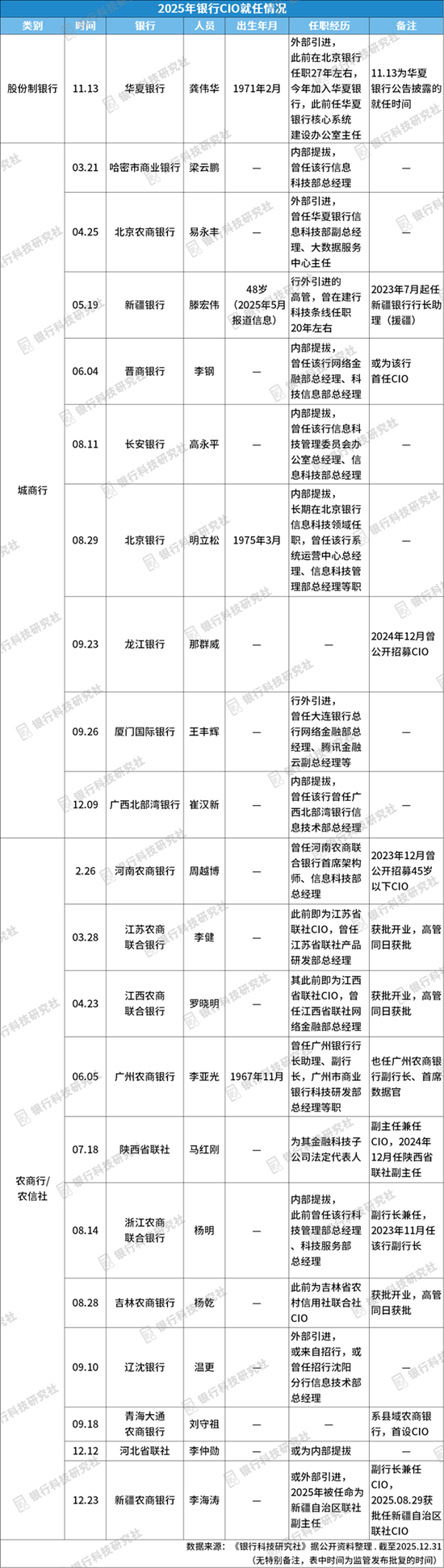
2025年银行CIO盘点:建行、中行CIO离任,多家中小银行行外引进CIO
Xin Lang Cai Jing· 2026-01-07 03:33
Core Insights - The digital transformation is crucial for the banking industry, with a significant focus on the restructuring of digital talent, particularly the Chief Information Officers (CIOs) [1][2] Group 1: Changes in CIO Positions - In 2025, several major banks experienced changes in their technology leadership, with the CIOs of China Construction Bank (CCB) and Bank of China (BOC) resigning [2][4] - CCB's former CIO, Jin Panshi, resigned due to age reasons after serving for four years [2][3] - BOC's former CIO, Meng Qian, also resigned for age reasons after a 38-year tenure, during which she held multiple senior positions [4][6] - The Industrial and Commercial Bank of China (ICBC) also saw its technology leader, CTO Lv Zhongtao, leave at the end of 2025 [7][8] Group 2: New Appointments and Trends - In 2025, 21 new CIOs were appointed, primarily in small and medium-sized banks, with many being external hires [10][11] - Notable new CIOs include Gong Weihua at Huaxia Bank and Wang Fenghui at Xiamen International Bank, both of whom were brought in from outside the banking sector [11][12] - The trend indicates a shift towards external recruitment for CIO positions, with 48% of the new appointments being external hires [16] Group 3: Recruitment Trends in Smaller Banks - Many small and medium-sized banks have publicly announced CIO recruitment in 2025, including Xiamen International Bank and Zhengzhou Bank [18][19] - Recruitment criteria often include age limits and specific experience requirements, such as a minimum of six years in information technology and four years in senior management roles [18][20] - The trend reflects a growing emphasis on digital leadership within smaller banks, as they seek to enhance their technological capabilities [18][19]
广州农商银行(01551) - 截至2025年12月31日止股份发行人的证券变动月报表
2026-01-06 09:29
FF301 股份發行人及根據《上市規則》第十九B章上市的香港預託證券發行人的證券變動月報表 截至月份: 2025年12月31日 狀態: 新提交 致:香港交易及結算所有限公司 公司名稱: 廣州農村商業銀行股份有限公司 (「本行」) 呈交日期: 2026年1月6日 I. 法定/註冊股本變動 | 1. 股份分類 | 普通股 | 股份類別 | H | | 於香港聯交所上市 (註1) | | 是 | | | --- | --- | --- | --- | --- | --- | --- | --- | --- | | 證券代號 (如上市) | 01551 | 說明 | | | | | | | | | | 法定/註冊股份數目 | | | 面值 | | 法定/註冊股本 | | | 上月底結存 | | | 2,674,925,000 | RMB | | 1 RMB | | 2,674,925,000 | | 增加 / 減少 (-) | | | 0 | | | RMB | | 0 | | 本月底結存 | | | 2,674,925,000 | RMB | | 1 RMB | | 2,674,925,000 | | 2. 股份分 ...
成都农商银行晋级万亿元:农商行头部阵营扩容至五家 金融资源“极化”趋势凸显
Mei Ri Jing Ji Xin Wen· 2026-01-04 15:24
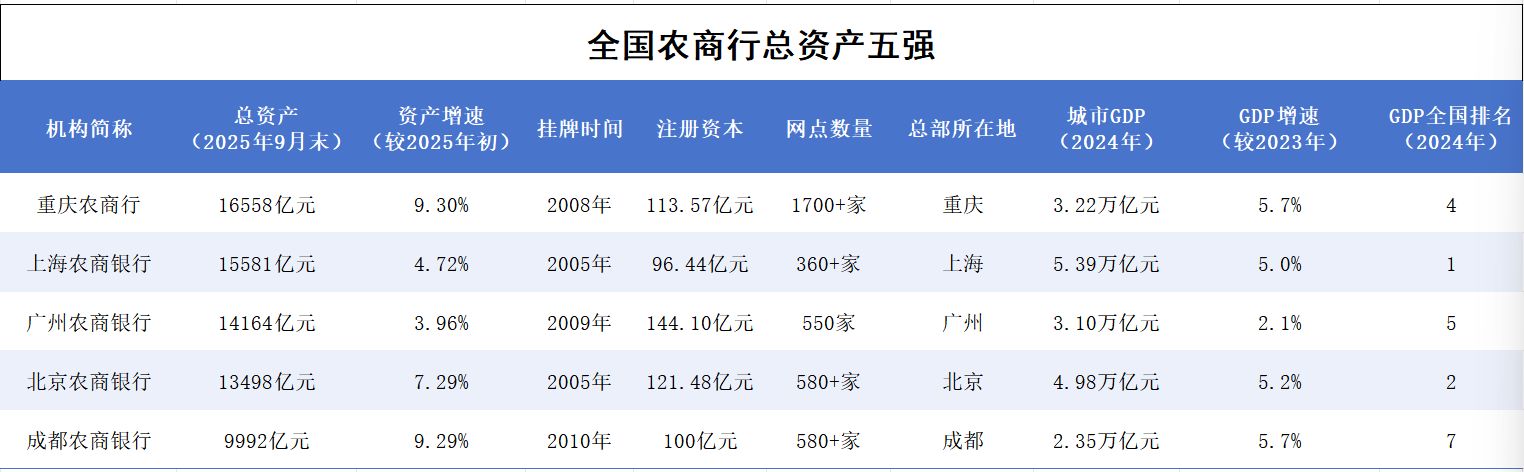
Core Insights - Chengdu Rural Commercial Bank has officially announced that its asset scale has surpassed 1 trillion yuan as of December 31, 2025, joining the "trillion yuan club" alongside four other major rural commercial banks in China [1][3] - The emergence of these banks reflects a trend of financial resource concentration in economically vibrant regions, indicating a shift in China's regional economic development landscape [1][8] Group 1: Overview of the Trillion Yuan Club - The "trillion yuan era" for rural commercial banks began six years ago, with Chongqing Rural Commercial Bank being the first to exceed this threshold in June 2019 [2] - As of September 2025, the total assets of the five major rural commercial banks exceeded 11% of the total assets of all rural financial institutions in China, showcasing significant concentration effects [4] - The five banks—Chongqing, Shanghai, Guangzhou, Beijing, and Chengdu—are primarily located in major cities with strong economic performance, collectively accounting for over 14% of the national GDP [4] Group 2: Individual Bank Performance - As of September 2025, the asset scales of the five banks are as follows: Chongqing Rural Commercial Bank at 1.66 trillion yuan, Shanghai Rural Commercial Bank at 1.56 trillion yuan, Guangzhou Rural Commercial Bank at 1.42 trillion yuan, Beijing Rural Commercial Bank at 1.35 trillion yuan, and Chengdu Rural Commercial Bank at 999.2 billion yuan [6] - Each bank has developed unique strategies based on their regional characteristics, such as Beijing's focus on serving agriculture and small enterprises, and Shanghai's emphasis on wealth management and technology [10][11] Group 3: Strategic Implications - The formation of the "trillion yuan club" among these banks enhances their ability to support local infrastructure projects, providing greater financial autonomy for regional development [15] - The collective strength of these banks facilitates the integration of financial services across administrative boundaries, potentially lowering financing costs for businesses operating in multiple regions [15] - The emergence of this banking cluster is expected to contribute to the establishment of a Western financial center, attracting more financial resources and fostering innovation in financial products tailored to local industries [15]
普益标准发布商业银行综合竞争力评价报告农商行百强榜(2025年),哪些银行上榜?
Xin Lang Cai Jing· 2025-12-31 07:14
Core Viewpoint - The 2025 ranking of the top 100 rural commercial banks in China highlights the competitive landscape, focusing on various dimensions of performance including comprehensive competitiveness, operational scale, profitability, stability, technological innovation, and brand building [3][4][6]. Comprehensive Competitiveness - The top ten banks in comprehensive competitiveness are: Chongqing Rural Commercial Bank, Shanghai Rural Commercial Bank, Beijing Rural Commercial Bank, Shenzhen Rural Commercial Bank, Chengdu Rural Commercial Bank, Dongguan Rural Commercial Bank, Guangzhou Rural Commercial Bank, Jiangsu Jiangnan Rural Commercial Bank, Tianjin Rural Commercial Bank, and Qingdao Rural Commercial Bank [1][8]. Operational Scale and Capital Strength - The leading banks in operational scale and capital strength are: Shanghai Rural Commercial Bank, Chongqing Rural Commercial Bank, Beijing Rural Commercial Bank, Guangzhou Rural Commercial Bank, Dongguan Rural Commercial Bank, Shenzhen Rural Commercial Bank, Chengdu Rural Commercial Bank, Jiangsu Jiangnan Rural Commercial Bank, Tianjin Rural Commercial Bank, and Guangdong Shunde Rural Commercial Bank [1][13]. Profitability - The top banks in profitability are: Shanghai Rural Commercial Bank, Chongqing Rural Commercial Bank, Chengdu Rural Commercial Bank, Jiangsu Changshu Rural Commercial Bank, Shenzhen Rural Commercial Bank, Hangzhou United Rural Commercial Bank, Beijing Rural Commercial Bank, Jiangsu Jiangnan Rural Commercial Bank, Dongguan Rural Commercial Bank, and Zhejiang Xiaoshan Rural Commercial Bank [1][18]. Stability - The banks excelling in stability are: Shanghai Rural Commercial Bank, Chongqing Rural Commercial Bank, Shenzhen Rural Commercial Bank, Dongguan Rural Commercial Bank, Jiangsu Jiangnan Rural Commercial Bank, Tianjin Rural Commercial Bank, Guangzhou Rural Commercial Bank, Beijing Rural Commercial Bank, Shaanxi Qinong Rural Commercial Bank, and Wuhan Rural Commercial Bank [1][6]. Technological and Service Innovation Capability - The top banks in technological and service innovation capability are: Chongqing Rural Commercial Bank, Shanghai Rural Commercial Bank, Beijing Rural Commercial Bank, Chengdu Rural Commercial Bank, Guangzhou Rural Commercial Bank, Jiangsu Suzhou Rural Commercial Bank, Shenzhen Rural Commercial Bank, Qingdao Rural Commercial Bank, Tianjin Rural Commercial Bank, and Dongguan Rural Commercial Bank [2][6]. Brand Building Capability - The leading banks in brand building capability are: Chongqing Rural Commercial Bank, Shanghai Rural Commercial Bank, Jiangsu Zijin Rural Commercial Bank, Dongguan Rural Commercial Bank, Jiangsu Kunshan Rural Commercial Bank, Shenzhen Rural Commercial Bank, Jiangsu Jiangnan Rural Commercial Bank (tied for seventh), Zhejiang Shaoxing Ruifeng Rural Commercial Bank (tied for seventh), Beijing Rural Commercial Bank, and Chengdu Rural Commercial Bank [2][6].

“百千万”三年见成效 这家湾区上市农商行解锁商业可持续发展密码
2 1 Shi Ji Jing Ji Bao Dao· 2025-12-26 23:19
Core Insights - The "Hundred Counties, Thousand Towns, and Ten Thousand Villages" project has shown initial success in promoting coordinated urban-rural development in Guangdong, with financial institutions actively participating in this initiative [1][2] - Guangzhou Rural Commercial Bank has positioned itself as a key player in this project, exploring new growth opportunities in traditional sectors while ensuring sustainable business practices [1][2] Financial Institutions' Participation - Financial institutions, particularly large banks and local banks, are increasingly competing to engage in the "Hundred Counties, Thousand Towns, and Ten Thousand Villages" project, leveraging their unique advantages [1][2] - The project has transformed the rural market into a new growth curve for financial institutions, driven by emerging agricultural entities and increasing rural income [2][3] Market Dynamics - Guangzhou Rural Commercial Bank has identified a stable customer base in rural areas, characterized by low liquidity and high loyalty, which can lead to long-term business relationships [2][3] - The bank has successfully increased its agricultural customer base by over 3,000 in 2024, with a 26.39% growth in the number of agricultural enterprises [2][3] Asset Growth and Quality - As of now, the agricultural loan balance of Guangzhou Rural Commercial Bank has exceeded 42 billion yuan, reflecting a net increase of over 6 billion yuan in three years, primarily directed towards modern agriculture and rural infrastructure [3] - The bank's consumer loan products for rural households have surpassed 2 billion yuan, with a growth rate exceeding 50%, indicating a shift in financial demand from production to diversified needs [3][5] Innovative Business Models - Financial institutions are focusing on sustainable profit models rather than short-term charity, with Guangzhou Rural Commercial Bank leading in product innovation and differentiated services [4][5] - The bank has introduced unique products tailored to rural needs, such as loans secured by land operating rights and forest compensation rights, which help address local financial challenges [5][6] Diversification of Services - Guangzhou Rural Commercial Bank is expanding into various business areas, including rural payment services and wealth management, to reduce reliance on traditional interest income [6][7] - The bank's innovative "Rong e Rent" platform addresses local housing management needs, enhancing customer engagement and loyalty [6][7] Community Integration - The bank's deep understanding of local markets allows it to create a symbiotic service system that supports rural development and investment [7][8] - By establishing a comprehensive service network, including over 500 branches and 141 rural financial service stations, the bank enhances its customer connection and service delivery [7][8] Conclusion - Guangzhou Rural Commercial Bank's involvement in the "Hundred Counties, Thousand Towns, and Ten Thousand Villages" project exemplifies a pragmatic approach to tapping into rural markets and building long-term competitive advantages [8][9]
深度|银行业“瘦身”
2 1 Shi Ji Jing Ji Bao Dao· 2025-12-26 13:02
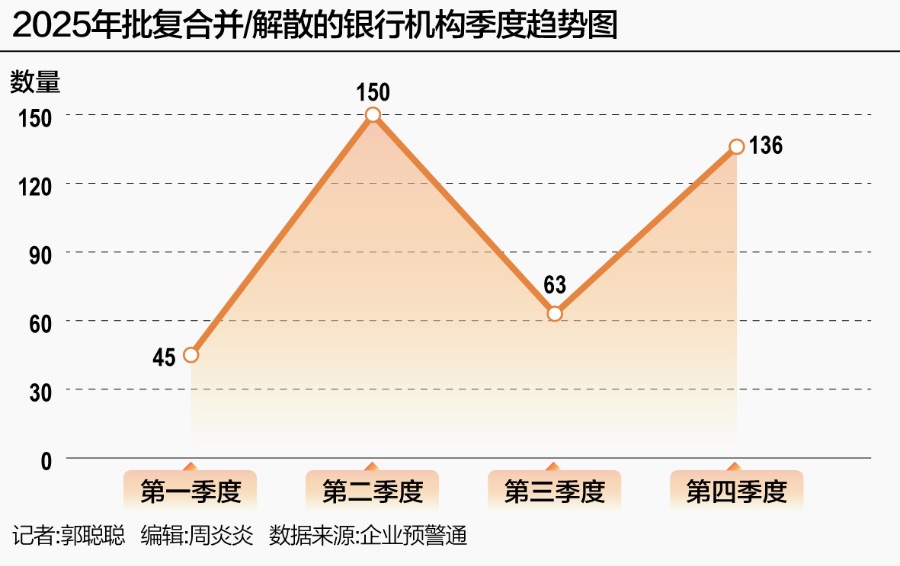
Core Insights - The wave of mergers and restructuring among China's small and medium-sized banks has progressed with unexpected intensity and speed, focusing on financial risk prevention and high-quality industry development as the core themes of the year [1][2]. Summary by Sections Mergers and Restructuring - As of December 26, 2025, a total of 394 banking institutions were approved to exit the market through mergers and dissolutions, doubling the total from 2024 [1][7]. - Between 2024 and 2025, nearly 550 banking institutions were reduced through mergers and restructuring, surpassing the total from the previous seven years [1]. - The restructuring involved 28 provinces, with Inner Mongolia leading by integrating 139 institutions, followed by Shandong (33), Henan (26), and others [1][9]. Characteristics of the Restructuring - The integration of small and medium-sized banks in 2025 is characterized by two significant trends: the involvement of state-owned banks in "village-to-branch" transformations and the acceleration of provincial-level reforms in the rural credit system [1][15]. - The core entities in the restructuring are village banks (231), followed by rural commercial banks (81) and rural credit cooperatives (71) [12]. Policy and Regulatory Framework - The central financial work conference in 2024 emphasized the need to "properly handle risks in small financial institutions," placing them alongside local debts and real estate as key areas for financial risk prevention [3]. - The regulatory focus during the "14th Five-Year Plan" period has been on risk prevention and resolution for small financial institutions, with a commitment to personalized reform strategies based on regional differences [4]. Achievements and Future Directions - Significant progress has been made in risk resolution, with over 40% more non-performing asset disposals compared to the previous five-year period, and the total capital and provisions in the industry exceeding 50 trillion yuan [5]. - The government work report for 2025 outlined a market-oriented and legal approach to risk resolution and transformation of local small financial institutions [5]. Service Upgrades and Market Dynamics - The restructuring is not merely a reduction in numbers but aims to enhance the quality and efficiency of financial services, particularly for rural and small enterprises [19][20]. - Merged institutions are expected to improve operational standards, risk resistance, and expand their service offerings through enhanced digital capabilities [19][20]. Long-term Outlook - The ongoing restructuring of small and medium-sized banks is anticipated to continue into 2026, with a focus on quality improvement and effective integration as the core theme [21].



三年超480亿资产“出表”,蔡建执掌下的万亿级广州农商行加速“减负”
Xin Lang Cai Jing· 2025-12-14 09:11
Core Viewpoint - Guangzhou Rural Commercial Bank has completed a significant asset sale of 12.25 billion yuan, marking its third sale of over 10 billion yuan in recent years, as part of a strategy to offload low-efficiency assets and improve its financial metrics [1][18]. Group 1: Asset Sale Details - The bank sold low-efficiency credit assets totaling 18.928 billion yuan, with the principal amount being 14.978 billion yuan [2][19]. - The sale price of 12.25 billion yuan represents a 35% discount compared to the total asset amount, but the bank stated that the sale was in line with its and its shareholders' interests [4][21]. - The cumulative asset sales from 2023 to 2025 exceed 48 billion yuan, indicating a proactive approach to risk management [5][22]. Group 2: Financial Impact - The asset sales have led to a short-term improvement in the bank's capital adequacy ratios, with the capital adequacy ratio, tier one capital ratio, and core tier one capital ratio reported at 14.52%, 11.42%, and 9.90% respectively by the end of 2024 [9][24]. - The bank's non-performing loan ratio improved to 1.66% by the end of 2024, the lowest in five years, following the disposal of low-efficiency assets [6][24]. - However, the non-performing loan ratio increased to 1.98% by mid-2025, indicating potential long-term challenges despite short-term gains [10][25]. Group 3: Strategic Adjustments - The bank is undergoing structural adjustments and integrating village banks to enhance competitiveness and profitability [1][18]. - The chairman has set a target for significant improvement in profitability by 2025, emphasizing market expansion, risk reduction, and management optimization [30][31]. - Recent reforms in village banks have been implemented, with several banks merging into branches of Guangzhou Rural Commercial Bank, aiming to expand its market presence [33].
新华财经看广东|金融如何赋能“百千万工程”?——专访广州农商银行党委书记、董事长蔡建
Xin Hua Cai Jing· 2025-12-11 09:28
Group 1 - The "Hundred Counties, Thousand Towns, and Ten Thousand Villages High-Quality Development Project" (referred to as "Hundred Thousand Project") is a core strategy initiated by Guangdong Province in December 2022 to address the imbalance in urban and rural development [2] - The project aims for a phased approach with goals set for one year, three years, five years, and ten years, focusing on achieving significant changes in urban-rural coordination [2] - Financial support is emphasized as crucial for the success of the "Hundred Thousand Project," with policies established to direct financial resources and services towards rural areas [2] Group 2 - Guangzhou Rural Commercial Bank's Chairman, Cai Jian, highlighted the project's effectiveness in promoting urban-rural coordination within the province [3] - The bank's primary responsibility is to support agriculture and small enterprises, maintaining a strong commitment to this development focus [3] - The bank boasts extensive coverage, comprehensive product offerings, and high service efficiency, with a quick decision-making process for small loans, fulfilling financial needs related to the "Hundred Thousand Project" within 7-10 days [3]