GRCB(01551)

Search documents
广州农商银行(01551.HK):朱桂龙独立董事任职资格获核准
Ge Long Hui· 2026-02-15 10:20
Core Viewpoint - Guangzhou Rural Commercial Bank has received approval from the Guangdong Regulatory Bureau of the National Financial Supervision Administration for the appointment of Zhu Guilong as an independent director, effective from February 14, 2026, until the end of the current board's term, with the possibility of re-election thereafter [1] Company Summary - The appointment of Zhu Guilong as an independent director is a strategic move for Guangzhou Rural Commercial Bank, indicating a focus on governance and oversight [1] - The term for the new independent director will last until the completion of the fourth board's term, suggesting stability in leadership [1] - The approval from the regulatory authority highlights the bank's compliance with governance standards set by financial regulators [1]
广州农商银行(01551) - 董事名单与其角色和职能
2026-02-15 10:06
Guangzhou Rural Commercial Bank Co., Ltd.* 廣州農村商業銀行股份有限公司 * 執行董事: 蔡建先生 鄧曉雲女士 譚波先生 非執行董事: 倪開先生 王曉斌先生 左梁先生 張研先生 幸秋玉女士 胡戈游先生 馮耀良先生 獨立非執行董事: 廖文義先生 杜金岷先生 朱桂龍先生 張華先生 馬學銘先生 1 董事會設有五個委員會,下表提供各董事擔任有關委員會成員的資料。 (於中華人民共和國註冊成立的股份有限公司) (股份代號:1551) 董事名單與其角色和職能 廣州農村商業銀行股份有限公司*董事會(「董事會」)成員載列如下。 | 董事委員會 | | 提名與薪酬 | 戰略與投資 | 關聯交易與 | 消費者權益 | | --- | --- | --- | --- | --- | --- | | | 審計委員會 | 委員會 | 委員會 | 風險管理 | 保護委員會 | | 董事 | | | (三農委員會) | 委員會 | | | 蔡建先生 | | | C | | | | 鄧曉雲女士 | | | M | | C | | 倪開先生 | | | | | M | | 左梁先生 | | | M | ...
广州农商银行(01551) - 董事任职资格获监管机构核准
2026-02-15 10:03
香港交易及結算所有限公司及香港聯合交易所有限公司對本公告的內容概不負責,對其準確性 或完整性亦不發表任何聲明,並明確表示,概不對因本公告全部或任何部份內容而產生或因倚 賴該等內容而引致的任何損失承擔任何責任。 Guangzhou Rural Commercial Bank Co., Ltd.* 有關朱先生的簡歷詳情及其他資料請參見公告及通函。於本公告日期,該等資料 並無重大變動。 於委任朱先生後,本行重新符合上市規則第3.10A條,獨立非執行董事人數佔董 事會成員三分之一。 承董事會命 廣州農村商業銀行股份有限公司* 董事長 蔡建 中國廣州 廣州農村商業銀行股份有限公司 * (於中華人民共和國註冊成立的股份有限公司) (股份代號:1551) 董事任職資格獲監管機構核准 茲提述廣州農村商業銀行股份有限公司*(「本行」)日期為2024年11月22日的公 告,日期為2024年11月28日的2024年第一次臨時股東大會(「臨時股東大會」) 通函以及日期為2024年12月13日的臨時股東大會投票表決結果公告(「公告及通 函」)。 近日,本行收到國家金融監督管理總局廣東監管局的批覆,國家金融監督管理總 局廣東監管局已核准 ...
广州农商银行组织开展“志愿服务暖人心 金融教育有温度”消保宣传月活动
Xin Lang Cai Jing· 2026-02-12 12:14
Core Viewpoint - Guangzhou Rural Commercial Bank is enhancing financial consumer risk awareness through a series of consumer rights protection activities, combining financial education with volunteer services to reach over 10,000 people in January 2026 [3][26]. Group 1: Activities and Outreach - The bank organized 115 events across 21 branches in January 2026, focusing on delivering accessible financial knowledge to consumers [3][26]. - Activities included traditional cultural experiences, such as making lanterns and spring festival decorations, combined with financial knowledge quizzes to engage consumers [11][35]. - The bank's branches, such as Panyu, Heyuan, and Zengcheng, integrated financial knowledge dissemination with festive activities, like writing Spring Festival couplets, to connect with older consumers [6][30]. Group 2: Targeted Education - Tianhe branch conducted a financial fraud prevention workshop at Guangzhou Open University, using quizzes to educate older consumers about common scams [16][40]. - Huannan branch offered free health check-ups alongside financial education to cater to the diverse needs of older consumers, reinforcing their financial safety [19][43]. - Zhaoqing branch set up community outreach initiatives to explain financial suitability and protect the financial interests of older consumers [22][46]. Group 3: Future Plans - The bank plans to continue focusing on key demographics, including the elderly and youth, integrating financial knowledge into customer service to make it more relatable and accessible [27][48].


广州农商银行独董辞任致治理承压,股价交易极度低迷
Xin Lang Cai Jing· 2026-02-12 01:31
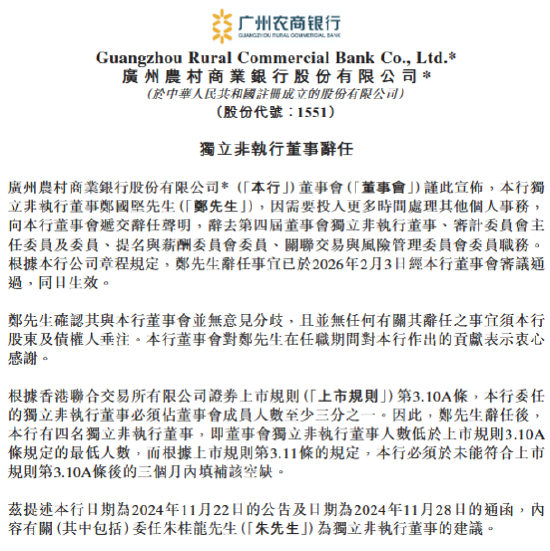
Group 1 - Guangzhou Rural Commercial Bank's independent non-executive director Zheng Guojian resigned due to personal matters, reducing the number of independent directors to 4, below the Hong Kong Stock Exchange's requirement of at least one-third [1] - The bank's 2025 performance was under pressure, with a 2.35% year-on-year decline in revenue and an 18.73% year-on-year decline in net profit for the first three quarters [1] - The bank emphasized optimizing asset quality through a "3+2" specialized operation strategy during its 2026 work meeting [1] Group 2 - The stock price has shown stability but with extremely low trading activity, closing at HKD 1.52 on February 11, 2026, with a 0.65% decline over the past five days and a trading range of only 0.65% [2] - Most trading days from February 5 to 11 recorded zero transactions, with only 2,000 shares traded on February 6, indicating very low market participation [2] - Technical indicators show a bearish short-term moving average arrangement, with the 5-day moving average at HKD 1.524 being lower than the 20-day moving average at HKD 1.549, and the MACD histogram remaining negative, suggesting weak short-term momentum [2] Group 3 - Small and medium-sized banks in the Hong Kong stock market, including Guangzhou Rural Commercial Bank, are facing liquidity marginalization issues due to concentrated business regions, narrowing net interest margins, and pressured asset quality, with the non-performing loan ratio rising to 1.98% in the first half of 2025 [3] - Experts suggest that these banks need to alleviate pressure through capital replenishment and specialized operations, but short-term valuation recovery relies on performance realization [3]
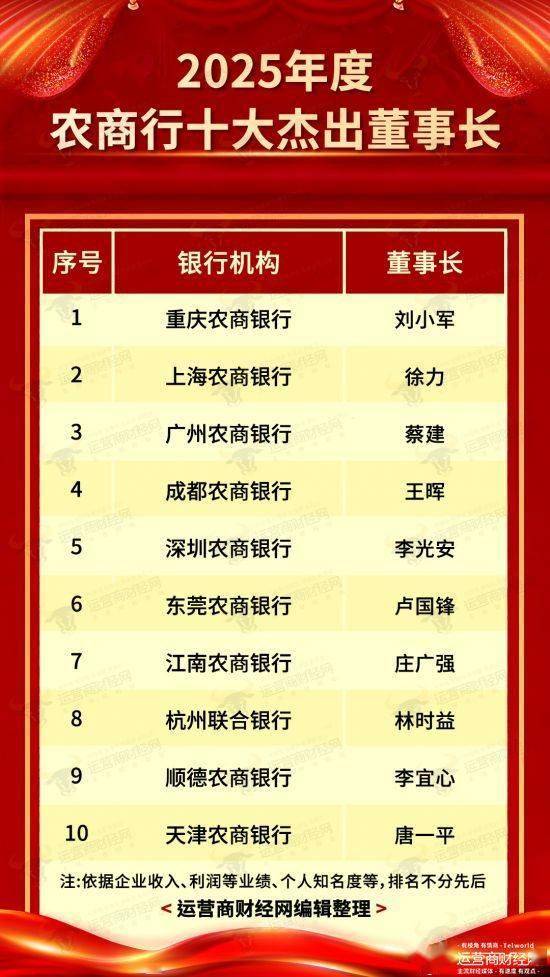
运营商财经网正式公布“2025年度农商行十大杰出董事长”榜单
Sou Hu Cai Jing· 2026-02-09 02:11
Core Viewpoint - The "2025 Outstanding Chairmen of Rural Commercial Banks" list has been officially announced, highlighting key figures in the financial industry, particularly in rural commercial banks [1]. Group 1: List of Outstanding Chairmen - The list includes notable chairmen from various rural commercial banks, such as: - Liu Xiaojun from Chongqing Rural Commercial Bank - Xu Li from Shanghai Rural Commercial Bank - Cai Jian from Guangzhou Rural Commercial Bank - Wang Hui from Chengdu Rural Commercial Bank - Li Guang'an from Shenzhen Rural Commercial Bank - Lu Guofeng from Dongguan Rural Commercial Bank - Zhuang Guangqiang from Jiangnan Rural Commercial Bank - Lin Shiyi from Hangzhou United Bank - Li Yixin from Shunde Rural Commercial Bank - Tang Yiping from Tianjin Rural Commercial Bank [2][3]. Group 2: Evaluation Criteria - The selection of the outstanding chairmen was based on a comprehensive assessment of various factors, including: - Company performance metrics such as sales, revenue, and profit - Personal recognition and contributions of the executives [3].


广州农商银行(01551) - 截至2026年1月31日止股份发行人的证券变动月报表
2026-02-05 08:45
FF301 股份發行人及根據《上市規則》第十九B章上市的香港預託證券發行人的證券變動月報表 截至月份: 2026年1月31日 狀態: 新提交 致:香港交易及結算所有限公司 | 1. 股份分類 | 普通股 | 股份類別 | H | | 於香港聯交所上市 (註1) | | 是 | | | --- | --- | --- | --- | --- | --- | --- | --- | --- | | 證券代號 (如上市) | 01551 | 說明 | | | | | | | | | | 法定/註冊股份數目 | | | 面值 | | 法定/註冊股本 | | | 上月底結存 | | | 2,674,925,000 | RMB | | 1 RMB | | 2,674,925,000 | | 增加 / 減少 (-) | | | 0 | | | RMB | | 0 | | 本月底結存 | | | 2,674,925,000 | RMB | | 1 RMB | | 2,674,925,000 | | 2. 股份分類 | 普通股 | 股份類別 | 其他類別 (請註明) | | 於香港聯交所上市 (註1) | | 否 | | | ...
人数告急!广州农商行独董辞职,新人选任职资格一年仍未获批
Nan Fang Du Shi Bao· 2026-02-04 09:53
Core Viewpoint - Guangzhou Rural Commercial Bank is facing a governance issue due to the resignation of independent non-executive director Zheng Guojian, which has reduced the number of independent directors below the regulatory requirement set by the Hong Kong Stock Exchange [1][2][4] Group 1: Resignation of Independent Director - Zheng Guojian resigned from his position as an independent non-executive director and various committee roles due to personal commitments, effective immediately [2][3] - Following Zheng's resignation, the number of independent non-executive directors at Guangzhou Rural Commercial Bank decreased to four, below the required one-third ratio mandated by the Hong Kong Stock Exchange [2][4] - The bank must fill this vacancy within three months to comply with regulatory requirements [2][4] Group 2: Challenges in Appointing New Directors - The bank's efforts to appoint new independent directors have faced setbacks, including the unapproved qualifications of Zhu Guilong, who was approved by the shareholders in December 2024 but has yet to receive regulatory approval [4][6] - Previous attempts to appoint directors, such as Xu Zhi and Qin Min'an, resulted in resignations before they officially took office, indicating ongoing challenges in governance [3][4] Group 3: Financial Performance and Asset Management - As of the third quarter of 2025, Guangzhou Rural Commercial Bank reported total assets of 1.42 trillion yuan, making it the largest rural commercial bank in Guangdong province [6] - The bank's revenue for the first three quarters of 2025 was 11.02 billion yuan, a decrease of 2.35% year-on-year, while net profit fell by 18.73% to 1.72 billion yuan [6] - The bank has been significantly impacted by credit impairment losses, which reached 3.81 billion yuan in the first half of 2025, representing a 30.6% increase year-on-year and accounting for 47.4% of revenue [6]
广州农商银行:郑国坚辞任独立非执行董事
Xin Lang Cai Jing· 2026-02-03 11:58
Core Viewpoint - Guangzhou Rural Commercial Bank announced the resignation of independent non-executive director Zheng Guojian due to personal commitments, effective February 3, 2026 [2][3]. Summary by Relevant Sections - **Resignation Announcement** - Zheng Guojian submitted his resignation to the board, stepping down from multiple roles including independent non-executive director, chairman of the audit committee, member of the nomination and remuneration committee, and member of the related party transactions and risk management committee [2][3]. - **Effective Date** - The resignation was approved by the board on February 3, 2026, and took effect on the same day [2][3].
因需要投入更多时间处理其他个人事务,广州农商行独立非执行董事郑国坚辞任
Xin Lang Cai Jing· 2026-02-03 11:35
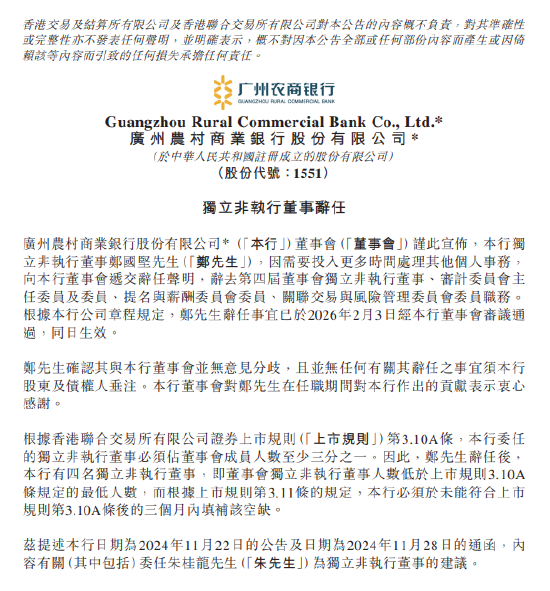
Core Viewpoint - Guangzhou Rural Commercial Bank announced the resignation of independent non-executive director Zheng Guojian due to personal commitments, effective February 3, 2026, after board approval [1][2]. Group 1 - Zheng Guojian has submitted his resignation from multiple positions, including independent non-executive director, chairman of the audit committee, and member of the nomination and remuneration committee, as well as the related party transaction and risk management committee [1][2]. - The bank confirmed that there are no disagreements between Zheng and the board, and no issues regarding his resignation that require attention from shareholders or creditors [1][2]. - The board expressed gratitude for Zheng's contributions during his tenure [1][2].