
BRAINAURORA-B(06681)

Search documents
脑动极光(06681) - 截至2026年1月31日止之股份发行人的证券变动月报表
2026-02-04 11:47
致:香港交易及結算所有限公司 公司名稱: 腦動極光醫療科技有限公司(於開曼群島註冊成立的有限公司) 呈交日期: 2026年2月4日 I. 法定/註冊股本變動 | 1. 股份分類 | 普通股 | 股份類別 | 不適用 | | 於香港聯交所上市 (註1) | | 是 | | | --- | --- | --- | --- | --- | --- | --- | --- | --- | | 證券代號 (如上市) | 06681 | 說明 | | | | | | | | | | 法定/註冊股份數目 | | | 面值 | | 法定/註冊股本 | | | 上月底結存 | | | 500,000,000,000 | USD | 0.0000001 | USD | | 50,000 | | 增加 / 減少 (-) | | | 0 | | | USD | | 0 | | 本月底結存 | | | 500,000,000,000 | USD | 0.0000001 | USD | | 50,000 | 本月底法定/註冊股本總額: USD 50,000 股份發行人及根據《上市規則》第十九B章上市的香港預託證券發行人的證券變動月報表 ...
智通港股52周新高、新低统计|2月3日





智通财经网· 2026-02-03 08:44
Group 1 - A total of 78 stocks reached a 52-week high as of February 3, with notable performers including Asia Pacific Financial Investments (08193) at 57.14%, Chao Wei Holdings (08059) at 36.00%, and Asia Backup (08290) at 33.33% [1] - The closing prices for the top three stocks that reached new highs were 0.550, 0.052, and 0.024 respectively, with their highest prices being 0.550, 0.068, and 0.036 [1] - Other significant stocks that reached new highs include Huameilele (08429) with a high rate of 20.37% and Haode Holdings (08149) at 17.65% [1] Group 2 - The report also lists stocks that reached 52-week lows, with the worst performer being Gaodi Holdings (01676) at -10.00%, followed by Huajian Medical (01931) at -9.29% and Electronic Trading Group (08036) at -9.09% [3] - The closing prices for the stocks that reached new lows include 0.340, 1.280, and 0.021 respectively, with their lowest prices being 0.315, 1.270, and 0.020 [3] - Other notable stocks that reached new lows include Controllon (01912) at -8.93% and Cool Link (08491) at -8.11% [3]
23亿的天价官司,暴露出车企自研电池的「致命隐患」
36氪· 2026-02-02 09:39
Core Viewpoint - The article discusses a significant quality dispute in the domestic power battery industry, highlighting the lawsuit filed by Weir against XWANDA for 2.3 billion yuan due to battery quality issues, which raises concerns about the implications for automakers who develop their own battery packs [4][6][26]. Group 1: Lawsuit Details - Weir has sued XWANDA for 2.3 billion yuan, claiming that the battery cells supplied by XWANDA from June 2021 to December 2023 had quality issues [4]. - The lawsuit stems from problems with the Zeekr 001 WE86 version, which experienced slow charging and abnormal battery degradation [5][6]. - XWANDA argues that the issues are due to Weir's aggressive charging strategies and modifications to battery usage conditions, not the quality of the cells themselves [6][7]. Group 2: Financial Implications - If Weir wins the lawsuit, XWANDA could face a loss equivalent to approximately two years of net profit, as their projected net profits for 2022 to Q1 2025 are 1.068 billion, 1.076 billion, 1.468 billion, and 386 million yuan respectively [6][7]. - The lawsuit not only poses a financial threat but also risks damaging XWANDA's reputation among customers, potentially affecting future business opportunities [7]. Group 3: Industry Trends - The dispute highlights the risks associated with automakers developing their own battery packs, as seen with companies like Leap Motor, Li Auto, and Xiaomi, which have sought to reduce reliance on major battery suppliers [7][24]. - The trend towards self-manufactured battery packs aims to lower costs and enhance product quality control, but the lawsuit illustrates the complexities and potential liabilities that can arise from this approach [24][26]. Group 4: Technical Considerations - The core issue in the dispute revolves around the responsibility for battery pack quality, specifically the roles of the battery cells and Battery Management System (BMS) [9][15]. - Variability in battery cell production can lead to quality differences, complicating accountability when issues arise [11][27]. - The BMS plays a crucial role in battery performance, and its strategies can significantly impact the longevity and efficiency of the battery pack [15][18]. Group 5: Future Outlook - Despite the challenges highlighted by the lawsuit, the trend towards self-manufactured battery packs is expected to continue as automakers seek greater control over supply chain safety and cost management [35].



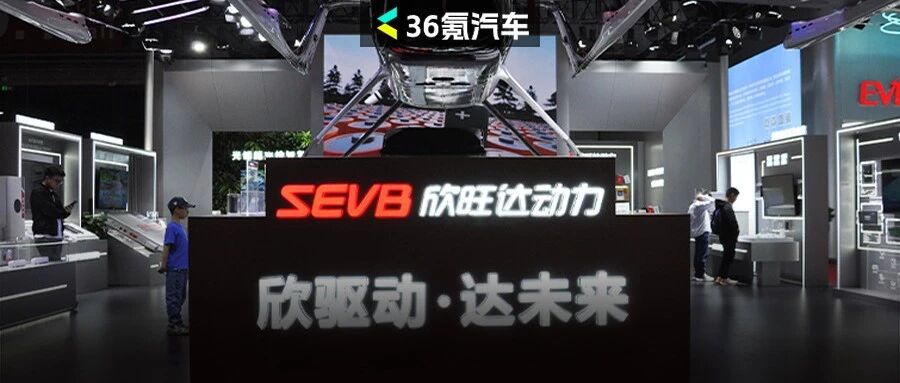
23亿元天价官司,没有吓退车企自制电池包
3 6 Ke· 2026-02-02 09:19
Core Viewpoint - The lawsuit involving a 2.3 billion yuan claim against Xiwanda by Weirui highlights significant quality disputes in the domestic power battery industry, particularly concerning the battery cells supplied by Xiwanda to Weirui for the Zeekr 001 WE86 model, which experienced issues such as slow charging and abnormal battery degradation [1][2][3]. Summary by Sections Legal Dispute - Weirui claims that the quality issues with the battery cells supplied by Xiwanda led to costs for battery replacements and damage to the Zeekr brand image, thus seeking 2.3 billion yuan in compensation [2]. - Xiwanda argues that Weirui's aggressive charging strategy and "lock battery" operations altered the usage conditions of the batteries, which contributed to the problems [2]. Financial Impact - The potential loss of 2.3 billion yuan in compensation could equate to approximately two years of net profit for Xiwanda, which reported net profits of 1.068 billion, 1.076 billion, 1.468 billion, and 386 million yuan from 2022 to Q1 2025 [2]. - The lawsuit has negatively impacted Xiwanda's corporate image among end consumers, leading to a cautious stance from potential clients [2]. Industry Implications - The dispute underscores the risks associated with automakers developing their own battery packs and the complexities of determining responsibility for battery quality issues [3][4]. - The trend of automakers like Leap Motor, Li Auto, and Xiaomi to self-develop battery packs and BMS systems to reduce reliance on major battery suppliers is now facing scrutiny due to this legal case [3][13]. Technical Aspects - The core controversy revolves around the responsibility for battery pack quality issues, specifically between the battery cells and the Battery Management System (BMS) [4]. - Variability in battery cell quality between different production batches can lead to significant performance differences, complicating quality assurance [5][6]. - The design and control of battery cells, particularly in terms of manufacturing consistency, are critical to ensuring performance and longevity [5][6]. Future Trends - Despite the challenges highlighted by the lawsuit, the trend towards self-manufactured battery packs is expected to continue as automakers seek greater control over costs and product quality [19]. - The complexities of determining liability in battery quality disputes may lead to more collaborative approaches between automakers and battery manufacturers to mitigate risks [19].
脑动极光(06681) - 澄清公告
2026-01-27 12:51
香港交易及結算所有限公司及香港聯合交易所有限公司對本公告的內容概不負責,對其準確性 或完整性亦不發表任何聲明,並明確表示,概不對因本公告全部或任何部分內容而產生或因倚 賴該等內容而引致的任何損失承擔任何責任。 本公告僅作參考用途,並不構成收購、購買或認購本公司任何證券的邀請或要約。 下列責任聲明應載於該公告之末: BrainAurora Medical Technology Limited 「全體董事願就本公告所載資料的準確性共同及個別承擔全部責任,並在作出一切 合理查詢後確認,就彼等所深知,本公告所表達的意見乃經審慎周詳考慮後始行 作出,且本公告並無遺漏任何其他事實,致使本公告任何陳述產生誤導。」 腦動極光醫療科技有限公司 除上文所述外,該公告所載其他資料維持不變。 (於開曼群島註冊成立的有限公司) (股份代號:6681) 澄清公告 茲提述本公司日期為2026年1月23日的公告(「該公告」),內容有關(其中包括)配 售事項及先舊後新認購事項。除另有界定外,本公告所用詞彙與該公告所界定者 具有相同涵義。 譚錚先生 主席兼執行董事 香港,2026年1月27日 截至本公告日期,董事會包括:(i)執行董事譚錚先生; ...
三大指数表现不一 传统板块逆袭科技热点成新主线
Xin Lang Cai Jing· 2026-01-26 08:37
Market Performance - The Hong Kong stock market showed mixed performance with the Hang Seng Index up by 0.06% closing at 26,765.52 points, while the Tech Index fell by 1.24% to 5,725.99 points, and the National Enterprises Index decreased by 0.15% to 9,147.21 points [1][2]. Sector Performance - Traditional cyclical stocks such as oil, coal, and non-ferrous metals performed strongly, indicating a shift in market focus towards value assets. In contrast, previously popular sectors like commercial aerospace and brain-computer interface technologies experienced a pullback [2][11]. Oil Sector - Oil stocks saw significant gains, with China National Offshore Oil Corporation (CNOOC) rising by 4.01%, China Petroleum & Chemical Corporation (Sinopec) increasing by 3.68%, and China Oilfield Services Limited up by 3.23%. This strength is attributed to a recent extreme cold wave in North America, which caused a 63% spike in U.S. natural gas prices from January 20 to 22, subsequently boosting prices of light hydrocarbons and supporting domestic petrochemical prices [4][5]. Coal Sector - Coal stocks also showed robust performance, with Mongolian Energy up by 5.80%, China Shenhua Energy rising by 4.42%, and China Qinfa up by 3.74%. The increase in coal prices is linked to heightened demand due to cold weather, with daily coal output from the Bohai Rim ports averaging 1.682 million tons, a week-on-week increase of 14.2 tons or 9.19% [6][7]. Non-Ferrous Metals Sector - Non-ferrous metal stocks were active, with Rusal rising by 12.31%, China Nonferrous Mining increasing by 9.87%, and Chifeng Jilong Gold Mining up by 7.44%. Citigroup's report indicates a structural bull market in aluminum, predicting a 61,000-ton structural deficit by early 2026 and raising the price target for aluminum from $2,950 to $3,400 per ton [8][9]. Gold Market - Morgan Stanley's research indicates that gold prices have surpassed their forecast of $4,750 per ounce for the second half of the year, with expectations of further increases due to geopolitical risks, central bank purchases, and ETF inflows. A bullish scenario suggests a target price of $5,700 per ounce for the second half [10]. Weakness in Tech Sectors - Commercial aerospace stocks faced collective declines, with Asia Pacific Satellite down by 11.53%, Goldwind Technology down by 7.14%, and JunDa Co. down by 6.56%. This adjustment is attributed to short-term profit-taking pressures [11]. Brain-computer interface stocks also showed weakness, with Nanjing Panda Electronics down by 6.15% and Brainstorming Technology down by 5.35%, partly due to a recent share placement announcement [13][14]. Individual Stock Movements - Zhizhuo (02513.HK) surged by 13.02% following a significant increase in subscription service users after the launch of its flagship model GLM-4.7, indicating strong market interest in its AI capabilities [15]. Lao Pu Gold (06181.HK) rose by 7.80% due to increased customer traffic during a promotional event, with expectations of substantial revenue growth during the upcoming Spring Festival [16].




港股异动丨折价配股!脑动极光大跌12%
Ge Long Hui· 2026-01-23 04:02
Core Viewpoint - The company experienced a significant drop in stock price, falling 12% to HKD 5.6, following the announcement of a share placement to raise funds [1] Group 1: Share Placement Details - The company announced a placement of 92 million shares, representing approximately 6.77% of the enlarged share capital [1] - The placement price is set at HKD 5.6 per share, which is about 12.09% lower than the previous closing price of HKD 6.37 [1] - The total funds raised from this placement are expected to be HKD 515 million [1] Group 2: Use of Proceeds - The net proceeds from the placement are anticipated to be around HKD 501 million [1] - Approximately 50% of the funds will be allocated to research and development initiatives [1] - About 30% will be used for domestic and international market development [1] - Approximately 10% is earmarked for strategic investments and acquisitions, with the remaining 10% designated for general corporate operational expenses [1]
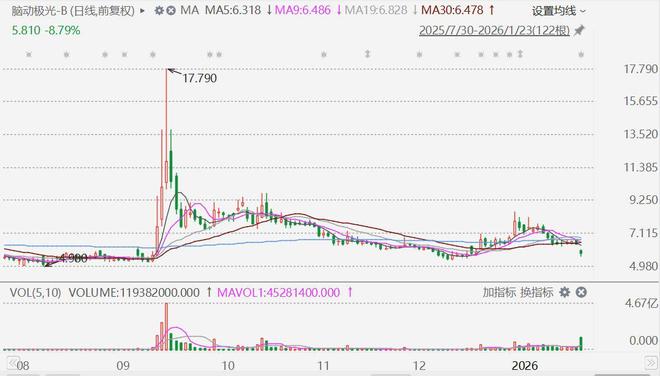
脑动极光-B低开逾6% 拟折让约12%先旧后新配股 净筹约5.01亿港元
Zhi Tong Cai Jing· 2026-01-23 01:31
Core Viewpoint - The company, Brainstorm Cell Therapeutics (脑动极光-B), experienced a significant decline in stock price following the announcement of a share placement, indicating market reaction to the capital raising strategy [1] Group 1: Stock Performance - The stock opened down over 6%, currently trading at 5.97 HKD, reflecting a drop of 6.28% [1] - The trading volume reached 519 million HKD, indicating active market participation [1] Group 2: Share Placement Details - The company plans to place 92 million shares, representing approximately 6.77% of the enlarged share capital [1] - The placement price is set at 5.6 HKD per share, which is about 12.09% lower than the closing price of 6.37 HKD on January 22 [1] - The total capital raised is expected to be 515 million HKD, with a net amount of approximately 501 million HKD after expenses [1] Group 3: Use of Proceeds - Approximately 50% of the net proceeds will be allocated to research and development [1] - About 30% will be used for domestic and international market development [1] - Approximately 10% is earmarked for strategic investments and acquisitions, with another 10% designated for general corporate operational funds [1]
港股异动 | 脑动极光-B(06681)低开逾6% 拟折让约12%先旧后新配股 净筹约5.01亿港元
智通财经网· 2026-01-23 01:30
Group 1 - The core viewpoint of the article is that Brainstorm Cell Therapeutics Inc. (06681) experienced a significant drop in stock price following the announcement of a share placement [1] - The company plans to issue 92 million shares, which represents approximately 6.77% of the enlarged share capital [1] - The placement price is set at HKD 5.6 per share, reflecting a discount of about 12.09% compared to the closing price of HKD 6.37 on January 22 [1] Group 2 - The total funds raised from the share placement are expected to be HKD 515 million, with a net amount of approximately HKD 501 million [1] - About 50% of the proceeds will be allocated to research and development initiatives [1] - Approximately 30% of the funds will be used for domestic and international market development, while 10% will be designated for strategic investments and acquisitions, and the remaining 10% will be used for general corporate operational expenses [1]
脑动极光折让12%配股 筹逾5亿港元
Ge Long Hui A P P· 2026-01-23 01:12
Group 1 - The company, Brainstorm Cell Therapeutics Inc. (6681.HK), plans to issue 92 million shares through a placement, representing approximately 6.77% of the enlarged share capital [1] - The placement price is set at HKD 5.6 per share, which is a discount of about 12.09% compared to the closing price of HKD 6.37 from the previous day [1] - The total funds raised are expected to be HKD 515 million, with a net amount of approximately HKD 501 million after expenses [1] Group 2 - Approximately 50% of the net proceeds will be allocated to research and development initiatives [1] - About 30% of the funds will be used for domestic and international market development [1] - The remaining 20% will be split between strategic investments and acquisitions (10%) and general corporate operational expenses (10%) [1]