
AikoSolar(600732)

Search documents
爱旭股份增资至21.2亿
2 1 Shi Ji Jing Ji Bao Dao· 2026-02-26 07:41
Core Viewpoint - Aiko Solar Energy Co., Ltd. (爱旭股份) has increased its registered capital from approximately 1.83 billion RMB to about 2.12 billion RMB, marking a growth of approximately 16% [1]. Company Information - Aiko Solar was established in August 1996 and is engaged in the research and development of emerging energy technologies, manufacturing and sales of photovoltaic equipment and components [1]. - The legal representative of the company is Chen Gang, and the company is co-held by Chen Gang, Zhuhai Hengqin Shunhe Enterprise Management Partnership (Limited Partnership), and Harmony Tianming Investment Management (Beijing) Co., Ltd. - Yiwu Qiguang Equity Investment Partnership (Limited Partnership) [1]. Capital Changes - The recent business change occurred on February 24, 2026, with the registered capital increasing from 1,826 million RMB to 2,117 million RMB [2]. - The capital increase reflects a significant investment in the company's growth and operational capabilities [1][2]. Shareholding Structure - Chen Gang holds 15.49% of the shares, making him the largest shareholder and actual controller of the company [3]. - Other major shareholders include Zhuhai Hengqin Shunhe Enterprise Management Partnership (10.73%) and Harmony Tianming Investment Management (6.83%) [3].


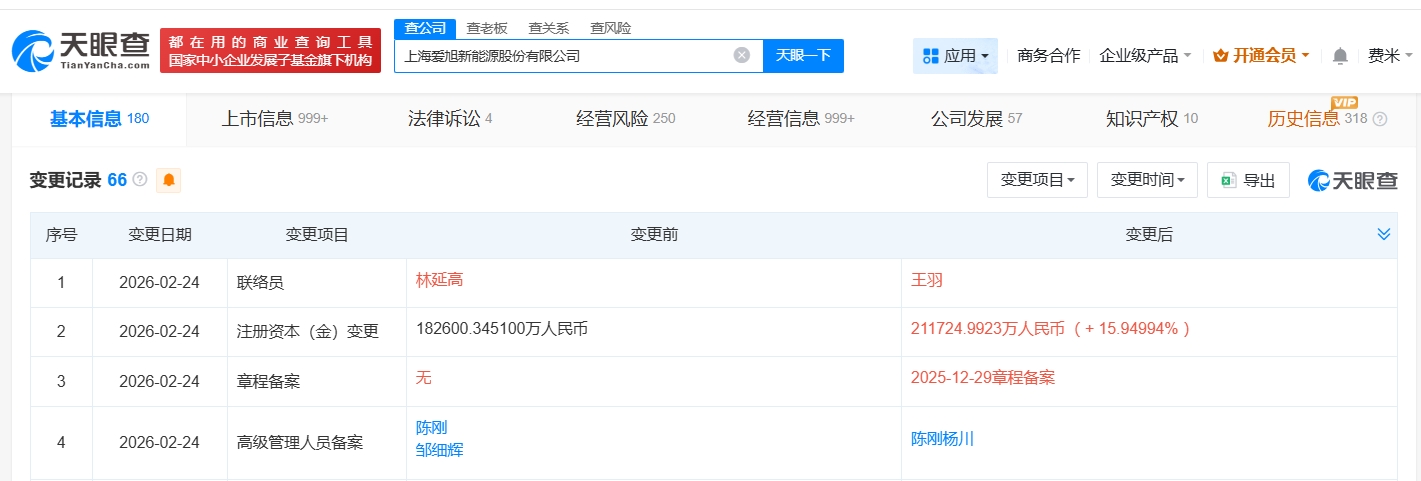
爱旭股份增资至21.2亿,增幅约16%
Zhong Guo Neng Yuan Wang· 2026-02-26 07:29
Group 1 - The core point of the article is that Aishuxin Co., Ltd. (stock code: 600732) has increased its registered capital from approximately 1.83 billion RMB to about 2.12 billion RMB, representing an increase of around 16% [1] Group 2 - Aishuxin Co., Ltd. was established in August 1996 and is represented by Chen Gang [1] - The company's business scope includes research and development of emerging energy technologies, manufacturing of photovoltaic equipment and components, and sales of photovoltaic equipment and components [1] - The shareholders include Chen Gang, Zhuhai Hengqin Shunhe Enterprise Management Partnership (Limited Partnership), and Hesheng Tianming Investment Management (Beijing) Co., Ltd. - Yiwu Qiguang Equity Investment Partnership (Limited Partnership) [1]
中国光伏涨价,印度怎么急了?
商业洞察· 2026-02-23 09:22
Core Viewpoint - The price of Chinese photovoltaic (PV) modules, especially the 670W high-power modules, has surged, entering the "1 yuan era," causing concern in India as it impacts their energy development [2][4]. Price Surge Reasons - The primary reason for the price increase is not due to raw material costs or insufficient production capacity, but rather China's decision to stop subsidizing global markets [4][5]. - China previously provided a 13% VAT rebate on PV module exports, effectively subsidizing global buyers, but this will be reduced to 9% in December 2024 and eliminated by January 2027 [4]. Impact on Indian Market - The price increase has led to a projected rise in overall project capital expenditure in India by approximately 14%-18%, which could push the cost of electricity from 2.5 rupees per unit to over 2.8 rupees, breaching the breakeven point [5][6]. - Many Indian PV companies have warned that if they cannot secure low-cost modules, over 30% of their ongoing projects may face delays or cancellations by 2026 [5]. Dependency on Chinese Supply - India's PV industry is heavily reliant on Chinese imports, with over 95% dependency on polysilicon and silicon wafers, and 85% on battery cells and core equipment [6][8]. - The technological gap is significant, with Chinese TOPCon technology achieving commercial efficiencies exceeding 25.4%, while Indian efficiencies are generally below 24.5% [8][10]. Future Considerations for India - To reduce dependency on China, India needs to invest in R&D to overcome battery technology bottlenecks, build a complete supply chain starting from polysilicon, enhance automation to lower labor and waste rates, and foster open collaboration rather than isolationist policies [10][11].



银价波动推高光伏产业成本 高功率组件涨价明显
Mei Ri Jing Ji Xin Wen· 2026-02-12 10:49
Core Viewpoint - The Chinese photovoltaic industry is facing a significant cost increase due to soaring silver prices, which have become a critical material for battery metallization, impacting profit margins and pricing strategies across the supply chain [1][2]. Group 1: Silver Price Impact - Silver prices have shown a sharp increase, with futures reaching 32,400 yuan/kg and spot prices hitting $121.64/oz by the end of January 2026, leading to a substantial rise in costs for photovoltaic components [2]. - The demand for silver in the photovoltaic sector has surged, consuming over 6,000 tons annually since 2020, accounting for nearly 20% of total silver demand [2]. - The cost of silver paste has increased, raising the complete cost of battery cells to over 0.5 yuan/W, with module costs exceeding 0.9 yuan/W [2][3]. Group 2: Cost Structure and Profit Margins - The proportion of silver in photovoltaic raw material costs has risen from approximately 9% in 2024 to over 30%, becoming the largest cost component outside of silicon [3]. - The rising raw material costs combined with low terminal product prices have created a "scissors gap," severely squeezing profit margins, contributing to widespread industry losses in 2025 [4]. - As of early February 2026, silver prices experienced volatility, with futures dropping to 20,600 yuan/kg, leading to a decrease in battery and module prices [4]. Group 3: Market Dynamics and Order Visibility - Domestic market orders are declining, with limited visibility on new contracts, while overseas markets are expected to dominate shipments in Q1 2026 due to export tax influences [5]. - The procurement attitude is cautious amid weak seasonal demand and recent price increases in components, resulting in insufficient order visibility for Q1 2026 [5]. Group 4: Cost Reduction Strategies - Companies are pursuing technological upgrades to reduce costs, with Longi Green Energy focusing on "cheap metalization" technology for mass production by Q2 2026 [6][8]. - Aiko Solar has implemented silver-free technology, significantly reducing costs and avoiding the impact of silver price fluctuations [8]. - The industry is exploring pathways for cost reduction through the substitution of cheaper metals and process optimizations, aiming for a silver consumption reduction of 10% to 20% [9]. Group 5: Future Outlook - The silver price is expected to remain high with fluctuations, driven by an expanding supply-demand gap and increased industrial demand, particularly from the photovoltaic sector [9]. - The impact of the "space photovoltaic" concept on silver demand is currently limited, with expectations for a 10% decrease in global silver usage in photovoltaics in 2026 compared to 2025 [9].
光伏行业"反内卷"成效进一步显现
Zheng Quan Ri Bao· 2026-02-12 09:29
Core Viewpoint - The photovoltaic industry is experiencing a significant cost gradient differentiation due to fluctuations in silver prices and technological upgrades, leading to a visible "anti-involution" effect within the industry [1]. Cost Pressure - The global silver investment demand is expected to remain strong through 2026, supported by geopolitical tensions and U.S. policy uncertainties, with silver prices having risen by 11% this year after surpassing $100 per ounce for the first time in January [2]. - Despite high prices leading to a projected 17% reduction in global jewelry and silverware demand, industrial demand remains resilient [2]. - A supply shortage of approximately 67 million ounces is anticipated in the global silver market by 2026, marking the sixth consecutive year of deficit, which is expected to keep silver prices strong [2]. - The photovoltaic sector, as a major consumer of silver, will continue to face cost pressures due to high silver prices, accelerating the development of silver paste substitution technologies among leading companies [2][3]. Technological Breakthroughs - Leading companies are rapidly advancing silver paste substitution technologies, with some planning large-scale production of alternative materials in the near future [4]. - Longi Green Energy has announced plans to start large-scale production of non-silver solutions, which could further reduce component costs [4]. - Other major players like JinkoSolar and Aiko are also actively pursuing silver paste alternatives, with significant collaborations aimed at industrializing low-silver technologies by 2026 [4][5]. Industry Restructuring - The shift towards high-efficiency and reliable components is expected to create a competitive landscape where companies with technological advantages can command price premiums, while less efficient capacities face dual pressures from price and demand declines [5][6]. - The Chinese photovoltaic industry is projected to see a significant change in 2026, with new installations expected to range between 180GW and 240GW, following a record high of 315GW in 2025 [5][6]. - The core theme of the industry's "anti-involution" in 2026 will be driven by upgraded end-user demand, pushing manufacturers towards high-quality development through technological iterations and improved market mechanisms [6].

银价波动推高光伏业成本,高功率组件涨价明显 头部企业: 通过贱金属替代和工艺优化实现降本
Mei Ri Jing Ji Xin Wen· 2026-02-12 07:25
Core Viewpoint - The Chinese photovoltaic industry is facing significant cost pressures due to soaring silver prices, which have become the primary driver of increased costs, surpassing traditional materials like silicon [1][2]. Group 1: Silver Price Impact - Silver prices have shown a rising trend, with futures reaching 32,400 yuan/kg and spot prices hitting $121.64/oz by the end of January [1]. - The demand for silver in the photovoltaic sector has surged, consuming over 6,000 tons annually since 2020, accounting for nearly 20% of total silver demand [1]. - The cost of silver paste has increased, raising the complete cost of battery cells to over 0.5 yuan/W and components to over 0.9 yuan/W [2]. Group 2: Cost Transmission - A 10% increase in silver prices results in an approximate 0.01 yuan/W rise in the unit cost of photovoltaic components, with silver's share of raw material costs rising from 9% in 2024 to over 30% [2][3]. - The disparity between rising raw material costs and stagnant product prices has created a "scissors gap," squeezing profit margins for manufacturers [3]. Group 3: Market Dynamics - The domestic market is experiencing a decline in project order execution, while overseas demand is expected to increase due to export tax incentives [4]. - The prices of copper and aluminum have also risen, further exacerbating cost pressures on photovoltaic components [4]. Group 4: Technological Responses - Companies are pursuing technological upgrades to reduce costs, with Longi Green Energy focusing on "cheap metalization" technology and JA Solar locking in suppliers to hedge against price fluctuations [5]. - Aiko Solar has successfully implemented a silver-free technology, significantly reducing costs and enhancing competitiveness [5]. Group 5: Future Outlook - Analysts predict that silver prices will remain high due to a widening supply-demand gap and increased industrial demand [6]. - The "space photovoltaic" concept discussed by Elon Musk is still in the ground verification stage and is not expected to significantly impact silver demand in the near term [6].
国内光伏组件报价大涨
2 1 Shi Ji Jing Ji Bao Dao· 2026-02-12 07:05
Group 1 - The core point of the article is the significant increase in solar module prices in China, with recent bidding results showing prices exceeding 1 yuan/W for the first time in years [1] - The bidding for Huadian Group's 8GW solar module procurement included two segments: 6GW of N-type high-efficiency modules at an average price of 0.8831 yuan/W and 2GW of N-type conventional modules at an average price of 0.8438 yuan/W [1] - Longi Green Energy reported that high-power (670W) module prices have surpassed 1 yuan/W, indicating a broader trend of rising component prices in the market [1][2] Group 2 - Aiko Solar indicated that their domestic module prices are nearing 0.9 yuan/W, while overseas prices exceed 1 yuan/W, reflecting the overall price increase in the industry [2] - Several companies noted that the recent rise in silver prices is a major factor driving the increase in module prices [3] - According to the China Photovoltaic Industry Association, the average all-in cost of mainstream photovoltaic products varies with silver prices, with costs at 0.783 yuan/W, 0.824 yuan/W, and 0.866 yuan/W at silver prices of 15,000 yuan/kg, 20,000 yuan/kg, and 25,000 yuan/kg respectively [3]
央企光伏组件集采再现1元/W报价 多家公司回应涨价
2 1 Shi Ji Jing Ji Bao Dao· 2026-02-12 06:36
Group 1 - The core point of the news is the significant increase in the prices of photovoltaic (PV) components in China, with recent bidding results showing prices exceeding 1 yuan/W for the first time in years [1][2] - China Huadian Group's recent tender for 8GW of PV components included two segments: 6GW of N-type high-efficiency components (645W) and 2GW of N-type conventional components (620W) [1] - The bidding results revealed that 25 companies participated in the first segment with prices ranging from 0.78 to 1.018 yuan/W, averaging 0.8831 yuan/W, while 31 companies participated in the second segment with prices from 0.76 to 0.923 yuan/W, averaging 0.8438 yuan/W [1] Group 2 - Longi Green Energy reported a noticeable increase in component prices, with high-power (670W) components now exceeding 1 yuan/W [1] - Trina Solar has raised its distributed PV component prices three times this year, with current prices for mid-size and large-size components ranging from 0.88 to 0.92+ yuan/W, and anti-glare components priced at 0.95 to 0.99+ yuan/W [1] - Aiko Solar indicated that domestic component prices are nearing 0.9 yuan/W, while overseas prices exceed 1 yuan/W [2] Group 3 - The increase in component prices is attributed to the rising silver prices, which have been identified as a key factor driving the current price surge [2] - The China Photovoltaic Industry Association's report on the cost analysis of mainstream PV products indicates that the average all-in cost for the TOPCon210R product varies significantly with silver prices, ranging from 0.783 yuan/W to 0.866 yuan/W depending on the silver price per kilogram [2]
爱旭股份:BC龙头,破茧成蝶-20260212
Shanxi Securities· 2026-02-12 02:24
Investment Rating - The report upgrades the investment rating of the company to "Buy-A" [1][8] Core Insights - The company has secured Maxeon patent authorization, enhancing its competitive edge in overseas markets with its BC technology, which is expected to have a longer profit period compared to PERC and TOPCon technologies [3][4] - The company maintains a leading position in ABC component efficiency, achieving a record efficiency of 24.8% as of December 2025, and has consistently ranked first globally for 35 months [5][62] - The company has seen significant growth in orders and sales, with a 400% year-on-year increase in N-type ABC component shipments, reaching 8.57GW in the first half of 2025 [7][78] Financial Performance - The company is projected to achieve total revenues of 187.6 billion yuan, 269.5 billion yuan, and 378.4 billion yuan for the years 2025, 2026, and 2027, respectively, with year-on-year growth rates of 68.2%, 43.7%, and 40.4% [8] - The net profit is expected to turn positive in 2026, with estimates of -15.1 billion yuan, 11.5 billion yuan, and 28.5 billion yuan for the years 2025, 2026, and 2027, respectively, reflecting significant growth [8][9] - The company's EPS is projected to be -0.71 yuan, 0.54 yuan, and 1.35 yuan for the years 2025, 2026, and 2027, with corresponding P/E ratios of -20.5, 26.9, and 10.9, indicating a valuation below the average of comparable companies [8][9] Technology and Competitive Advantage - The BC technology offers significant cost advantages, with non-silver costs lower than TOPCon, and the performance of BC components is superior, achieving a theoretical efficiency of 29.1% [4][40] - The BC components are priced at a premium of over 10% compared to TOPCon, with current prices for centralized BC components at 0.80 yuan/W and distributed BC components at 0.84 yuan/W [47] - The company is expanding its ecosystem with over 20 enterprises entering the BC technology route, indicating a collaborative innovation environment [57][58] Market Position and Strategy - The company is focusing on high-value markets in Europe, Australia, New Zealand, and Japan, with over 40% of its sales coming from overseas in Q2 2025, which has positively impacted its overall gross margin [7][78] - The company has a robust order book with approximately 10GW of new component procurement orders in the first half of 2025, indicating strong demand for its products [7][78] - The company is continuously innovating its product offerings, with the introduction of the third-generation ABC "full-screen" components and the "Navigator" ABC components expected to achieve over 25% efficiency [18][63]
爱旭股份(600732):BC龙头,破茧成蝶
Shanxi Securities· 2026-02-12 01:40
Investment Rating - The report upgrades the investment rating of the company to "Buy-A" [1][8] Core Viewpoints - The company has secured Maxeon patent authorization, enhancing its overseas market expansion and establishing a strong technical barrier with its BC technology [3][4] - The BC technology offers significant cost advantages, outperforming TOPCon in terms of non-silicon costs and providing higher efficiency and reliability [4][6] - The company maintains the highest efficiency in ABC components, achieving a record of 24.8% in mass production efficiency as of December 2025 [5][62] - The company has seen substantial growth in orders, with a 400% year-on-year increase in N-type ABC component shipments in the first half of 2025 [7][78] Summary by Sections Market Performance - As of February 12, 2026, the closing price of the company's stock is 14.63 CNY per share, with a total market capitalization of 264.59 billion CNY [2] Financial Data and Forecast - The company is projected to achieve total revenue of 187.6 billion CNY, 269.5 billion CNY, and 378.4 billion CNY for the years 2025, 2026, and 2027, respectively, with year-on-year growth rates of 68.2%, 43.7%, and 40.4% [8][9] - The net profit forecast for the same years is -15.1 billion CNY, 11.5 billion CNY, and 28.5 billion CNY, with corresponding growth rates of 71.6%, 176.2%, and 147.7% [8][9] Technology and Product Advantages - The BC technology is recognized for its high efficiency, aesthetic appeal, and reliability, with a theoretical efficiency of up to 29.1% [4][40] - The company’s ABC components demonstrate a 6%-10% higher power generation compared to TOPCon components in various scenarios [7][69] - The company has a strong order backlog, with approximately 10GW of new orders in the first half of 2025, indicating robust demand for its products [7][78] Industry Position and Competitive Landscape - The company is positioned as a leader in the BC technology space, with a growing ecosystem and collaboration among over 20 enterprises entering the BC route [4][57] - The BC components are priced at a premium of over 10% compared to TOPCon, reflecting their advanced technology and market positioning [47]