
Wuxi Rural Commercial Bank(600908)

Search documents
城商行板块1月22日涨0.8%,青岛银行领涨,主力资金净流入3.96亿元
Zheng Xing Xing Ye Ri Bao· 2026-01-22 09:01
Group 1 - The city commercial bank sector increased by 0.8% on January 22, with Qingdao Bank leading the gains [1] - The Shanghai Composite Index closed at 4122.58, up 0.14%, while the Shenzhen Component Index closed at 14327.05, up 0.5% [1] - Key individual stock performances in the city commercial bank sector included Qingdao Bank at 4.41 with a rise of 2.80%, and Ningbo Bank at 29.50 with a rise of 2.15% [1] Group 2 - The city commercial bank sector saw a net inflow of 396 million yuan from main funds, while retail funds experienced a net outflow of 172 million yuan [2] - The trading volume for Qingdao Bank was 712,800 shares, with a transaction value of 312 million yuan [1][2] - The main fund inflow for Jiangsu Bank was 202 million yuan, representing 13.49% of its total trading volume [3]





农商行板块1月21日跌1.32%,沪农商行领跌,主力资金净流入1.07亿元
Zheng Xing Xing Ye Ri Bao· 2026-01-21 08:55
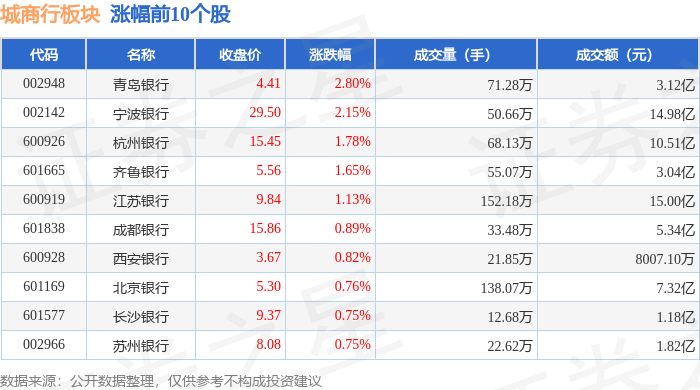
Core Viewpoint - The rural commercial bank sector experienced a decline of 1.32% on January 21, with the Shanghai Rural Commercial Bank leading the drop, while the overall Shanghai Composite Index rose by 0.08% [1] Group 1: Market Performance - The Shanghai Composite Index closed at 4116.94, up 0.08%, and the Shenzhen Component Index closed at 14255.12, up 0.7% [1] - The rural commercial bank sector saw various individual stock performances, with the following notable declines: - Shanghai Rural Commercial Bank: -1.83% - Changshu Bank: -1.38% - Chongqing Rural Commercial Bank: -1.28% [1] Group 2: Trading Volume and Capital Flow - The total trading volume for the rural commercial bank sector was significant, with the following notable figures: - Jiangyin Bank: 32.52 million shares traded - Yunnan Bank: 69.28 million shares traded [1] - The net capital flow for the rural commercial bank sector showed a net inflow of 107 million yuan from institutional investors and a net inflow of 109 million yuan from retail investors, while retail investors had a net outflow of 217 million yuan [1] Group 3: Individual Stock Capital Flow - The following stocks had notable capital flows: - Shanghai Rural Commercial Bank: 34.33 million yuan net inflow from institutional investors, but a net outflow of 62.48 million yuan from retail investors [2] - Chongqing Rural Commercial Bank: 29.51 million yuan net inflow from institutional investors, with a net outflow of 38.80 million yuan from retail investors [2] - Zhangjiagang Bank: 18.05 million yuan net inflow from institutional investors, but a net outflow of 24.22 million yuan from retail investors [2]






农商行板块1月20日涨1.37%,常熟银行领涨,主力资金净流入1201.4万元
Zheng Xing Xing Ye Ri Bao· 2026-01-20 08:56
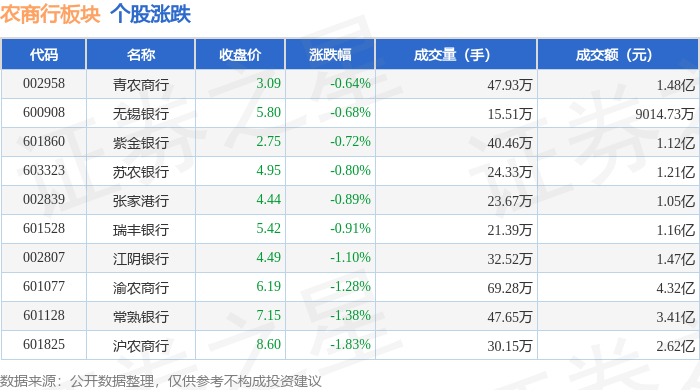
Group 1 - The agricultural commercial bank sector increased by 1.37% on January 20, with Changshu Bank leading the gains [1] - The Shanghai Composite Index closed at 4113.65, down 0.01%, while the Shenzhen Component Index closed at 14155.63, down 0.97% [1] - The trading volume and turnover for Changshu Bank were 1.0572 million shares and 760 million yuan, respectively, with a price increase of 2.40% [1] Group 2 - The net inflow of main funds in the agricultural commercial bank sector was 12.014 million yuan, while retail investors experienced a net outflow of 47.1263 million yuan [1] - The net inflow of speculative funds was 35.1124 million yuan [1] - Specific banks like Chongqing Rural Commercial Bank saw a main fund net inflow of 44.9272 million yuan, while Changshu Bank had a significant net outflow of 61.4796 million yuan [2]


农商行板块1月16日跌0.64%,渝农商行领跌,主力资金净流出617.66万元
Zheng Xing Xing Ye Ri Bao· 2026-01-16 08:56
Group 1 - The agricultural commercial bank sector experienced a decline of 0.64% on January 16, with Yunnan Agricultural Commercial Bank leading the drop [1] - The Shanghai Composite Index closed at 4101.91, down 0.26%, while the Shenzhen Component Index closed at 14281.08, down 0.18% [1] - The trading volume and turnover for various agricultural commercial banks are detailed, with Changshu Bank closing at 6.97, up 0.29%, and Yunnan Agricultural Commercial Bank closing at 6.35, down 1.70% [1] Group 2 - The net outflow of main funds from the agricultural commercial bank sector was 6.1766 million yuan, while retail funds saw a net outflow of 12.6 million yuan [1] - The table shows the net inflow and outflow of funds for individual banks, with notable figures such as 14.69% net inflow for Shanghai Agricultural Commercial Bank from main funds [2] - Jiangyin Bank had a significant net outflow of 30.1445 million yuan from main funds, indicating a 20.35% decrease [2]
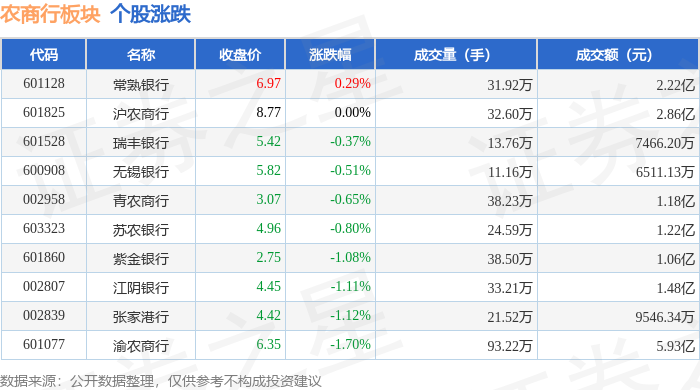
农商行板块1月15日跌0.94%,沪农商行领跌,主力资金净流出4296.1万元
Zheng Xing Xing Ye Ri Bao· 2026-01-15 08:59
Group 1 - The agricultural commercial bank sector experienced a decline of 0.94% on January 15, with Hu Nong Commercial Bank leading the drop [1] - The Shanghai Composite Index closed at 4112.6, down 0.33%, while the Shenzhen Component Index closed at 14306.73, up 0.41% [1] - The trading volume and turnover for various agricultural commercial banks are detailed in a table, showing mixed performance among individual stocks [1] Group 2 - The net outflow of main funds from the agricultural commercial bank sector was 42.961 million yuan, while retail funds saw a net outflow of 56.997 million yuan [1] - The table of fund flows indicates that some banks, like Changshu Bank and Zhangjiagang Bank, had positive net inflows from retail and speculative funds, while others like Yunnan Agricultural Bank and Jiangyin Bank faced significant outflows [2] - Specific data shows that Changshu Bank had a main fund net inflow of 8.1314 million yuan, while Yunnan Agricultural Bank had a net outflow of 25.5857 million yuan [2]

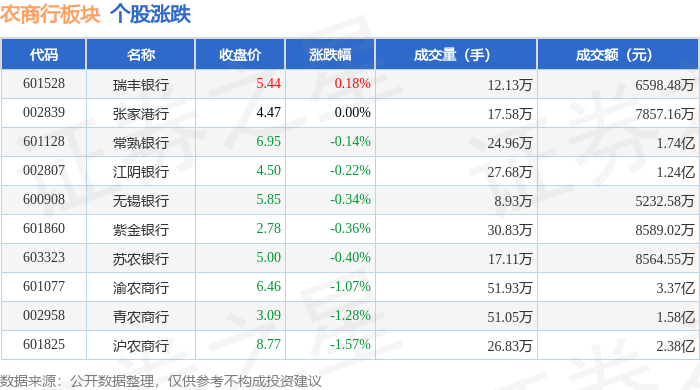
农商行板块1月14日跌1.28%,瑞丰银行领跌,主力资金净流入1.14亿元
Zheng Xing Xing Ye Ri Bao· 2026-01-14 08:58
Core Viewpoint - The rural commercial bank sector experienced a decline of 1.28% on January 14, with Ruifeng Bank leading the drop, while the Shanghai Composite Index fell by 0.31% and the Shenzhen Component Index rose by 0.56% [1] Group 1: Market Performance - The closing price of Qingnong Commercial Bank was 3.13, unchanged from the previous day, with a trading volume of 645,900 shares and a transaction value of 202 million yuan [1] - Zijin Bank closed at 2.79, down 0.71%, with a trading volume of 498,600 shares and a transaction value of 140 million yuan [1] - Changshu Bank's closing price was 6.96, also down 0.71%, with a trading volume of 569,400 shares and a transaction value of 398 million yuan [1] - Wuxi Bank closed at 5.87, down 0.84%, with a trading volume of 183,700 shares and a transaction value of 108 million yuan [1] - The overall rural commercial bank sector saw a net inflow of 114 million yuan from main funds, while retail investors experienced a net outflow of 1.41 billion yuan [1] Group 2: Fund Flow Analysis - Changshu Bank had a main fund net inflow of 22.95 million yuan, accounting for 5.77% of its total, while retail investors had a net outflow of 5.30 million yuan [2] - Yunnan Agricultural Commercial Bank saw a main fund net inflow of 20.12 million yuan, representing 4.30%, but a retail net outflow of 34.64 million yuan [2] - Zhangjiagang Bank recorded a main fund net inflow of 15.78 million yuan, with a retail net outflow of 29.95 million yuan [2] - Wuxi Bank had a main fund net inflow of 12.01 million yuan, which is 11.10% of its total, while retail investors faced a net outflow of 9.00 million yuan [2] - Ruifeng Bank experienced a main fund net inflow of 3.60 million yuan, with a retail net outflow of 9.82 million yuan [2]
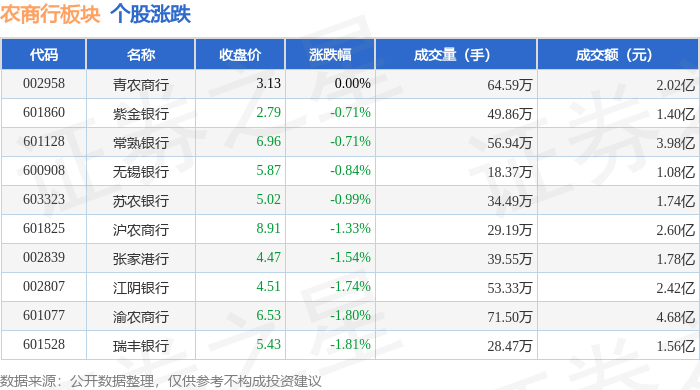
农商行板块1月13日涨0.62%,渝农商行领涨,主力资金净流入5648.9万元
Zheng Xing Xing Ye Ri Bao· 2026-01-13 09:06
Core Viewpoint - The agricultural commercial bank sector experienced a rise of 0.62% on January 13, with Chongqing Rural Commercial Bank leading the gains, while the Shanghai Composite Index fell by 0.64% and the Shenzhen Component Index dropped by 1.37% [1] Group 1: Market Performance - Chongqing Rural Commercial Bank (601077) closed at 6.65, up by 2.15% with a trading volume of 813,100 shares and a transaction value of 540 million yuan [1] - Other notable banks included Zijin Bank (601860) with a closing price of 2.81, up by 0.72%, and Qingnong Bank (002958) at 3.13, up by 0.64% [1] - The overall trading volume for the agricultural commercial bank sector was significant, with total net inflow of main funds amounting to 56.49 million yuan [1] Group 2: Fund Flow Analysis - Main funds saw a net inflow of 17.50 million yuan into Chongqing Rural Commercial Bank, while retail investors experienced a net outflow of 47.08 million yuan [2] - Jiangyin Bank (002807) had a net inflow of 13.55 million yuan from main funds, but retail investors withdrew 8.41 million yuan [2] - The fund flow data indicates a mixed sentiment among retail and institutional investors, with main funds generally showing positive interest in several banks while retail investors were more cautious [2]
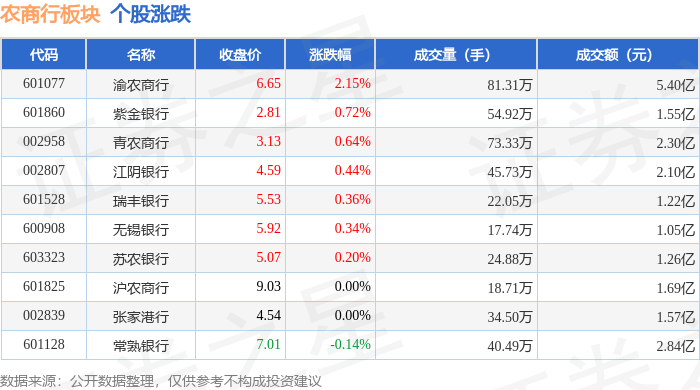
农商行板块1月12日跌0.14%,渝农商行领跌,主力资金净流出5928.29万元
Zheng Xing Xing Ye Ri Bao· 2026-01-12 09:04
Market Overview - The agricultural commercial bank sector experienced a decline of 0.14% on January 12, with Yunnan Agricultural Commercial Bank leading the drop [1] - The Shanghai Composite Index closed at 4165.29, up 1.09%, while the Shenzhen Component Index closed at 14366.91, up 1.75% [1] Individual Bank Performance - Zijin Bank closed at 2.79, with an increase of 0.72% and a trading volume of 386,600 shares, totaling a transaction value of 107 million yuan [1] - Su Nong Bank closed at 5.06, up 0.40%, with a trading volume of 204,900 shares, totaling 104 million yuan [1] - Ruifeng Bank closed at 5.51, up 0.36%, with a trading volume of 181,100 shares, totaling approximately 99.28 million yuan [1] - Qing Nong Bank closed at 3.11, up 0.32%, with a trading volume of 422,100 shares, totaling 131 million yuan [1] - Yunnan Agricultural Commercial Bank closed at 6.51, down 0.91%, with a trading volume of 690,100 shares [1] Capital Flow Analysis - The agricultural commercial bank sector saw a net outflow of 59.28 million yuan from institutional investors, while retail investors contributed a net inflow of 49.11 million yuan [1] - The table of capital flow indicates that Changshu Bank had a net inflow of 7.30 million yuan from institutional investors, while it faced a net outflow of 22.43 million yuan from speculative funds [2] - Yunnan Agricultural Commercial Bank experienced a net outflow of 21.20 million yuan from institutional investors, but a net inflow of 42.56 million yuan from speculative funds [2]

无锡银行1月8日大宗交易成交595.00万元
Zheng Quan Shi Bao Wang· 2026-01-08 15:04
无锡银行1月8日大宗交易平台出现一笔成交,成交量100.00万股,成交金额595.00万元,大宗交易成交 价为5.95元,相对今日收盘价溢价1.02%。该笔交易的买方营业部为国泰海通证券股份有限公司成都剑 南大道证券营业部,卖方营业部为山西证券股份有限公司运城河东街证券营业部。 进一步统计,近3个月内该股累计发生2笔大宗交易,合计成交金额为3115.00万元。 两融数据显示,该股最新融资余额为6.63亿元,近5日增加431.40万元,增幅为0.65%。(数据宝) 1月8日无锡银行大宗交易一览 | 成交量 | 成交金额 | 成交价 | 相对当日收盘 | | | | --- | --- | --- | --- | --- | --- | | (万 | (万元) | 格 | 折溢价(%) | 买方营业部 | 卖方营业部 | | 股) | | (元) | | | | | 100.00 | 595.00 | 5.95 | 1.02 | 国泰海通证券股份有限公司 | 山西证券股份有限公司 | | | | | | 成都剑南大道证券营业部 | 运城河东街证券营业部 | (文章来源:证券时报网) 证券时报·数据宝统计显示,无锡 ...
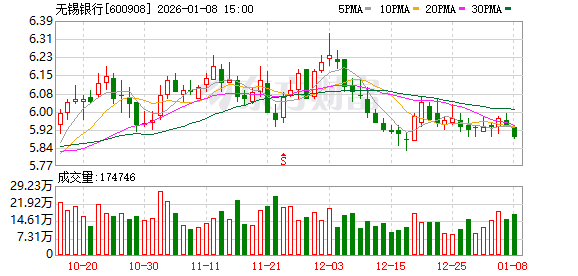
无锡银行今日大宗交易溢价成交100万股,成交额595万元
Xin Lang Cai Jing· 2026-01-08 09:35
| DE 200 DE 200 TELL VES | | | | | | | | --- | --- | --- | --- | --- | --- | --- | | 交易日期 | 证券简称 | 证券代码 | 成交价(元) 成交金额(万元) 成交量( *) 买入营业部 | | | 卖出营业部 是否为专场 | | 026-01-08 | 无锡银行 | 600908 | . 5.95 ਵੋਰੇ ਟੋ | 100 | 買載書書書書籍 | 品質量發酵素品 190 | 1月8日,无锡银行大宗交易成交100万股,成交额595万元,占当日总成交额的5.46%,成交价5.95元, 较市场收盘价5.89元溢价1.02%。 ...
