Autowell(688516)

Search documents
商业航天为何会成为2026年的主线?
Soochow Securities· 2026-01-29 00:20
Investment Rating - The report maintains an "Overweight" rating for the commercial aerospace industry, indicating a positive outlook for the sector in the coming months [1]. Core Insights - The commercial aerospace industry is expected to undergo a significant transformation by 2026, driven by advancements in launch capabilities and the successful deployment of domestic rockets, which will remove previous constraints on industry growth [8][9]. - The competition in commercial aerospace is fundamentally a "land grab" for space sovereignty and resource allocation, emphasizing the need for increased launch frequency to secure China's position in low Earth orbit [10]. - The report highlights the strategic importance of commercial aerospace in national defense and resource acquisition, particularly in the context of lunar resources like Helium-3, which could reshape global energy dynamics [12]. - Key catalysts for the industry include domestic policy support and capital market developments, with significant IPOs expected from leading aerospace companies in 2026 [13][15]. Summary by Sections 1. Why has the domestic commercial aerospace industry reached a qualitative change? - The industry has transitioned from a limited payload capacity to a robust launch capability, marked by the successful launch of the Zhuque-3 rocket, which signifies a shift from speculative themes to a narrative driven by operational capacity [8]. 2. How to understand the importance of commercial aerospace? - The scarcity of low Earth orbit resources has made the commercial aerospace race a critical national strategy, with the need to enhance launch frequency to secure space assets and maintain competitive advantages [10][11]. 3. What subsequent catalysts are worth paying attention to in commercial aerospace? 3.1. Domestic: Accelerated release of policy and capital dividends - The report anticipates significant policy support and capital market activity, with major aerospace companies expected to enter the IPO market in 2026, reflecting the strategic importance of the sector [13]. 3.2. International: Clear policy framework and tight planning timeline - The U.S. has shifted from a public to a private ownership model for space resources, establishing a legal framework that encourages commercial investment in space resource development [15][16]. 4. Investment Recommendations 4.1. SpaceX Concept - Companies that could potentially enter the SpaceX supply chain are highlighted, indicating a strong future in commercial aerospace [17]. 4.2. Rocket Sector: "Many Stars, Few Rockets" Expected to Breakthrough - The report suggests that advancements in large-capacity reusable rocket technology will lead to significant changes and valuation adjustments in the sector [19]. 4.3. Satellite Sector: Certainty in Implementation - The urgency to secure low Earth orbit resources is driving domestic satellite constellations from planning to large-scale deployment [20]. 4.4. Space Computing and Space Photovoltaics: Next-Generation Core Tracks - The report identifies space computing and space photovoltaics as critical future sectors, emphasizing their role in supporting lunar economies and global intelligence ecosystems [22].



光伏设备板块1月28日跌2.77%,欧普泰领跌,主力资金净流出52.16亿元
Zheng Xing Xing Ye Ri Bao· 2026-01-28 09:04
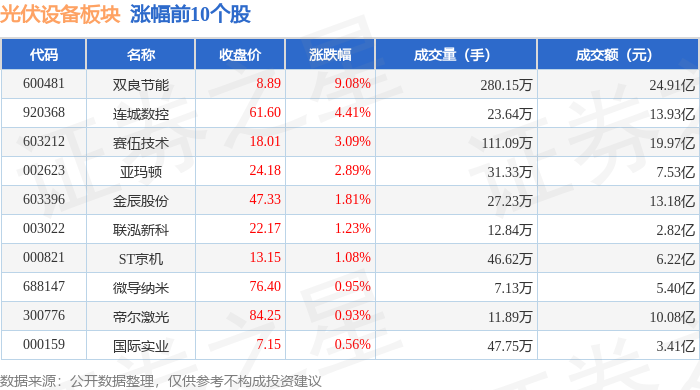
Core Viewpoint - The photovoltaic equipment sector experienced a decline of 2.77% on January 28, with Optec leading the drop, while the Shanghai Composite Index rose by 0.27% and the Shenzhen Component Index increased by 0.09% [1]. Group 1: Market Performance - The closing price of Optec was 17.16, reflecting a decrease of 10.81% with a trading volume of 147,700 shares and a transaction value of 261 million [2]. - The sector saw a net outflow of 5.216 billion from major funds, while retail investors contributed a net inflow of 3.687 billion [2]. Group 2: Individual Stock Performance - Shuangliang Energy closed at 68.8, with a rise of 9.08% and a trading volume of 2.8015 million shares, resulting in a transaction value of 2.491 billion [1]. - The stock of Jianqiang Technology closed at 18.01, up by 3.09%, with a trading volume of 1.1109 million shares and a transaction value of 1.997 billion [1]. - The stock of Jicheng Technology saw a decline of 5.97%, closing at 128.57, with a trading volume of 351,200 shares and a transaction value of 4.570 billion [2].


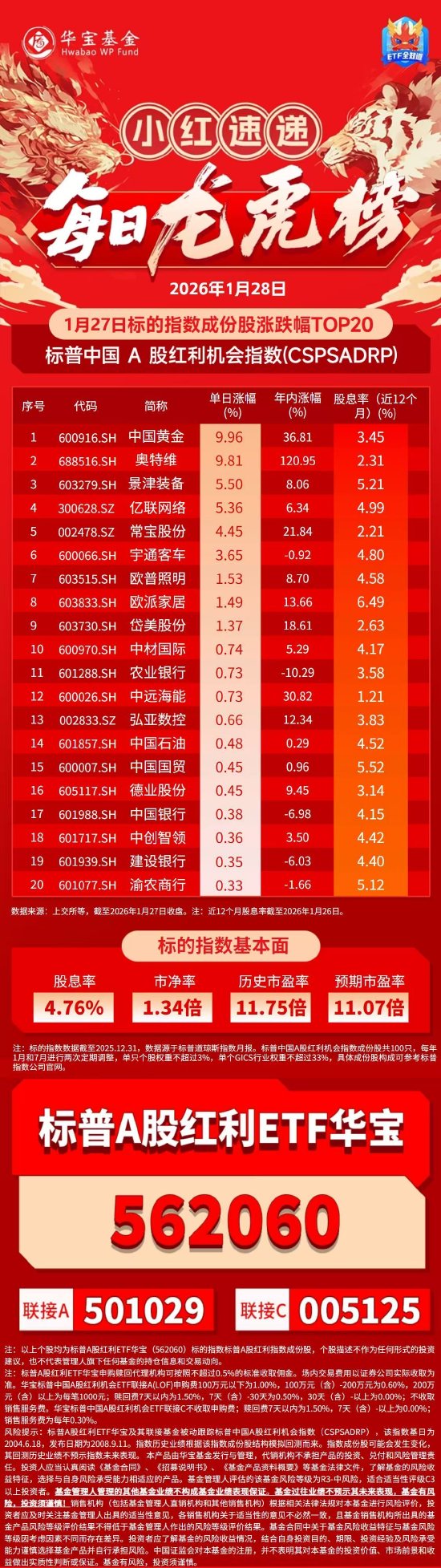
小红日报|止步场内六连阳,标普A股红利ETF华宝(562060)标的指数微跌收盘
Xin Lang Cai Jing· 2026-01-28 01:24
Group 1 - The article highlights the top 20 stocks in the S&P China A-Share Dividend Opportunity Index (CSPSADRP) based on their daily and year-to-date performance as of January 27, 2026 [1][5] - China Gold (600916.SH) leads with a daily increase of 9.96% and a year-to-date increase of 36.81%, with a dividend yield of 3.45% [1][5] - Aotewei (688516.SH) shows a remarkable year-to-date increase of 120.95%, with a daily increase of 9.81% and a dividend yield of 2.31% [1][5] Group 2 - The index's historical price-to-earnings ratio is reported at 4.76%, with an expected price-to-earnings ratio of 11.07 [2] - The dividend yield for the index over the past 12 months is noted as 1.34 times, indicating a strong return for investors [2] - The article mentions the formation of a MACD golden cross signal, suggesting positive momentum for the stocks listed [4][8]





杠杆资金净买入前十:明阳智能(5.71亿元)、紫金矿业(3.40亿元)
Jin Rong Jie· 2026-01-28 00:14
Group 1 - The top ten stocks with net financing purchases on January 27 include Mingyang Smart Energy (571 million), Zijin Mining (340 million), SMIC (228 million), China Railway (219 million), Cambricon (209 million), Yuguang Gold Lead (182 million), Chipone (162 million), Chipright (158 million), Industrial Fulian (152 million), and Aotwei (134 million) [1]




光伏反内卷攻坚,政企同心方得始终
第一财经· 2026-01-27 13:08
Core Viewpoint - The photovoltaic industry is undergoing a deep reform to combat internal competition, with regulatory measures and policy adjustments reflecting a commitment to high-quality development. However, many companies are still facing significant losses, indicating that this battle is not a short-term fix but a necessary step to resolve structural issues within the industry [2][5]. Industry Performance - Major companies like Tongwei Co., Ltd. and LONGi Green Energy are projected to incur substantial losses in 2025, with estimated net losses of 9 to 10 billion yuan and 6 to 6.5 billion yuan respectively. Other companies such as JA Solar, JinkoSolar, and Trina Solar are also expected to report significant losses, highlighting the severe challenges faced by the industry [2][3]. - The average gross margin for the entire industry is only 3.64%, with many companies trapped in a cycle of "production equals loss" due to oversupply and rising raw material costs [3][4]. Causes of Losses - The industry's performance crisis is primarily attributed to excessive homogenous production capacity and fierce price competition, compounded by soaring raw material costs. The supply of silicon materials is projected to exceed global demand by more than double over the next three years, leading to a significant imbalance [3][4]. - The price of silver, a key material in photovoltaic cells, has surged by 231% in 2025, pushing companies to adopt cost-cutting measures at the expense of technological innovation and quality [4][5]. Recommendations for Improvement - Companies must shift their focus from price competition to technological innovation and quality improvement, investing in advanced battery technologies such as TOPCon, BC, and ABC to enhance efficiency and reduce costs [4][6]. - The industry needs to establish self-regulatory standards to combat unfair competition practices, such as selling below cost and misrepresenting product capabilities, while promoting collaboration among companies to consolidate resources [4][6]. Government Role - Government policies and regulatory actions are crucial for supporting the industry's reform efforts. A unified and clear policy direction is necessary to stabilize market expectations and foster industry consensus [5][6]. - Regulatory bodies should enhance oversight on low-price dumping and set higher energy consumption and environmental standards for mature production stages, while also optimizing bidding rules to prioritize technology and quality over price [5][6]. Future Outlook - The photovoltaic industry is at a critical juncture, with the potential for recovery as companies begin to reduce losses and improve profitability. Analysts suggest that the industry may see a turning point in profitability by early 2026 [6][7]. - A collaborative effort between companies and government is essential to ensure that innovation becomes the cornerstone of industry development, allowing China to transition from a manufacturing hub to a center of innovation in the global energy transformation [7].






太空光伏午后拉升,拉普拉斯20CM涨停!光伏ETF华夏(515370)太空光伏含量指数维度全市场第一
Mei Ri Jing Ji Xin Wen· 2026-01-27 06:16
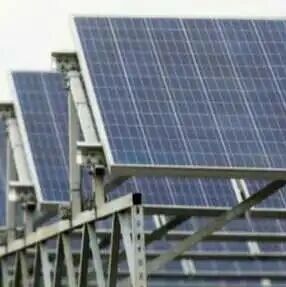
2026年1月27日午后,太空光伏午后拉升,光伏ETF华夏(515370)受益上涨1.12%,持仓股拉普拉斯 20CM涨停,奥特维涨超12%,协鑫集成、迈为股份涨超8% 光伏ETF华夏(515370)及其联接基金(012885/012886)跟踪中证光伏产业指数,涉及光伏产业链 上、中、下游企业,包括硅片、多晶硅、电池片、电缆、光伏玻璃、电池组件、逆变器、光伏支架和光 伏电站等,能够更好的反映光伏产业整体表现。指数其太空光伏含量18.49%,指数维度全市场排名第 一。 (文章来源:每日经济新闻) 消息面上,马斯克在达沃斯表示,在太空设立太阳能AI数据中心是理所当然的事。"SpaceX与特斯拉正 同步推进太阳能产能提升,目标在未来三年内实现每年100GW的太阳能制造能力。用于地面数据中心 与太空AI卫星供能。" 国盛证券认为,马斯克提出的SpaceX计划每年部署约100万颗太阳能AI卫星,为太空光伏带来了新的产 业机遇。这一规划被视为推动光伏技术向极端空间场景突破、重构全球光伏产业格局的关键布局。 ...


壹快评丨光伏反内卷攻坚,政企同心方得始终
Di Yi Cai Jing· 2026-01-27 04:26
Core Viewpoint - The photovoltaic industry is undergoing a significant transformation towards high-quality development, driven by both internal corporate self-discipline and external government support, as evidenced by recent regulatory measures and policy adjustments aimed at combating price competition and fostering innovation [1][4][7]. Industry Performance - The photovoltaic sector is currently facing severe financial challenges, with major companies like Tongwei Co. and LONGi Green Energy projected to incur substantial losses in 2025, highlighting the industry's struggle with low-price competition and rising material costs [1][2]. - The average gross margin for the industry has plummeted to just 3.64%, leading many companies into a cycle of "production equals loss" [2]. Competitive Landscape - The industry is experiencing an oversupply of homogeneous production capacity, with silicon material capacity exceeding global demand by more than double, resulting in a fierce price war among companies [2][3]. - Companies that previously relied on scale advantages are now also facing revenue declines and negative profits, indicating a widespread crisis across the sector [2]. Material Costs and Innovation - The price of silver, a critical component in photovoltaic cells, has surged by 231% in 2025, pushing companies to adopt cost-reduction technologies such as "less silver" or "silver-free" approaches [3]. - The focus on price competition has led some companies to neglect technological innovation and quality improvement, which are essential for long-term survival [3]. Government Role and Policy Recommendations - Government intervention is crucial for the success of the anti-involution measures, requiring a unified and clear policy direction to stabilize market expectations and foster industry consensus [4][6]. - There is a need for coordinated regulatory efforts across various government departments to effectively combat unfair competition and ensure sustainable industry practices [5][6]. Future Outlook - The current challenges in the photovoltaic industry present an opportunity for transformation, shifting from a focus on quantity to value creation, which is expected to be a long-term process [7]. - Some companies are beginning to reduce losses, and there is optimism that the industry may see a profitability turning point in early 2026 [7].
光伏设备行业深度报告:太空光伏深度报告:光伏向空,志在星海
KAIYUAN SECURITIES· 2026-01-26 05:43
Investment Rating - The investment rating for the photovoltaic equipment industry is optimistic (maintained) [1] Core Insights - The photovoltaic sector is entering a silicon era in space applications, driven by the need for cost reduction and efficiency improvement in photovoltaic technology [5][18] - Photovoltaic systems are the most reliable and sustainable power source for spacecraft, providing stable energy supply without the need for fuel resupply [18] - The transition to silicon-based photovoltaic technology in space is being accelerated by the high costs and limitations of III-V multi-junction solar cells, which are currently the most efficient but expensive [64][67] Summary by Sections 1. From Parallel to Convergence: Space Enters the Silicon Era - Photovoltaics are the most important energy supply for spacecraft, providing stable energy without atmospheric interference [18] - Cost reduction and efficiency improvement are the main drivers for the evolution of photovoltaic technology [19] - P-type HJT (Heterojunction Technology) cells show significant advantages in space applications due to their superior radiation resistance [6][69] - Silicon-perovskite tandem cells are expected to become the ultimate solution, breaking the efficiency-cost-radiation resistance triangle [6][68] 2. The Space Race Begins: Photovoltaics Open New Blue Oceans - Low Earth orbit communication satellites are driving the demand for large-scale satellite deployment [7] - The space computing market is expected to release significant potential, with a focus on reliable power supply rather than cost competition [7] 3. Pre-Volume Layout: Equipment Manufacturers Seize Opportunities - Key equipment manufacturers benefiting from the space photovoltaic technology include Maiwei, Jiejia Weichuang, Laplace, and others [8] 4. Competition Among Giants: Leading Manufacturers Tap into Blue Oceans - Major battery manufacturers deeply involved in space photovoltaic technology include Dongfang Risheng, Junda, Trina Solar, and JinkoSolar [8]


光伏设备是太空卫星电源系统,更是AI电力设备
2026-01-26 02:50
Summary of Conference Call on Photovoltaic Equipment Industry Industry Overview - The conference focused on the photovoltaic (PV) equipment industry, particularly in relation to space satellite power systems and AI power devices [1] - The discussion highlighted the recent surge in the PV sector, driven by developments from companies like SpaceX and Tesla, which are planning to build significant solar capacity both in space and on the ground [2][3] Key Points and Arguments SpaceX and Tesla Developments - SpaceX is reportedly planning to construct 100 GW of solar capacity for space applications, which has positively impacted the stock prices of related companies [2] - The technology being explored includes P-type heterojunction cells due to their better radiation resistance and thinner silicon wafers, which are crucial for weight reduction in space applications [3][4] - The choice of technology differs between domestic and international players, with SpaceX favoring crystalline silicon due to lower launch costs associated with their reusable rockets [4][5] Market Dynamics - The PV equipment sector has seen a significant increase in stock prices, with a reported 60% rise since late November, driven by optimism surrounding space-related solar projects [10][11] - The anticipated demand from Tesla for an additional 10 GW of capacity has further fueled market enthusiasm, with potential orders expected in the second quarter of the year [6][7] Long-term Projections - The long-term vision includes both SpaceX and Tesla aiming for 100 GW each, which could reshape the PV market and create new demand narratives beyond just space applications [7][11] - The potential for AI-driven power solutions is highlighted, suggesting that PV and energy storage could become essential for AI infrastructure, expanding the market's scope [10][20] Important but Overlooked Content - The conference emphasized the importance of the ground-based 100 GW project, which is expected to have a significant impact on the PV market, potentially leading to a re-evaluation of company valuations [11][19] - The discussion also touched on the supply chain implications, including the need for materials and auxiliary components, which could see increased demand as the industry evolves [18][19] - Companies like Maiwei and Aotewi were identified as key players due to their strong market positions and technological capabilities in the PV equipment sector [14][15] Conclusion - The overall sentiment is optimistic regarding the PV equipment industry, with expectations of continued growth driven by both space and ground-based solar initiatives [20][21] - The potential for AI integration into the energy supply chain is seen as a transformative trend that could significantly enhance the industry's growth trajectory [20][21]
商业航天行业:太空光伏,逐日天穹,叩问千亿星辰市场
2026-01-26 02:49
Summary of the Conference Call on the Space Photovoltaics Industry Industry Overview - **Industry Focus**: Space Photovoltaics - **Key Players**: SpaceX, Amazon, Chinese satellite companies - **Market Potential**: Estimated to reach a trillion-dollar market Core Insights and Arguments 1. **Cost Reduction through Reusable Technology**: The advent of reusable rocket technology has significantly lowered launch costs, creating a golden opportunity for space photovoltaics. The successful exploration of reusable rockets by companies like SpaceX has led to a rapid decrease in launch costs, making commercial space activities more frequent [5][23][24] 2. **US-China Competition in Commercial Space**: The competition between the US and China in commercial space is accelerating, particularly in low Earth orbit (LEO) communications satellites, which is expected to drive demand for solar wings. The US currently leads in LEO satellite deployment, with China planning to submit applications for 203,000 satellites to the International Telecommunication Union (ITU) by December 2025, aiming to secure valuable orbital resources [5][44][46] 3. **AI and Space Computing**: The concept of deploying AI data centers in space is gaining traction among tech giants. Space-based computing, or "computing in space," is seen as a solution to energy and space limitations. The cost of deploying a 40MW AI data center in space is estimated at $8.2 million, significantly lower than ground deployment costs [5][52][53] 4. **Technological Developments in Photovoltaics**: - **Gallium Arsenide (GaAs)** is currently the mainstream choice for space photovoltaics due to its excellent performance, though it is costly and has material sourcing limitations. - **Heterojunction (HJT)** technology is expected to be a significant choice for large-scale industrialization due to its efficiency and simpler manufacturing process. - **Perovskite technology** shows promise but lacks sufficient empirical data for large-scale application in the short term [5][64] 5. **Investment Recommendations**: The space photovoltaics sector is entering an active exploration phase, with equipment manufacturers poised to benefit. Key companies to watch include: - **HJT/Perovskite Equipment Suppliers**: Maiwei Co., Aotwei, and Jiejia Weichuang - **Comprehensive Photovoltaic Companies**: Jing Sheng Mechanical and Gao Ce Co. [5][5] Additional Important Content 1. **Risks**: Potential risks include slower-than-expected development of the commercial space industry, uncertainties in the technological pathways for space photovoltaics, and lower-than-expected investment and application demand for space computing [5][5] 2. **Market Dynamics**: The global satellite launch frequency has increased significantly since 2020, with projections indicating around 4,000 launches annually by 2025, marking a growth rate exceeding 50% [5][38] 3. **Future Projections**: The estimated demand for space photovoltaics from existing satellite plans could reach nearly 10GW in the near term, with significant growth expected as more satellites are deployed [5][46][62] 4. **Cost Comparisons**: The Levelized Cost of Energy (LCOE) for space photovoltaics is projected to decrease significantly due to reduced launch costs and advancements in technology, potentially reaching $0.04/kWh by 2050 [5][33][34] 5. **Global Competition**: The competition for orbital resources is intensifying, with the US and China leading the charge in satellite deployments, highlighting the strategic importance of space resources [5][42][43] This summary encapsulates the key points discussed in the conference call regarding the space photovoltaics industry, emphasizing the technological advancements, market dynamics, and investment opportunities within this rapidly evolving sector.