Dell Technologies(DELL)

Search documents
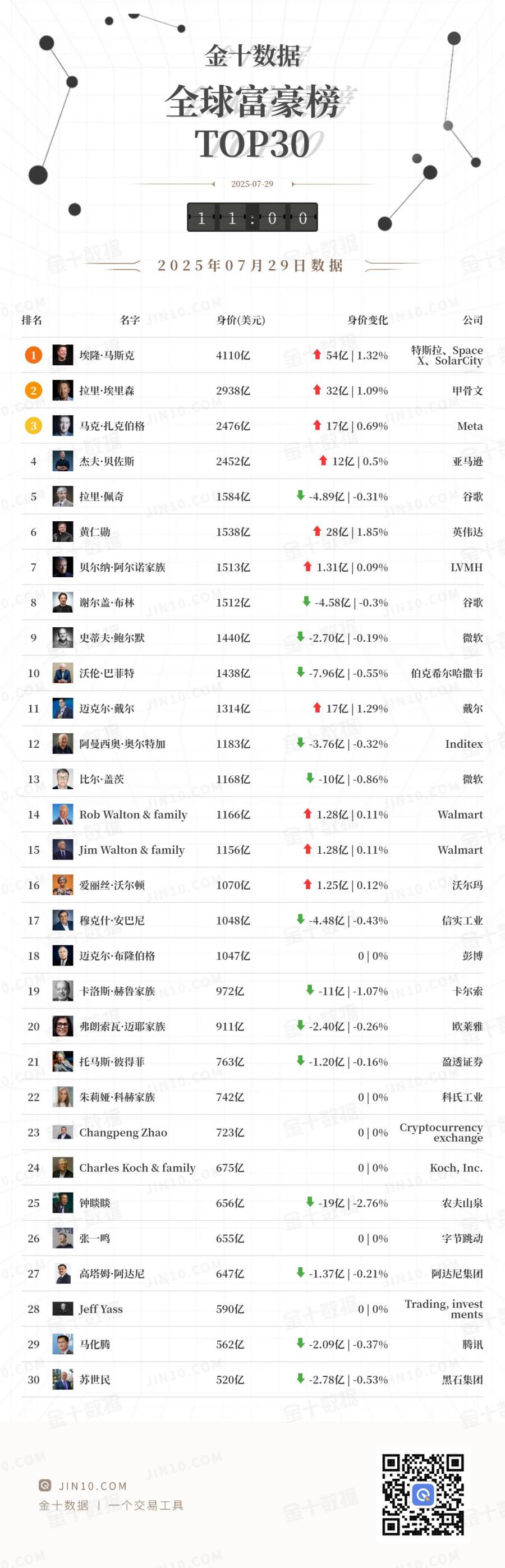
金十图示:2025年07月29日(周二)全球富豪榜
news flash· 2025-07-29 03:02
Group 1 - Elon Musk remains the richest person in the world with a net worth of $411 billion, experiencing an increase of $1.54 billion or 1.32% [2] - Larry Ellison ranks second with a net worth of $293.8 billion, up by $1.32 billion or 1.09%, associated with Oracle [2] - Mark Zuckerberg's net worth is $247.6 billion, increasing by $1.7 billion or 0.69%, linked to Meta [2] - Jeff Bezos follows closely with a net worth of $245.2 billion, up by $1.2 billion or 0.5%, from Amazon [2] - Larry Page's net worth is $158.4 billion, decreasing by $489 million or -0.31%, related to Google [2] Group 2 - Jensen Huang has a net worth of $153.8 billion, increasing by $1.28 billion or 1.85%, associated with Nvidia [2] - The Bernard Arnault family has a net worth of $151.3 billion, up by $131 million or 0.09%, linked to LVMH [2] - Sergey Brin's net worth is $151.2 billion, decreasing by $458 million or -0.3%, related to Google [2] - Steve Ballmer has a net worth of $144 billion, decreasing by $270 million or -0.19%, associated with Microsoft [2] - Warren Buffett's net worth stands at $143.8 billion, decreasing by $796 million or -0.55%, linked to Berkshire Hathaway [2] Group 3 - Michael Dell's net worth is $131.4 billion, increasing by $1.17 billion or 1.29%, associated with Dell [2] - Amancio Ortega has a net worth of $118.3 billion, decreasing by $376 million or -0.32%, linked to Inditex [3] - Bill Gates' net worth is $116.8 billion, decreasing by $1 billion or -0.86%, associated with Microsoft [3] - The Walton family members, including Rob Walton and Jim Walton, have net worths of $116.6 billion and $115.6 billion respectively, both increasing by $1.28 million or 0.11% [3] - Mukesh Ambani's net worth is $104.8 billion, decreasing by $448 million or -0.43%, linked to Reliance Industries [3]

Is Dell Technologies (DELL) Outperforming Other Computer and Technology Stocks This Year?
ZACKS· 2025-07-25 14:41
Group 1 - Dell Technologies (DELL) is a notable stock in the Computer and Technology sector, currently outperforming its peers with a year-to-date gain of approximately 11.4% compared to the sector average of 10.8% [4] - The Zacks Rank for Dell Technologies is 2 (Buy), indicating a positive outlook based on earnings estimates and revisions [3] - The Zacks Consensus Estimate for DELL's full-year earnings has increased by 7.8% in the past quarter, reflecting improved analyst sentiment [4] Group 2 - Dell Technologies is part of the Computer - Micro Computers industry, which has seen an average loss of 14.1% this year, highlighting DELL's relative strength in this segment [6] - Advantest Corp. (ATEYY) is another strong performer in the Computer and Technology sector, with a year-to-date return of 34.6% and a Zacks Rank of 1 (Strong Buy) [5] - The Electronics - Measuring Instruments industry, to which Advantest belongs, is currently ranked 8 and has gained 4.9% this year [6]


Dell: An AI Investment For Value Investors
Seeking Alpha· 2025-07-25 14:24
Group 1 - Bert Hochfeld has a strong background in economics and business, with degrees from the University of Pennsylvania and Harvard [1] - Hochfeld has extensive experience in the tech industry, having worked for notable companies such as IBM, Raytheon Data Systems, and BMC Software [1] - He established Hochfeld Independent Research Group in 2001, providing research services to major institutions and hedge funds [1] - The Hepplewhite Fund, operated by Hochfeld, was recognized as the best performing small-cap fund for the five years ending in 2011 [1] - Hochfeld has published over 500 articles on Seeking Alpha, focusing on information technology companies [1] - He ranks in the top 0.1% of Tip Ranks analysts for his successful selection of information technology stocks [1] Group 2 - In 2012, Hochfeld was convicted of misappropriating funds from his hedge fund [1]
Dell No. 2 Jeff Clarke is taking control of its stuttering PC business. Read the memo he sent to staff.
Business Insider· 2025-07-25 10:41
Core Insights - Dell's PC and hardware division, the largest revenue driver, has seen a decline in revenue for the past three years, with total CSG revenue at $48.6 billion in 2025, down 21% from its 2022 peak [1][8] - Jeff Clarke, the vice chairman and COO, will take on day-to-day leadership of the consumer solutions group (CSG) to accelerate decision-making and capitalize on the PC refresh cycle [2][14] - The company is undergoing a reorganization to modernize operations, including leadership changes, with Sam Burd appointed to lead corporate strategy [2][16] Revenue Performance - CSG's revenue has declined annually since 2022, while ISG revenue, driven by AI server demand, increased by 29% in the last financial year [8] - Dell's total annual revenue rose by 8% in the 2025 financial year, and the company's stock increased by 11% since January [9] Market Position - Dell has been losing market share to competitors like Lenovo and HP in consumer and commercial notebooks and desktops [9] - The company aims to lead in the commercial and consumer PC markets and is focused on the critical PC refresh cycle [10] Employee Sentiment - Dell's employee satisfaction score, known as the employee net promoter score (eNPS), fell to 32, a nearly 50% decline over two years amid workforce reductions and return-to-office mandates [13]

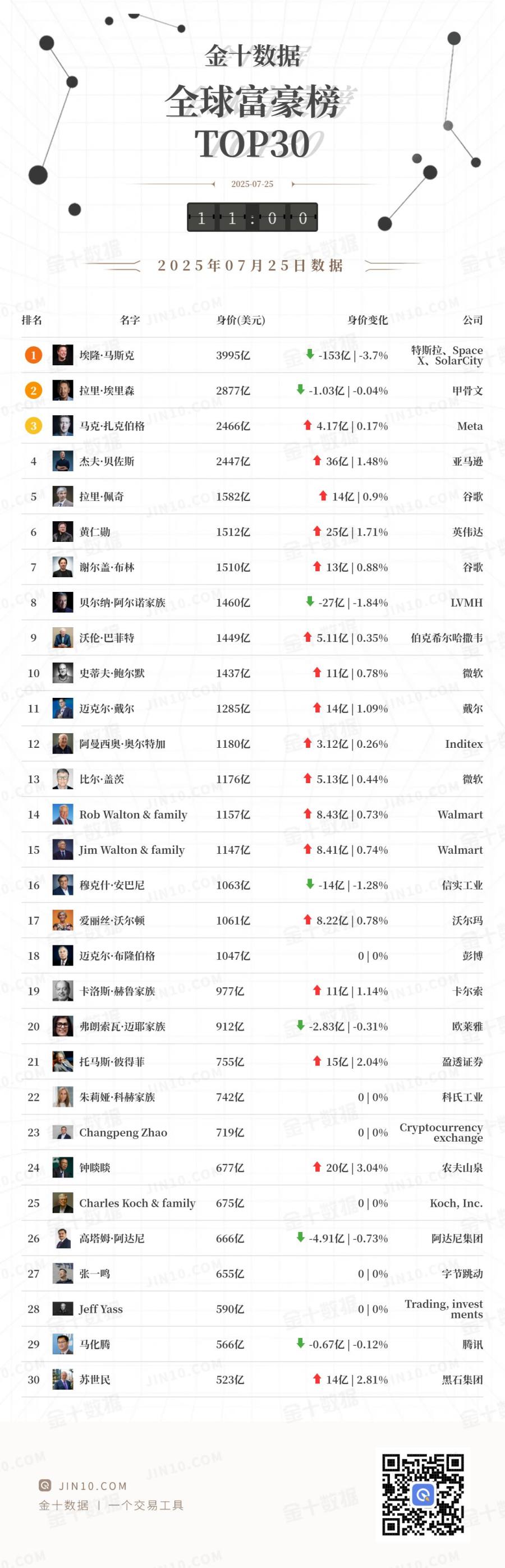
金十图示:2025年07月25日(周五)全球富豪榜




news flash· 2025-07-25 03:04
Group 1 - Elon Musk remains the richest person with a net worth of $399.5 billion, experiencing a decrease of $15.3 billion or 3.7% [1] - Larry Ellison ranks second with a net worth of $287.7 billion, down by $1.03 billion or 0.04% [1] - Mark Zuckerberg's net worth is $246.6 billion, increasing by $14.17 billion or 0.17% [1] - Jeff Bezos has a net worth of $244.7 billion, up by $3.6 billion or 1.48% [1] - Larry Page's net worth stands at $158.2 billion, with an increase of $1.4 billion or 0.9% [1] - Jensen Huang's net worth is $151.2 billion, rising by $2.5 billion or 1.71% [1] - Sergey Brin has a net worth of $151.0 billion, increasing by $1.3 billion or 0.88% [1] - Bernard Arnault's family has a net worth of $146.0 billion, down by $2.7 billion or 1.84% [1] - Warren Buffett's net worth is $144.9 billion, with an increase of $5.11 billion or 0.35% [1] - Steve Ballmer's net worth stands at $143.7 billion, up by $1.1 billion or 0.78% [1] - Michael Dell has a net worth of $128.5 billion, increasing by $1.4 billion or 1.09% [1] Group 2 - Amancio Ortega's net worth is $118.0 billion, with an increase of $3.12 billion or 0.26% [3] - Bill Gates has a net worth of $117.6 billion, rising by $5.13 billion or 0.44% [3] - Rob Walton & family have a net worth of $115.7 billion, increasing by $8.43 billion or 0.73% [3] - Jim Walton & family have a net worth of $114.7 billion, up by $8.41 billion or 0.74% [3] - Mukesh Ambani's net worth is $106.3 billion, down by $1.4 billion or 1.28% [3] - Alice Walton has a net worth of $106.1 billion, increasing by $8.22 billion or 0.78% [3] - Michael Bloomberg's net worth stands at $104.7 billion, unchanged [3] - Carlos Slim Helu's family has a net worth of $97.7 billion, increasing by $1.1 billion or 1.14% [3] - François Pinault's family has a net worth of $91.2 billion, down by $2.83 billion or 0.31% [3] - Thomas Peterffy's net worth is $75.5 billion, with an increase of $1.5 billion or 2.04% [3] - Julia Koch's family has a net worth of $74.2 billion, unchanged [3] - Changpeng Zhao has a net worth of $71.9 billion, unchanged [3] - Zhong Tantan's net worth is $67.7 billion, increasing by $2.0 billion or 3.04% [3] - Charles Koch's family has a net worth of $67.5 billion, unchanged [3] - Gautam Adani's net worth is $66.6 billion, down by $4.91 billion or 0.73% [3] - Zhang Yiming has a net worth of $65.5 billion, unchanged [3] - Jeff Yass has a net worth of $59.0 billion, unchanged [3] - Ma Huateng has a net worth of $56.6 billion, down by $0.67 billion or 0.12% [3] - Stephen Schwarzman has a net worth of $52.3 billion, increasing by $1.4 billion or 2.81% [3]
金十图示:2025年07月24日(周四)美股热门股票行情一览(美股盘中)


news flash· 2025-07-24 16:39
Market Overview - The market capitalization of major US stocks shows varied performance, with Oracle at 762.30 billion, Mastercard at 321.36 billion, and Visa at 770.15 billion, reflecting increases of +0.66%, +0.86%, and +0.68% respectively [3] - Exxon Mobil's market cap is 679.53 billion, with a slight decrease of -0.98%, while Johnson & Johnson and Netflix show minor changes of -0.08% and -0.05% respectively [3] - Companies like Wells Fargo and Cisco have market caps of 270.15 billion and 279.59 billion, with respective increases of +0.98% and -0.58% [3] Notable Stock Movements - T-Mobile US Inc experienced a significant increase of +6.20%, reaching a market cap of 272.19 billion [3] - General Electric and Coca-Cola saw market caps of 285.05 billion and 298.76 billion, with increases of +0.37% and +0.91% respectively [3] - Companies like Disney and Goldman Sachs have market caps of 229.06 billion and 221.80 billion, with slight changes of +0.01% and -0.60% [3] Sector Performance - The technology sector shows mixed results, with Intel at 991.05 billion, down -3.28%, while AMD increased by +2.46% to 254.92 billion [5] - The consumer goods sector is represented by companies like Procter & Gamble and Coca-Cola, with market caps of 371.68 billion and 298.76 billion, showing slight increases [3][4] - The energy sector, represented by Exxon Mobil and Chevron, shows varied performance, with Exxon down -0.98% and Chevron up +0.66% [3] Summary of Key Companies - Oracle's market cap stands at 762.30 billion, reflecting a positive trend [3] - Mastercard and Visa show strong performance with market caps of 321.36 billion and 770.15 billion, both increasing [3] - Companies like Pfizer and Comcast have market caps of 1579.81 billion and 1332.00 billion, with Pfizer showing minimal change and Comcast down -3.16% [4][5]

金十图示:2025年07月24日(周四)全球富豪榜
news flash· 2025-07-24 03:06
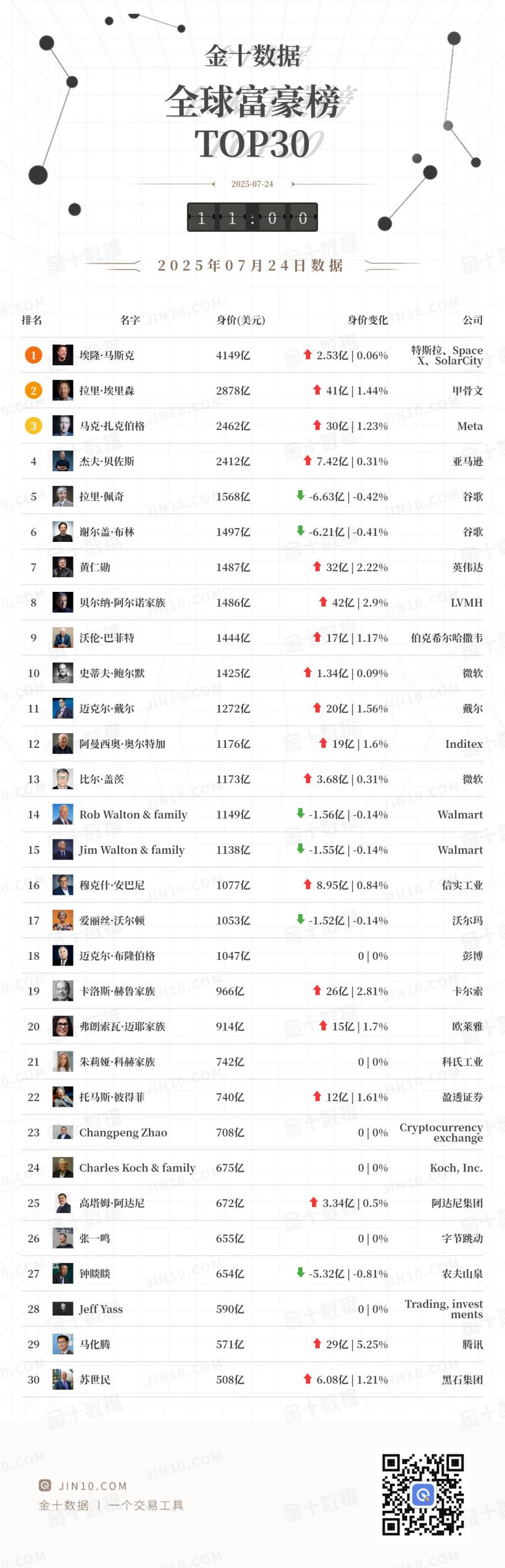
Group 1 - Elon Musk remains the richest person in the world with a net worth of $414.9 billion, showing a slight increase of $125.3 million or 0.06% [2] - Larry Ellison ranks second with a net worth of $287.8 billion, increasing by $1.41 billion or 1.44% [2] - Mark Zuckerberg's net worth is $246.2 billion, up by $300 million or 1.23% [2] - Jeff Bezos holds the fourth position with a net worth of $241.2 billion, with a modest increase of $74.2 million or 0.31% [2] - Larry Page and Sergey Brin, co-founders of Google, have net worths of $156.8 billion and $149.7 billion respectively, both experiencing slight declines [2] Group 2 - Nvidia's CEO Jensen Huang has a net worth of $148.7 billion, increasing by $3.2 billion or 2.22% [2] - The Arnault family, associated with LVMH, has a net worth of $148.6 billion, up by $4.2 billion or 2.9% [2] - Warren Buffett's net worth is $144.4 billion, with an increase of $1.7 billion or 1.17% [2] - Steve Ballmer, former Microsoft CEO, has a net worth of $142.5 billion, increasing by $134 million or 0.09% [2] - Michael Dell's net worth stands at $127.2 billion, with an increase of $2 billion or 1.56% [2] Group 3 - Amancio Ortega has a net worth of $117.6 billion, increasing by $1.9 billion or 1.6% [3] - Bill Gates' net worth is $117.3 billion, with a slight increase of $36.8 million or 0.31% [3] - The Walton family members, Rob and Jim, have net worths of $114.9 billion and $113.8 billion respectively, both showing slight declines [3] - Mukesh Ambani's net worth is $107.7 billion, increasing by $895 million or 0.84% [3] - The Koch family has a net worth of $67.5 billion, remaining unchanged [3]
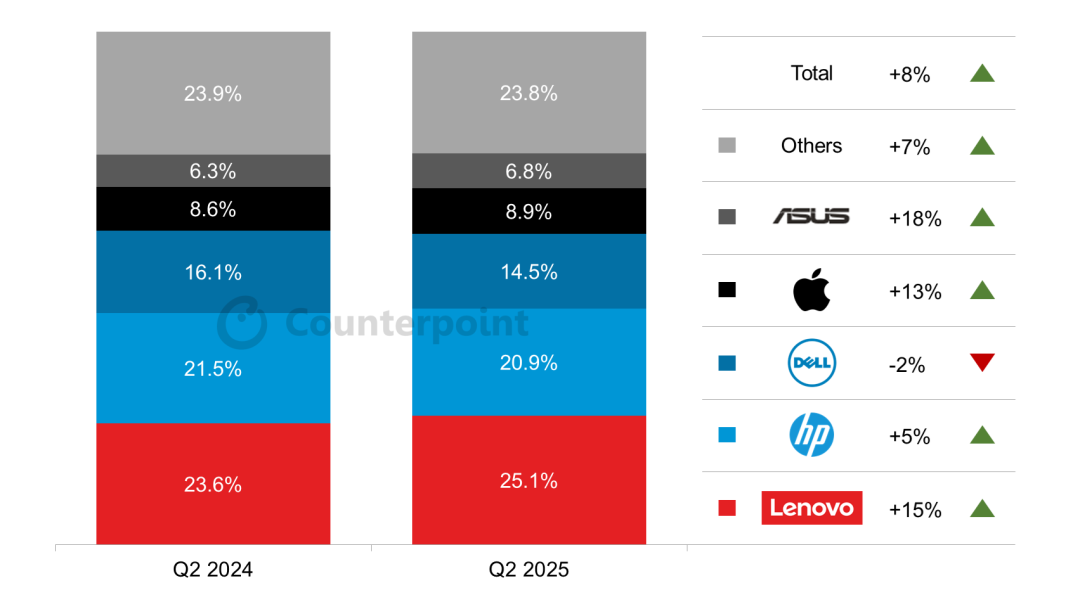
Counterpoint Research:二季度全球PC出货量同比增长8.4% 关税担忧加剧
智通财经网· 2025-07-24 01:23
Group 1 - Global PC shipments are expected to grow by 8.4% year-on-year in Q2 2025, marking the largest increase since the peak demand during the pandemic in 2022 [1] - The growth is driven by the countdown to the end of Windows 10 support, the rise of AI PCs, and early inventory stocking in anticipation of back-to-school demand amid tariff policy uncertainties [1][4] - Business demand is a significant contributor to this quarter's growth, as large enterprises and public institutions accelerate device upgrades before the Windows 10 support deadline at the end of 2025 [1][4] Group 2 - Lenovo leads the global PC market with a 25% shipment share, benefiting from pre-tariff inventory adjustments and the replacement cycle of Windows 10 [4] - HP and Dell follow in second and third place, maintaining stable enterprise demand but facing price competition from smaller OEMs [4] - Apple’s MacBook sales remain steady, supported by the M4 series, although growth rates have slowed compared to previous quarters [4] Group 3 - Future PC shipment growth may slow in the second half of 2025 due to uncertainties surrounding U.S. tariff policies, but demand for AI PCs is expected to become a significant growth driver by 2026 [4][5] - Counterpoint predicts that over half of the laptops shipped after 2026 will be AI laptops [4][6] - Manufacturers are prioritizing the establishment of reliable and cost-effective supply chains for products aimed at the U.S. market to mitigate tariff impacts and reduce reliance on single-country manufacturing [5] Group 4 - The global PC industry is actively pursuing a diversification strategy in production layout to ensure stability and adaptability in the face of ongoing tariffs and trade uncertainties [5] - This strategic shift requires significant investment in factory infrastructure, employee training, and logistics, highlighting a major transformation in the global PC manufacturing landscape [5] - Companies that prepare in terms of price competitiveness and ecosystem readiness are expected to gain an advantage in the next wave of PC upgrades [6]


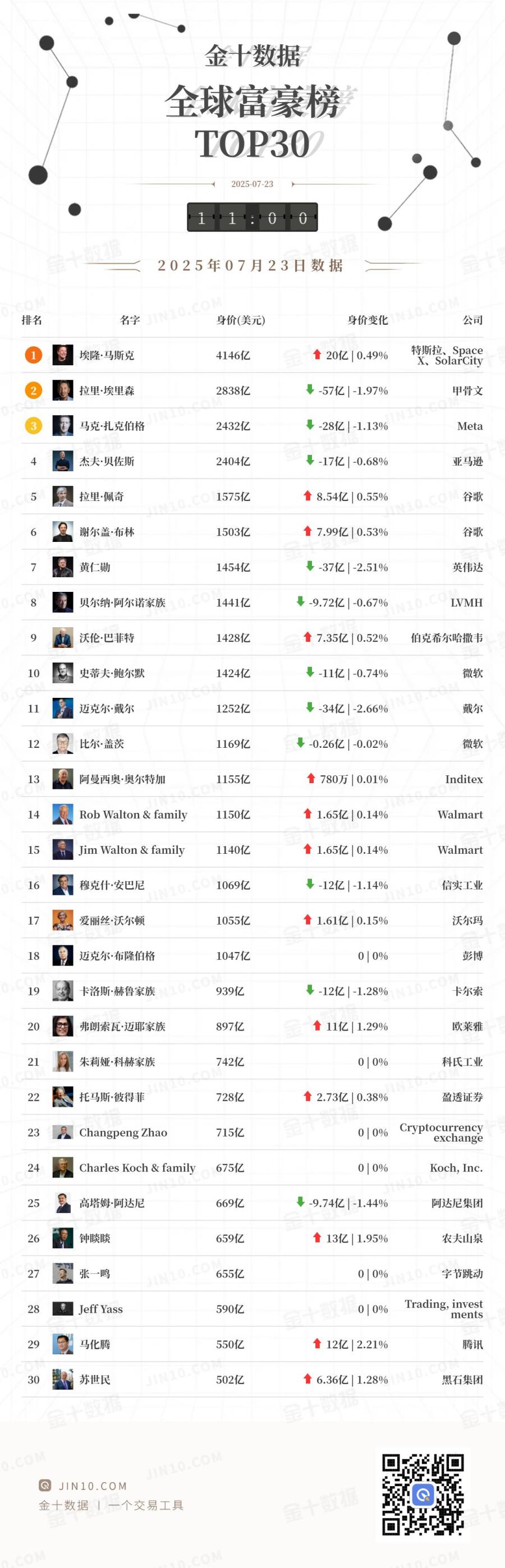
金十图示:2025年07月23日(周三)全球富豪榜
news flash· 2025-07-23 03:04
-- | 排名 | 名字 | 身价(美元) | 身价变化 | 公司 | | --- | --- | --- | --- | --- | | | 埃隆·马斯克 | 4146亿 | 1 20亿 0.49% | | | 2 | 拉里·埃里森 | 2838亿 | 4 -57亿 -1.97% | 甲骨文 | | | 马克·扎克伯格 | 2432亿 | + -28亿 -1.13% | Meta | | 4 | 杰夫·贝佐斯 | 2404亿 | + -17亿 -0.68% | 亚马逊 | | 5 | 拉里·佩奇 | 0 1575亿 | 1 8.54亿 0.55% | 谷歌 | | 6 | 谢尔盖·布林 | 1503亿 | 1 7.99亿 0.53% | 谷歌 | | 7 | 黄仁勋 | 1454亿 | + -37亿 -2.51% | 英伟达 | | 8 | 贝尔纳·阿尔诺家族 | 1441亿 | + -9.72亿 -0.67% | LVMH | | 9 | 沃伦·巴菲特 | 1428亿 | -1 7.35亿 0.52% | 伯克希尔哈撒韦 | | 10 | 史蒂夫·鲍尔默 | 1424亿 | + - 11亿 -0.74% ...
Dell Technologies (DELL) Stock Slides as Market Rises: Facts to Know Before You Trade
ZACKS· 2025-07-22 22:46
Group 1: Stock Performance - Dell Technologies (DELL) closed at $124.33, reflecting a -3.59% change from the previous day, which is less than the S&P 500's daily gain of 0.06% [1] - Over the past month, DELL shares have gained 9.27%, while the Computer and Technology sector gained 9.6% and the S&P 500 gained 5.88% [1] Group 2: Earnings Estimates - Dell Technologies is set to release earnings on August 28, 2025, with projected earnings per share (EPS) of $2.28, indicating a 20.63% increase from the same quarter last year [2] - The consensus estimate anticipates revenue of $29.21 billion, reflecting a 16.72% increase from the same quarter last year [2] - Full-year Zacks Consensus Estimates predict earnings of $9.45 per share and revenue of $104.02 billion, representing year-over-year changes of +16.09% and +8.84%, respectively [3] Group 3: Analyst Estimates and Rankings - Recent modifications to analyst estimates for Dell Technologies indicate short-term business trends, with positive changes reflecting analyst optimism [4] - The Zacks Rank system, which incorporates estimate changes, currently ranks Dell Technologies as 1 (Strong Buy), with a notable track record of outperforming the market [6] - Over the past month, there has been a 0.16% rise in the Zacks Consensus EPS estimate for Dell Technologies [6] Group 4: Valuation Metrics - Dell Technologies has a Forward P/E ratio of 13.65, which is a premium compared to its industry's Forward P/E of 12.32 [7] - The company has a PEG ratio of 0.95, indicating a favorable valuation relative to the expected earnings growth rate, while the average PEG ratio for Computer - Micro Computers stocks is 1.48 [8] Group 5: Industry Context - The Computer - Micro Computers industry, part of the broader Computer and Technology sector, holds a Zacks Industry Rank of 188, placing it in the bottom 24% of over 250 industries [9] - Research indicates that the top 50% rated industries outperform the bottom half by a factor of 2 to 1 [9]