
PCs

Search documents
联想集团(0992.HK)香港科技日:关注存储涨价、中东冲突和OPENCLAW
Ge Long Hui· 2026-03-13 06:36
Core Viewpoint - Lenovo is well-positioned to manage the impact of rising storage costs and geopolitical tensions, with a strong outlook for its PC and ISG (Infrastructure Solutions Group) segments, supported by new product demand and strategic partnerships. Group 1: Impact of Storage Price Increases - The impact of rising storage prices on the PC business is limited, as Lenovo can effectively transfer costs to downstream through scale bargaining and mature pricing mechanisms [1][2] - In the mobile segment, while sensitive to storage prices, the overall impact on group profitability is manageable due to smaller revenue scale compared to peers [2] Group 2: ISG Profit Recovery - ISG is expected to see a profit recovery driven by strong AI demand and a structural shift from CSP (Cloud Service Providers) to higher-margin ESMB (Enterprise Small and Medium Business) [2] - The introduction of Neptune liquid cooling technology is anticipated to enhance server value amid increasing AI computing needs [2] - Overall, ISG is projected to return to profitability in the next fiscal quarter [2] Group 3: Geopolitical Impact in the Middle East - The ongoing geopolitical tensions have a limited impact on Lenovo's overall revenue, with the Middle East contributing a small percentage to total income [3] - Despite potential delays in establishing new headquarters and production facilities in Saudi Arabia, the long-term strategic focus in the region remains unchanged [3] - Lenovo's flexible global factory scheduling helps maintain supply stability in the region [3] Group 4: New Product Demand and PC Replacement Cycle - The recent popularity of OpenClaw and related AI products is expected to stimulate a new wave of PC replacement demand, benefiting Lenovo as the leading global PC vendor [4] - Lenovo's comprehensive strategy in the hybrid AI space, including the Qira platform, is likely to enhance its competitive edge in the AI PC market [4] - The company reported an 18% year-over-year increase in PC revenue, with AI PC penetration exceeding 30% and continuing to rise [4] Group 5: Investment Rating and Financial Outlook - The target price for Lenovo is maintained at 14.0 HKD, corresponding to a 12x FY27E PE, with a "Buy" rating upheld [5] - Projected non-HKFRS net profits for FY26, FY27, and FY28 are 1.8 billion, 2.03 billion, and 2.24 billion USD, reflecting year-on-year growth rates of 25%, 12.6%, and 10.4% respectively [5]

Here's how much Apple is raising prices on MacBook Air, Pro models
New York Post· 2026-03-03 18:14
Price Increases - Apple has increased prices on its latest MacBook Air and Pro models by $100 to $400 due to rising memory costs [1][6] - The 13-inch MacBook Air now starts at $1,099 (up from $999), and the 15-inch model is priced at $1,299 (up from $1,199) [1][9] - The 14-inch MacBook Pro with the base M5 chip now costs $1,699 (up from $1,599), while higher-end Pro and Max versions have increased by $200 to $400, with the most expensive model reaching $3,899 [1][6] Storage Enhancements - To mitigate the impact of price hikes, Apple has doubled the base storage for many models, with the MacBook Air now featuring 512 gigabytes (up from 256 gigabytes) [2] - The MacBook Pro has a new standard of 1 terabyte for most configurations, compared to 512 gigabytes in earlier models, and the highest-end M5 Max versions start with 2 terabytes of storage [2][11] Industry Context - Analysts indicate that DRAM and NAND flash prices are rising sharply as chipmakers prioritize supply for higher-margin AI data center demands [3][7] - Apple CEO Tim Cook noted that memory pricing has been increasing significantly and is expected to continue impacting the company through 2026 [3][6] - Other PC manufacturers, including Dell, HP, Lenovo, Acer, and ASUS, are also raising prices or adjusting specifications due to similar memory cost pressures [6][7] Memory Market Dynamics - Major memory producers like Samsung, SK Hynix, and Micron are reallocating production capacity towards high-bandwidth memory for AI data centers, which offers higher profit margins [8] - TrendForce projects that AI-centric memory will consume 70% of global memory hardware production by 2026, limiting supply for conventional consumer devices [11] - Gartner estimates that memory will account for 23% of a PC's total bill of materials in 2026, up from 16% in 2025, predicting a 17% increase in average PC prices compared to the previous year [12]



JPMorgan Mixed on HP (HPQ) Amid Demand Concerns
Yahoo Finance· 2026-03-02 20:40
Core Viewpoint - HP Inc. (NYSE:HPQ) is considered one of the most undervalued AI stocks currently available for investment, supported by analyst and hedge fund sentiment, as well as a low forward price-to-earnings (PE) ratio [1] Group 1: Analyst Ratings and Target Price Changes - JPMorgan reduced its target price for HP Inc. from $21 to $19 on February 25, 2026, maintaining a 'Neutral' rating due to a challenging earnings outlook [1] - Earlier, on February 19, 2026, JPMorgan had cut the target from $25, citing weak sentiment and concerns about the sustainability of short-term results driven by pull-forward demand [2] - Citi also issued a mixed outlook for HP Inc. on February 17, 2026, retaining a 'Neutral' rating and lowering the target from $22 to $20, highlighting headwinds related to end-demand for PCs [3] Group 2: Current Stock Performance - As of February 26, 2026, HP Inc. shares were trading at $18.81, which is over 44% below its 52-week high of $34.07, indicating significant pressure on the stock due to broader industry challenges affecting PC makers [2] Group 3: Company Overview - HP Inc. provides personal computers, printers, supplies, and related solutions, catering to both commercial and consumer customers [3]

PC & AI Server Business Backs DELL Earnings, NVDA Partnership's Potential
Youtube· 2026-02-26 17:01
Core Viewpoint - Dell is set to report earnings, with analysts expecting adjusted EPS of $3.54 and revenue of nearly $32 billion for the quarter, while shares have declined over 25% from their 52-week high [1][3]. Business Segments - Dell's business is divided into two main parts: the infrastructure segment, which is experiencing strong demand for AI servers and has a growing backlog, and the PC segment, which is facing challenges due to rising costs for data storage and memory [3][5]. - The infrastructure business is performing well, particularly due to partnerships with Nvidia, which target customers in the AI server space [3][9]. Cost Challenges - The cost of memory is expected to double sequentially, significantly impacting the bill of materials for PC production, which poses a challenge for Dell and other PC manufacturers [6][4]. - Dell will need to work closely with suppliers and implement cost-cutting measures to mitigate these challenges, while also considering price adjustments [5][6]. Market Position - Dell is the third-largest PC maker globally and the second-largest in the U.S., but it faces competition from other major players like Lenovo and HP, who are also dealing with increased costs [3][4]. - Despite the challenges in the PC market, Dell's integrated offerings in AI servers and storage solutions position it well for future growth [8][9]. Investment Outlook - Analysts maintain a buy rating on Dell with a price target of $200, citing the company's strong infrastructure business as a buffer against the downturn in the PC segment [7][8]. - The stock is currently trading at a lower price-to-earnings ratio compared to historical averages, suggesting potential for recovery as the company navigates its challenges [11].


Buy, Sell or Hold the Apple Stock? Key Tips Ahead of Q1 Earnings
ZACKS· 2026-01-27 18:46
Core Viewpoint - Apple is expected to report first-quarter fiscal 2026 results on January 29, with projected net sales growth of 10% to 12% year-over-year, driven primarily by strong iPhone sales and a steady performance in Services [1][2]. Group 1: Financial Expectations - Apple anticipates first-quarter fiscal 2026 net sales to grow between 10% and 12% year-over-year, with iPhone sales expected to increase in double digits [2]. - The Zacks Consensus Estimate for fiscal first-quarter net sales is $137.47 billion, indicating a year-over-year growth of 10.6% [3]. - The consensus estimate for earnings per share is $2.65, reflecting a 10.4% increase from the previous year [3]. Group 2: Segment Performance - iPhone sales are projected to reach $77.63 billion, suggesting a 12.2% year-over-year growth, benefiting from strong demand for iPhone 17 and 16 models [9]. - The Services segment is expected to generate $30.04 billion in revenue, indicating a 14.1% growth year-over-year, driven by Apple TV, Arcade, and an expanding device base [12]. - Mac revenue is forecasted to rise modestly to $9 billion, reflecting a 0.9% year-over-year growth amid tough comparisons and market share losses [14]. Group 3: Market Position and Competition - Apple holds a 20% share of the smartphone market as of calendar 2025, with iPhone sales increasing by 6.1% year-over-year [7]. - In the PC market, Apple has lost market share, trailing competitors like Lenovo, Dell, and HP, with a 0.2% shipment growth compared to Lenovo's 14.4% [13][14]. - Apple shares have risen 7.2% over the past year, underperforming the Zacks Computer & Technology sector's return of 24.7% [15]. Group 4: Strategic Initiatives - Apple is enhancing its position in the AI space through a collaboration with Alphabet, which will improve its Siri capabilities and drive demand for its Services business [19][20]. - The adoption of Apple Intelligence is expected to boost the company's Services segment, which accounts for approximately 26% of net sales [20].

联想集团:12 月 PC 出货超预期;内存成本上涨下韧性更强,稳居全球龙头;评级:买入
2026-01-14 05:05
Summary of Lenovo (0992.HK) Conference Call Company Overview - **Company**: Lenovo Group Limited (0992.HK) - **Industry**: Personal Computers (PCs) and Technology Key Points and Arguments 1. **PC Shipment Performance**: Lenovo reported a flat quarter-over-quarter (QoQ) PC shipment of 19.3 million units in the December quarter, maintaining its position as the global leader with a year-over-year (YoY) growth of 14%, compared to the global PC shipment growth of 9.6% [1][2] 2. **Market Position**: The strong shipment growth reflects Lenovo's robust market position and suggests a consumption pull-in effect amid rising memory costs [1] 3. **Gross Margin (GM) Stability**: Lenovo's gross margin remained stable in the September quarter, and it is expected to stay stable in the December and March quarters due to strong bargaining power and market position. However, a decline in GM is anticipated in the June quarter, dropping from 15.6% to 14.6% due to rising memory costs [1][2] 4. **Historical GM Trends**: In previous memory price upcycles, Lenovo's blended GM decreased from 14.7% in CY2016 to 13.8% in CY2017, before recovering to 14.0% in CY2018 [1] 5. **Earnings Revision**: FY2026E revenues have been reduced by 2% due to a less aggressive product mix upgrade in PCs, leading to a slight reduction in GM from 15.4% to 15.2% and a 3% cut in gross profit [2] 6. **Operating Expenses**: The operating expense (opex) ratio is expected to improve due to better operational efficiency, keeping net income largely unchanged [2] 7. **Future Earnings Estimates**: For FY2027E, net income is reduced by 5% mainly due to lower GM, while FY2028E estimates remain largely unchanged as product mix upgrades are expected to support GM recovery post-memory upcycle [2] 8. **Valuation and Price Target**: The target price for Lenovo is set at HK$11.98, reflecting a 9.6% reduction from HK$13.25, based on a target P/E multiple of 10.3x derived from peer averages [8][11] 9. **Investment Rating**: Goldman Sachs maintains a "Buy" rating on Lenovo, indicating a potential upside of 33.9% from the current price of HK$8.95 [11] Risks and Considerations 1. **Market Demand Recovery**: Risks include slower-than-expected recovery in market demand across PCs, servers, storage, and smartphones [9] 2. **Competition**: Increased competition in smartphones and AI servers could impact Lenovo's market share [9] 3. **Inventory Management**: Longer-than-expected inventory digestion in PCs and servers may pose challenges [9] 4. **Product Mix Upgrades**: Slower-than-expected upgrades in product mix or total solutions could hinder growth [9] Additional Insights - **Operational Efficiency**: The company is focusing on improving operational efficiency, which is expected to positively impact the SG&A ratio in FY2026E compared to FY2025A [2] - **Investment in AI**: Lenovo is maintaining a stable R&D ratio to continue investing in generative AI, which is seen as a key growth area [2] This summary encapsulates the essential insights from the conference call regarding Lenovo's performance, market position, financial outlook, and associated risks.

What Is the Net Worth of Michael and Susan Dell?
Yahoo Finance· 2026-01-13 16:45
Core Insights - Michael Dell and his wife Susan are contributing $6.25 billion to expand a pilot program aimed at providing financial support to children in America [1][2] - The donation will provide $250 in seed money to 25 million children under the age of 10 who do not qualify for Treasury-funded "Trump Accounts" [2][3] - This contribution is considered historic and is reported as the largest donation ever dedicated to American children [3] Financial Overview - Michael Dell's net worth is estimated at $140.5 billion, making him the 12th richest person globally [4] - The $6.25 billion donation represents approximately 4.45% of his total net worth [4] - Dell's company, founded in 1984, has grown significantly, with a current market capitalization of $88.63 billion [5] Philanthropic Background - The Dells will distribute the donation through their own charitable funds rather than the Dell Foundation [6] - In 2023, the Dells previously donated $3 billion to child poverty initiatives through their private foundation, which Susan Dell co-founded in 1999 [6]
中国科技十大关键趋势;iPhone 形态革新与 ASIC 人工智能引领增长 2026 Outlook_ 10 key trends; iPhone form factor change and ASIC AI as the drivers
2026-01-05 15:43
Summary of Key Points from the Conference Call Industry Overview - The conference call discusses the Greater China Technology sector, focusing on trends and projections for 2026, particularly in AI and related technologies, as well as the smartphone supply chain influenced by Apple’s form factor changes [2][3]. Key Trends Identified for 2026 1. **AI Servers**: Anticipated growth in rack-level AI servers, with shipments expected to rise to 50,000 racks in 2026 from 19,000 in 2025. Major suppliers include Hon Hai and FII, with a projected ASIC penetration rate of 40% in 2026 and 45% in 2027 [1][13]. 2. **Optical Transceivers**: Growth in optical module shipments, with a forecasted increase of 253% year-over-year in 2026, driven by the demand for high-speed connections in AI data centers [1][13]. 3. **Cooling Solutions**: A shift towards liquid cooling in AI servers is expected, reflecting the rising complexity and computing power requirements [1][13]. 4. **Original Design Manufacturers (ODMs)**: Companies with strong commitments and capacity plans in the US, such as Hon Hai, Wistron, and Wiwynn, are expected to outperform in the market [1][13]. 5. **Smartphones**: Apple suppliers are projected to excel in 2026, while Android smartphone demand remains muted. The introduction of foldable iPhones may drive demand [1][2]. 6. **Printed Circuit Boards (PCBs)**: Demand is expected to remain solid despite ongoing debates about long-term supply and demand dynamics [1]. 7. **Semiconductors**: Local leaders in advanced nodes, such as SMIC and Hua Hong, are expected to drive industry growth, supported by rising local GPU suppliers [1]. 8. **L4 Chips & Robotaxi**: Continued upgrades and expansions in this area are anticipated, contributing to growth for chipset, software, and sensor suppliers [1]. 9. **LEO Satellites**: Accelerating satellite launches and reduced launch costs are expected to drive the development of constellation networking infrastructure [1]. Financial Projections - AI and AI-related technologies are expected to deliver mid-double-digit year-over-year revenue growth in 2026 [2]. - The total addressable market (TAM) for global smartphones is raised by 1% to 2% for 2026 and 2027 due to higher average selling prices (ASP) [3]. - The TAM for global PCs is projected to increase by 3% year-over-year for 2025 and 2026, with gaming PCs expected to reach a penetration rate of 11% to 13% by 2025 and 2028 [3]. Investment Recommendations - The report highlights several companies as "Buy" recommendations based on their expected performance in the evolving technology landscape, particularly in AI servers and components [14]. - Specific companies mentioned include Hon Hai, FII, Wistron, and various optical component manufacturers like Innolight and Eoptolink [14]. Additional Insights - The complexity of AI servers is expected to lead to a reliance on leading suppliers with strong designs and manufacturing capabilities, creating a stable competitive landscape [14]. - The report emphasizes the importance of R&D, vertical integration, and comprehensive chipset platform exposure for companies to succeed in the market [14]. This summary encapsulates the critical insights and projections from the conference call, providing a comprehensive overview of the anticipated trends and investment opportunities within the Greater China Technology sector for 2026.
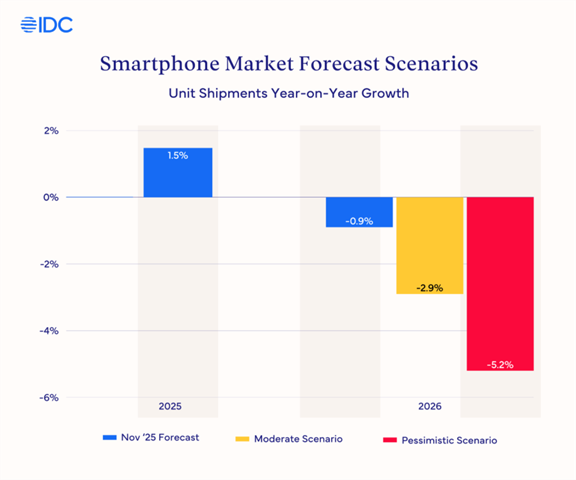
IDC:AI驱动内存芯片产能结构性重构 2026年技术产品或因供应受限涨价
智通财经网· 2025-12-22 06:05
Core Insights - The global semiconductor ecosystem is experiencing an unprecedented memory chip shortage driven by the AI infrastructure boom, leading to adjustments in product strategies and pricing logic for consumer and enterprise devices [1][2] - The demand for AI data centers is outpacing supply, causing a significant increase in DRAM prices, with the shortage expected to persist until 2027 [1][3] - IDC maintains its official forecasts but highlights potential downside risks for the smartphone and PC markets due to the ongoing memory shortage [1] Group 1: Causes of Shortage - The memory market is undergoing a structural transformation driven by AI, with demand growth significantly outpacing supply [2] - Manufacturers are reallocating capacity from consumer electronics to higher-margin AI-specific memory solutions, limiting the supply of traditional DRAM and NAND used in smartphones and PCs [2][3] - The shift in focus towards high-bandwidth memory (HBM) and fifth-generation DDR (DDR5) for AI data centers is exacerbating the supply constraints for general-purpose memory modules [2][3] Group 2: Impact on Device Markets - The smartphone market, particularly for Android manufacturers, is facing severe challenges, with rising memory costs potentially leading to price increases and reduced configurations [5][6] - The cost structure of smartphones heavily relies on memory, with mid-range models seeing memory costs account for 15%-20% of BOM, while high-end models account for 10%-15% [5] - The impact of the shortage is asymmetric, with low-end manufacturers suffering more due to thin profit margins, while high-end companies like Apple and Samsung have structural advantages to mitigate the impact [6] Group 3: Market Size and Price Predictions - The global smartphone market is expected to experience a contraction in scale alongside rising average selling prices (ASP), with a moderate scenario predicting a 2.9% decline in market size and a 3%-5% increase in ASP for 2026 [8] - In a pessimistic scenario, the market size could decline by 5.2% with ASP rising by 6%-8%, particularly affecting the low-end market where profit margins are already minimal [8] - Despite the anticipated downturn in 2026, manufacturers are likely to stock up in advance, leading to potentially better-than-expected performance in Q4 2025 [8] Group 4: PC Market Disruptions - The PC market is facing a disruptive impact due to the memory shortage coinciding with the end of the Windows 10 lifecycle and the promotion of AI PCs [9][10] - Major PC manufacturers are signaling price increases of 15%-20% in response to rising costs, with larger firms likely to gain market share from smaller regional brands [10] - The shortage may hinder the growth narrative for AI PCs, which require larger memory configurations, leading to potential price increases and reduced profit margins for manufacturers [11] Group 5: PC Market Size and Price Forecasts - IDC has not adjusted its official PC market forecasts but presents two downside scenarios for 2026, with a moderate scenario predicting a 4.9% decline in market size and a 4%-6% increase in ASP [13] - In a pessimistic scenario, the market size could decline by 8.9% with ASP rising by 6%-8%, reflecting the ongoing supply constraints [13][14] - Similar to the smartphone market, PC channel partners are expected to stock up to mitigate the impact of future price increases, leading to better-than-expected performance in Q4 2025 [14]
戴尔(DELL.US)Q3电话会:AI服务器订单异常强劲 预计Q4出货量约94亿美元将创纪录
Zhi Tong Cai Jing· 2025-11-26 08:04
Core Insights - Dell's Q3 FY26 earnings call highlighted a significant acceleration in AI growth, with record orders of $12.3 billion and a backlog of $18.4 billion [1] - The company expects Q4 revenue to be between $31 billion and $32 billion, with a non-GAAP EPS of $3.50, reflecting a 31% year-over-year increase [1] - For FY26, Dell anticipates total revenue of $111.2 billion to $112.2 billion, representing a 17% growth, and an EPS of $9.92, a 22% increase [1] AI Business Outlook - Dell has strong confidence in its AI business, projecting revenue growth driven by backlog orders and project reserves [2] - The company plans to leverage market expansion, gross margin improvement, cost control, and stock buybacks to enhance EPS growth [2] Financial Performance - Q3 orders reached $12.3 billion, with year-to-date orders totaling $30 billion, both record highs [1] - Q3 shipments amounted to $5.6 billion, with year-to-date shipments at $15.6 billion [1] - The backlog of orders stands at $18.4 billion, indicating robust demand [1] Profitability and Cost Management - AI server profitability improved quarter-over-quarter, with margins recovering to the mid-single digits [6] - The company is focused on managing rising costs through pricing adjustments and operational efficiency [3][7] - ISG's operating margin increased by 350 basis points to 12.4% in Q3, driven by strong storage performance and strict pricing discipline [8] Market Dynamics - The PC market is expected to remain vibrant due to the ongoing transition to Windows 11 and the demand for AI PCs [10] - Dell's traditional server demand has shown double-digit growth, although revenue growth has not fully aligned with demand [10] - The company is optimistic about the potential for significant upgrades in the server market, as approximately 70% of existing devices are outdated [10] Strategic Focus - Dell is shifting towards its proprietary IP storage solutions, which are expected to enhance revenue and improve margins [12] - The company is actively targeting three core areas: open automation in private cloud, AI data platforms, and network resilience solutions [12] - Dell's procurement strategy remains stable, with a focus on ensuring supply chain continuity amid rising component costs [13]