Honeywell(HON)

Search documents
Honeywell Q3 Earnings: I Avoid Solstice, But Look Toward The Aerospace Spinoff
Seeking Alpha· 2025-10-23 20:04
Core Insights - The article emphasizes the advantages of a dividend-focused value investment strategy, highlighting its focus on capital preservation and consistent income growth [1] Group 1 - The investment strategy prioritizes high-quality value stocks that provide significant growth potential and long-term safety [1] - The author encourages engagement through direct messaging and social media, indicating a community-oriented approach to sharing investment insights [1] Group 2 - The author has disclosed a beneficial long position in specific stocks, indicating a personal investment in the companies mentioned [2] - The article is presented as a personal opinion and does not constitute professional investment or tax advice, emphasizing the author's status as a private investor [3]



Stock Market Rebounds Amid Tech Earnings and Geopolitical Shifts; Energy Surges
Stock Market News· 2025-10-23 18:07
Market Overview - U.S. equities showed signs of recovery on October 23, 2025, with major indexes bouncing back from a volatile session the previous day, driven by corporate earnings, U.S.-China trade relations, and a surge in oil prices [1][2] - The Dow Jones Industrial Average (DJIA) rose by approximately 0.1% or 25 points, while the S&P 500 (SPX) advanced by about 0.3%, and the Nasdaq Composite (IXIC) led gains with a rise of around 0.6% [2] Sector Performance - The Energy Select Sector SPDR (XLE) surged by 1.62%, significantly contributing to market gains, fueled by a nearly 6% increase in West Texas Intermediate crude oil futures, which reached $61.90 per barrel due to new U.S. sanctions on Russian oil companies [3] - The Technology Select Sector SPDR (XLK) experienced a slight decline of 0.34%, while Consumer Discretionary (XLY) and Health Care (XLV) sectors also finished lower [3] Upcoming Events - Investors are awaiting the Consumer Price Index (CPI) report scheduled for October 24, which is expected to provide insights into inflation trends and influence Federal Reserve policy decisions, with a 96.7% probability of a Fed rate cut in October [4] Corporate Earnings - Major companies are set to report quarterly results, including Apple (AAPL) on October 30, Microsoft (MSFT) on October 29, and Alphabet (GOOGL, GOOG) also on October 29, with expectations of strong revenue growth [5] - Intel (INTC), Ford (F), Honeywell (HON), T-Mobile US (TMUS), and American Airlines (AAL) are also expected to release their results [5] Geopolitical Factors - The White House is considering new curbs on software exports to China, which previously affected tech stocks, indicating ongoing geopolitical tensions that could lead to market volatility [6] Major Stock News - Tesla (TSLA) reported a 12% revenue increase but a 37% narrowing of net income for Q3 2025, leading to initial stock declines despite record vehicle deliveries of 497,099 units [7] - Google (GOOGL, GOOG) announced a corporate agreement for a gas-fired power plant with carbon capture technology and a significant quantum computing breakthrough, with shares climbing 0.82% [9] - Nvidia (NVDA) continued strong momentum with shares near all-time highs, driven by major AI partnerships and a $5 billion investment in Intel for a 4% stake [10] - Apple (AAPL) faced a legal setback in the UK regarding its App Store commission, but remains financially robust ahead of its earnings release [11] - Microsoft (MSFT) is expected to exceed revenue expectations, driven by strong growth in its Azure cloud business [12] - IBM (IBM) saw its stock drop despite better-than-expected profit and revenue, indicating challenges in its enterprise business [13]







Honeywell International Inc. 2025 Q3 - Results - Earnings Call Presentation (NASDAQ:HON) 2025-10-23
Seeking Alpha· 2025-10-23 16:52
Group 1 - The article does not provide any relevant content regarding company or industry insights [1]

Honeywell's Q3 Earnings Top Estimates on Strong Aerospace Momentum
ZACKS· 2025-10-23 16:11
Core Insights - Honeywell International Inc. reported third-quarter 2025 adjusted earnings of $2.82 per share, exceeding the Zacks Consensus Estimate of $2.56, with a year-over-year increase of 9% on an adjusted basis and a reported earnings of $2.86 per share, up 32% year over year [1][10] Financial Performance - Total revenues reached $10.41 billion, surpassing the consensus estimate of $10.16 billion, marking a 7% increase from the previous year, driven by strong performance in Aerospace Technologies and Building Automation segments, with organic sales up 6% year over year [2][10] - Aerospace Technologies generated quarterly revenues of $4.51 billion, a 15% increase year over year, with organic sales rising 12% due to increased flight activity in commercial aftermarket and defense markets [4] - Industrial Automation revenues declined 9% year over year to $2.27 billion, with organic sales growing 1% year over year, primarily due to the divestiture of the personal protective equipment business [5] - Building Automation revenues totaled $1.88 billion, up 8% year over year, with organic sales increasing 7% driven by strength in building solutions and products [6] - Energy and Sustainability Solutions revenues increased 11% to $1.74 billion, although organic sales fell 2% year over year due to weaknesses in the UOP business [7] Costs and Margins - Total cost of sales was approximately $6.86 billion, up 14.7% year over year, while selling, general, and administrative expenses decreased by 7.3% to $1.30 billion [8] - Operating income was $1.75 billion, down 6% year over year, with an operating income margin of 16.9%, compared to 19.1% in the previous year [8] Balance Sheet and Cash Flow - As of the end of the third quarter 2025, Honeywell had cash and cash equivalents of $12.9 billion, up from $10.6 billion at the end of December 2024, while long-term debt increased to $30.1 billion from $25.5 billion [9] - The company generated net cash of $3.3 billion from operating activities, compared to $2 billion in the prior-year quarter, with capital expenditure totaling $374 million [9] 2025 Guidance - For 2025, Honeywell expects sales in the range of $40.7-$40.9 billion, slightly lower than the previous projection of $40.8-$41.3 billion, with organic sales expected to increase approximately 6% [12] - The company anticipates a segment margin of 22.9-23.0%, indicating a slight increase year over year, and adjusted EPS is expected to be between $10.60 and $10.70, reflecting a 7-8% year-over-year increase [13]
Honeywell rallies 7% on earnings beat — our plan heading into next week's spin-off
CNBC· 2025-10-23 16:09
Core Insights - The market is experiencing a rotation from speculative stocks to companies with strong fundamentals, as consumer staples, healthcare, and tech sectors outperform [1] - Honeywell's stock rose 7% following a strong quarterly earnings report, with organic revenue and adjusted earnings per share exceeding guidance [1] - GE Vernova is recovering after a significant drop, with positive sentiment around its nuclear franchise and CEO's engagement with OpenAI [1] Company Summaries - **Honeywell**: The company reported strong quarterly earnings, with all key metrics meeting or exceeding the higher end of its guidance. The upcoming spin-off of its advanced materials business, Solstice, is expected to reveal more value [1] - **GE Vernova**: After a decline of over 10%, the stock is rebounding, driven by positive perceptions of its nuclear business and strategic connections being made by its CEO with major tech players [1] Stock Coverage - Stocks mentioned in the rapid-fire segment include Tesla Inc., Lam Research, IBM, United Rentals, and American Airlines, indicating a broad interest in various sectors [1]

Top Stock Movers Now: IBM, Tesla, Molina Healthcare, and More
Yahoo Finance· 2025-10-23 15:47
Matthias Balk / picture alliance via Getty Images IBM's shares fell as its software revenue came in lower than analysts expected Key Takeaways Major U.S. equities indexes mostly advanced Thursday as investors monitored China trade developments and digested the latest batch of corporate earnings. IBM's shares declined after its software revenue came in lower than analysts expected. Honeywell shares surged after the conglomerate raised its full-year profit outlook and gave an update on planned spinoffs ...


Honeywell Third-Quarter Aerospace Sales Jump Ahead of Spin-Off
Yahoo Finance· 2025-10-23 15:41
Core Viewpoint - Honeywell International is restructuring and spinning off several businesses, including its aerospace division, while raising its full-year earnings outlook and reporting strong third-quarter sales growth in its aerospace segment [1][4]. Financial Performance - In the third quarter, Honeywell's sales increased by 7% to $10.41 billion, with aerospace sales showing a 12% organic growth driven by the commercial aftermarket and defense and space sectors [2]. - The company reported a profit of $1.83 billion, or $2.86 per share, compared to $1.41 billion, or $2.16 per share, in the same quarter last year [5]. - Adjusted per-share earnings, excluding certain one-time items, were $2.82, surpassing analysts' expectations of $2.57 [6]. Future Outlook - Orders increased by 22%, primarily led by aerospace technologies and energy and sustainability sectors [7]. - Honeywell expects adjusted earnings per share for 2025 to be between $10.60 and $10.70, an increase from the previous range of $10.45 to $10.65. Full-year sales are projected to be between $40.7 billion and $40.9 billion, slightly down from the prior range of $40.8 billion to $41.3 billion [7]. - The guidance now incorporates the impact of the spinoff of its advanced material business, which is expected to have a $700 million effect on annual sales and a 21-cent reduction in adjusted earnings per share [8]. Business Strategy - Honeywell's CEO noted that the aerospace segment continues to perform well, maintaining momentum in win rates and backlog, which is helping to offset margin pressures in other business areas [3]. - The company plans to announce leadership and headquarters for the independent aerospace company later this year, with the spinoff expected to be completed in the second half of next year [4].
Honeywell lifts 2025 profit outlook despite Solstice spinoff, shares rise
Yahoo Finance· 2025-10-23 15:40
Company Overview - Honeywell raised its 2025 profit forecast despite the planned separation of its advanced materials unit, indicating strong growth prospects driven by robust aerospace demand, resulting in a more than 7% increase in its shares [1] - The advanced materials unit, now named Solstice, is set to begin independent trading on Nasdaq from October 30 as part of Honeywell's strategy to split into three independent companies [1] Aerospace Sector Performance - Aerospace suppliers are experiencing strong demand for parts due to planemakers increasing production amid booming demand for new jets [2] - Honeywell's aerospace business faced pressures from higher costs and tariffs but maintained steady pricing, with margins in this segment falling by 160 basis points in the quarter ended September [2] Financial Projections - Honeywell expects full-year adjusted earnings per share to be between $10.60 and $10.70, which includes a 21 cent impact from the Solstice separation, an increase from the previous range of $10.24 to $10.44 [3] - The aerospace business reported a 15% increase in sales to $4.51 billion in the third quarter, with supply chain issues appearing to ease [4] Overall Financial Performance - Honeywell's total sales rose by 7% to $10.41 billion in the reported quarter, exceeding expectations of $10.14 billion [5] - Adjusted profit per share was $2.82, surpassing expectations of $2.57 [5]
Honeywell Q3 financial results beat, company raises forecast on aerospace demand
Proactiveinvestors NA· 2025-10-23 14:11
Group 1 - Proactive provides fast, accessible, informative, and actionable business and finance news content to a global investment audience [2] - The news team covers key finance and investing hubs including London, New York, Toronto, Vancouver, Sydney, and Perth [2] - Proactive focuses on medium and small-cap markets while also covering blue-chip companies, commodities, and broader investment stories [3] Group 2 - The team delivers insights across various sectors including biotech, pharma, mining, natural resources, battery metals, oil and gas, crypto, and emerging technologies [3] - Proactive adopts technology to enhance workflows and improve content production [4] - Automation and software tools, including generative AI, are used, but all content is edited and authored by humans [5]
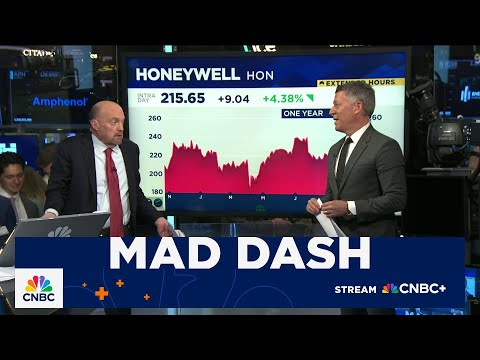
Cramer's Mad Dash: Honeywell
CNBC Television· 2025-10-23 13:47
It is time now for Kramer's Mad Dash as we countd down to the opening bell. What would you like to talk about. >> Well, let's talk about Honeywell.Now, this company is splitting up. We already have a terrific chemicals business uh which by the way, the numbers were uh much better, but people didn't. Some services did not take out the chemical business, so it looked like it might not be as good.That was wrong. You're going to get aerospace, you get this industrial automation business. Let's talk about aerosp ...