
IBM(IBM)

Search documents
Analysts See IBM as a Macro-Resistant AI Leader With Multiple Growth Drivers
Yahoo Finance· 2025-11-25 16:46
Core Viewpoint - IBM is recognized as a leading AI stock on Wall Street, with an Outperform rating and a price target of $315 following a meeting with its CEO and Global Head of IR [1][2]. Group 1: Company Strategy and Positioning - The discussions highlighted IBM's strategy, including its enterprise AI vision and mergers-and-acquisitions philosophy, positioning it as a macro-resistant hybrid IT/AI leader [2]. - Analysts believe IBM is well-positioned to benefit from trends such as enterprise AI adoption, productivity initiatives, data sovereignty prioritization, and Quantum differentiation [2]. Group 2: Market Outlook and Growth Potential - Enterprise IT spending is expected to grow ahead of mid-single-digit GDP growth, potentially leading to high-single-digit growth in overall technology spending [3]. - IBM's business transformation has resulted in strong free cash flow generation, profit margin expansion, and significant revenue visibility, indicating multiple growth vectors in the medium term [3].

IBM: Boring Has Been Beautiful For Big Blue, Eyeing 2026
Seeking Alpha· 2025-11-25 15:50
Big Blue has delivered big gains for investors so far in 2025. Year to date, shares are up almost 40%, dividends included. That beats the S&P 500 SPDR ETF’s ( SPY ) 13% advance while also topping the SPDR Information Technology ETF (Freelance Financial Writer | Investments | Markets | Personal Finance | RetirementI create written content used in various formats including articles, blogs, emails, and social media for financial advisors and investment firms in a cost-efficient way. My passion is putting a nar ...

International Business Machines Corporation (IBM) Presents at Global Technology, Internet, Media & Telecommunications Conference 2025 Transcript
Seeking Alpha· 2025-11-24 22:13
Core Insights - The individual has nearly 40 years of experience in the IT industry, with 32 years spent at Hewlett Packard Enterprise, focusing on entrepreneurial innovation and as-a-service delivery models [1][2] - The transition to IBM was motivated by a desire to engage in the company's transformation efforts under the leadership of Arvind [2] Company Background - The individual has a background in chip design and has progressively taken on larger business responsibilities within Hewlett Packard Enterprise [1] - The experience includes significant work in hyperconverged and composable infrastructure, indicating a strong foundation in modern IT solutions [1] Industry Trends - The emphasis on as-a-service delivery and innovative infrastructure solutions reflects current trends in the IT industry, highlighting the shift towards more flexible and scalable IT environments [1]

Pure-Play vs Big Tech in Quantum: How IBM, NVDA, IONQ Stand at '25 End
ZACKS· 2025-11-24 21:01
Core Insights - The quantum-computing industry gained significant momentum in 2025, with both private and public sectors accelerating hardware development and policy support [1] - Investor interest surged, as evidenced by the Defiance Quantum Computing ETF crossing $2 billion in assets under management and delivering approximately 25% year-to-date returns [2] - Major technology companies like IBM, Google, Amazon, and NVIDIA made substantial advancements in quantum technology, indicating a strategic focus on this frontier [3] Industry Developments - IonQ reported $39.9 million in revenues for Q3 2025, exceeding guidance by 37% and achieving 222% year-over-year growth, alongside a world-record two-qubit gate fidelity of 99.99% [4] - D-Wave reported $3.7 million in Q3 revenues, doubling year-over-year, and secured a €10 million sale, showcasing increasing commercial adoption [5] - IBM introduced the Quantum Nighthawk processor with 120 qubits and advanced its fault-tolerance roadmap, targeting quantum advantage by 2026 [8] Investment Opportunities - Pure-play companies like IonQ and D-Wave present high upside potential but come with significant risks, including high cash burn and reliance on technical progress [5][11] - Large-cap technology firms provide a more stable investment avenue, supported by diversified cash flows and robust R&D capabilities, making them attractive for risk-adjusted performance [11] - Investors seeking asymmetric returns may consider modest positions in pure-plays, while those prioritizing stability should focus on established tech giants [11]





ASTS vs. IBM: Which Connectivity Innovator is the Better Buy Today?
ZACKS· 2025-11-24 15:06
Core Insights - AST SpaceMobile is developing the first global cellular broadband network in space, accessible by standard smartphones, while IBM focuses on cloud and data solutions for enterprise digital transformation [1][2] AST SpaceMobile - AST SpaceMobile has launched its first five commercial satellites, named Bluebird, which feature the largest commercial communications arrays at 693 square feet, providing non-continuous service across the U.S. with over 5,600 cells in the low-band spectrum [4] - The company plans to deploy 45 to 60 additional satellites by Q1 2026 and holds a portfolio of over 3,650 patents related to direct-to-cell satellite technology [4] - Partnerships with major carriers like AT&T and Verizon aim to enhance cellular coverage and eliminate dead zones in the U.S. [5] - Despite advancements, AST SpaceMobile faces challenges from macroeconomic conditions and competition from companies like SpaceX's Starlink and Globalstar, which may pressure its financial performance [6] IBM - IBM is experiencing strong demand for hybrid cloud and AI solutions, which are expected to drive growth in its Software and Consulting segments [7][8] - The acquisition of HashiCorp has enhanced IBM's capabilities in managing complex cloud environments, complementing its Red Hat portfolio [9] - IBM's sales are projected to grow by 6.8% in 2025, with EPS expected to improve by 10.2%, indicating a positive trend in earnings estimates [11][13] - The company faces competition from AWS and Microsoft Azure, which is leading to pricing pressure and margin erosion [10] Performance Comparison - Over the past year, AST SpaceMobile's stock has increased by 112.2%, while IBM's stock has risen by 31.5% [14] - In terms of valuation, IBM's price/sales ratio is 3.97, significantly lower than AST SpaceMobile's 78.47, indicating that IBM may be a more attractive investment option [15] - Both companies are expected to see sales growth in 2025, but AST SpaceMobile's earnings are projected to decline significantly, contrasting with IBM's expected modest growth [18]


Oppenheimer Initiates International Business Machines Corporation (IBM) With a Buy
Yahoo Finance· 2025-11-24 13:58
Group 1: Investment Ratings and Price Targets - Oppenheimer initiated a Buy rating for International Business Machines Corporation (IBM) with a price target of $360 [1] - Evercore ISI reiterated a Buy rating for IBM with a price target of $315 [1] Group 2: Revenue Growth and Business Segments - The company's software portfolio is expected to achieve double-digit revenue growth, driven by strong automation and growth in Red Hat [2] - The consulting segment is projected to sustain low single-digit growth, alongside a recovery in application development and management [2] Group 3: Quantum Computing Developments - IBM and Cisco Systems are collaborating to link quantum computers over long distances, aiming to demonstrate the feasibility of this concept by the end of 2030 [3] - IBM unveiled its experimental quantum computing chip, Loon, which management considers a significant milestone towards making quantum computers practical by 2029 [4] Group 4: Company Overview - IBM is recognized as a global technology leader, focusing on software, consulting, and infrastructure solutions, with a strategic emphasis on hybrid cloud and artificial intelligence [4]
HPC市场迎来十年最快增长
半导体行业观察· 2025-11-23 03:37
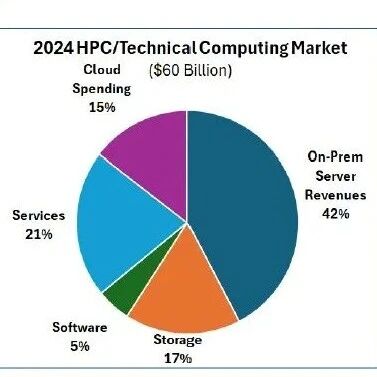
Core Insights - The article discusses the significant growth in data center infrastructure spending driven by AI training and inference cluster architectures, which also positively impacts the HPC (High-Performance Computing) architecture [1][2]. HPC-AI Market Overview - According to Hyperion Research, the global HPC spending over the past three years and future five-year forecasts indicate a robust market [2]. - The HPC-AI market is projected to generate $59.93 billion in total sales in 2024, reflecting a 23.5% growth compared to 2023, with on-premises HPC-AI systems contributing $50.39 billion (up 22.9%) and cloud HPC-AI systems contributing $9.54 billion (up 4.9%) [4][5]. Future Projections - For 2025, the overall HPC-AI market is expected to bring in $58.963 billion, a 17% increase from 2024, with cloud consumption at $12.38 billion and on-premises systems at $57.75 billion [5][6]. - The growth rate is anticipated to stabilize at around 7% to 8% annually by the end of the decade, which is still double the historical average [6]. Spending Breakdown - In 2024, cloud computing consumption will account for 15.9% of the HPC-AI product spending, with 30% of cloud spending allocated to storage, compared to 21.7% for on-premises HPC-AI centers [8]. - Services constitute a significant portion of the HPC-AI budget, primarily for system installation, maintenance, and technical support, while software accounts for only 5% of the total budget [8]. Revenue by Vendor - In 2024, the leading vendors in the HPC-AI market include HPE with $7.151 billion (28.2% market share), Dell Technologies with $3.916 billion (15.5%), and Lenovo with $1.450 billion (5.7%) [13][14]. - Non-traditional suppliers, referred to as Original Design Manufacturers (ODMs), have revenue nearly equal to HPE, indicating a competitive landscape [14]. Market Segmentation - The HPC-AI market is segmented into various price ranges, with the largest share (27.9%) coming from large HPC systems priced between $1 million and $10 million, while entry-level HPC systems (under $250,000) account for 24.3% [15]. Investment Trends - Investment in HPC-AI systems is accelerating, as evidenced by new supercomputers announced by the US Department of Energy, which are expected to stabilize revenue over time due to a shift towards cloud models [17].




Quantum Computing Stocks: How the Quantum Computing Players Stack Up by Patents (Yes, Nvidia Has Such Patents)
Yahoo Finance· 2025-11-22 17:00
Industry Overview - Quantum computers are expected to solve problems that classical computers cannot or would take years to solve, utilizing quantum bits (qubits) in superposition to encode more data simultaneously [1] - The global quantum computing market for hardware and software is projected to reach between $90 billion and $170 billion by 2040, with a current valuation of approximately $1.4 billion in 2024, indicating a compound annual growth rate (CAGR) of about 30% to 35% [2] Market Growth Potential - Significant growth in the quantum computing market is anticipated towards the backend of the forecast period, as the technology is still in its early stages and several challenges need to be addressed for practical applications [3] Patent Activity Insights - Monitoring patent activity is a valuable tool for investors in emerging technologies, as patents provide a temporary monopoly on inventions [5] - The top companies in quantum computing patent activity in 2024 include IBM with 117 patents (16% increase), Alphabet with 63 patents (13% increase), and Microsoft with 21 patents (45% decrease) [9][11] - The U.S. leads in quantum computing patents awarded in 2024, with IBM and Alphabet being the frontrunners, while Rigetti Computing holds the most patents among pure-play quantum companies [10][12]


Global Geopolitical Tensions Mount as UAE Boosts African AI Investment, US Pushes Ukraine Peace, and US Political Drama Unfolds
Stock Market News· 2025-11-22 13:38
Group 1: UAE AI Investment in Africa - The UAE is launching a $1 billion initiative to enhance AI infrastructure and projects across Africa, focusing on sectors like education, agriculture, healthcare, and digital identity [2][3] - This investment aims to provide access to AI computing power, technical expertise, and global partnerships, fostering a robust AI ecosystem in Africa [3] - Ghana has signed a $1 billion deal with the UAE to create a major innovation and technology hub, attracting global tech firms such as Microsoft, Meta, Oracle, IBM, and Alphabet [3] Group 2: California's Fast-Food Minimum Wage - California's $20 fast-food minimum wage has sparked debate over its economic impact, with mixed data on job losses and benefits for workers [9] - Some studies indicate a loss of 18,000 jobs in the fast-food sector since the wage increase in April 2024, while others report no measurable job losses and wage gains for workers [10] - Fast-food workers have reported improved financial stability, although some employers express concerns about profitability [10] Group 3: Japan's Security Concerns - Japan is on high alert for potential security crises, particularly regarding rising tensions with China over Taiwan [11] - The Japanese government views any military action by China against Taiwan as a significant threat, potentially prompting a defensive response [11] - The U.S. has reaffirmed its commitment to its alliance with Japan, including defense pledges concerning disputed islands in the East China Sea [12]



Jim Cramer Highlights International Business Machines As One of the Profitable Companies With Quantum Computing
Yahoo Finance· 2025-11-22 07:29
Group 1 - Jim Cramer highlighted IBM as one of the leading companies in quantum computing, alongside Alphabet, suggesting that these are the only two companies with real quantum technology currently available [1][2] - Cramer emphasized that many speculative quantum stocks are far from being viable, with IBM having operational quantum machines that are expected to deliver results within the next one to two years [2] - IBM is positioned as a cost-effective option in the quantum computing space, with eight functioning quantum machines, making it a preferable choice over other speculative stocks [2] Group 2 - The article suggests that while IBM has potential as an investment, certain AI stocks may offer better upside potential and lower downside risk [2]