
SentinelOne(S)

Search documents
CrowdStrike's Higher Multiple Is Justified, But SentinelOne Is The Better Investment
Seeking Alpha· 2025-09-22 16:14
Core Insights - SentinelOne, Inc. and CrowdStrike Holdings Inc. are identified as promising investments in the cybersecurity sector with potential to outperform the S&P 500 [1] - The focus is on companies with a market capitalization of less than $10 billion, which are expected to have significant growth opportunities [1] - A long-term investment perspective is emphasized, aiming for substantial returns through capital compounding [1] Investment Strategy - The investment approach is primarily conservative, with occasional pursuit of high-risk, high-reward opportunities [1] - The strategy includes careful consideration of risk-reward ratios to maintain overall portfolio stability [1] - The goal is to achieve a compound annual growth rate that could potentially deliver tenfold returns or greater [1]

Self-Help or Self-Sabotage? Activist’s Proposal for UBS to Leave Switzerland Risks Spiking Costs
Yahoo Finance· 2025-09-22 10:30
Core Viewpoint - The Swiss government is proposing to compel UBS to add $26 billion to its reserves, with the Swiss parliament clearing the way for $11 billion of that amount to be imposed directly [1][3]. Group 1: Government Proposals and UBS's Response - UBS is lobbying for a softer stance from policymakers, arguing that the proposed capital requirements would place the bank at a competitive disadvantage [2]. - An activist investor with a 1.4% stake in UBS is suggesting that the bank should consider relocating its headquarters to the US as a bargaining tactic [2][4]. - UBS is pressing the Swiss government to roll back its June proposals, which would require the bank to fully capitalize its foreign subsidiaries [4]. Group 2: Implications of Potential Relocation - The activist investor claims that the new capital proposals would make it "not viable" for UBS to operate a global investment bank in Switzerland, leading to the suggestion of relocation [4]. - Reports indicate that UBS officials have met with the Trump administration regarding a potential move to the US, but this is viewed as more of a negotiation tactic than a genuine threat [4]. - If UBS were to relocate to the US, its large Swiss business would be treated as a foreign entity, likely facing stricter capital requirements, which could complicate its operations [4].
心智观察所:美国网络安全智库的“反华合唱团”
Guan Cha Zhe Wang· 2025-09-22 01:58
Core Viewpoint - The article discusses the increasing scrutiny and criticism of Chinese cybersecurity companies by U.S. experts and institutions, particularly focusing on the actions of Dakota Cary and the implications for the cybersecurity industry. Group 1: Criticism of Chinese Cybersecurity Companies - Dakota Cary, a prominent figure in U.S. cybersecurity, has accused several Chinese companies, including Alibaba and Baidu, of being "weapons suppliers" for state-sponsored hacking, distorting the nature of penetration testing services [1][3][6] - Cary's claims are seen as part of a broader strategy to isolate Chinese cybersecurity firms from international collaborations, particularly the Microsoft Active Protections Program (MAPP) [6][7] - Following Cary's accusations, Microsoft announced restrictions on Chinese companies' access to vulnerability information, which was celebrated by Cary as a victory [7][8] Group 2: Historical Context and Evolution - The article traces the origins of U.S. criticism of Chinese cybersecurity back to a 2012 congressional hearing where Richard Bejtlich accused the Chinese government of extensive cyber espionage [9][13] - This hearing marked the beginning of a decade-long focus on China as a primary adversary in cyberspace, leading to a series of reports and accusations against Chinese firms [13][14] - The narrative has evolved, with newer figures like Cary taking the lead in shaping public perception and policy against Chinese cybersecurity entities [17][20] Group 3: The Role of U.S. Cybersecurity Firms - U.S. cybersecurity firms, such as SentinelOne, have benefited from the political climate by increasing government contracts, with SentinelOne's government orders rising from 12% in 2021 to 37% by 2025 [32][33] - The article highlights a pattern where U.S. cybersecurity companies publish reports that criticize Chinese firms, which in turn helps them secure government contracts and funding [32][34] - The rise of companies like CrowdStrike and SentinelOne is linked to their ability to align with U.S. government interests and narratives against China [33][34] Group 4: Response from Chinese Cybersecurity Firms - In response to the accusations, Chinese cybersecurity companies have begun to publish their own reports exposing U.S. cyber activities, aiming to counter the narrative and assert their capabilities [36][37] - Reports from firms like Qihoo 360 and Antiy have detailed U.S. cyber attacks, marking a shift towards a more aggressive defense strategy against U.S. claims [35][36] - The article notes that these responses are part of a broader struggle for legitimacy and recognition in the global cybersecurity landscape [34][38] Group 5: Future Implications - The ongoing conflict between U.S. and Chinese cybersecurity firms reflects a larger geopolitical struggle, with implications for international cybersecurity cooperation and competition [48][49] - The article suggests that the U.S. is conducting a comprehensive assessment of China's cybersecurity capabilities, which may signal preparations for future cyber confrontations [48][49] - The narrative constructed by U.S. experts may influence policy decisions and funding allocations within the U.S. government, further entrenching the divide between the two nations in the cybersecurity domain [57][58]




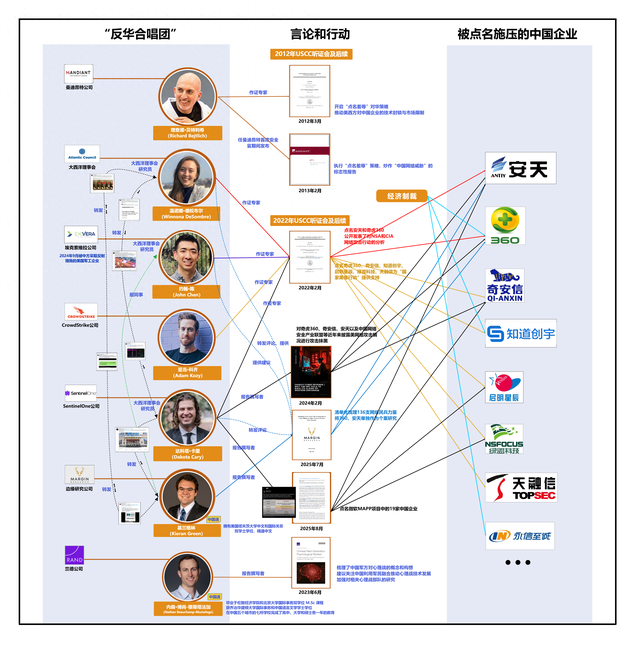
美国网络安全智库的“反华合唱团”
Guan Cha Zhe Wang· 2025-09-22 01:38
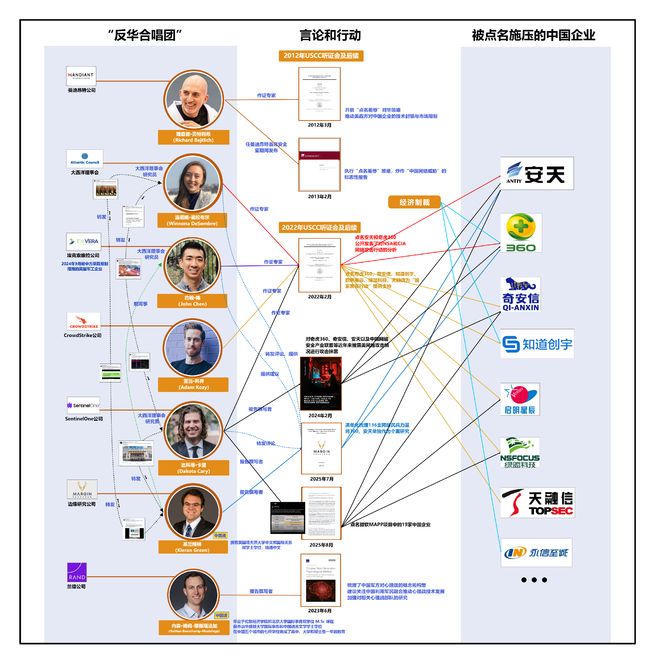
Core Viewpoint - The article discusses the increasing scrutiny and criticism of Chinese cybersecurity companies by U.S. experts and institutions, particularly focusing on the actions of Dakota Cary and the implications for the cybersecurity industry [1][3][9]. Group 1: Criticism of Chinese Cybersecurity Firms - Dakota Cary, a prominent figure in U.S. cybersecurity, has accused several Chinese companies, including Alibaba and Baidu, of being "weapons suppliers" for state-sponsored hacking [1][3]. - Cary's claims are based on the misinterpretation of penetration testing services, which are standard in the cybersecurity industry and not inherently malicious [3][7]. - The U.S. cybersecurity landscape has seen a rise in anti-China rhetoric, with Cary and others labeling Chinese firms as threats to national security [9][10]. Group 2: U.S. Cybersecurity Strategy and Actions - The Microsoft Active Protections Program (MAPP) has been a focal point, with Cary pushing for the exclusion of Chinese firms from this initiative, arguing that they pose a risk of leaking vulnerabilities to state actors [7][8]. - Following Cary's pressure, Microsoft announced restrictions on Chinese companies' access to vulnerability information, indicating a shift in U.S. cybersecurity policy [8][9]. - The article highlights a pattern where U.S. cybersecurity firms gain government contracts and funding by promoting narratives that vilify Chinese companies [34][35]. Group 3: Historical Context and Evolution - The narrative against Chinese cybersecurity firms has roots in earlier U.S. congressional hearings, such as the 2012 USCC hearing, which established China as a primary adversary in cyberspace [16][18]. - The article traces the evolution of U.S. cybersecurity firms' strategies, noting how they have leveraged political narratives to secure government contracts and enhance their market positions [19][36]. - Recent hearings in 2022 further solidified this trend, with experts calling for direct sanctions against Chinese entities, reflecting a more aggressive stance [20][23]. Group 4: Response from Chinese Cybersecurity Firms - In response to the accusations, Chinese cybersecurity firms have begun to publish reports exposing U.S. cyber activities, aiming to counter the negative narratives [36][38]. - Companies like Qihoo 360 and An Tian have released findings on U.S. cyberattacks, showcasing their capabilities and challenging the claims made by U.S. experts [37][41]. - The article emphasizes the ongoing struggle between U.S. and Chinese cybersecurity firms, with each side attempting to assert its narrative in the global cybersecurity landscape [40][49]. Group 5: Implications for the Future - The article suggests that the increasing scrutiny of Chinese cybersecurity firms may lead to a more fragmented global cybersecurity environment, with potential implications for international cooperation [49][50]. - The actions of U.S. experts and firms may also signal a broader strategy to undermine Chinese technological advancements in cybersecurity [56][59]. - The ongoing conflict in narratives and actions between U.S. and Chinese cybersecurity entities reflects a larger geopolitical struggle, with significant consequences for the industry as a whole [59].
SentinelOne (S) Strengthens Cybersecurity Platform with Observo AI Integration, Says Baird
Yahoo Finance· 2025-09-19 18:49
SentinelOne Inc. (NYSE:S) is one of the best low-priced technology stocks to buy right now. On September 8, Robert W. Baird analyst Shrenik Kothari reaffirmed a Buy rating with a $23 price target, as the company continues to strengthen its position in the cybersecurity market following its acquisition of Observo AI. SentinelOne (S) Strengthens Cybersecurity Platform with Observo AI Integration, Says Baird Photo by FlyD on Unsplash The analyst highlighted that the acquisition enhances SentinelOne’s reach ...
SentinelOne, Inc. (S): A Bull Case Theory
Yahoo Finance· 2025-09-19 17:25
Core Thesis - SentinelOne, Inc. is positioned as a disruptive force in the cybersecurity industry, leveraging its AI-driven, cloud-native platform, Singularity, to autonomously prevent, detect, and respond to threats across various environments [2][3]. Company Overview - As of September 11th, SentinelOne's share was trading at $18.46, with a forward P/E ratio of 92.59 [1]. - The company operates under a subscription-based SaaS model, which has driven rapid growth, with Annual Recurring Revenue (ARR) projected to rise from $67 million in 2020 to $1 billion by 2025 [3]. Market Position and Strategy - SentinelOne's agent-based architecture allows for real-time responses without continuous connectivity, providing a competitive edge over legacy providers and next-generation competitors [2]. - The company is targeting high-growth markets, including endpoint security, data analytics, cloud, and identity, with a total addressable market (TAM) exceeding $100 billion [3]. Growth and Financial Metrics - Despite recent retention issues, SentinelOne's valuation is attractive, trading at a steep discount to competitors like CrowdStrike, with a significantly lower price-to-sales (P/S) ratio [4]. - If the company successfully executes its growth plan and expands margins, its valuation model suggests potential upside of nearly 150% [4]. Customer Demand and Recognition - SentinelOne's solutions have been recognized by Gartner as among the top offerings in endpoint and cloud security, indicating strong customer demand for its products [3]. Recent Performance and Sentiment - The stock price has depreciated approximately 4.59% since previous coverage due to retention concerns, but the long-term bullish thesis remains intact [5].
SentinelOne Continues to Sharpen Its AI Edge
Yahoo Finance· 2025-09-18 20:33
Group 1 - SentinelOne has become the subject of takeover rumors but has instead pursued its own acquisitions, indicating a potential strategy to remain independent [1][6] - The company has made two bolt-on acquisitions of smaller competitors since August, which may signal its intention to continue operating independently [1] - Despite slowing growth, the recent acquisitions could positively impact SentinelOne's stock price and future fiscal results [2][7] Group 2 - Founded in 2012, SentinelOne has grown to nearly $1 billion in annual revenue, primarily due to its AI-powered cybersecurity platform, Singularity [4] - Revenue growth has slowed significantly, dropping from over 100% in the early 2020s to just 32.2% last fiscal year, with further downward revisions expected [5][8] - Recent fiscal results showed a 22% increase in revenue year-over-year, but the growth slowdown remains a concern [8]
SentinelOne: 3 Reasons Why I'm Not Buying (NYSE:S)

Seeking Alpha· 2025-09-12 11:45
Group 1 - SentinelOne has underperformed the market in 2023, with a year-to-date performance of -19%, while the S&P 500 has gained +12% [1] - The analysis emphasizes the importance of quantitative methods for identifying undervalued stocks across various industries [1] Group 2 - The author has been investing since 2013 and has gained knowledge from extensive reading on stock market strategies [1]
SentinelOne (S) Partners with Schwarz Digits on New AI Cybersecurity Platform
Yahoo Finance· 2025-09-10 11:35
Core Insights - SentinelOne Inc. is recognized as a leading cybersecurity stock, particularly following its strategic partnership with Schwarz Digits to develop an AI-powered cybersecurity platform [1][2]. Group 1: Partnership and Platform Development - The partnership aims to deliver a cybersecurity platform specifically targeting European customers, addressing the increasing demands for data sovereignty and regulatory compliance [2]. - The collaboration combines SentinelOne's Singularity Platform with Schwarz Digits' STACKIT sovereign cloud infrastructure, ensuring that data remains within specific jurisdictions while complying with European regulations [2][3]. Group 2: Market Demand and Compliance - There is a strong demand from European customers for security solutions that provide advanced protection while ensuring full data sovereignty [3]. - The new platform will align with EU policy frameworks related to Cloud and AI development, ensuring digital sovereignty for both public and private sectors in Europe [3]. Group 3: Company Overview - SentinelOne is a cybersecurity company that leverages artificial intelligence to provide an autonomous platform for comprehensive enterprise-wide cybersecurity, covering endpoints, cloud environments, and identity infrastructure [4]. - The platform utilizes behavioral and static AI for real-time prevention, detection, and response to cybersecurity threats [4].
SentinelOne (S) Stock Target Increased After Beating $1 Billion ARR Milestone
Yahoo Finance· 2025-09-10 03:55
Group 1 - SentinelOne, Inc. ranks among the most active stocks to buy according to Wall Street analysts, with a price target increase from $17 to $19 by DA Davidson, maintaining a Neutral rating [1] - The company's Annual Recurring Revenue (ARR) reached $1.001 billion, surpassing projections of $985 million, reflecting a 24% year-over-year growth [1] - Despite strong performance metrics, SentinelOne's fiscal year 2026 revenue guidance was only raised by $1.5 million at the midpoint, attributed to cautious management considering macroeconomic conditions [2] Group 2 - The company reduced its operating margin expectation by about 50 basis points, linked to foreign exchange effects and the Prompt Security acquisition [2] - SentinelOne is recognized for its cybersecurity technologies, including the Singularity Platform, endpoint protection, and attack surface management tools [3]