Western Alliance Bancorporation(WAL)

Search documents
Dow futures tank 350 points amid bad loans fears: 5 things to know before Wall Street opens
Invezz· 2025-10-17 11:28
Dow futures plummeted by over 350 points on Friday, as investor sentiment remained fragile following renewed concerns over US regional banks and deteriorating credit quality. The futures on the Dow Jo... ...



美国地区银行遭贷款欺诈 美银行板块股价暴跌
Yang Shi Xin Wen· 2025-10-17 11:26
Core Viewpoint - Two major regional banks in the U.S., Zion Bank and Western Alliance Bank, faced loan fraud incidents, leading to significant stock price declines and heightened concerns about credit risk in the banking sector [1] Group 1: Company Impact - Zion Bank reported $60 million in bad debts from two commercial and industrial loans and has initiated fraud lawsuits against relevant parties [1] - Western Alliance Bank confirmed it provided credit services to the involved borrowers and has also filed fraud lawsuits [1] Group 2: Market Reaction - On the day of the news, both banks' stock prices dropped over 10%, contributing to a 6.3% decline in the U.S. regional bank index [1] - The total market value of 74 large U.S. banks decreased by over $100 billion as a result of these events [1]

Plummeting bank stocks lead global selloff as fear of private credit ‘contagion’ moves across equities and the dollar
Yahoo Finance· 2025-10-17 11:21
Core Points - Global markets experienced a sharp decline following the disclosure of fraudulent loans by two U.S. regional banks, raising concerns about the private credit market [1][4] - The VIX fear index surged over 30%, indicating heightened market volatility and investor anxiety [1][2] - The exposure of Zions Bancorporation and Western Alliance Bank to potentially fraudulent loans of $50 million to $60 million triggered widespread sell-offs in bank stocks [3][4] Market Reactions - 74 American bank stocks collectively lost $100 billion in market capitalization, with the S&P 500 dropping 0.63% [4] - The S&P Regional Banks Select Industry Index fell by 6.3%, marking its worst decline since April [4] - European markets, including the Stoxx 600 and FTSE 100, also saw losses exceeding one percentage point immediately after opening [5] Broader Implications - The contagion effect is impacting other risk assets, reflecting ongoing sensitivity to regional bank issues, reminiscent of the SVB collapse in 2023 [6][7] - The dollar weakened by 0.08% in response to these developments, losing 0.73% against foreign currencies over the past five days [6] - Analysts suggest that the current risks, while appearing more isolated than in 2023, could indicate a deteriorating U.S. business environment and credit quality [7]
Pest Problem For Banks As Credit Cockroaches Scurry Around
Seeking Alpha· 2025-10-17 11:07
Group 1: Legal and Regulatory Developments - The U.S. Chamber of Commerce is suing the Trump administration over a $100,000 annual fee on H-1B visas, claiming it is unlawful and economically damaging to American businesses [2] Group 2: Financial Market Trends - CME plans to introduce financial contracts linked to sports games and economic indicators, similar to partnerships like Intercontinental Exchange-Polymarket and Robinhood-Kalshi [3] - Federal Reserve Governor Stephen Miran expresses optimism about inflation, anticipating "significant disinflation" in the housing sector [4] Group 3: Banking Sector Concerns - Major banks, including JPMorgan Chase, reported substantial loan loss charges amid concerns over the health of their lending businesses, with JPMorgan taking a $170 million charge related to Tricolor exposure [5][7] - The financial industry is experiencing heightened anxiety following bankruptcies in the auto parts sector and subprime auto lending, attributed to unsustainable debt levels and fraudulent activities [6] - Treasury yields have fallen sharply, indicating liquidity issues in money markets, while equities in Europe and Asia have also seen sell-offs [8] Group 4: Global Economic Events - China's rare earth export controls have sparked global pushback, indicating potential geopolitical tensions [9] - U.S.-Canada trade talks are ongoing, with discussions about the restart of the Keystone XL pipeline [10]


US Regional Bank Rout Deepens on Losses From Fraud
Yahoo Finance· 2025-10-17 10:18
US bank stocks extended their slide in premarket trading on Friday, following a sharp selloff in regional lenders led by declines at Zions Bancorp and Western Alliance Bancorp. Steven Arons reports on Bloomberg Television. ...
美国地方银行股价暴跌,信用风险重燃
3 6 Ke· 2025-10-17 09:30
Group 1 - The market's concern over the banking sector has intensified following the bankruptcies of First Brand Group and Tricolor Holdings in September, leading to increased fears of creditor losses and credit risk expansion [1][2] - On October 16, the Dow Jones Industrial Average fell by 301 points, closing at 40,952, with bank stocks experiencing the most significant sell-off, as the S&P 500 banking sector index dropped by 2.8% and the SPDR S&P Regional Banking ETF fell by 6.2% [1] - Western Alliance Bancorporation announced a lawsuit against borrowers due to improper conduct related to commercial real estate loans, while Zions Bancorporation is suing borrowers for "obvious false statements and contract breaches" [2] Group 2 - Western Alliance maintained its full-year performance forecast, while Zions set aside approximately $60 million in bad debt reserves [2] - Concerns about the banking sector are exacerbated by the uncertainty surrounding the debts of First Brand Group and Tricolor Holdings, with no clarity on whether the debts of the two regional banks are related to these bankruptcies [2] - Kenny Polcari from SlateStone Wealth indicated that the current situation reflects a broader concern in the banking industry, with potential ripple effects from the issues faced by these two banks [3]
Bank Stocks Slide in U.S. and Europe as Loan Worries Mount
Barrons· 2025-10-17 09:12
CONCLUDED Stock Market News From Oct. 17, 2025: Dow Rises After Trump's China Comments Last Updated: 13 hours ago Bank Stocks Slide in U.S. and Europe as Loan Worries Mount By Adam Clark Banks are in focus Friday as investors gauge whether worries over U.S. regional lenders could spill over into the wider sector. Customer Service Customer Center Network Cryptocurrencies Data Magazine Markets Stock Picks Barron's Live Roundtable Barron's Stock Screen Personal Finance Streetwise Advisor Directory Zions Bancor ...
美国信贷冲击波抵达欧洲!银行股集体重挫 创两月来最大跌幅
智通财经网· 2025-10-17 08:48
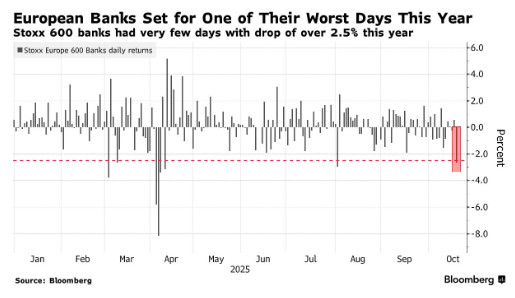
Group 1 - European bank stocks declined on Friday due to loan issues reported by several U.S. regional banks, which negatively impacted market sentiment and raised concerns about the credit market [1] - The Stoxx 600 bank index fell nearly 3%, marking the largest single-day drop since August 1, with major banks like Deutsche Bank, Barclays, and Société Générale seeing declines of over 4% [1] - Despite the recent pullback, the banking sector has maintained a cumulative increase of over 40% since 2025 [1] Group 2 - U.S. regional banks Zion and Alliance West reported significant stock price drops after disclosing fraudulent loans to funds investing in troubled commercial mortgages [3] - Recent loan defaults have occurred, including issues with subprime auto loan company Tricolor Holdings and the bankruptcy of First Brands Group, which owes over $10 billion to several well-known Wall Street firms [3] - In contrast, Spanish bank BBVA saw its stock price rise over 10%, while Sabadell's stock fell by 8.6% after shareholders rejected a takeover bid from BBVA [3]


美股异动丨两家地区银行爆雷引恐慌,美股银行股盘前继续下跌
Ge Long Hui A P P· 2025-10-17 08:35
消息面上,当地时间10月16日,美国两大地区银行齐昂银行(Zions Bancorp)和阿莱恩斯西部银行 (Western Alliance Bancorp)传出贷款暴雷事件,表示它们成为欺诈受害者,涉及向投资不良商业抵押贷 款的基金放贷。齐昂银行昨日跌超13%,阿莱恩斯西部银行昨日跌近11%。 格隆汇10月17日|延续昨日跌势,美股银行股今日盘前继续下跌。其中,巴克莱银行跌超3%,美国银 行、桑坦德银行、花旗集团、荷兰国际集团跌超2%,瑞银、摩根大通、富国银行、纽约梅隆银行、齐 昂银行跌超1%。 分析人士指出,虽然此次暴雷的两家银行披露的损失金额在数千万美元,相对较小,但现在更担心的是 投资者情绪受到打击,而不是地区银行的资产负债表受到重创。从昨日标普地区银行精选行业指数暴跌 6.3%,创出4月关税引发抛售以来最大跌幅的表现来看,交易员普遍秉持这样一种观点:先卖掉,有问 题过后再探究。 ...
刚刚,大跌原因找到了!
天天基金网· 2025-10-17 08:04
Market Overview - On October 17, global markets experienced a significant downturn, with major indices in the US, Japan, and Europe all reporting declines. The Nasdaq 100 futures fell by 1.5%, S&P 500 futures dropped by 1.4%, and Dow futures decreased by 1% [5][11]. - The Japanese Nikkei futures fell by approximately 2% after market close [7]. - In the Chinese market, the Shanghai Composite Index closed down by 1.95%, the Shenzhen Component Index fell by 3.04%, and the ChiNext Index dropped by 3.36% [8]. Market Performance - The total trading volume in the Chinese market reached 19,544.08 billion, with only 602 stocks rising while 4,783 stocks declined [10]. - The Hang Seng Index in Hong Kong fell by 2.5%, and the Hang Seng Tech Index dropped over 4% [10]. Causes of Market Decline - The market's sharp decline is attributed to concerns over a potential credit crisis triggered by the collapse of two regional banks in the US. Zions Bancorp and Western Alliance Bancorp reported significant losses due to fraudulent loans, leading to a sharp drop in their stock prices [11][12]. - The KBW Bank Index recorded its largest drop in six months, with a total market value loss exceeding $100 billion across 74 major US banks [12]. - This situation is compounded by recent bankruptcies in the lending sector, including Tricolor Holdings and First Brands Group, which have raised further concerns about the stability of the credit market [12].