Western Alliance Bancorporation(WAL)

Search documents
Western Alliance Bancorporation(WAL) - 2025 Q3 - Earnings Call Transcript
2025-10-22 17:00
Financial Data and Key Metrics Changes - Western Alliance Bancorporation reported record net revenue of $938 million and pre-provision net revenue of $394 million for Q3 2025, supported by a 30% linked quarter annualized expansion in net interest income [3][4] - Earnings per share (EPS) reached $2.28, with a return on average assets of 1.13% and return on average tangible common equity of 15.6% [4][15] - The Common Equity Tier 1 (CET1) capital ratio increased to 11.3%, while the allowance for loan losses (ALL) to funded loans ratio rose to 0.85% [4][21] Business Line Data and Key Metrics Changes - Net interest income grew by $53 million, or 8% quarter over quarter, driven by solid organic loan growth and higher average earning asset balances [11][12] - Non-interest income rose nearly 27% from Q2 to $188 million, primarily due to improved mortgage banking results [11][12] - Commercial and industrial loans led loan growth momentum, while construction loans decreased by $460 million as they converted to term financing [16][17] Market Data and Key Metrics Changes - Total assets increased by $4.2 billion from Q2 to $91 billion, with deposits growing by $6.1 billion in Q3 [15][16] - Regional banking deposits grew by $1.1 billion, with significant contributions from in-market commercial banking and innovation banking [17] - Specialty escrow deposits increased by $1.8 billion, indicating strong growth across various banking segments [17] Company Strategy and Development Direction - The company aims for loan growth of $5 billion and raised year-end deposit growth expectations to $8.5 billion, indicating a positive outlook for the remainder of 2025 [25] - The management emphasized the importance of maintaining asset quality and has implemented strategies to mitigate potential credit risks [5][10] - The company plans to issue subordinated debt to support its share repurchase program, which is expected to be accretive to EPS [22][39] Management's Comments on Operating Environment and Future Outlook - Management expressed confidence in asset quality, stating that criticized assets have declined and are expected to continue to do so [31][32] - The economic backdrop is viewed positively, with GDP growth and low unemployment rates supporting the banking environment [60] - The company anticipates continued growth in mortgage-related income due to favorable interest rate conditions [35][36] Other Important Information - The company has initiated a $300 million stock buyback program, with $25 million already executed [22][39] - The allowance for loan losses increased to $440 million, reflecting proactive measures in response to credit exposures [18][21] - The company has maintained a strong focus on operational efficiency, achieving an adjusted efficiency ratio below 50% [12][14] Q&A Session Summary Question: Comfort level with current reserves and potential need for increases - Management feels comfortable with asset quality and does not foresee a significant increase in reserves unless new information arises [31][32] Question: Expectations for ECR deposit beta and mortgage revenue - The expected beta for ECR-related deposits is around 70%, with mortgage-related income showing strong growth due to declining mortgage rates [34][35] Question: Insights on buybacks and capital management - The company plans to maintain its $300 million buyback authorization and may accelerate purchases depending on stock performance [38][39] Question: Seasonal deposit flows and expectations for runoff - Management anticipates some seasonal runoff in deposits but expects to manage it effectively through pricing strategies [44][74] Question: Trends in classified loans and underlying fundamentals - The reduction in classified loans was driven by improved borrower performance and successful resolutions, with no significant losses expected from recent credit exposures [48][49]

Western Alliance Bancorporation(WAL) - 2025 Q3 - Earnings Call Transcript
2025-10-22 17:00
Financial Data and Key Metrics Changes - Western Alliance Bancorporation reported record net revenue of $938 million and pre-provision net revenue of $394 million for Q3 2025, reflecting a healthy business momentum [5][6] - Net interest income increased by $53 million or 8% quarter-over-quarter to $750 million, driven by solid organic loan growth and higher average earning asset balances [14][19] - The company generated EPS of $2.28, with a return on average assets of 1.13% and return on average tangible common equity of 15.6% [6][20] - The adjusted efficiency ratio improved to 48%, a decline of 400 basis points from the prior quarter, indicating positive operating leverage [19][20] Business Line Data and Key Metrics Changes - Commercial and Industrial loans led loan growth momentum, while construction loans decreased by $460 million as they converted to term financing [21] - Mortgage banking revenue rose significantly to $95 million, an increase of $17 million or 21% from the previous quarter, supported by lower mortgage rates [41] - Non-interest income increased nearly 27% from Q2 to $188 million, bolstered by firming mortgage banking results [14][15] Market Data and Key Metrics Changes - Total assets increased by $4.2 billion from Q2 to $91 billion, driven by healthy loan and deposit growth [19][20] - Deposits grew by $6.1 billion in Q3, with significant contributions from non-interest bearing and savings accounts [21][22] - The allowance for loan losses increased from 67 to 78 basis points over the past year, reflecting the company's proactive approach to credit quality [20][26] Company Strategy and Development Direction - The company aims to maintain a loan growth outlook of $5 billion and raised year-end deposit growth expectations to $8.5 billion [30] - Western Alliance is focused on enhancing its underwriting practices and portfolio monitoring to mitigate risks associated with credit migrations [7][10] - The company plans to issue subordinated debt and utilize a portion of the proceeds for its share repurchase program, which is expected to be accretive to EPS [28][45] Management's Comments on Operating Environment and Future Outlook - Management expressed confidence in asset quality, stating that criticized assets have declined and are expected to continue performing well [35][36] - The economic backdrop is viewed positively, with GDP growth around 3.8% to 3.9% and stable employment rates [73][74] - The company anticipates continued momentum in mortgage revenue due to favorable interest rates, despite seasonal declines expected in Q4 [42][56] Other Important Information - The company has a strong capital position with a CET1 ratio of 11.3%, comfortably above the target of 11% [30][45] - Total equity increased to $7.7 billion, and tangible book value per share rose 13% year-over-year [20][28] - The company has been a consistent leader in creating shareholder value, with tangible book value per share growth exceeding peers by five times over the past decade [28][29] Q&A Session Summary Question: Credit quality and loss potential on Cantor exposures - Management feels comfortable with asset quality and does not foresee losses related to Cantor V, supported by sufficient collateral and guarantees [35][36] Question: Expectations on ECR deposit beta - The loaded beta for ECR deposits is expected to be around 70%, with a focus on reducing deposit costs [38][40] Question: Seasonal deposit flows and mortgage banking - Management expects a seasonal decline in mortgage revenues in Q4 but remains optimistic about maintaining momentum [56] Question: Loan to deposit ratio and liquidity - The company aims to increase the loan to deposit ratio, indicating a desire to put liquidity to work through safe and sound loans [67][68] Question: Corporate trust market share growth - The company has gained market share in corporate trust services and expects continued growth in this area [62][64]
Western Alliance Bancorporation 2025 Q3 - Results - Earnings Call Presentation (NYSE:WAL) 2025-10-22
Seeking Alpha· 2025-10-22 16:30
Group 1 - The article discusses the importance of enabling Javascript and cookies in browsers to prevent access issues [1] - It highlights that users with ad-blockers may face restrictions when trying to access content [1]


Western Alliance Bancorporation(WAL) - 2025 Q3 - Earnings Call Presentation
2025-10-22 16:00
Financial Performance - Earnings per share increased to $2.28 in Q3 2025, a 30.4% year-over-year increase[5, 7, 10] - Net income reached $260.5 million in Q3 2025, up 30.4% year-over-year[5, 7, 10] - Net revenue increased to $938.2 million in Q3 2025, compared to $823.1 million in Q3 2024[5, 10] - Pre-provision net revenue (PPNR) was $393.8 million in Q3 2025, a 37.8% year-over-year increase[5, 7, 10] - Adjusted efficiency ratio decreased to 47.8% in Q3 2025, a decrease of 490 bps from Q3 2024[5, 27, 31] - Tangible book value per share increased to $58.56, a 12.7% year-over-year increase[5, 7, 36, 38] Balance Sheet and Loan Portfolio - Total loans reached $56.646 billion in Q3 2025, an increase of $3.3 billion or 6.2% year-over-year[5, 7, 36, 38] - Total deposits increased to $77.247 billion in Q3 2025, an increase of $9.2 billion or 13.5% year-over-year[5, 36, 39] - Securities and cash increased $5.6 billion, or 29.6%, over prior year to $24.6 billion[36, 39] - Non-performing loans (NPLs) to funded HFI loans ratio was 0.92%[5, 7] Asset Quality and Credit Losses - Provision for credit losses increased to $80.0 million, primarily due to a $30 million reserve related to the Cantor Group V loan[5, 9, 13] - Total loan ACL to funded loans ratio increased to 0.85%[5, 9, 59, 64]
三大股指期货齐跌 奈飞、德州仪器绩后跳水 特斯拉盘后公布财报
Zhi Tong Cai Jing· 2025-10-22 12:26
Market Overview - US stock index futures are all down ahead of the market opening, with Dow futures down 0.00%, S&P 500 futures down 0.04%, and Nasdaq futures down 0.27% [1] - European indices show mixed results, with Germany's DAX down 0.21%, UK's FTSE 100 up 0.90%, France's CAC40 down 0.33%, and the Euro Stoxx 50 down 0.21% [2][3] - WTI crude oil increased by 1.96% to $58.36 per barrel, while Brent crude oil rose by 1.83% to $62.44 per barrel [3][4] Market Sentiment - Bank of America warns of five emerging risks that could impact the S&P 500 index, including high valuations, signals of an impending bear market, data gaps, speculative activities, and liquidity shocks [5] - The Federal Reserve is expected to cut rates by 25 basis points next week, but there is significant uncertainty regarding the interest rate path for next year, with predictions ranging from 2.25%-2.50% to 3.75%-4.00% [6] - Goldman Sachs cautions that market estimates for US GDP may be overly optimistic due to data voids during the government shutdown, with GDP estimates for Q2 and Q3 at 3.8% and 3.3% respectively [7] Company News - Netflix (NFLX.US) missed earnings expectations due to a tax dispute in Brazil, reporting Q3 revenue growth of 17% to $11.5 billion but earnings per share of $5.87, below the expected $6.94 [9][10] - Texas Instruments (TXN.US) reported Q3 revenue growth of 14% to $4.74 billion, slightly above market expectations, but provided a weaker outlook for Q4, leading to an 8% pre-market drop [10] - Alliance West Bank (WAL.US) reported a 15.2% increase in Q3 revenue to $938.2 million and a net profit surge of over 27% to $250.2 million, alleviating market concerns [11] - Intuitive Surgical (ISRG.US) saw a 23% increase in Q3 revenue to $2.51 billion, driven by a strong increase in surgical procedures [11] - Barclays (BCS.US) announced a £235 million provision for auto credit but raised its profit guidance for the year, leading to a 4% pre-market increase [12] - AT&T (T.US) reported mixed Q3 results, with revenue of $30.7 billion slightly below expectations, but exceeded new wireless subscriber growth forecasts [12] - Teck Resources (TECK.US) reported a nearly 20% increase in Q3 adjusted core earnings to CAD 1.17 billion, benefiting from rising metal prices [13] - Beyond Meat (BYND.US) experienced a significant stock price increase due to a short squeeze, despite concerns about its fundamental outlook [13]



营收15%增长+利润激增27%,Western Alliance(WAL.US)Q3用“超预期财报”驱散区域银行恐慌
智通财经网· 2025-10-22 00:02
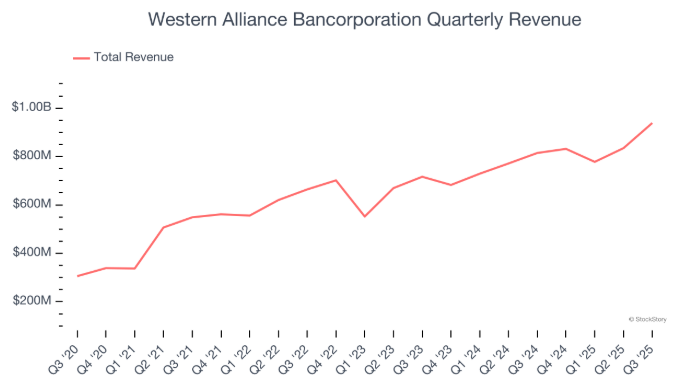
Core Viewpoint - Western Alliance Bancorp reported strong third-quarter results, exceeding market expectations, which alleviated previous market concerns regarding systemic risks in the banking sector [1][3]. Financial Performance - The bank's third-quarter revenue increased by 15.2% year-over-year to $938.2 million, while net profit surged over 27% to $250.2 million, translating to earnings per share of $2.28, significantly outperforming analyst expectations [1][3]. - Net interest income rose by 7.7% year-over-year to $750.4 million, surpassing the average analyst estimate of $737 million [3]. - The bank recorded a provision for loan losses of $31.1 million, close to the market estimate of $30 million, with future credit loss reserves increasing to $80 million, nearly double the analyst expectations [3]. Business Structure - Western Alliance Bancorp operates through five regional banking divisions in the western United States, offering commercial banking, financial management, mortgage services, and specialized financial solutions [4]. - The company's revenue structure is characterized by a "dual engine," with net interest income accounting for 85.2% of total revenue, providing a solid profit foundation, while fee-based services from banking, credit, wealth management, and trading contribute supplementary income [4]. Growth Metrics - Over the past five years, the company's revenue has grown at a compound annual growth rate (CAGR) of 23.3%, outpacing the industry average [4]. - The annualized revenue growth over the past two years stands at 13.2%, indicating healthy market demand despite being lower than the five-year trend [9]. Valuation Metrics - The tangible book value per share (TBVPS) has shown a remarkable five-year CAGR of 14.9%, reaching $58.56 from $44.02, with a projected growth of 12.9% to $66.14 over the next 12 months [12][13]. Market Reaction - Following the strong quarterly performance, the stock rose by 3.32% to $79 in after-hours trading, reflecting market confidence in the bank's robust operational capabilities [17].
隔夜美股 | 黄金一夜暴跌超5%!美股三大股涨跌不一 苹果(AAPL.US)盘中再创新高
Zhi Tong Cai Jing· 2025-10-21 23:43
Market Performance - US stock indices closed mixed, with the Dow Jones reaching a new high driven by corporate earnings, while tech and small-cap stocks were pressured by trade uncertainties, leading to a decline in the Nasdaq [1] - The Dow Jones increased by 218.16 points (0.47%) to 46,924.74, while the Nasdaq fell by 36.88 points (0.16%) to 22,953.67, and the S&P 500 barely remained flat, gaining 0.22 points to 6,735.35 [1] - In the European market, the Eurozone Stoxx 50 index rose by 0.10% to a record high of 5,686.83, with Germany's DAX 30 up 0.29% and France's CAC 40 up 0.64% [1] Commodities - WTI crude oil for November delivery rose by $0.30 (0.52%) to $57.82 per barrel, while Brent crude for December delivery increased by $0.31 (0.51%) to $61.32 per barrel [2] - Gold and silver experienced significant sell-offs, with gold dropping over 5.7%, marking its largest single-day decline since 2013, and silver falling nearly 8% [4][7] Cryptocurrency - Bitcoin rose by 0.7% to $111,811, while Ethereum experienced wide fluctuations, trading at $3,995 [3] Corporate Earnings - Texas Instruments (TXN.US) issued disappointing earnings guidance, indicating a slowdown in the semiconductor recovery, with Q3 revenue of $4.74 billion, slightly above expectations, but EPS of $1.48 fell short [8] - Netflix (NFLX.US) reported Q3 earnings impacted by a tax dispute in Brazil, with operating profit of $3.24 billion, approximately $400 million below expectations, despite a consistent outlook for Q4 [9] - Alliance West Bank (WAL.US) exceeded earnings expectations with a 27% YoY profit increase, reporting net income of $250.2 million and EPS of $2.28, alleviating market tensions [10] Technology Developments - Apple is facing engineering challenges with its large foldable iPad project, potentially delaying its release from 2028 to 2029 or later due to issues with weight, functionality, and display technology [11] - OpenAI launched its AI-driven web browser, ChatGPT Atlas, marking a competitive move against Google, aimed at providing a personalized browsing experience [12]

Western Alliance (WAL) Q3 Earnings: How Key Metrics Compare to Wall Street Estimates
ZACKS· 2025-10-21 23:31
Core Insights - Western Alliance (WAL) reported revenue of $947.9 million for Q3 2025, marking a year-over-year increase of 13.8% and exceeding the Zacks Consensus Estimate by 6.79% [1] - The earnings per share (EPS) for the same quarter was $2.28, up from $1.80 a year ago, with an EPS surprise of 8.06% compared to the consensus estimate of $2.11 [1] Financial Performance Metrics - Efficiency Ratio stood at 57.4%, better than the average estimate of 58.8% from four analysts [4] - Net charge-offs to average loans were annualized at 0.2%, matching the average estimate [4] - Net Interest Margin was reported at 3.5%, slightly above the average estimate of 3.4% [4] - Average Balance of Total interest-earning assets was $85.33 billion, exceeding the estimate of $82.76 billion [4] - Tier 1 Leverage Ratio was 8.1%, below the average estimate of 8.4% [4] - Total non-interest income reached $187.8 million, significantly higher than the average estimate of $148.73 million [4] - Net interest income was reported at $750.4 million, surpassing the estimate of $734.18 million [4] - Net gain on loan origination and sale activities was $75.5 million, exceeding the average estimate of $46.34 million [4] - Service charges and fees totaled $35.4 million, below the average estimate of $37.83 million [4] - Net loan servicing revenue was $19.1 million, significantly lower than the average estimate of $41.27 million [4] Stock Performance - Over the past month, shares of Western Alliance have returned -15.8%, contrasting with the Zacks S&P 500 composite's +1.2% change [3] - The stock currently holds a Zacks Rank 3 (Hold), indicating potential performance in line with the broader market in the near term [3]

Western Alliance (WAL) Q3 Earnings and Revenues Top Estimates
ZACKS· 2025-10-21 23:26
Core Viewpoint - Western Alliance (WAL) reported quarterly earnings of $2.28 per share, exceeding the Zacks Consensus Estimate of $2.11 per share, and showing an increase from $1.8 per share a year ago, representing an earnings surprise of +8.06% [1] Financial Performance - The company posted revenues of $947.9 million for the quarter ended September 2025, surpassing the Zacks Consensus Estimate by 6.79%, compared to $833.1 million in the same quarter last year [2] - Over the last four quarters, Western Alliance has exceeded consensus EPS estimates four times and topped consensus revenue estimates three times [2] Stock Performance and Outlook - Western Alliance shares have declined approximately 9.7% since the beginning of the year, while the S&P 500 has gained 14.5% [3] - The company's current consensus EPS estimate for the upcoming quarter is $2.55 on revenues of $914.65 million, and for the current fiscal year, it is $8.47 on revenues of $3.44 billion [7] Industry Context - The Zacks Industry Rank for Banks - West is currently in the bottom 31% of over 250 Zacks industries, indicating potential challenges for stock performance [8] - Empirical research suggests a strong correlation between near-term stock movements and trends in earnings estimate revisions, which can impact investor sentiment [5]

Western Alliance profit rises on higher interest income, loan-loss fears eased
Reuters· 2025-10-21 21:42
Core Insights - Western Alliance Bancorp reported an increase in third-quarter profit, driven by higher interest income and increased lending fees, which helped to mitigate the impact of rising rainy day funds [1] Financial Performance - The company experienced a rise in interest income, contributing positively to its overall profit [1] - Higher lending fees also played a significant role in offsetting costs associated with increased rainy day funds [1] - Following the positive financial results, the company's shares rose by 4% [1]