
WeRide

Search documents
WeRide Teams Up with Renault to Bring Autonomous Shuttle to Roland-Garros Again
Globenewswire· 2025-06-03 10:21
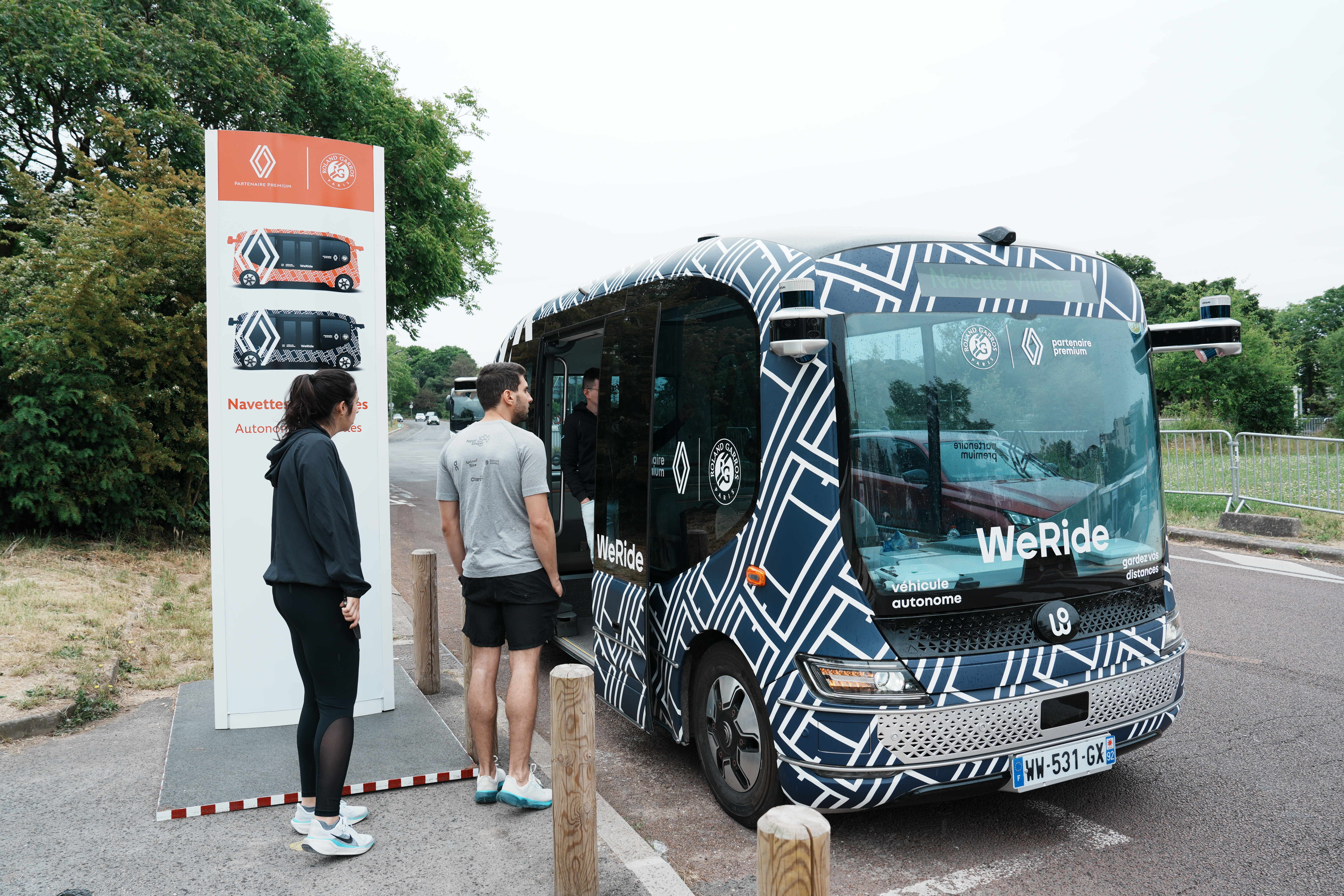
Core Insights - WeRide partners with Renault Group to provide a Level-4 autonomous minibus shuttle service at the 2025 Roland-Garros tournament, marking the second consecutive year of collaboration [1][2] - The Robobus service has demonstrated safety and reliability in real-world environments, leading to the renewal of the partnership [2] - The service covers a distance of 2.8 km in 12 minutes, operating daily from May 25 to June 8, with added night service from 10 PM to midnight [3][4] Company Developments - WeRide's CEO emphasizes the importance of the European market and the company's commitment to commercializing autonomous mobility solutions [5] - The Robobus is the world's first pre-designed autonomous driving minibus deployed on a large scale, with a presence in nearly 30 cities globally [8] - WeRide has received autonomous driving permits in five markets, including France, and is recognized in Fortune Magazine's 2024 "The Future 50" list [9] Industry Trends - The partnership between WeRide and Renault reflects a growing trend towards the commercialization of autonomous public transport in Europe [6] - The successful operation of the Robobus service at a major sporting event indicates increasing public acceptance and readiness for autonomous mobility solutions [5][6] - The introduction of the night service showcases advancements in technology that allow for safe operation in complex urban environments [4]


Why WeRide Stock Soared Today
The Motley Fool· 2025-05-27 22:07
Core Viewpoint - WeRide's stock surged 18.2% following the announcement of its expansion into Saudi Arabia, indicating positive market reception and investor confidence in the company's growth strategy [1][2]. Group 1: Expansion Plans - WeRide is set to launch operations in Saudi Arabia in partnership with Uber, allowing users to hail its robotaxis. Testing of vehicles has already commenced, with full operations expected by the end of the year [2]. - This expansion positions WeRide as one of the first companies to operate commercially on a large scale in the Middle East, marking a significant milestone for the company [2]. Group 2: Financial Strategies - WeRide's board approved a substantial share repurchase program of up to $100 million over the next 12 months, aimed at driving shareholder value and reflecting confidence in the company's future [3][5]. - The CFO emphasized that the share repurchase program demonstrates the company's strong business fundamentals and long-term outlook, reinforcing its commitment to delivering value to shareholders [5]. Group 3: Competitive Landscape - WeRide is experiencing early success in the autonomous vehicle market, competing against major players like Tesla and Waymo, but faces significant competition [5]. - Despite currently operating at a loss, the company is expected to improve its financial position with the launch of commercial operations, appealing to investors with a high risk tolerance [6].
Hesai Group Reports First Quarter 2025 Unaudited Financial Results
GlobeNewswire News Room· 2025-05-26 21:00
Core Insights - Hesai Group reported strong financial results for Q1 2025, with net revenues of RMB525.3 million (US$72.4 million), a 46.3% increase year-over-year [17][31] - The company shipped 195,818 lidar units in Q1 2025, representing a 231.3% increase from the same period in 2024 [16][15] - Hesai was ranked as the world's No.1 automotive lidar company by revenue market share for the fourth consecutive year in 2024 [3] Financial Performance - Net revenues for Q1 2025 were RMB525.3 million, up from RMB359.1 million in Q1 2024, driven by increased sales of ADAS lidar products [17][31] - Gross margin improved to 41.7% in Q1 2025 from 38.8% in Q1 2024, attributed to effective cost and scale optimization [17][31] - The net loss narrowed significantly by 83.6% year-over-year to RMB17.5 million (US$2.4 million) [22][31] Operational Highlights - ADAS lidar shipments reached 146,087 units in Q1 2025, a 178.5% increase from 52,462 units in Q1 2024 [16][15] - The company secured new design wins with 23 OEMs globally across over 120 vehicle models, including partnerships with Chery, Great Wall Motor, Zeekr, and Geely [5][15] - Hesai is the main lidar supplier for next-generation Robotaxi fleets from Baidu Apollo Go, DiDi, Pony.ai, and WeRide [14][15] Product Development - New products include the AT1440 lidar, which delivers ultra-high-definition point clouds, and the FTX solid-state lidar for blind spot detection [14] - The company announced the successful resolution of all IP-related litigation against it, reinforcing its commitment to innovation and R&D [8][10] Business Outlook - For Q2 2025, Hesai expects net revenues to be between RMB680 million (US$93.7 million) and RMB720 million (US$99.2 million), indicating a year-over-year increase of approximately 48% to 57% [19]


Will Tencent Give WeRide the Edge in the Robotaxi Race?
ZACKS· 2025-05-22 14:15
Core Viewpoint - WeRide is enhancing its strategic partnership with Tencent Cloud to accelerate the commercial deployment of its Level-4 robotaxi services and expand its global market reach [1][5]. Group 1: Partnership and Technology Development - The collaboration builds on a previous partnership established in April 2024, now focusing on integrating self-driving technology into Tencent's platforms like WeChat and Tencent Maps [2]. - Users will be able to hail WeRide robotaxis directly through Tencent's Smart Transportation Mini Program, making the service more accessible [2]. - The companies will co-develop a data-driven platform that combines cloud computing and advanced mapping tools to support data compliance and expedite the mass production of smart driving technologies [4]. Group 2: Financial Performance and Market Position - WeRide's revenues declined approximately 10% last year, totaling $49 million, prompting the need for enhanced R&D and commercial operations through Tencent Cloud's infrastructure [3]. - The partnership aims to leverage localized cloud services to efficiently scale WeRide's presence in international markets, where it already has a first-mover advantage [3]. Group 3: Competitive Landscape - WeRide's collaboration with Tencent is expected to intensify competition with rivals such as Alphabet's Waymo and Baidu [6]. - Waymo is a leader in the U.S. robotaxi market, providing over 250,000 paid rides weekly and heavily investing in safety and AI [7]. - Baidu's Apollo Go has established a fleet of 1,000 vehicles and has completed over 11 million ride orders, indicating its ambition to expand internationally [8]. Group 4: Stock Performance and Valuation - WeRide's shares have decreased by 28% year-to-date, contrasting with the industry's growth of 3.2% [9]. - The company trades at a forward price-to-sales ratio of 9.68, significantly higher than the industry average, and carries a Value Score of F [10]. - The Zacks Consensus Estimate predicts a year-over-year earnings increase of 64% for 2025 and 51% for 2026 [11].

Uber invests $100M in WeRide to fuel robotaxi expansion across 15 more cities
TechCrunch· 2025-05-07 15:14
Uber and Chinese autonomous vehicle technology company WeRide plan to expand a commercial robotaxi partnership and bring the service to another 15 cities over the next five years. The expansion comes five months after the two companies launched a commercial robotaxi service in Abu Dhabi. As part of that expansion, Uber will increase its investment into WeRide by $100 million, according to a Wednesday regulatory filing. WeRide said it expects the cash to come through by the second half of 2025. The compani ...


Uber turns to Chinese companies to snap up robotaxi market share in Europe, Middle East
TechCrunch· 2025-05-06 16:47
Core Insights - Uber is expanding its global presence in the robotaxi sector through partnerships with Chinese autonomous vehicle companies, including Pony AI, Momenta, and WeRide [1][2][3] Group 1: Partnerships and Expansion - Uber's partnership with Pony AI aims to launch robotaxis on its platform in a key Middle Eastern market later this year [1] - The collaboration with Momenta will facilitate the launch of robotaxis in Europe by 2026, while WeRide will help expand Uber's services into 15 cities across the Middle East and Europe over the next five years [2] - These new partnerships add to Uber's existing network of over 15 autonomous vehicle collaborations, which primarily include U.S.-based companies like Waymo and May Mobility [3] Group 2: Market Context and Competition - Uber is responding to competitive pressures from companies like Tesla, which is set to launch its robotaxi service in Austin next month, and is also addressing federal probes regarding its subscription practices [4] - Collaborating with Chinese AV firms is seen as a strategic move to leverage their international expansion efforts, as companies like WeRide and Pony are already operating in multiple markets [5][8] Group 3: Operational Details - The initial phase of the robotaxi service will include safety operators in the vehicles until a full commercial launch is achieved [9] - Uber's strong presence in the Middle East, bolstered by its acquisition of Careem in 2019, positions it well for further growth in the region [8]
Uber and WeRide set their robotaxi sights on 15 more cities
TechCrunch· 2025-05-05 22:00
Core Insights - Uber and WeRide are expanding their commercial robotaxi partnership to 15 additional cities over the next five years, following the launch of their service in Abu Dhabi five months ago [1][3] - The expansion will include cities in Europe, and WeRide's robotaxi services will be accessible through the Uber app, similar to Uber's collaboration with Waymo [2][3] - The partnership aims to focus on cities outside of China and the United States, with plans to add Dubai to their existing operations in Abu Dhabi [3] Company Partnerships - Uber has established over 15 partnerships with various autonomous vehicle technology companies in the past two years, covering ride-hailing, delivery, and trucking sectors [4] - Recent partnerships include collaborations with May Mobility, Volkswagen, and Momenta, indicating a strategic push in the autonomous vehicle space [4] - The most notable partnership in the U.S. is with Waymo, which is currently operational in Austin and soon to be in Atlanta [5]

Uber's latest autonomous vehicle partner? Chinese startup Momenta
TechCrunch· 2025-05-02 18:12
Core Insights - Uber has announced a new partnership with Chinese self-driving firm Momenta to enhance its autonomous vehicle capabilities, leveraging its existing ride-hail and delivery services while relying on external partners for self-driving technology [1][2] - The partnership will see Momenta's robotaxis integrated into the Uber app in Europe starting in early 2026, with safety operators present in the vehicles [2] - This collaboration follows Uber's recent addition of May Mobility to its list of autonomous vehicle partners, which includes several other companies like Volkswagen and Waymo [1][2] - The strategic partnerships are in response to potential competition from Tesla, which plans to launch its own robotaxi service in Austin this summer [2] - Uber previously had its own self-driving unit but sold it to Aurora Innovation in 2020, indicating a shift in strategy towards collaboration rather than in-house development [3]
California is overhauling its self-driving vehicle regulations
CNBC· 2025-04-25 18:05
Core Viewpoint - California is proposing new comprehensive regulations for the testing and deployment of self-driving vehicles, aiming to enhance public safety and foster innovation in autonomous vehicle technology [2][4]. Regulatory Framework - The California DMV is seeking public comments on proposed regulations that will apply to various types of self-driving vehicles, from light-duty robotaxis to heavy-duty driverless trucks [1][4]. - The proposed regulations require driverless vehicle manufacturers to obtain permits for testing with a human safety driver, complete a specified number of test-drive miles, and subsequently obtain additional permits for driverless testing and deployment [5][6]. Industry Competition - Competitors such as Waymo, Zoox, and WeRide have already secured higher-level permits in California, with Waymo operating a robotaxi service in Los Angeles and the San Francisco Bay Area [3]. - Tesla, despite its engineering headquarters in Palo Alto and promises of a self-driving vehicle, has not yet obtained deployment permits in California [2][3]. Data Reporting and Compliance - The new regulations will impose data-reporting requirements on all autonomous vehicle manufacturers operating in California and will establish standards for interactions between driverless vehicles and first responders [6]. Legal Context - The California DMV previously sued Tesla in 2022 for deceptive marketing practices related to its Autopilot and Full Self-Driving systems, which still require a human driver to be ready to take control [8].



2025年全球自动驾驶行业洞察报告
亚瑟·D·利特尔咨询公司· 2025-04-08 01:50
Investment Rating - The report does not explicitly provide an investment rating for the autonomous mobility industry Core Insights - The autonomous mobility sector is experiencing a paradigm shift with increasing integration of autonomous vehicles (AVs) into daily life, driven by advancements in technology and changing consumer preferences [8][10] - Despite a challenging venture-funding environment, real-world testing and deployment of AVs are expanding globally, particularly in the US and China, with notable developments in the Gulf Cooperation Council (GCC) region [13][14][16] - The successful commercialization of AVs requires an ecosystem approach, emphasizing collaboration among public and private sectors, technology providers, and transport agents [17][24] Industry Dynamics - The autonomous driving sector is pursuing commercialization despite a sluggish venture-funding environment, with trends including the exploration of robobuses and robotaxis as part of mobility-as-a-service (MaaS) offerings [13][14] - AV companies are scaling up testing and commercial pilot efforts globally, with significant activity in the US and China, while the GCC is emerging as a hotspot for AV pilots [14][16] - Financial struggles persist in the AV industry, with a shift in investor focus towards targeted applications like trucking and last-mile delivery, as companies seek profitability through specific use cases [18][20] Use Case of the Semester - Autonomous buses, or robobuses, are being integrated into urban transportation systems, offering efficiency and safety improvements while addressing driver shortages [44][45] - Successful integration of robobuses faces challenges such as safety, connectivity, and consumer acceptance, necessitating a thorough piloting process [46][48] - The deployment of robobuses requires careful planning and execution, including regulatory approvals, infrastructure modifications, and operational testing [52][55] City of the Semester: Beijing - Beijing is recognized for its rapid advancement in AV deployment, with over 300 autonomous delivery vehicles fulfilling over 4 million orders by January 2024 [70][71] - The city has established a supportive regulatory environment, advanced testing infrastructure, and public awareness initiatives to facilitate AV integration [71][89] - Beijing's digital infrastructure, including high-speed 5G networks and smart traffic management systems, supports the growth of autonomous mobility [87][90] Interview of the Semester - The interview with Dr. Tony Han, CEO of WeRide, highlights the industry's transition from testing to commercialization, emphasizing technological advancements and regulatory developments [91][92]
