Reliance Industries

Search documents
From Campa to Kelvinator: Why Reliance is buying old, nostalgic brands
The Economic Times· 2026-01-06 17:30
Core Insights - Reliance is reviving legacy brands such as Campa, BPL, and Kelvinator, aiming to leverage nostalgia and aggressive pricing strategies to capture market share in the FMCG and consumer electronics sectors [1][17] - The company plans to double its distribution network to three million outlets and invest Rs 40,000 crore over the next three years to create Asia's largest integrated food parks [10][11] FMCG Sector - Reliance's FMCG business has shown rapid growth, with sales increasing from Rs 3,000 crore in FY24 to Rs 11,500 crore in FY25, and Rs 5,400 crore in the July to September FY26 quarter [1][17] - The company aims to achieve Rs 1 lakh crore in FMCG revenue within five years, positioning itself as India's largest FMCG company with a global presence [11][18] - Reliance is focusing on tier two and three cities, where competition from global brands is less intense, allowing for significant market expansion opportunities [9][18] Consumer Electronics Sector - The reintroduction of brands like Kelvinator and BPL is part of a strategy to compete against established global brands such as LG and Samsung, which have a strong foothold in the Indian market [4][7] - Industry experts note that the consumer electronics market is highly fragmented, and while legacy brands face challenges, there is potential for success if re-launched with strong value propositions [7][8] - Reliance's strategy includes aggressive pricing, often 20 to 30% lower than competitors, and expanding distribution channels to local retailers and e-commerce platforms [2][6] Competitive Landscape - Competitors in the FMCG sector have acknowledged the disruption caused by Reliance, indicating a heightened awareness and responsiveness to market dynamics [14][18] - The revival of legacy brands and the aggressive push into FMCG and consumer electronics suggest that Reliance is preparing for a long-term presence in these markets, driven by nostalgia and competitive pricing [14][18]



Stock markets fall for second day as selling in Reliance Industries, HDFC Bank dents sentiment
The Hindu· 2026-01-06 12:04
Market Performance - Benchmark indices Sensex and Nifty ended lower for the second consecutive day, with Sensex dropping 376.28 points (0.445%) to settle at 85,063.34 and Nifty declining 71.60 points (0.275%) to end at 26,178.70 [1][2] - Heavy selling was observed in blue-chip stocks such as Reliance Industries, which fell 4.42%, and HDFC Bank, contributing to the overall market decline [1][2] Sector Performance - The services sector growth in India moderated in December, with the HSBC India Services PMI Business Activity Index falling from 59.8 in November to 58.0 in December, indicating the slowest rate of expansion since January [4][5] - Despite the slowdown, firms remained optimistic about growth prospects, although overall sentiment reached its lowest level in nearly three-and-a-half years [5] Institutional Activity - Foreign institutional investors sold equities worth ₹36.25 crore on January 5, 2026, while domestic institutional investors purchased stocks worth ₹1,764.07 crore [3] Global Context - U.S. President Donald Trump indicated potential tariff increases on India due to dissatisfaction with India's purchases of Russian oil, which may impact market sentiment [3][4] - In contrast, Asian markets showed positive performance, with indices such as South Korea's Kospi and Japan's Nikkei 225 ending significantly higher [6]
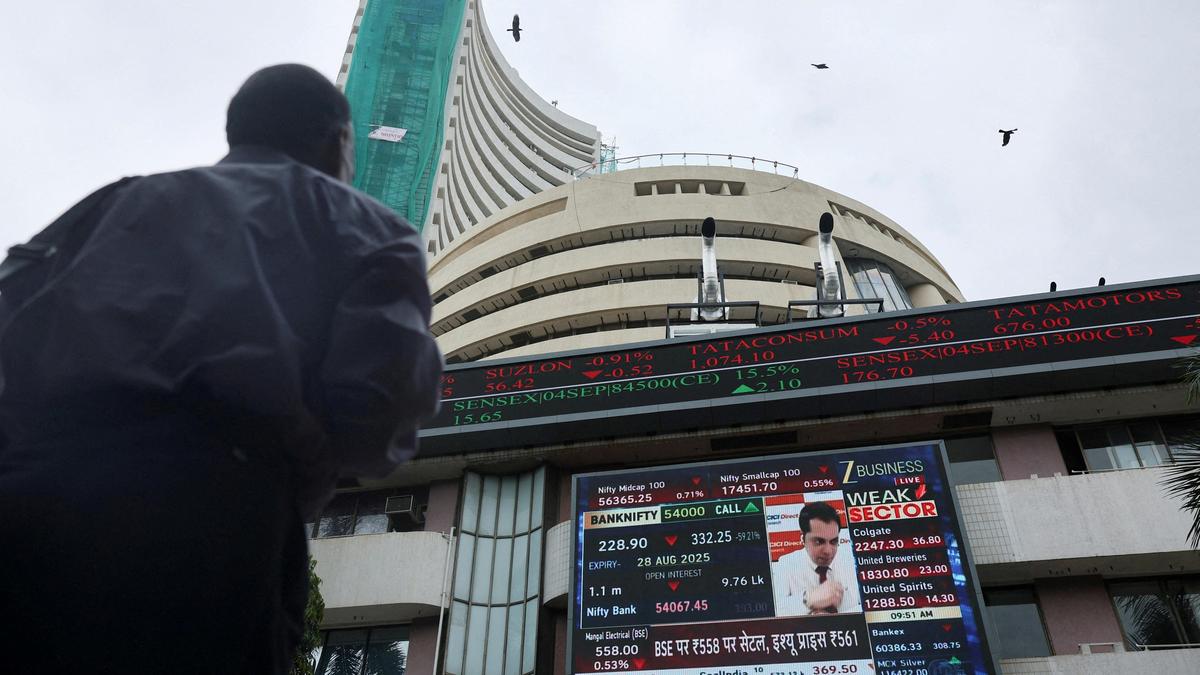
Sensex down 376 points on selling in RIL, HDFC Bank
Rediff· 2026-01-06 10:56
Market Performance - Benchmark indices Sensex and Nifty ended lower for the second consecutive day, influenced by heavy selling in blue-chip stocks such as Reliance Industries and HDFC Bank, alongside concerns over potential tariff increases from the US against India [1][4] - The 30-share BSE Sensex dropped by 376.28 points, or 0.44%, closing at 85,063.34, with an intraday low of 84,900.10, down 539.52 points or 0.63% [3] - The 50-share NSE Nifty declined by 71.60 points, or 0.27%, ending at 26,178.70 [3] Company-Specific Movements - Trent's shares fell by 8.62% after disappointing revenue growth in the December quarter [3] - Reliance Industries saw a decline of 4.42%, with other laggards including ITC, Kotak Mahindra Bank, InterGlobe Aviation, and HDFC Bank [4] - In contrast, ICICI Bank, Sun Pharma, Hindustan Unilever, and State Bank of India were among the gainers [4] Institutional Investment Trends - Foreign institutional investors sold equities worth ₹36.25 crore on Monday, following a brief pause in selling [4] - Domestic institutional investors, however, purchased stocks worth ₹1,764.07 crore [4] Economic Indicators - India's services sector growth moderated in December, with the HSBC India Services PMI Business Activity Index falling from 59.8 in November to 58.0 in December, marking the slowest expansion rate in 11 months [6] - Despite the slowdown, firms remained optimistic about growth prospects, although overall sentiment reached its lowest level in nearly three-and-a-half years [7]
Stock markets decline in early trade dragged by IT firms
The Hindu· 2026-01-05 04:35
Market Performance - The equity benchmark indices Sensex and Nifty experienced declines in early trade on January 5, 2026, with Sensex dropping 125.96 points to 85,636.05 and Nifty dipping 30.95 points to 26,297.60 [1] - Major blue-chip IT stocks such as HCL Tech, Infosys, Tech Mahindra, HDFC Bank, Tata Consultancy Services, and NTPC were among the biggest laggards [1] - Conversely, Bharat Electronics, Tata Steel, Axis Bank, and Reliance Industries were noted as gainers during the same period [1] Institutional Investment - Foreign Institutional Investors (FIIs) purchased equities worth ₹289.80 crore on January 2, 2026, while Domestic Institutional Investors (DIIs) bought stocks worth ₹677.38 crore [2] Geopolitical Context - The year 2026 has commenced with significant geopolitical developments, particularly U.S. actions in Venezuela, which may have far-reaching implications for global geopolitics, as noted by V.K. Vijayakumar, chief investment strategist at Geojit Investments Ltd [2] Asian Market Trends - In Asian markets, South Korea's Kospi, Japan's Nikkei 225, and Shanghai's SSE Composite indices were trading significantly higher, while Hong Kong's Hang Seng index was marginally lower [3] - U.S. markets concluded mostly in positive territory on the preceding Friday [3] Oil Prices - Brent crude, the global oil benchmark, saw a slight decrease of 0.08% to $60.70 per barrel [3] Previous Market Performance - On the preceding Friday, January 2, 2026, the Sensex increased by 573.41 points, or 0.67%, closing at 85,762.01, while the Nifty rose by 182 points, or 0.70%, to settle at 26,328.55 [3]
Market recap of the week: Seven of top 10 firms add Rs 1.23 lakh crore in mcap; Reliance leads gains
The Times Of India· 2026-01-04 10:13
Market Performance - The Indian equity markets ended positively, with the BSE Sensex rising by 720.56 points, or 0.84%, over the week [2][4] - The combined market value of seven of the country's ten most-valued companies increased by Rs 1,23,724.19 crore [4] Top Gainers - Reliance Industries led the gains, with its market capitalisation increasing by Rs 45,266.12 crore to Rs 21,54,978.60 crore [2][4] - State Bank of India saw a rise of Rs 30,414.89 crore, reaching a valuation of Rs 9,22,461.77 crore [2][4] - Larsen & Toubro's market value increased by Rs 16,204.34 crore to Rs 5,72,640.56 crore [2][4] - Hindustan Unilever's valuation climbed by Rs 14,626.21 crore to Rs 5,51,637.04 crore [2][4] - HDFC Bank recorded an increase of Rs 13,538.43 crore, bringing its market capitalisation to Rs 15,40,303.87 crore [3][4] - ICICI Bank's valuation rose by Rs 3,103.99 crore to Rs 9,68,773.14 crore [3][4] - Bharti Airtel added Rs 570.21 crore, reaching Rs 12,01,262.53 crore [3][4] Decliners - Tata Consultancy Services (TCS) experienced a decline of Rs 10,745.72 crore, ending with a market value of Rs 11,75,914.62 crore [3][4] - Infosys lost Rs 6,183.25 crore, concluding the week at Rs 6,81,635.59 crore [3][4] - Bajaj Finance saw a drop of Rs 5,693.58 crore, with its valuation falling to Rs 6,16,430.43 crore [3][4] Company Rankings - At the end of the week, Reliance Industries remained the most valuable company in India, followed by HDFC Bank, Bharti Airtel, TCS, ICICI Bank, State Bank of India, Infosys, Bajaj Finance, Larsen & Toubro, and Hindustan Unilever [3][4]
Mukesh Ambani's Reliance earns Rs 45266 crore in just 5 days from...; market cap surges to Rs...
DNA India· 2026-01-04 10:11
Core Insights - Reliance Industries maintained its position as the most valued firm in India, followed by HDFC Bank and Bharti Airtel [1][3] Group 1: Market Performance - Reliance Industries earned Rs 45,266 crore from the share market due to a 2.50% increase in its shares over five days from December 29 to January 2, 2026 [2] - The market capitalization of Reliance Industries increased by Rs 45,266.12 crore, reaching Rs 21,54,978.60 crore, with shares closing at Rs 1,593 on January 2 [3] - The BSE benchmark index rose by 720.56 points, or 0.84%, during the same period, reflecting an optimistic trend in equities [2] Group 2: Valuation Changes - The combined market capitalization of seven of the top-10 most-valued firms surged by Rs 1,23,724.19 crore, with Reliance Industries showing the largest increase in valuation [2] - Among the top-10 firms, Reliance, HDFC Bank, Bharti Airtel, ICICI Bank, State Bank of India, Larsen & Toubro, and Hindustan Unilever experienced valuation gains, while Tata Consultancy Services (TCS), Infosys, and Bajaj Finance saw declines [4] - State Bank of India added Rs 30,414.89 crore to its valuation, bringing it to Rs 9,22,461.77 crore [4]
Mcap of 7 of top-10 most valued firms surges ₹1.23 lakh crore; Reliance biggest winner
BusinessLine· 2026-01-04 06:26
Market Overview - The combined market capitalisation of seven of the top-10 most-valued firms increased by ₹1,23,724.19 crore last week, reflecting a positive trend in equities, with Reliance Industries experiencing the largest valuation increase [1] - The BSE benchmark rose by 720.56 points, or 0.84 percent [1] Gainers - Reliance Industries saw its market valuation rise by ₹45,266.12 crore, reaching ₹21,54,978.60 crore [2] - State Bank of India added ₹30,414.89 crore to its valuation, totaling ₹9,22,461.77 crore [2] - Larsen & Toubro's valuation increased by ₹16,204.34 crore to ₹5,72,640.56 crore [3] - Hindustan Unilever's market capitalisation climbed by ₹14,626.21 crore to ₹5,51,637.04 crore [3] - HDFC Bank's valuation edged up by ₹13,538.43 crore to ₹15,40,303.87 crore [3] - ICICI Bank advanced by ₹3,103.99 crore to ₹9,68,773.14 crore [3] - Bharti Airtel's market capitalisation rose by ₹570.21 crore to ₹12,01,262.53 crore [3] Decliners - Tata Consultancy Services (TCS) experienced a decline in market valuation by ₹10,745.72 crore, bringing it down to ₹11,75,914.62 crore [2][4] - Infosys saw a decrease of ₹6,183.25 crore in its valuation, now at ₹6,81,635.59 crore [4] - Bajaj Finance's market capitalisation dropped by ₹5,693.58 crore to ₹6,16,430.43 crore [4] Rankings - Reliance Industries remains the most valued firm, followed by HDFC Bank, Bharti Airtel, TCS, ICICI Bank, State Bank of India, Infosys, Bajaj Finance, Larsen & Toubro, and Hindustan Unilever [4]

Mcap of 7 of top-10 most valued firms surges Rs 1.23 lakh cr; Reliance biggest winner
The Economic Times· 2026-01-04 05:51
Market Overview - The BSE benchmark increased by 720.56 points, or 0.84 percent last week [1] Company Valuations - Reliance Industries saw its market valuation rise by Rs 45,266.12 crore, reaching Rs 21,54,978.60 crore, maintaining its position as the most valued firm [6] - The market valuation of State Bank of India increased by Rs 30,414.89 crore, bringing its total to Rs 9,22,461.77 crore [6] - Larsen & Toubro's valuation surged by Rs 16,204.34 crore to Rs 5,72,640.56 crore [4] - Hindustan Unilever's market valuation climbed by Rs 14,626.21 crore to Rs 5,51,637.04 crore [4] - HDFC Bank's market capitalisation edged higher by Rs 13,538.43 crore to Rs 15,40,303.87 crore [5] - ICICI Bank's valuation advanced by Rs 3,103.99 crore to Rs 9,68,773.14 crore [5] - Bharti Airtel's market capitalisation increased by Rs 570.21 crore to Rs 12,01,262.53 crore [6] Valuation Erosion - Tata Consultancy Services (TCS) experienced a decline in market valuation by Rs 10,745.72 crore, reducing its total to Rs 11,75,914.62 crore [6] - Infosys saw a decrease in market capitalisation by Rs 6,183.25 crore to Rs 6,81,635.59 crore [6] - Bajaj Finance's market valuation dropped by Rs 5,693.58 crore to Rs 6,16,430.43 crore [6] Overall Market Capitalisation - The combined market capitalisation of seven of the top-10 most-valued firms surged by Rs 1,23,724.19 crore, reflecting an optimistic trend in equities [6]
Stock markets surge nearly 1% on last trading session of 2025
Rediff· 2025-12-31 12:06
Market Performance - Equity benchmark indices Sensex and Nifty increased nearly 1 percent on the final trading session of 2025, following days of range-bound trading due to sustained buying by domestic institutional investors [1] - The BSE Sensex rose by 545.52 points, or 0.64 percent, closing at 85,220.60, with an intraday high of 85,437.17, marking a surge of 762.09 points, or 0.90 percent [3] - The NSE Nifty climbed 190.75 points, or 0.74 percent, finishing at 26,129.60 after four consecutive days of decline [3] Yearly Performance - In 2025, the Sensex experienced a rally of 7,081.59 points, or 9 percent, while the Nifty increased by 2,484.8 points, or 10.50 percent [6] - The Indian equity markets concluded the year positively, with a bullish sentiment while respecting key resistance levels [6] Sector Performance - Among the 30 Sensex firms, Tata Steel, Kotak Mahindra Bank, Reliance Industries, Axis Bank, Titan, and Trent were the top gainers [4] - Conversely, Tata Consultancy Services, Tech Mahindra, Infosys, Bajaj Finance, and Sun Pharma were identified as laggards [4] Investor Activity - Foreign Institutional Investors (FIIs) sold equities worth ₹3,844.02 crore, while Domestic Institutional Investors (DIIs) purchased stocks worth ₹6,159.81 crore [8] - The session reflected a gradual improvement in risk appetite driven by short covering and selective buying rather than aggressive new positions [7]
中国聚偏二氯乙烯(PVDC)行业销售投资及运作模式探讨报告2026-2032年
Sou Hu Cai Jing· 2025-12-31 02:02
Group 1 - The report discusses the sales investment and operational models of the polyvinylidene chloride (PVDC) industry in China from 2026 to 2032, highlighting market trends and forecasts [1][3] - It categorizes PVDC products into different types and applications, analyzing growth trends from 2021 to 2031 [3][4] - The report provides an overview of the current state of the PVDC industry, including development characteristics and influencing factors [4][6] Group 2 - Global supply and demand dynamics for PVDC are examined, with forecasts for production capacity, output, and utilization rates from 2021 to 2031 [4][5] - The report details the revenue and sales volume trends for PVDC in both global and Chinese markets, including market share analysis [5][6] - It analyzes the competitive landscape of the PVDC industry, identifying key players and their market shares [5][6] Group 3 - The report includes a detailed analysis of different product types and applications of PVDC, with projections for sales and revenue from 2021 to 2031 [6][10] - It discusses the industry development environment, including driving factors and policy analysis relevant to the PVDC sector in China [6][7] - The supply chain of the PVDC industry is outlined, covering procurement and production models [7][8]