Hyundai Motor

Search documents
Foresight, KONEC and GINT Collaborate on Prototype Development for Autonomous Tractors Toward Mass Production
Globenewswire· 2025-08-11 12:53
Core Insights - Foresight Autonomous Holdings Ltd. has signed a three-way agreement with KONEC Ltd. and GINT Ltd. to develop an autonomous control system for tractors, leveraging Foresight's 3D perception technology [1][2] - The collaboration aims to generate up to $35 million in revenue by 2030, with initial sales expected as early as 2026 [2][3] - The first phase will focus on developing a prototype of Foresight's ScaleCam system integrated with GINT's autonomous tractor kit "Pluva Auto," followed by validation and mass production [3][4] Company Overview - Foresight Autonomous Holdings Ltd. specializes in advanced 3D perception systems and cellular-based applications, with subsidiaries focused on various automotive and safety technologies [7][8] - KONEC Ltd. is a leading Tier-One automotive supplier known for manufacturing parts for eco-friendly vehicles and has major clients including Tesla, Hyundai, and Kia [5] - GINT Ltd. develops technologies for enhancing efficiency in transportation and production equipment, offering South Korea's top-selling autonomous driving tractor kit [6]



X @The Wall Street Journal
The Wall Street Journal· 2025-08-07 09:56
General Motors and Hyundai Motor will co-develop five vehicles in the Americas as part of their existing partnership https://t.co/ACl5Gf4FMC ...

X @Bloomberg
Bloomberg· 2025-07-31 07:12
Hyundai Motor and affiliate Kia could face as much as $5 billion in additional costs this year under a new trade agreement between the US and South Korea that imposes a 15% import tariff on automobiles https://t.co/gJFQMlQXjD ...
X @Bloomberg
Bloomberg· 2025-07-24 05:40
Hyundai Motor second-quarter earnings beat analyst expectations, propelled by solid hybrid vehicle sales in North America that helped alleviate concerns over slowing demand and intensifying tariff pressure https://t.co/M8D8iJrZip ...
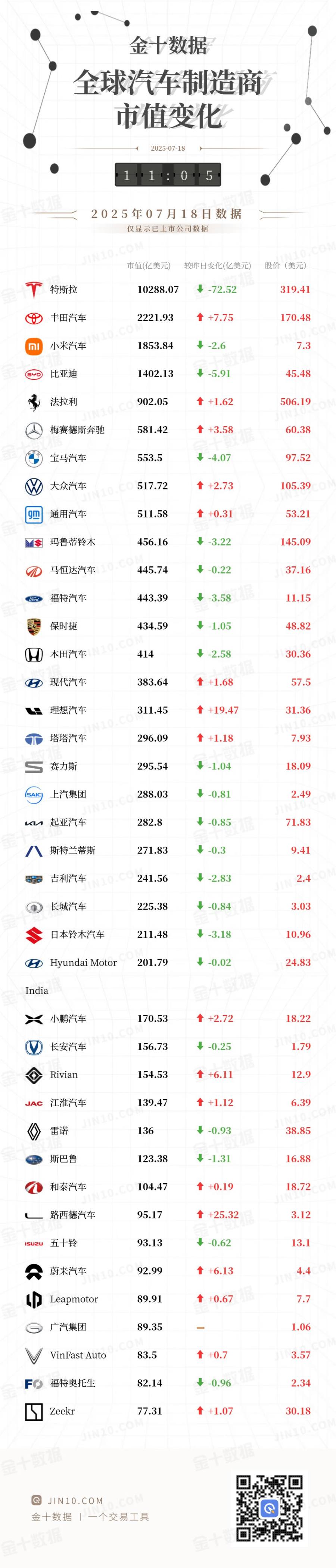
金十图示:2025年07月18日(周五)全球汽车制造商市值变化
news flash· 2025-07-18 03:12
Group 1 - The global automotive manufacturers' market capitalization has shown significant changes as of July 18, 2025, with Volkswagen leading at $517.72 billion, reflecting an increase of 2.73% [1][3] - General Motors follows closely with a market cap of $511.58 billion, up by 0.31% [1][3] - Notable declines were observed in companies like Maruti Suzuki and Ford, with market caps of $456.16 billion (down 3.22%) and $443.39 billion (down 3.58%) respectively [1][3] Group 2 - Chinese electric vehicle manufacturer Li Auto has seen a substantial increase in market capitalization, reaching $311.45 billion, up by 19.47% [1][4] - Rivian also experienced growth, with a market cap of $154.53 billion, increasing by 6.11% [1][4] - NIO's market cap stands at $92.99 billion, reflecting a rise of 6.13% [1][4]




Robotaxi 已落地 7 城,20 城在路上!一文讲透全球自动驾驶投资机会
Zhi Tong Cai Jing· 2025-07-03 11:15
Core Insights - The autonomous vehicle (AV) market is projected to reach a potential size of $1.2 trillion by 2040, covering various sectors including automotive, trucking, logistics, agriculture, and mining [1][7] - Currently, commercial AV deployment is scaling, with 7 cities globally offering commercial robotaxi services and an additional 20 cities set to launch soon [1][7] - The report encompasses companies with a combined market capitalization of approximately $10 trillion, highlighting their strategies in AV technology development and market share competition [1][3] Market Overview - The AV market is expected to grow from $137 billion in 2024 to $1.2 trillion by 2040, with significant compound annual growth rates (CAGR) across various sectors [7] - The automotive sector alone is anticipated to reach $686.89 billion by 2040, with a CAGR of 14.6% from $78.08 billion in 2024 [10] - The trucking sector is projected to grow to $353.52 billion by 2040, with a CAGR of 14.5% [10] Key Companies and Their Roles - Major players in the OEM sector include companies like Caterpillar, Deere, Daimler Truck, and Toyota, all of which are investing in AV technologies and partnerships [4][9] - Chinese companies such as Xiaomi and XPeng are also significant, with Xiaomi focusing on LiDAR technology and XPeng developing the XNGP system for nationwide deployment [8][10] - In the software domain, companies like Google (Waymo) and Baidu (Apollo Go) are leading in AV commercialization, with Waymo planning to provide 250,000 paid rides weekly by 2025 [8][10] Technology and Innovation - The semiconductor sector plays a crucial role in AV development, providing essential capabilities such as AI training and sensor processing [11] - Key semiconductor companies include Nvidia, Qualcomm, and Mobileye, with Nvidia expected to generate $1.7 billion in automotive revenue by 2025 [11] - LiDAR technology is dominated by companies like Hesai and RoboSense, with significant revenue growth projected in the coming years [8][11] Future Projections - By 2030, it is estimated that 10% of Deere's revenue will come from recurring sources related to AV solutions in agriculture and construction [9] - Daimler Truck's Torc system is expected to contribute $1.5 billion in profit by 2035, representing 30% of its adjusted EBIT in 2024 [9] - Horizon Robotics anticipates that 97% of its revenue will come from AV-related solutions by 2024, with significant market share growth expected by 2030 [9][10]




Auto sales are on a 'roller coaster ride' as tariffs are expected to increase prices
CNBC· 2025-04-07 17:21
Core Insights - Prices of new and used vehicles in the U.S. are expected to significantly increase this year due to President Trump's 25% auto tariffs [1][2] - The automotive industry is responding to these tariffs with various strategies, including temporary pricing deals and halting shipments [5][6] Price Increases - Cox Automotive estimates a $6,000 increase for imported vehicles and a $3,600 increase for U.S.-assembled vehicles due to the tariffs, in addition to $300 to $500 increases from prior tariffs on steel and aluminum [6] - Wholesale prices of used vehicles are projected to rise between 2.1% and 2.8% by the end of the year, up from a previous estimate of 1.4% [8] Market Dynamics - The automotive market is described as volatile, with demand fluctuating based on regulatory changes and economic uncertainty [4][12] - Automakers are expected to cut production and some have ceased imports, but these actions are not anticipated to be as drastic as during the early 2020s [13] Consumer Impact - Changes in new vehicle prices and production are expected to affect the used car market, which is crucial for most American consumers [7] - The average listing price of a used vehicle was approximately $25,000 as of mid-March, ahead of anticipated sales increases [9] Future Expectations - The automotive industry anticipates volatility in pricing throughout the year, with the week following the confirmation of tariffs potentially marking the peak in sales [10] - The increase in used vehicle pricing is expected to be less dramatic than during the pandemic, which saw unprecedented price hikes due to high demand and low availability [11][14]

Trump's 25% auto tariffs are in effect. What investors need to know
CNBC· 2025-04-03 11:54
Core Viewpoint - The implementation of President Trump's 25% tariffs on imported vehicles is expected to significantly impact the automotive industry and investor sentiment, with potential long-term effects on earnings and market dynamics [1][2][3]. Industry Impact - The tariffs apply to vehicles not assembled in the U.S., affecting 46% of the approximately 16 million vehicles sold domestically in the previous year [2]. - Analysts express concerns that prolonged tariffs could lead to a recession in the automotive sector, with significant negative implications for company earnings [2][3]. - The tariffs are anticipated to increase vehicle prices, with estimates suggesting new vehicle prices could rise by as much as $10,000 if costs are fully passed on to consumers [20]. Company-Specific Effects - Automakers such as Volvo, Mazda, Volkswagen, and Hyundai are identified as most at risk, with over 60% of their U.S. sales being imported [11]. - General Motors (GM) is projected to face the highest exposure to tariffs, with estimates indicating a potential 79% drop in earnings before interest and taxes (EBIT) and an 81% decline in earnings per share (EPS) [13]. - Ford is expected to see a 16.5% hit to EBIT and a 23% decline in EPS due to the tariffs [14]. - Tesla, Rivian Automotive, and Lucid Group are positioned more favorably as their vehicles are assembled in the U.S., insulating them from the tariffs [15][16]. Market Dynamics - U.S. auto sales in the first quarter exceeded expectations as consumers rushed to purchase vehicles before the tariffs took effect [17]. - S&P Global Mobility forecasts that U.S. light-vehicle sales could decline to between 14.5 million and 15 million units annually if tariffs remain in place, down from approximately 16 million in 2024 [18]. - Entry-level vehicles, which typically have lower profit margins, are particularly vulnerable to price increases due to the tariffs [18][19]. Supply Chain Considerations - The concept of a fully U.S.-sourced vehicle is deemed unrealistic, as even domestically assembled vehicles rely on a global supply chain for parts [7][8]. - Automakers are awaiting clarity on potential tariffs for auto parts, which could further complicate their supply chain and financial outlook [6][10].