Tesla

Search documents
Elon Musk-Led Tesla's Cybercab Spotted Testing In Austin Amid Robotaxi, Driverless Push - Tesla (NASDAQ:TSLA)
Benzinga· 2025-12-19 08:24
Core Viewpoint - Tesla is actively testing its Cybercab in Austin, aiming for driverless operations, amidst mixed reactions regarding its autonomous technology and regulatory challenges [1][2][7]. Group 1: Cybercab Testing and Development - A Cybercab was spotted in Austin, Texas, indicating Tesla's ongoing efforts to develop autonomous taxi services [2]. - Influencer Sawyer Merritt noted that this was the first time the Cybercab was tested on Austin roads, aligning with CEO Elon Musk's vision for driverless operations [2][3]. - Tesla's Board Chair Robyn Denholm mentioned the possibility of manufacturing a Cybercab with steering wheels and pedals to comply with regulatory requirements [6]. Group 2: Regulatory Challenges - Tesla is facing a 30-day suspension of its license to manufacture and sell vehicles in California due to a court ruling that deemed its marketing terms like "Autopilot" and "Full Self-Driving (FSD)" deceptive [7]. - Investor Gene Munster criticized the ruling as "absurd," emphasizing that Tesla communicates the need for driver attentiveness when using FSD [8]. Group 3: Market Reactions and Future Prospects - Tesla's stock declined by 4.62% to $467.26 at market close, but saw a slight recovery in after-hours trading, rising 0.46% to $469.40 [10]. - The company is perceived to have strong momentum and quality metrics, although it struggles with value, indicating potential investment opportunities [10].


Tesla Stock Remains A Sell Due To Inflated Valuation Metrics (NASDAQ:TSLA)
Seeking Alpha· 2025-12-19 01:55
Group 1 - Tesla has experienced a stock appreciation of approximately 14% since the last analysis, attributed to recent breakthroughs [1] - Energy Transfer is highlighted as a company that has been undervalued and is now considered a strong investment opportunity [1] - The focus is on long-term value investing, with a tendency to explore deal arbitrage opportunities in various sectors [1] Group 2 - The analyst expresses a preference for sectors like Oil & Gas and consumer goods, particularly those that are undervalued [1] - There is a clear aversion to investing in high-tech businesses and cryptocurrencies due to a lack of understanding [1]
NKE, RIVN, DJT, FDX, BB: 5 Trending Stocks Today - Rivian Automotive (NASDAQ:RIVN)
Benzinga· 2025-12-19 01:35
Market Overview - U.S. markets experienced gains, with the Nasdaq rising nearly 1.4% to 23,006.36, the S&P 500 increasing by almost 0.8% to 6,774.76, and the Dow Jones Industrial Average edging up 0.1% to 47,951.85 [1] Rivian - Rivian's stock surged by 15.03%, closing at $20.28, with an intraday high of $20.33 and a low of $18.26, and a 52-week range between $20.33 and $10.36 [1] - The company expanded its hands-free assisted driving capabilities with software update 2025.46, increasing coverage to over 3.5 million miles of roads in the U.S. and Canada from about 135,000 miles previously [2] - Analysts view Rivian's advancements in autonomy and the upcoming R2 platform as positive indicators for the company's long-term outlook [2] Nike - Nike's stock dipped by 0.091%, closing at $65.63, with an intraday high of $67 and a low of $65.40, and a 52-week range between $82.44 and $52.28 [3] - Despite reporting better-than-expected second-quarter earnings with revenue of $12.43 billion and earnings of 53 cents per share, the stock fell, with revenue up 1% year-over-year and Nike Brand revenues totaling $12.1 billion [3] Trump Media & Technology Group - Trump Media's stock skyrocketed by 41.93%, closing at $14.86, with an intraday high of $15.20 and a low of $12.71, and a 52-week range between $43.45 and $10.18 [4] - The company announced plans to merge with TAE Technologies in an all-stock deal valued at over $6 billion, targeting a mid-2026 close and planning to begin construction of a utility-scale fusion power plant next year [5] FedEx - FedEx shares rose by 1.74%, closing at $287.12, with an intraday high of $288.05 and a low of $281.60, and a 52-week range between $295.24 and $194.30 [6] - The company reported second-quarter revenue of $23.5 billion and adjusted earnings of $4.82 per share, exceeding estimates, driven by stronger package yields and higher U.S. volume [7] - FedEx raised its fiscal 2026 revenue growth outlook to 5%–6% and lifted the low end of its adjusted EPS guidance to $17.80, while reiterating plans for $1 billion in permanent structural cost reductions [7] BlackBerry - BlackBerry's stock increased by 1.64%, closing at $4.33, with an intraday high of $4.43 and a low of $4.28, and a 52-week range between $6.24 and $2.80 [8] - The company reported third-quarter fiscal 2026 revenue of $141.8 million and adjusted earnings of 5 cents per share, both exceeding expectations, although revenue slipped about 1% year-over-year [9] - BlackBerry raised its full-year fiscal 2026 revenue outlook to $531–$541 million and adjusted EPS guidance to 14–16 cents [9]





Elon Musk's net worth soars, now more than double his closest rival’s as Tesla stock continues to surge
Fox Business· 2025-12-18 22:08
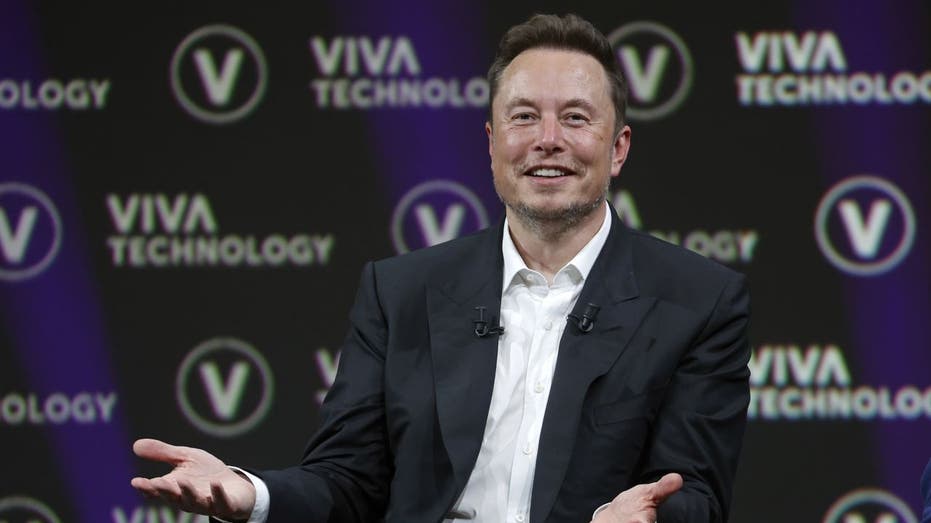
Group 1: Elon Musk's Wealth and Tesla Stock Performance - Elon Musk's net worth has reached approximately $681 billion, more than double that of the next closest billionaire, Larry Page, who has a net worth of $249 billion [1] - Tesla stock recently hit a new record closing high, marking its first since December 17, 2024, following Musk's announcement about testing robotaxis without safety monitors [5] - Tesla shares experienced a boost after the California Department of Motor Vehicles (DMV) decided to pause a 30-day sales suspension related to misleading marketing of its self-driving technology [6][7] Group 2: Regulatory Developments and Tesla's Self-Driving Technology - The California DMV has delayed the suspension of Tesla's sales for 90 days to allow the company to address regulatory concerns regarding its marketing terminology [7] - The DMV's focus is currently on the term "Autopilot," while Tesla has taken steps to clarify the term "Full-Self Driving" [10] - Tesla is now using the term "Supervised" to describe its Full-Self Driving feature in passenger vehicles, while also employing an unsupervised version for moving cars from assembly lines [11]
What Ford’s EV Mistakes Say About Tesla And The Upcoming Autonomy Tidal Wave (NASDAQ:TSLA)
Seeking Alpha· 2025-12-18 21:28
Core Viewpoint - Tesla, Inc. (TSLA) is considered overvalued based on traditional financial metrics, with a P/E ratio around 300X, raising questions about market perceptions and valuations [1]. Group 1: Investment Philosophy - The investment strategy involves a balanced portfolio of low-cost funds and individual stocks, with a preference for asymmetric bets [1]. - The investor emphasizes a long-term holding period of at least 10 years for stocks, focusing on macroeconomic factors and fundamentals while acknowledging the importance of market momentum and sentiment [1]. - Understanding market behavior beyond numerical metrics is crucial, as it involves analyzing sectors, industries, and long-term growth trends [1]. Group 2: Market Dynamics - The market is viewed as a meeting point of demand and supply, with the prediction of human behavior being a key element in investment decisions [1]. - The approach to investing requires creativity, curiosity, and a willingness to sometimes go against prevailing trends [1].
Tesla: Back To Accounting Basics (NASDAQ:TSLA)
Seeking Alpha· 2025-12-18 21:15
As you can tell, our core style is to provide actionable and unambiguous ideas from our independent research. If your share this investment style, check out Envision Early Retirement. It provides at least 1x in-depth articles per week on such ideas.We have helped our members not only to beat S&P 500 but also avoid heavy drawdowns despite the extreme volatilities in BOTH the equity AND bond market.Join for a trial and see if our proven method can help you too. ...

Tesla: Back To Accounting Basics
Seeking Alpha· 2025-12-18 21:15
Core Viewpoint - The company emphasizes providing actionable and clear investment ideas through independent research, aiming to help members outperform the S&P 500 and mitigate significant losses during market volatility [1] Group 1 - The service offers at least one in-depth article per week focused on investment ideas [1] - Members have reportedly achieved better performance than the S&P 500 while avoiding substantial drawdowns in both equity and bond markets [1]
Tesla stock rebounds around 5% today: what's driving the rally today?
Invezz· 2025-12-18 16:18
Core Viewpoint - Tesla stock experienced a strong rebound after a volatile trading session, which was influenced by a broader selloff in artificial intelligence-related stocks [1] Group 1 - The stock's recovery occurred early Thursday, indicating a potential stabilization after previous fluctuations [1] - The prior session's volatility was characterized by a significant selloff that affected various stocks linked to artificial intelligence [1]
Woods: Hesitant on MU Rally, CPI Positive Catalyst & 2026 to See "Tempered" Bull Run
Youtube· 2025-12-18 14:09
分组1: Micron Technology - Micron's stock has increased over 160% this year, but there are concerns about it being a crowded trade [2] - Despite a strong earnings report, Micron's stock sold off following earnings from other chip makers like Nvidia and Broadcom [3] - The stock has shown a significant increase of 192% to its peak but has recently experienced a notable pullback [3] 分组2: Economic Indicators - The Consumer Price Index (CPI) reported a surprising drop to 2.7%, which is seen as positive for the market and the Federal Reserve's potential rate cuts [6][8] - The CPI drop is viewed as a potential trend change that could provide the Fed with the opportunity to cut rates again [7][8] 分组3: Market Outlook for 2026 - The market is expected to continue its bull run, but gains may be tempered, with projections of only 3-5% growth for the S&P 500 [12][14] - Leadership in the market is shifting, with staples and financials expected to lead, while big tech may not perform as strongly [11][12] - Small caps may see improved performance if inflation continues to decrease and rate cuts occur [14] 分组4: Individual Stock Insights - Tesla is anticipated to have a strong year, driven by advancements in robotics and AI, despite stagnant car sales [16][17] - Alphabet is considered a more stable long-term investment compared to Tesla, but Tesla shows high upside potential going into the new year [18]


Tesla (NASDAQ: TSLA) Stock Price Prediction and Forecast 2026-2030 (Dec 18)
247Wallst· 2025-12-18 13:25
Tesla Inc.'s (NASDAQ: TSLA) share price is up 4.5% from a week ago. ...