Bridgewater Associates

Search documents
Ray Dalio says investors should take heed of the 1970s and increase their gold holdings
Yahoo Finance· 2025-10-08 15:04
Ray Dalio urged investors to allocate around 15% of their portfolios to gold, calling it a strong hedge against credit-dependent assets and a key protector of real returns. Speaking at the Greenwich Economic Forum, the Bridgewater Associates founder said the metal’s surge reflects a global shift away from debt assets and fiat currencies, reminiscent of the 1970s. It comes after Citadel CEO Ken Griffin warned gold’s rally signals investor unease with U.S. sovereign risk and growing efforts to “de-dollarize. ...
X @Investopedia
Investopedia· 2025-10-08 07:00
Investment Recommendation - Bridgewater Associates founder Ray Dalio suggests investors allocate approximately 15% of their portfolio to gold [1] Market Trend - Gold is experiencing a price increase [1]
Gold Within Whisker of $4,000 on US Shutdown, Tech Stock Wobble
Yahoo Finance· 2025-10-08 00:52
Core Insights - Gold has reached a record high just below $4,000 an ounce, driven by factors such as the US government shutdown, fluctuations in technology stocks, and political instability in Japan and France [1][2] - The price of gold has increased over 50% this year, influenced by trade and geopolitical changes initiated by President Donald Trump, leading to a shift away from the dollar [2][4] - Central banks have been significant buyers of gold, and the recent Federal Reserve rate cut has prompted investors to turn to gold-backed exchange-traded funds [2][4] Group 1: Market Dynamics - The US government shutdown has delayed key economic data, complicating the Federal Reserve's rate-cutting strategy, while concerns about the sustainability of the AI-driven market rally are emerging [1][3] - Spot gold prices rose to $3,996.11 an ounce, with the Bloomberg Dollar Spot Index remaining steady, indicating a stable demand for gold amidst market fluctuations [3] Group 2: Investor Sentiment - The narratives surrounding de-dollarization and de-globalization have significantly increased demand for gold, although there are concerns that speculators may take profits after the rapid price increase since mid-August [3][5] - Billionaire investors like Ray Dalio have emphasized gold's status as a safer asset compared to the dollar, drawing parallels to the 1970s when gold prices surged amid high inflation and economic uncertainty [4][5] Group 3: Future Outlook - Analysts predict that the rally in gold prices may continue, with Goldman Sachs raising its forecast for December 2026 to $4,900 an ounce, reflecting ongoing bullish sentiment in the market [2] - The current surge in gold prices is attributed to increasing safe-haven demand and growing distrust in paper assets due to rising fiscal risks and geopolitical tensions [5]
Bridgewater Associates Founder says China needs a restructuring
Bloomberg Television· 2025-10-07 19:00
Economic Concerns & Restructuring - Overproduction, referred to as involution, negatively impacts the economy [1] - Significant restructuring is needed, similar to the 1990s, involving selecting companies for survival, auction, or restructuring [2] - China's potential restructuring challenges are compared to Japan's debt issues, highlighting the need for decisive action [2][3] Global Manufacturing & Market Dynamics - China accounts for 32% of global manufactured goods, exceeding the combined output of the United States, Japan, and Germany [3] - Due to market closures, China may need to focus on developing countries [3] Innovation & Challenges - China faces challenges related to its pension and income tax systems [4] - China demonstrates significant innovation, particularly in government-directed initiatives [4] - China is more advanced in the application of AI compared to the United States [4]

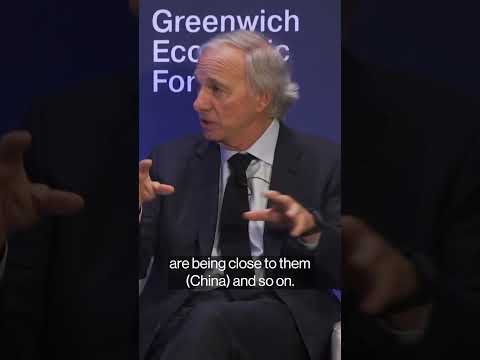
Gold hits $4,000 for the first time ever
Yahoo Finance· 2025-10-07 17:47
Core Insights - The price of gold has surpassed $4,000 for the first time, driven by a weakening U.S. dollar and persistent inflation [1][2] - Gold is up 50% year to date, reflecting its appeal as a hedge against inflation and economic uncertainty [1][2] Gold Price Dynamics - The U.S. dollar has decreased by 10% year to date, while inflation currently stands at 2.9%, exceeding the Federal Reserve's target of 2% [2] - Investors are increasingly turning to gold as a protective measure for their portfolios amid concerns about inflation eroding purchasing power [2] Investor Behavior - There is a notable increase in gold purchases by banks and retail investors, with countries like China reducing their holdings in U.S. Treasurys due to geopolitical tensions [3] - Ray Dalio, founder of Bridgewater Associates, recommends that gold should constitute about 15% of investment portfolios, highlighting its role as a diversifier [4] Retail Demand - Retailers such as Costco and Walmart are experiencing high demand for gold bars, with Costco struggling to keep up with sales since entering the gold market in 2023 [5] - Gold bars listed at Costco were priced just under $2,000 in October 2023, rising to over $3,000 by May 2025, indicating significant price appreciation [6] Investment Returns - Investors who purchased gold bars at the initial sale have seen gains of 100%, while those who bought a year ago have experienced over 50% returns [7]
Dalio Echoes Griffin in Seeing Gold as Safer Than the US Dollar
Yahoo Finance· 2025-10-07 16:56
Core Viewpoint - Billionaire Ray Dalio emphasizes that gold is a safer investment compared to the US dollar, drawing parallels to its performance during the 1970s amid high inflation and economic instability [1][4]. Investment Strategy - Dalio suggests that gold should constitute approximately 15% of an investment portfolio, highlighting its role as an excellent diversifier [3][4]. - The price of gold has increased by over 20% since the end of July, reaching around $4,000 an ounce, influenced by factors such as government shutdown speculation and potential Federal Reserve interest rate cuts [3]. Economic Context - Dalio points out that rising government debt, geopolitical tensions, and diminishing confidence in national currencies contribute to gold's appeal as a store of value [4]. - The US dollar has weakened against major currencies this year, experiencing its largest decline since the 1970s, following uncertainties related to President Donald Trump's policies [3]. Market Observations - Dalio expresses concerns about the recent surge in stock market valuations, likening it to a potential artificial intelligence bubble, reminiscent of past speculative excesses [5][6]. - Despite reservations about stock valuations, Dalio sees opportunities in companies leveraging AI for efficiency or providing platforms for the technology [7].
Gold tops $4K for first time as investors flee inflation, global turmoil
New York Post· 2025-10-07 15:05
Core Insights - Gold prices reached $4,000 an ounce for the first time, driven by persistent inflation, a government shutdown, and geopolitical risks [1][4] - Gold has surged over 50% this year, influenced by fears of a prolonged funding crisis and escalating trade tensions [10][19] - The demand for gold has increased significantly from both governments and consumers, with central banks, particularly in China and Russia, boosting their reserves [2][24] Price Movements - Gold futures briefly peaked at $4,005.80 before settling just below that level [1][8] - Spot gold traded at $4,002.10, reflecting a 0.6% increase [2][22] - Silver prices also rose by 1.3% to $48.22, while the dollar index fell by 0.4% [3][22] Market Sentiment - Investors are increasingly viewing gold as a hedge against inflation and political uncertainty, reminiscent of the inflationary environment of the 1970s [6][19] - Prominent investors like Ray Dalio and Ken Griffin have expressed concerns about the long-term stability of the US dollar and the implications of fiscal policies [3][7] - The trend of investing in gold is seen as a response to fears of currency depreciation and market volatility [6][22] Central Bank Activity - Central banks are accumulating gold at a record pace, with over 70% of monetary authorities planning to increase their gold holdings this year [24] - The trend is particularly strong among countries like China, India, and Turkey, indicating a strategic shift in reserve management [24] Economic Context - The current economic environment is characterized by high inflation, record borrowing, and heavy government spending, prompting a flight to hard assets like gold [6][19] - The S&P 500 has risen about 14% this year, but the parallel rise in gold prices suggests underlying investor anxiety about future economic conditions [20][22]

Ray Dalio says today is like the early 1970s and investors should hold more gold than usual
CNBC· 2025-10-07 14:14
Core Viewpoint - Investors should consider allocating up to 15% of their portfolios to gold as it serves as an effective diversifier and performs well when traditional assets decline [1][4]. Group 1: Gold Market Insights - Gold futures are currently trading at $4,005.80 per ounce, having increased over 50% this year due to a flight to safety amid rising fiscal deficits and global tensions [2]. - The current market environment is likened to the early 1970s, characterized by inflation, heavy government spending, and high debt, which undermined confidence in paper assets and fiat currencies [2][3]. Group 2: Investment Strategies - Ray Dalio's recommendation of a 15% allocation to gold contrasts with the traditional 60-40 stock-bond portfolio strategy typically advised by financial advisors, who usually suggest a low single-digit percentage for alternative assets like gold [3]. - Jeffrey Gundlach, CEO of DoubleLine Capital, has suggested an even higher allocation of up to 25% in gold, citing ongoing inflationary pressures and a weaker dollar as key factors [4]. Group 3: Gold as a Hedge - Gold is highlighted as a unique asset that does not require reliance on others for value, making it a strong hedge against monetary debasement and geopolitical uncertainty [4].
Major bank flags southern US city as the world’s biggest real estate bubble risk, as metrics top 2006 housing levels
Yahoo Finance· 2025-10-07 11:11
Core Insights - Miami's housing market is facing a potential bubble risk, with a bubble risk score of 1.73, indicating high risk compared to other major cities like Los Angeles and New York [4] - The housing inventory in Miami has returned to near pre-pandemic levels, but rising costs from deferred maintenance and surging insurance premiums are pressuring owners to sell [2][4] - Despite a forecast of negative price growth, a sharp correction in the housing market is not anticipated due to Miami's coastal appeal and favorable tax environment [1][4] Housing Market Dynamics - The report highlights that Miami has experienced the strongest inflation-adjusted housing appreciation over the past 15 years, with current price-to-rent ratios exceeding those seen during the 2006 property bubble [3] - Affordability for buyers in Miami has reached near record lows, with home prices diverging significantly from rental prices [3] Regulatory and Environmental Factors - Regulatory changes are compelling condo associations to address long-standing maintenance issues, leading to increased financial burdens on owners [2] - Environmental risks, such as flooding and hurricanes, are contributing to rising insurance premiums, further straining the housing market [2]

25 Wall Street Rising Stars and Executives to Watch
Business Insider· 2025-10-06 09:50
Core Insights - The article highlights the emergence of young dealmakers and investors who are shaping the future of finance, particularly in areas like private credit and data center deals [1][3][32]. Group 1: Rising Stars in Finance - Business Insider annually recognizes young professionals under 35 who are making significant impacts in investing, trading, and dealmaking [2]. - This year's list includes 25 individuals from prominent firms such as JPMorgan, Apollo, Citadel, and Bridgewater, showcasing their creativity and drive [3]. Group 2: Dealmaking Trends - After a slow start to the year due to various uncertainties, dealmaking is gaining momentum with significant IPOs, carve-outs, and buyouts being driven by bankers and private equity investors [4]. - The article features several notable dealmakers, including Jack Levendoski from JPMorgan, who has been involved in major technology transactions totaling over $300 billion in deal value [5][6]. Group 3: Sector-Specific Insights - The data center industry is highlighted as a multi-trillion-dollar opportunity, with Aman Mittal from Moelis & Company advising on over 15 data center-related transactions worth more than $25 billion [33][35]. - Infrastructure investments have surged, with private infrastructure fund assets increasing from $500 billion in 2016 to $1.5 trillion in 2024, driven by the AI boom and energy transition [32]. Group 4: Private Credit Evolution - The private credit sector is evolving, with Madelaine O'Connell from HPS leading innovative financing solutions for investment-grade companies, indicating a shift towards more customized loan structures [59][60]. - Knut Kirchoff from Blackstone has witnessed the rapid growth of private credit, with the firm's assets increasing from $80 billion to over $400 billion in recent years [64][66]. Group 5: Macro Insights - The article emphasizes the importance of macroeconomic understanding, with professionals like Adam Theriault-Shay at Citadel focusing on in-depth research and on-the-ground insights to inform trading strategies [92][95]. - Catherine Kress at BlackRock is positioned at the intersection of geopolitics and finance, reflecting the growing demand for insights on national security and economic resilience [97][100].