
Federal Reserve

Search documents
Housing market affordability is so strained that Trump directs Fannie and Freddie to buy $200B mortgage bonds
Fastcompany· 2026-01-09 21:21
Core Viewpoint - President Trump announced that Fannie Mae and Freddie Mac will purchase an additional $200 billion in mortgage bonds to lower mortgage rates and make home ownership more affordable [1]. Group 1: Government Sponsored Enterprises (GSEs) Actions - Fannie Mae and Freddie Mac are instructed to buy $200 billion in mortgage bonds, which is expected to drive down mortgage rates and monthly payments [1]. - The GSEs have already increased their retained mortgage holdings by approximately $69 billion in the second half of 2025 [6]. - If the GSEs add another $200 billion in mortgage bond holdings in 2026, they would approach their legal limit of $450 billion, with $225 billion for each [7]. Group 2: Market Dynamics - Long-term yields, such as the 10-year Treasury yield and the average 30-year fixed mortgage rate, are influenced by the demand for underlying bonds, with yields moving inversely to bond prices [1]. - The "mortgage spread," which is the difference between the 10-year Treasury yield and the average 30-year fixed mortgage rate, peaked at 2.96 percentage points in June 2023, significantly above the historical average of 1.76 percentage points since 1972 [5]. - The goal of the $200 billion purchase is to accelerate the compression of the "mortgage spread," which has already decreased to 2.05 percentage points by December 2025 [6]. Group 3: Historical Context and Federal Reserve Actions - Prior to the Great Financial Crisis, Fannie Mae and Freddie Mac were significant buyers of mortgage-backed securities (MBS), providing stability to the market [9]. - The Federal Reserve took on the role of market stabilizer after the GSEs went into conservatorship, purchasing $1.25 trillion in agency MBS between January 2009 and March 2010 [9]. - The Federal Reserve's pivot to quantitative tightening in March 2022 removed a major buyer from the MBS market, leading to increased volatility and higher mortgage rates [11].



Fed split deepens as Miran calls for 1.5-point rate cut
Yahoo Finance· 2026-01-09 02:03
Core Viewpoint - Federal Reserve officials are divided on the extent of interest rate cuts for 2026, with some advocating for steady rates until more data is available on inflation and employment [1] Group 1: Interest Rate Cuts - Fed Governor Stephen Miran is advocating for aggressive interest rate cuts, suggesting a reduction of at least 150 basis points this year to support the labor market [2][3] - Miran describes current monetary policy as restrictive, indicating that underlying inflation is around 2.3%, which allows for further cuts [2] - The Federal Funds Rate currently stands at 3.50% to 3.75%, with a total of 75 basis points cut in 2025 [8] Group 2: Economic Context - There are approximately one million Americans unemployed who could potentially find jobs without triggering unwanted inflation, according to Miran [5] - Fed officials estimate that the long-run neutral rate is between 2.5% and 3%, but can rise to approximately 4.5% to 5% when factoring in inflation [9] - The neutral rate is defined as the interest rate that maintains full employment while keeping inflation stable around the Fed's 2% target [10]
Current personal loan statistics in 2026
Yahoo Finance· 2026-01-07 20:29
Core Insights - The article discusses the impact of federal rate changes and inflation on personal loan interest rates, emphasizing the importance for consumers to understand these factors when borrowing [1][4]. Group 1: Interest Rate Dynamics - Personal loan interest rates are influenced by the Federal Reserve's decisions regarding the federal funds rate, with increases leading to higher borrowing costs [4]. - Historical trends show that major economic events, such as recessions, typically result in the Fed lowering rates to stimulate recovery, which in turn affects personal loan rates [5][6]. Group 2: Current Statistics - The average personal loan interest rate is currently 12.21%, with rates from lenders ranging between 6.24% and 35.99% [8]. - As of September 2025, the average personal loan debt per borrower in the U.S. was $11,724, and inflation is reported at 3% month over month [8]. - The Federal Reserve has reduced the federal funds rate three times in 2025, with the current target rate set between 3.5% and 3.75% [8]. Group 3: Credit Score Influence - Credit scores play a significant role in determining personal loan interest rates, with higher scores generally leading to better rates for borrowers [7].
Fed Governor Stephen Miran says more than 100 basis points in rate cuts justified this year
Fox Business· 2026-01-06 19:36
Federal Reserve Governor Stephen Miran said the central bank should move more aggressively on interest rates this year, arguing that rate reductions totaling more than 100 basis points are justified as underlying inflation pressures continue to fade. In an interview with Maria Bartiromo on FOX Business’ "Mornings with Maria," Miran said inflation is already running close to the Federal Reserve’s 2% target once temporary measurement distortions are stripped out. He said current policy remains clearly restric ...

Bankrate’s Interest Rate Forecast for 2026: See what’s next for mortgage rates, credit card rates, auto loans and more
Yahoo Finance· 2026-01-06 09:05
Core Insights - The Federal Reserve is expected to cautiously cut interest rates to support a cooling job market while aiming for a 2% inflation target [2][3] - Political pressure may influence the Fed's decisions, potentially leading to concerns about inflation if rate cuts are perceived as politically motivated [3][4] - The forecast indicates that mortgage rates could fall below 6% in 2026, which may help alleviate housing affordability issues [9][12] Interest Rate Forecast - The Fed is projected to cut interest rates by 0.75 percentage points in 2026, bringing rates close to pre-pandemic levels [6] - The average 30-year fixed mortgage rate is expected to average 6.1% in 2026, with a range between 5.7% and 6.5% [9][16] - Home equity loan rates are forecasted to average about 7.75% in 2026, with HELOC rates averaging around 7.3% [18][20] Auto Loan Forecast - Five-year new car loan rates are projected to average about 6.7% in 2026, with a range from 6.4% to 7% [25][26] - Four-year used car loan rates are expected to average 7.1%, with a high of 7.4% and a low of 6.8% [26] - Despite lower interest rates, high car prices remain a significant challenge for affordability [30] Savings and CD Rates - The top savings account rate is expected to fall to about 3.7% by the end of 2026, while the national average savings rate will drop to approximately 0.45% [33][36] - The highest-yielding one-year CD is projected to ease to roughly 3.5% by the end of 2026 [34] - Competition among banks is expected to keep savings yields relatively higher compared to borrowing costs [36][41] Credit Card Rate Forecast - Credit card rates are expected to range from a high of 19.7% to a low of 19.1% in 2026, averaging 19.4% [42][44] - The average credit card balance holder would see minimal savings from rate cuts, with significant debt remaining a concern [45][47] - Credit cards are characterized as a high-cost form of debt, making it difficult for borrowers to escape [46]
CFPB must request funds from Fed, court rules
Yahoo Finance· 2026-01-05 08:44
This story was originally published on Banking Dive. To receive daily news and insights, subscribe to our free daily Banking Dive newsletter. The Consumer Financial Protection Bureau must continue to request funding from the Federal Reserve, a federal judge ruled last week. “This process has unfolded seamlessly since the Bureau was established in 2011, even in the years since 2022 when the Federal Reserve's interest expenses have exceeded its earnings,” Judge Amy Berman Jackson of the U.S. District Court f ...
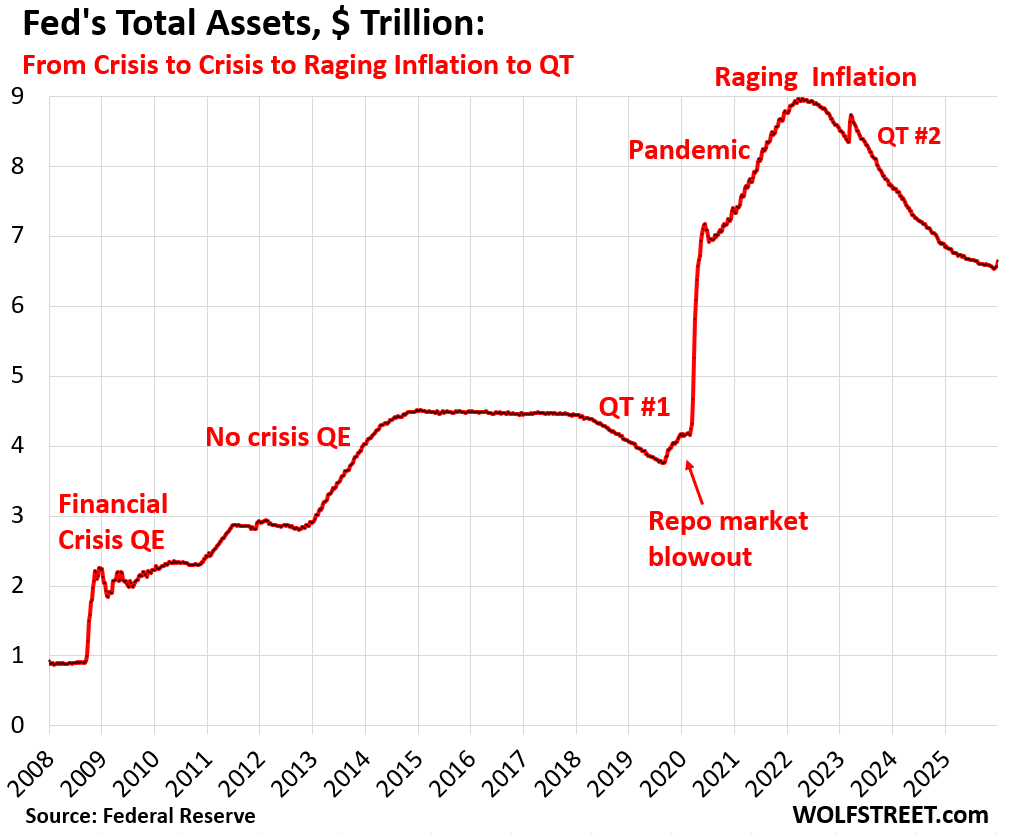
Year-End Liquidity Turmoil on the Fed’s Balance Sheet. Plus $38 Billion in T-bills Replace $15 Billion in MBS and Add $23 Billion in RMPs
Wolfstreet· 2026-01-03 02:46
Core Insights - The Federal Reserve's balance sheet experienced significant year-end liquidity shifts, with the Standing Repo Facility (SRF) spiking to $75 billion before falling back, and Overnight Reverse Repos (ON RRPs) reaching $106 billion before also declining [1][14][15] Group 1: Standing Repo Facility (SRF) - The SRF saw a one-day uptake of $75 billion on December 31, which increased the Fed's total assets temporarily [6][7] - By January 2, the SRF balance fell back to $23 billion, with expectations that it will approach zero in the following week [6][7] - The SRF allows approved counterparties, primarily large broker-dealers and banks, to borrow overnight at a rate of 3.75%, enabling them to profit from lending in the repo market [11][12] Group 2: Overnight Reverse Repos (ON RRPs) - ON RRP balances spiked to $106 billion on December 31, reflecting a significant influx of funds from money markets depositing at the Fed [14] - By January 2, ON RRP balances dropped to just $6 billion, indicating a rapid unwinding of year-end liquidity [14] Group 3: Treasury Bills and Balance Sheet Management - The Fed added $38 billion in short-term Treasury bills in December, with $15 billion replacing mortgage-backed securities (MBS) that came off the balance sheet [2][19] - The Fed's strategy aims to shift its balance sheet composition towards shorter-term securities, with T-bills expected to grow while MBS are phased out [18][23] - The Fed's total assets rose by $104 billion to $6.64 trillion, largely due to the SRF spike and Reserve Management Purchases (RMPs) [27] Group 4: Mortgage-Backed Securities (MBS) - MBS holdings fell by $15 billion in December to $2.04 trillion, with the Fed's plan to continue reducing MBS until they are eliminated [23][24] - The decline in MBS is primarily due to reduced pass-through principal payments as mortgage refinancing and sales have decreased significantly [24][25]
Will he stay or will he go? Powell is not saying whether he'll stay on Fed board when chair term ends
CNBC· 2026-01-02 12:35
Core Viewpoint - The future of Federal Reserve Chair Jerome Powell after his term ends in May 2026 is uncertain, with speculation surrounding whether he will remain on the board as a governor or leave the Fed entirely [1][5][12]. Group 1: Powell's Decision and Its Implications - Powell's potential departure could shift the balance of power on the Fed's Board of Governors, currently with three Trump appointees out of seven, potentially allowing the president to exert more influence over monetary policy [6][10]. - The Federal Reserve Act may allow the board's majority to dismiss individual bank presidents opposing rate cuts, raising concerns about the independence of the Fed if Powell were to leave [7][10]. - Powell's decision is complicated by the ongoing legal case involving Fed Governor Lisa Cook, which could affect the board's composition and Trump's ability to appoint new members [8][9]. Group 2: Political Context and Speculation - The current political climate is unprecedented, with President Trump openly seeking control over Fed policy, contrasting with past chairs who transitioned quietly to other roles [3][5]. - Powell's reluctance to disclose his future plans may serve as a strategic move to maintain leverage over the administration, signaling his willingness to stay or leave based on the president's nominee choices [11][13]. - Observers believe that Powell is likely to leave when his chairmanship ends, as staying could invite greater political scrutiny and undermine the Fed's independence [12].

Economist slams Fed for selling inflation under control narrative
Yahoo Finance· 2025-12-31 18:46
Core Viewpoint - Peter Schiff argues that the recent surge in gold prices reflects economic weakness rather than prosperity, contradicting the U.S. Federal Reserve's inflation narrative [1][2]. Group 1: Gold Market Insights - The rising gold price indicates that investors and central banks are seeking refuge from the declining value of fiat currencies, suggesting concerns about inflation [2]. - Schiff emphasizes that if there were no worries about inflation, there would be no demand for gold, highlighting a shift in central bank strategies towards gold as a hedge against inflation [2]. Group 2: Economic Indicators - The consumer price index (CPI) rose at a 2.7% annualized rate in November, slightly below the forecast of 3.1%, indicating that inflation remains a concern [3]. - Despite the Dow Jones index appearing significantly higher than at the start of the century, it has decreased by about 70% when measured in gold terms, illustrating a loss of purchasing power [3]. Group 3: Market Reactions and Expectations - Wall Street economists have raised concerns about the reliability of the inflation report due to missing data from the recent government shutdown, which could affect market expectations [4]. - Inflation and employment data are crucial as they influence Federal Reserve rate decisions, impacting the U.S. dollar and global liquidity, which in turn affects risk assets like Bitcoin [5].
Fed Injects $40 Billion in December as Global Liquidity Hits Record High
Yahoo Finance· 2025-12-31 07:41
Core Viewpoint - The Federal Reserve's recent $16 billion liquidity injection into the US banking system indicates underlying stress in short-term funding markets, raising concerns about the implications for risk assets like Bitcoin [1][2]. Group 1: Federal Reserve Actions - The Federal Reserve injected $16 billion into the banking system on December 30, marking the second-largest liquidity operation since the COVID-19 crisis [1]. - The total amount of Treasury securities purchased via repos in December reached $40.32 billion, highlighting significant liquidity support [1][4]. - The December 30 operation is noted to be just behind pandemic-era emergency measures in size, suggesting a potential facade of stability [2]. Group 2: Market Implications - Financial commentator Andrew Lokenauth expressed concerns that the large injection may indicate superficial stability, with deeper issues in the financial system [2]. - Institutions are reportedly in need of cash to meet obligations related to commodities and collateral mismatches, indicating stress in the financial system [3]. - The ongoing liquidity support reflects year-end balance sheet constraints rather than an outright crisis, as banks face tighter regulatory requirements during reporting periods [4].