
海南华铁

Search documents
2026年中国应急产业市场全景评估及投资趋势预测报告
Sou Hu Cai Jing· 2025-12-08 06:57
Core Insights - The emergency industry in China is a comprehensive and emerging sector that intersects multiple departments and fields, primarily encompassing emergency equipment and emergency services, with the former holding the majority share [1][12] - The development of the emergency industry is crucial for enhancing the national emergency system, improving emergency capabilities, ensuring public safety, and promoting economic growth [1][12] - The industry has entered a rapid growth phase, with significant investments and a mature technology and industrial chain being established [1][12] Market Size and Growth - The scale of China's emergency industry is projected to grow from 5,510.1 billion yuan in 2016 to 13,934.7 billion yuan in 2024, with expectations to reach 14,589.2 billion yuan by 2025 [4][12] - In 2024, the emergency equipment market is expected to be 9,199.8 billion yuan, accounting for 66.02% of the emergency industry, while emergency services and maintenance will reach 4,734.9 billion yuan, making up 33.98% [4][12] - By 2025, the emergency equipment market is anticipated to grow to 9,629 billion yuan (66.00%), and emergency services and maintenance to 4,960.2 billion yuan (34.00%) [4][12] Industry Definition and Classification - The emergency industry is defined as the sector that supports the first three phases of sudden events requiring urgent response, characterized by a wide coverage, long industrial chain, and cross-industry interactions [3][7] - According to the Ministry of Industry and Information Technology, the emergency industry is categorized into four main classes: safety protection, monitoring and early warning, emergency rescue and disposal, and safety emergency services [3][7] Regulatory Framework and Policies - The "14th Five-Year Plan" has marked a significant advancement in emergency management in China, with many key indicators being completed ahead of schedule [3][9] - The government has initiated revisions to several laws, including the "Emergency Response Law" and the "Production Safety Law," and has issued various policies to enhance emergency management capabilities [3][9] Industry Chain and Key Players - The upstream of the emergency industry includes emergency equipment suppliers and software information service providers, while the midstream focuses on emergency system services, and the downstream involves applications in natural disasters, accidents, public health, and social security [3][9] - Major players in the emergency industry include companies like Huatie Emergency, Beijing Lingtian Equipment Group, and Chuan Emergency, with some firms like Chuan Emergency and Chen An Technology involved in both monitoring and emergency rescue services [4][14] Technological Innovation - To promote the development of the emergency industry, it is essential to enhance technological innovation through measures such as talent cultivation, innovation platform construction, and the promotion of result transformation [5]

海南华铁(603300)股民索赔案已经提交法院立案
Xin Lang Cai Jing· 2025-12-05 01:53
Core Viewpoint - Hainan Huatie has been investigated by the China Securities Regulatory Commission (CSRC) for suspected violations of information disclosure laws, leading to a formal case being opened against the company [1][2][3]. Group 1: Regulatory Actions - The CSRC has issued a "Notice of Case Filing" to Hainan Huatie due to alleged violations of the Securities Law and the Administrative Penalty Law of the People's Republic of China [1][2]. - Prior to this case filing, the company had already attracted regulatory attention due to the termination of a significant contract [3]. Group 2: Investor Compensation - Investors who purchased Hainan Huatie stock before October 1, 2025, and sold or still hold the stock after this date may be eligible for compensation [4]. - Required documentation for compensation claims includes original transaction statements for Hainan Huatie stock, which must be stamped by the brokerage firm, and records of all transactions up to the date of printing [4]. - Additional required materials for claims include copies of the investor's ID, and a securities account inquiry statement issued by the brokerage [5].

趋势研判!2025年中国应急产业政策、产业链、市场规模、竞争格局及技术创新措施分析:已形成较为成熟的技术和产业链,产业规模不断壮大[图]
Chan Ye Xin Xi Wang· 2025-12-03 01:24
Core Viewpoint - The emergency industry in China is a comprehensive and emerging sector that spans multiple departments and fields, primarily consisting of emergency equipment and emergency services, with a significant focus on equipment. The development of this industry is crucial for enhancing national emergency systems, improving emergency capabilities, ensuring public safety, and promoting economic growth. The industry has entered a rapid growth phase, with projections indicating a market size of 13,934.7 billion yuan in 2024 and 14,589.2 billion yuan in 2025 [1][5]. Industry Definition and Classification - The emergency industry is defined as the sector that supports the response to sudden events requiring urgent handling, covering a wide range of applications and lacking clear industry boundaries. It is categorized into four main types: safety protection, monitoring and early warning, emergency rescue and disposal, and safety emergency services [2][4]. Current Development Status - The emergency industry in China has seen significant growth, with its market size increasing from 5,510.1 billion yuan in 2016 to an expected 13,934.7 billion yuan in 2024. The emergency equipment market is projected to reach 9,199.8 billion yuan in 2024, accounting for 66.02% of the total industry, while emergency services and maintenance are expected to reach 4,734.9 billion yuan, making up 33.98% [5][7]. Market Structure - The emergency industry consists of emergency equipment and emergency services, with equipment holding the majority share. The market for emergency services has been expanding in recent years, indicating a shift in focus within the industry [7]. Industry Chain - The emergency industry chain includes upstream suppliers of emergency equipment and software information services, midstream emergency system services, and downstream applications in various scenarios such as natural disasters, accidents, public health, and social security [8]. Development Environment and Policies - The Chinese government has made significant strides in emergency management, transitioning towards a preventive governance model. Key policies include the revision of laws such as the Emergency Response Law and the Safety Production Law, as well as the issuance of development action plans for emergency equipment [9][10]. Competitive Landscape - The main participants in the emergency industry include companies involved in safety protection equipment manufacturing, monitoring and early warning, and emergency rescue services. Notable companies include Hikvision, Dahua Technology, and China Shipbuilding Industry Corporation, among others [11][12]. Technological Innovation Measures - To enhance the technological innovation level of the emergency industry, measures such as talent cultivation, innovation platform construction, and promotion of result transformation are essential [14].


海南华铁索赔递交立案,此类投资者不容错过!
Xin Lang Cai Jing· 2025-12-01 02:09
Core Points - Hainan Huatie has received a notice from the China Securities Regulatory Commission (CSRC) regarding an investigation into alleged information disclosure violations [1] - The investigation is likely linked to the company's announcement on September 30, 2025, regarding the termination of a 36.9 billion yuan contract with Hangzhou X Company for computing power services [1][2] - A significant number of investors have registered for compensation claims, with legal actions already initiated in court [1] Summary by Sections Investigation and Legal Actions - The CSRC has decided to formally investigate Hainan Huatie for suspected violations of information disclosure laws [1] - Hundreds of investors have signed up for compensation claims, with some cases already filed in court [1] Contract Termination - Hainan Huatie's subsidiary terminated a computing power service agreement with Hangzhou X Company, which was originally signed in March 2025 and valued at 36.9 billion yuan [2] - The termination of this major contract is seen as a potential trigger for the CSRC's investigation and a basis for investor compensation claims [2]
海南华铁:无逾期对外担保
Zheng Quan Ri Bao Wang· 2025-11-28 13:12
证券日报网讯11月28日晚间,海南华铁(603300)发布公告称,公司及控股子公司均无逾期对外担保。 ...
海南华铁(603300) - 浙江海控南科华铁数智科技股份有限公司对外担保进展公告
2025-11-28 09:30
证券代码:603300 证券简称:海南华铁 公告编号:临 2025-093 浙江海控南科华铁数智科技股份有限公司 对外担保进展公告 本公司董事会及全体董事保证本公告内容不存在任何虚假记载、误导性陈述 或者重大遗漏,并对其内容的真实性、准确性和完整性承担法律责任。 重要内容提示: 被担保人名称:海南华铁大黄蜂建筑机械设备有限公司(以下简称"华 铁大黄蜂") 担保人名称:浙江海控南科华铁数智科技股份有限公司(以下简称"海 南华铁"或"公司") 一、担保情况概述 公司于 2025 年 4 月 30 日召开 2025 年第二次临时股东大会,审议通过了《关 于 2025 年度担保额度预计的议案》,2025 年度公司拟新增对子公司提供总计 不超过人民币 745,000 万元的担保额度,子公司拟对公司新增提供总计不超过 人民币 255,000 万元的担保额度。具体内容详见公司在上海证券交易所网站 (www.sse.com.cn)披露的《浙江海控南科华铁数智科技股份有限公司关于 2025 年度担保额度预计的公告》(公告编号:临 2025-023)及《浙江海控南科华铁 数智科技股份有限公司 2025 年第二次临时股东大会决议公 ...
多元金融板块11月25日涨1.21%,四川双马领涨,主力资金净流出5688.15万元
Zheng Xing Xing Ye Ri Bao· 2025-11-25 09:09
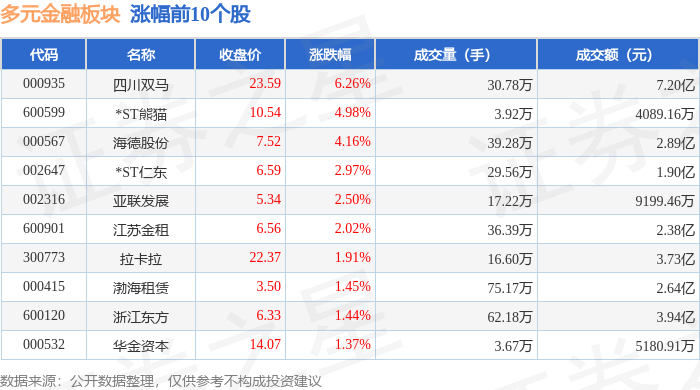
Core Viewpoint - The diversified financial sector experienced a rise of 1.21% on November 25, with Sichuan Shuangma leading the gains, while the Shanghai Composite Index closed at 3870.02, up 0.87% [1] Group 1: Market Performance - The diversified financial sector stocks showed varied performance, with Sichuan Shuangma closing at 23.59, up 6.26%, and a trading volume of 307,800 shares, amounting to 720 million yuan [1] - Other notable performers included *ST Panda, which rose by 4.98% to 10.54, and Haide Shares, which increased by 4.16% to 7.52 [1] - The Shenzhen Component Index closed at 12777.31, reflecting a 1.53% increase [1] Group 2: Capital Flow - The diversified financial sector saw a net outflow of 56.88 million yuan from institutional investors and 80.35 million yuan from retail investors, while retail investors contributed a net inflow of 137 million yuan [1] - Specific stock capital flows indicated that Jiangsu Jinzu experienced a net outflow of 45.92 million yuan from institutional investors, while Sichuan Shuangma had a net inflow of 17.55 million yuan [2] - The overall trend showed a mixed capital flow, with some stocks like Haide Shares and *ST Panda experiencing both inflows and outflows from different investor categories [2]

海南华铁11月20日获融资买入4108.50万元,融资余额9.22亿元
Xin Lang Cai Jing· 2025-11-21 01:31
Core Viewpoint - Hainan Huatie's stock experienced a slight decline of 0.53% on November 20, with a trading volume of 540 million yuan, indicating a low financing balance and a stable operational performance in recent months [1][2]. Financing and Margin Trading - On November 20, Hainan Huatie had a financing buy-in amount of 41.085 million yuan and a net financing buy of 11.539 million yuan, with a total financing and margin trading balance of 924 million yuan [1]. - The current financing balance of 922 million yuan accounts for 6.20% of the circulating market value, which is below the 30th percentile level over the past year, indicating a low financing level [1]. - In terms of margin trading, Hainan Huatie repaid 200 shares and sold 1,100 shares on November 20, with a margin balance of 2.1002 million yuan, also below the 20th percentile level over the past year [1]. Business Performance - As of September 30, Hainan Huatie reported a total revenue of 4.447 billion yuan for the first nine months of 2025, reflecting a year-on-year growth of 19.38%, and a net profit attributable to shareholders of 530 million yuan, up 8.83% year-on-year [2]. - The company's main business revenue composition includes 98.93% from operating leasing and services, with minimal contributions from other segments [1]. Shareholder Information - As of September 30, 2025, Hainan Huatie had 214,800 shareholders, a decrease of 4.50% from the previous period, with an average of 9,295 circulating shares per shareholder, an increase of 5.03% [2]. - The top ten circulating shareholders include notable entities such as Southern CSI 1000 ETF and Hong Kong Central Clearing Limited, with varying changes in shareholdings [3].
研判2025!中国安全应急服务行业分类、政策汇总、发展现状、竞争格局及未来前景展望:自然灾害和突发事件频发,行业需求不断增加[图]
Chan Ye Xin Xi Wang· 2025-11-21 01:26
Core Insights - The demand for emergency rescue and recovery services in China is increasing due to the frequent occurrence of natural disasters and emergencies, such as earthquakes, floods, and typhoons [1][7] - The market size of the safety emergency service industry in China is projected to grow from 0.88 trillion yuan in 2020 to 1.32 trillion yuan in 2024 [1][7] - The industry is supported by government policies aimed at enhancing disaster prevention and response capabilities, with significant investments in safety emergency services [4][10] Industry Overview - Safety emergency services encompass a range of professional services aimed at mitigating risks associated with natural disasters and accidents, including risk assessment, management consulting, and technical inspections [3] - The industry is categorized into consulting services and financial services, with consulting services covering various subcategories [3] Policy Support - The Chinese government has implemented several policies to promote the development of the safety emergency service industry, including the "14th Five-Year" National Earthquake Disaster Reduction Plan and the Safety Emergency Equipment Development Action Plan [4][10] - Future policies will focus on key technology research and development, industry innovation platform construction, and market regulation [10] Industry Chain - The safety emergency service industry consists of an upstream segment that includes hardware and software suppliers, a midstream service sector, and a downstream market that serves government, enterprises, communities, and individuals [6] Market Size and Growth - The safety emergency service market is expected to reach 2.48 trillion yuan in 2024, with a year-on-year growth of 6.6%, and the service market accounting for 58% of this total [6][7] Competitive Landscape - The industry features a diverse range of companies, including state-owned, private, and foreign enterprises, each with distinct advantages in funding, technology, and innovation [6][10] - Key players include China Shipbuilding Industry Corporation, Beijing Chenan Technology Co., Ltd., and Hainan Huatie [6][10] Future Trends - The industry is anticipated to see accelerated technological innovation driven by advancements in AI, IoT, big data, and blockchain, enhancing the efficiency and reliability of emergency management systems [10] - There will be a growing demand for diverse safety emergency services, including disaster prevention, information security, and personal safety solutions [10]


海南自贸区概念下跌4.52%,10股主力资金净流出超亿元
Zheng Quan Shi Bao Wang· 2025-11-19 09:20
Market Performance - The Hainan Free Trade Zone concept index declined by 4.52%, ranking among the top losers in the concept sector as of the market close on November 19 [1] - Notable stocks within the Hainan Free Trade Zone that hit the daily limit down include Hainan Haiyao, Haima Automobile, and *ST Shuangcheng, while stocks like Xindazhou A, Junda Co., and Jinpan Technology saw slight increases of 1.96%, 0.77%, and 0.24% respectively [1] Capital Flow - The Hainan Free Trade Zone concept experienced a net outflow of 2.356 billion yuan from major funds today, with 26 stocks facing net outflows, and 10 stocks seeing outflows exceeding 100 million yuan [2] - The stock with the highest net outflow was Hainan Airport, which saw a net outflow of 294 million yuan, followed by Haima Automobile, Zhongtung High-tech, and Hainan Development with net outflows of 268 million yuan, 191 million yuan, and 185 million yuan respectively [2] Stock Performance - The top stocks with significant net outflows in the Hainan Free Trade Zone include: - Hainan Airport: -4.95% with a turnover rate of 3.02% and a net outflow of 293.96 million yuan - Haima Automobile: -10.00% with a turnover rate of 19.58% and a net outflow of 267.67 million yuan - Zhongtung High-tech: -3.47% with a turnover rate of 6.92% and a net outflow of 191.25 million yuan - Hainan Development: -8.81% with a turnover rate of 14.49% and a net outflow of 185.28 million yuan [2][3]


