Synchrony Financial

Search documents
'Fast Money' traders look ahead to Wednesday's Fed decision
Youtube· 2025-09-17 14:44
Market Overview - The Federal Reserve is expected to cut rates by 25 basis points, marking its first cut since December, amid pressure from President Trump [1] - Major stock averages remained relatively unchanged, while gold reached its 35th record of the year [1] - The dollar is trading near three-year lows, impacting regional banks negatively, with Bank First, Synchrony Financial, Huntington Bank, and Keycorp among the worst performers [2] Gold and Dollar Dynamics - The rise in gold prices suggests a disconnect with the equity market, as the S&P reached a new all-time high [3] - The dollar's lack of recovery, aside from a brief period, raises concerns about its long-term trajectory [4] - A weaker dollar is generally supportive of equities, but diminishing returns may be approaching [4] Regional Banks Performance - Regional banks have seen significant gains since Liberation Day, up approximately 40%, but experienced sharp declines recently [5] - The expectation was that these banks would benefit from a stronger economic environment, yet their performance contradicts this assumption [5] Economic Outlook and Fed Actions - The Fed's rate cut occurs in a strong economic context, which could lead to increased market activity and potential long-term inflation [6] - Historically, markets tend to rise 12 months after a Fed cut in a strengthening economy, but this may also lead to higher long-term rates affecting mortgage demand [7] - Concerns exist regarding the potential for higher ten-year yields despite the Fed's actions [9][10] Labor Market and Consumer Behavior - Recent labor market data suggests weakening, which could impact other economic sectors and the rationale behind the Fed's rate cut [11] - Consumer behavior remains strong, with retail sales holding up, but this may not reflect overall economic health [11] Governance and Regulatory Considerations - The upcoming Supreme Court case regarding Lisa Cook could influence the composition of the Fed governors and their voting at the next meeting [9][12] - The uncertainty surrounding this situation adds complexity to the Fed's decision-making process [12]
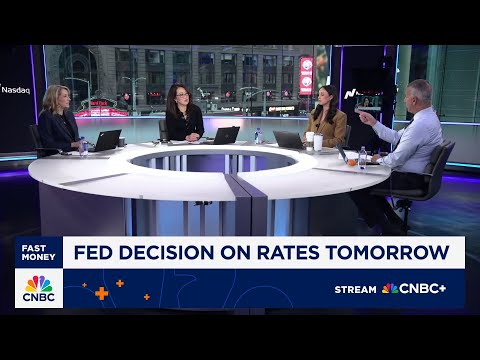
'Fast Money' traders look ahead to Wednesday's Fed decision
CNBC Television· 2025-09-17 14:44
Let's get back to the big market moves ahead of one of the most highly scrutinized Fed meetings of the year. The central bank widely expected to cut rates by 25 basis points tomorrow, its first cut since December amid continued pressure from President Trump. While major averages were little change today, gold settled at its 35th record of the year.The dollar traded near more than three-year lows and rate sensitive regional banks got hit hard. Bank first, Synchrony Financial, Huntington Bank shares, Keycorp ...

Jim Cramer Says He Prefers Capital One Over Synchrony Financial
Yahoo Finance· 2025-09-13 13:45
Group 1 - Synchrony Financial (NYSE:SYF) is a credit card issuer that has retired 7% of its shares annually, but Jim Cramer prefers Capital One due to its increased share repurchase plans [1] - The company provides consumer financial services, including credit cards, installment loans, and deposit products, and offers branded financing solutions across various sectors [2] - BofA analyst Mihir Bhatia raised Synchrony Financial's stock price target to $84 from $80, maintaining a Buy rating, citing stronger spending patterns and the initiation of the Walmart program as indicators of loan growth acceleration [2]

Klarna (KLAR) IPO Update: Don't Buy Now Or Later
Forbes· 2025-09-03 22:50
Core Viewpoint - Klarna is attempting to re-launch its IPO with a targeted valuation of $13-$14 billion, down from a previous expectation of $15 billion, but the stock is deemed unattractive for investors [3][5][38] Company Overview - Klarna provides buy now, pay later (BNPL) loans to consumers, experiencing strong revenue growth but facing challenges in profitability and competition [4][5] - The company grew its revenue by 22% compounded annually from 2022 to 2024, with a 24% year-over-year growth in 2024 and a 15% year-over-year growth in the first half of 2025 [7] Financial Performance - Despite revenue growth, Klarna's Core Earnings are declining, with a loss of -$132 million in the first half of 2025, following a previous loss of -$43 million in 2024 [7][10] - Total expenses as a percentage of revenue were 151% in 2022, decreasing to 104% in 2024, but rising again to 109% in the first half of 2025 [9] Market Trends - The BNPL industry is growing, with Klarna identifying a serviceable addressable market of $500 billion based on consumer retail and travel spending [11] - The company has the highest gross merchandise volume (GMV) among its BNPL peers, generating $112 billion in GMV compared to Affirm's $34 billion and Afterpay's $8.2 billion [13] Competitive Landscape - Klarna faces significant competition from both pure-play BNPL firms and traditional banking institutions offering similar services [19][20] - The company has the second lowest NOPAT margin and return on invested capital among its main competitors, indicating a competitive disadvantage [20][22] Valuation Concerns - The projected IPO valuation of $13.5 billion implies unrealistic growth expectations, requiring Klarna to achieve a 24% compounded annual growth rate and improve margins significantly [39][41] - Various scenarios suggest substantial downside risks to the stock, with potential valuations ranging from $6.2 billion to $10 billion based on different growth and margin improvement assumptions [42][44] Governance and Regulatory Issues - Klarna's dual-class share structure limits voting power for new investors, concentrating control with existing shareholders [32][33] - As a foreign private issuer, Klarna is exempt from certain U.S. regulatory requirements, which may reduce investor protections [34][35]
August's Top S&P 500 Performers in the Financial Services Sector
ZACKS· 2025-09-02 14:10
Market Overview - U.S. equity markets experienced modest gains in August 2025, with the S&P 500 increasing by 2.2%, marking its fourth consecutive month of growth, driven by investor optimism regarding potential interest rate cuts and strong corporate earnings despite ongoing inflation and tariff concerns [1][9] Financial Services Sector Performance - The Financial Services sector saw significant investor optimism, with the KBW Nasdaq Bank Index and S&P Banks Select Industry Index rising by 5.5% and 8.3%, respectively, fueled by AI momentum, digital advertising strength, and expectations of a Fed rate cut [2][6] - Stronger-than-expected earnings reports and positive guidance from major financial institutions contributed to the bullish sentiment, alongside a rebound in capital markets activity [7][9] Key Financial Services Stocks - Assurant, Inc. (AIZ) is focusing on growing fee-based capital-light businesses, which currently account for 52% of its segmental revenues, with management projecting double-digit growth in this area over the long term [8][10] - Synchrony Financial (SYF) is leveraging its strong distribution channels and has expanded its offerings through acquisitions and partnerships, although it anticipates a decline in net revenues for 2025 due to higher Retailer Share Arrangements and lower loan receivables [14][16] - American Express Company (AXP) benefits from its dual role as a credit card issuer and network operator, with a projected revenue increase of 8-10% for 2025, despite exposure to credit risk from macroeconomic challenges [18][21] - Fifth Third Bancorp (FITB) is expanding its non-interest income base through strategic partnerships and acquisitions, with plans to open 50-60 new branches annually in high-growth regions from 2025 to 2028 [23][24] - Citizens Financial Group, Inc. (CFG) is executing a long-term growth strategy focused on wealth management and market expansion, with a new private bank initiative expected to raise $7 billion in deposits by 2024 [27][30]



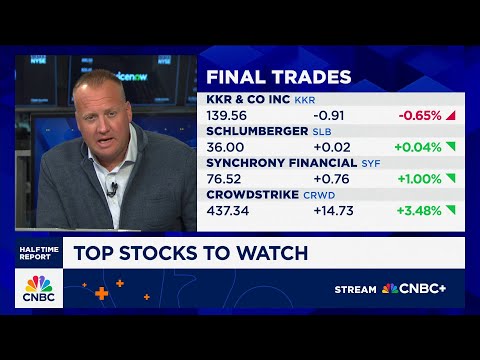
Final Trades: KKR & Co, Schlumberger, Synchrony Financial and CrowdStrike
CNBC Television· 2025-08-28 17:28
Investment Recommendations - KKR's stock experienced a 10% sell-off post-earnings, but presents a potentially favorable entry point due to strong growth [1] - Sirat slumberjier oil services is expected to see increased revenue, making the stock a potentially good buy due to being out of favor [1] - Synchrony Financial is highlighted as a strong performer, reaching 52-week highs, reflecting a broader trend in the financial sector [1] Stock Performance & Market Trends - Interactive Brokers, previously highlighted in the $50s, has risen into the $60s, exceeding earnings expectations and being added to the S&P 500, indicating a breakout [2] - CrowdStrike is being defended as a final trade [2] - An unnamed company's report is considered "unbelievable," with its CEO regarded as the best in the space, suggesting a strong long-term hold [3]
Capital One vs. Synchrony Financial: Which Stock is a Better Pick Now?
ZACKS· 2025-08-27 16:41
Core Insights - Capital One (COF) and Synchrony Financial (SYF) are significant players in the U.S. financial services sector, focusing on credit card and consumer lending, generating revenue primarily from interest income, transaction fees, and customer spending [1][2] Group 1: Company Strategies - COF targets consumer and small business segments with a traditional banking approach, while SYF focuses more on retail and commercial customers [2] - COF's acquisition of Discover Financial Services for $35 billion in May 2025 positioned it as the largest U.S. credit card issuer by balances, enhancing its payment network capabilities [5][10] - SYF has been growing through acquisitions and partnerships, including the acquisition of Ally Financial's point-of-sale financing business in 2024 [17][18] Group 2: Financial Performance - Over the past three months, COF and SYF stocks have increased by 17.7% and 29.2%, respectively, despite facing pressures from inflation and higher interest rates [3] - COF's revenue showed a five-year CAGR of 6.5% from 2019 to 2024, while net loans held for investment recorded a CAGR of 4.3% during the same period [8] - SYF's revenues experienced a five-year CAGR of 2.6% (ended 2024), but the trend reversed in the first half of 2025 [20] Group 3: Future Outlook - Analysts project COF's revenues to grow by 34.1% and 18.5% in 2025 and 2026, respectively, with earnings expected to rise by 19.1% and 13.7% [24] - SYF's revenue growth is anticipated to be more modest, with projections of 3.1% and 5% for 2025 and 2026, respectively, while earnings are expected to surge by 25.6% and 9.7% [24] Group 4: Valuation and Comparison - COF is trading at a forward P/E of 12.51X, higher than its five-year median of 9.04X, while SYF is trading at a trailing P/TB of 8.56X, also above its five-year median of 7.45X [26] - SYF has a higher return on equity (ROE) of 21.35% compared to COF's 10.01%, indicating more efficient use of shareholder funds [28] - SYF's dividend yield of 1.59% is slightly higher than COF's 1.07%, reflecting lower growth opportunities for SYF [29] Group 5: Investment Recommendation - Given the current macroeconomic challenges, both companies are taking steps to navigate the environment, but COF's recent acquisition and growth trajectory make it a more favorable investment option compared to SYF [31][33]

How 9% Yields Can Transform Your Retirement
Seeking Alpha· 2025-08-13 11:35
Group 1 - The article emphasizes the importance of creating a portfolio that generates income without the need for selling assets, aiming to simplify retirement investing [1] - It highlights a community-focused investment service that offers model portfolios, buy/sell alerts, and various investment options for conservative investors [2] - The service promotes education and collaboration among investors, suggesting that no one should invest alone [2] Group 2 - The article mentions that the service includes features like dividend and portfolio trackers, regular market updates, and an active chat with service leaders [2] - It indicates that the recommendations provided by the service are closely monitored, with exclusive buy and sell alerts for members [4] - The article clarifies that past performance does not guarantee future results, and the views expressed may not reflect the opinions of the broader platform [5]


Here's What Happens When You Get a CD From a Bank You Don't Recognize
The Motley Fool· 2025-08-12 16:04
Core Insights - The Federal Reserve's rapid interest rate hikes have led to a significant increase in Certificate of Deposit (CD) rates, with many top-paying CDs exceeding 5% APY, some even surpassing 5.5% [1] Group 1: CD Market Dynamics - Many high-paying CDs are offered by smaller credit unions rather than well-known national banks, which may cause skepticism among potential depositors [2] - Banks utilize CDs as a strategy to attract depositors, as they earn revenue by lending at higher rates than what they offer to depositors [3] - Lesser-known banks often provide better CD rates to compete for deposits, as they lack the brand recognition of larger institutions [4] Group 2: Comparison of CD Rates - Bank of America offers lower rates on most of its CDs, even in the current high-interest environment, making them less attractive [5] - In contrast, Quontic offers a 3.25% APY on a 1-year CD with a minimum deposit of $500, while Bread Financial also provides competitive rates [6] Group 3: Safety and Trust in CD Issuers - The presence of FDIC insurance is crucial for deposit safety, covering up to $250,000 per depositor, per bank [6] - Signs of a weak bank include branch closures, increasing fees, and loss of depositors, which can indicate potential problems [7] - Many lesser-known CD issuers are likely safe, and thorough research is recommended to find the best rates [8]


Blue Owl Capital's Q2 Earnings Beat on Strong Investment Results
ZACKS· 2025-08-11 19:15
Core Insights - Blue Owl Capital Corporation (OBDC) reported a 0.4% increase in shares following the release of its second-quarter 2025 results, which were supported by strong net investment income and new investment commitments, although elevated expenses partially offset the gains [1][9] Financial Performance - Adjusted earnings per share (EPS) for Q2 2025 were 40 cents, exceeding the Zacks Consensus Estimate by 2.6%, but reflecting a 16.7% decline year over year [1][9] - Total investment income rose 22.5% year over year to $485.8 million, surpassing the consensus mark by 4.7% [2][9] - Net investment income increased 14.6% year over year to $216.7 million, exceeding the estimate of $198.2 million [3] - Total expenses grew 2.8% year over year to $266.8 million, driven by higher interest expenses, management fees, and incentive fees [4][9] - Adjusted net increase in net assets from operations was $137.5 million, marking a 12.5% improvement year over year [4] Investment Commitments and Portfolio - OBDC made total new investment commitments of $1.1 billion across six new portfolio companies and 19 existing ones [3] - As of June 30, 2025, OBDC had investments in 233 portfolio companies with an aggregate fair value of $16.9 billion, resulting in an average investment size of $72.4 million per company [3] Cash and Debt Position - The company ended Q2 2025 with a cash balance of $359.5 million, a decline of 28.9% from the end of 2024 [5] - Total assets increased by 25.5% year over year to $17.4 billion, while debt rose 23.7% to $9.2 billion [5] - OBDC had $3.7 billion of undrawn capacity under its credit facilities, with a net debt to equity ratio of 1.17X at the end of Q2 [5] Dividend and Share Repurchase - The board declared a regular dividend of 37 cents per share for Q2 2025, to be paid by September 30, 2025, along with a supplemental dividend of two cents per share [7] - OBDC has a stock repurchase program approved for up to $150 million, but no shares were repurchased in the second quarter [8]