
Danaher

Search documents
Kytopen and Aldevron Expedite Cell Therapy Manufacturing Through Their Collaborative CRISPR-mediated Cellular Engineering Workflow
Prnewswire· 2025-04-29 14:07
Core Insights - Kytopen Corp and Aldevron have entered a joint marketing agreement to enhance workflow solutions for cell therapy manufacturers by combining their technologies [1][6] - The collaboration focuses on promoting the synergies of Aldevron's Nanoplasmid™ vector technology and Kytopen's Flowfect Tx™ GMP cellular engineering platform for CRISPR-mediated engineering of primary T Cells [1][2] Technology Overview - Aldevron's Nanoplasmid vector technology offers high transgene expression and an improved safety profile, while Kytopen's Flowfect technology ensures gentle gene delivery with unlimited scalability [2][6] - The combination of these technologies results in an enhanced CRISPR-mediated T-cell engineering workflow, yielding high outputs and saving time for cell therapy developers [2][6] Upcoming Presentations - Kytopen will present a joint poster at the International Society of Cell & Gene Therapy (ISCT) Annual Meeting from May 7-10, 2025, in New Orleans, showcasing data on increased yield and manufacturing ease compared to viral and electroporation technologies [3][6] - A Global Showcase Oral Presentation will also be held on May 8, 2025, highlighting a fully validated, non-viral GMP platform for engineered cell manufacture at clinical and commercial scales [5][6] Strategic Commitment - The collaboration reflects a shared commitment to advancing cell therapies by streamlining workflows to deliver higher yields of healthier cells [4] - The partnership aims to meet the growing patient demand as the adoption of CRISPR-based therapies accelerates [4]



Danaher(DHR) - 2025 Q1 - Earnings Call Transcript
2025-04-22 12:00
Financial Data and Key Metrics Changes - The company's Q1 2025 revenue was $5.7 billion, with core revenue flat year-over-year [15] - Gross profit margin increased by 100 basis points to 61.2%, while adjusted operating profit margin decreased by 50 basis points to 29.6% [16] - Adjusted diluted net earnings per share were $1.88, and free cash flow generated was $1.1 billion, resulting in a free cash flow to net income conversion ratio of over 110% [17] Business Line Data and Key Metrics Changes - In the biotechnology segment, core revenue increased by 7%, driven by high single-digit growth in bioprocessing [21] - Life sciences segment core revenue decreased by 4%, with low single-digit declines in instrument businesses [25] - Diagnostics segment core revenue declined by 1.5%, with clinical diagnostics essentially flat outside of China [27] Market Data and Key Metrics Changes - Core revenues in developed markets saw a slight decline in North America and a low single-digit increase in Western Europe [15] - High-growth markets experienced low single-digit growth, with solid performance outside of China offsetting a high single-digit decline within China [15] - The decline in China was attributed to volume-based procurement and reimbursement changes impacting diagnostics businesses [16] Company Strategy and Development Direction - The company is focused on delivering long-term value for shareholders while navigating a dynamic macro environment [10][13] - Investments of approximately $2 billion since 2020 have been made to expand capacity and ensure supply security [23] - The company aims to leverage the Danaher Business System (DBS) to manage supply chains and drive process improvements [12][35] Management's Comments on Operating Environment and Future Outlook - Management expressed confidence in the company's positioning despite geopolitical and trade tensions, emphasizing the strength of their recurring revenue model [11][10] - For 2025, the company expects core revenue growth of approximately 3%, with adjusted diluted EPS guidance in the range of $7.60 to $7.75 [33] - The company anticipates stable end market demand for the remainder of 2025, with a focus on addressing tariff impacts through various levers [32][46] Other Important Information - The company launched several impactful new products in Q1 2025, reinforcing competitive advantages and aiding customers in improving quality and reducing costs [18][20] - The company is prepared to address potential tariff impacts through supply chain adjustments and cost actions [50][51] Q&A Session Summary Question: Insights on bioprocessing order strength - Management noted strong orders and revenue performance in bioprocessing, expecting high single-digit core revenue growth for 2025, driven primarily by consumables [43][44] Question: Tariff impacts and offsets - Management indicated that the estimated tariff impact could be around $350 million, but they are well-positioned to offset these headwinds through various strategies [48][49] Question: Long-term outlook for China - Management believes China will remain a significant diagnostic market, with pricing adjustments aligning closer to global standards [71] Question: Genomics segment performance - Management confirmed that the pressure on Aldevron is expected to continue, but improvements are anticipated in the second half of the year [91] Question: Life sciences guidance adjustments - Management acknowledged a softening in U.S. academic and government demand, leading to a revised guidance for life sciences to flat growth for the year [110][111]
Danaher(DHR) - 2025 Q1 - Quarterly Results
2025-04-22 10:08
[Q1 2025 Performance and Outlook](index=1&type=section&id=Danaher%20Reports%20First%20Quarter%202025%20Results) [Q1 2025 Key Results](index=1&type=section&id=Key%20First%20Quarter%202025%20Results) Danaher's Q1 2025 results surpassed expectations, driven by strong bioprocessing and molecular diagnostics, with revenue at $5.7 billion and non-GAAP adjusted diluted EPS at $1.88 - Management stated that **Q1 2025 revenue, earnings, and cash flow exceeded expectations**, highlighting momentum in bioprocessing and better-than-expected respiratory demand in the molecular diagnostics business[2](index=2&type=chunk) Q1 2025 Financial Highlights | Metric | Value | Change (YoY) | | :--- | :--- | :--- | | Revenues | $5.7 billion | -1.0% | | Non-GAAP Core Revenue | Flat | 0.0% | | Net Earnings | $1.0 billion | - | | GAAP Diluted EPS | $1.32 | - | | Non-GAAP Adjusted Diluted EPS | $1.88 | - | | Operating Cash Flow | $1.3 billion | - | | Non-GAAP Free Cash Flow | $1.1 billion | - | [2025 Outlook](index=1&type=section&id=Second%20Quarter%20and%20Full%20Year%202025%20Outlook) Danaher forecasts low-single-digit non-GAAP core revenue growth for Q2 2025, maintaining full-year guidance of approximately 3% growth and initiating adjusted diluted EPS guidance of $7.60 to $7.75 Q2 and Full Year 2025 Guidance | Period | Metric | Guidance | | :--- | :--- | :--- | | Q2 2025 | Non-GAAP Core Revenue Growth (YoY) | Low-single digits | | Full Year 2025 | Non-GAAP Core Revenue Growth (YoY) | ~3.0% | | Full Year 2025 | Non-GAAP Adjusted Diluted EPS | $7.60 - $7.75 | - The company provides guidance on a non-GAAP basis due to the difficulty in estimating certain components of GAAP measures, such as currency translation, acquisitions, and discrete tax items[3](index=3&type=chunk) [Financial Statements](index=3&type=section&id=CONSOLIDATED%20CONDENSED%20STATEMENTS%20OF%20EARNINGS) [Consolidated Condensed Statements of Earnings (GAAP)](index=3&type=section&id=CONSOLIDATED%20CONDENSED%20STATEMENTS%20OF%20EARNINGS) In Q1 2025, Danaher's GAAP sales decreased to $5.74 billion from $5.80 billion, with net earnings falling to $954 million, or $1.32 per diluted share Q1 2025 vs Q1 2024 Statement of Earnings (in millions, except per share amounts) | Metric | Q1 2025 | Q1 2024 | | :--- | :--- | :--- | | Sales | $5,741 | $5,796 | | Gross Profit | $3,511 | $3,487 | | Operating Profit | $1,274 | $1,312 | | Net Earnings | $954 | $1,088 | | Diluted EPS | $1.32 | $1.45 | [Non-GAAP Financial Measures & Reconciliations](index=4&type=section&id=RECONCILIATION%20OF%20GAAP%20TO%20NON-GAAP%20FINANCIAL%20MEASURES) [Reconciliation of GAAP to Non-GAAP EPS](index=4&type=section&id=Diluted%20Net%20Earnings%20Per%20Common%20Share%20and%20Adjusted%20Diluted%20Net%20Earnings%20Per%20Common%20Share) Danaher's Q1 2025 GAAP diluted EPS of $1.32 was adjusted to a non-GAAP diluted EPS of $1.88, primarily due to amortization of intangibles and fair value losses on investments Q1 2025 EPS Reconciliation (GAAP to Non-GAAP) | Description | Per Share Amount ($) | | :--- | :--- | | **Diluted Net Earnings Per Common Share (GAAP)** | **$1.32** | | Amortization of acquisition-related intangible assets | $0.57 | | Fair value net losses on investments | $0.12 | | Impairments | $0.02 | | Gain on a product line disposition | ($0.01) | | Tax effect of adjustments | ($0.13) | | Discrete tax adjustments | ($0.01) | | **Adjusted Diluted Net Earnings Per Common Share (Non-GAAP)** | **$1.88** | [Segment Performance](index=5&type=section&id=Sales%20%28Decline%29%20Growth%20by%20Segment%20and%20Core%20Sales%20Growth%20%28Decline%29%20by%20Segment) In Q1 2025, Biotechnology drove growth with a **7.0%** non-GAAP core sales increase, offset by declines in Life Sciences and Diagnostics, resulting in flat total company non-GAAP core sales Q1 2025 Year-over-Year Growth by Segment | Segment | Total Sales Growth (GAAP) | Core Sales Growth (Non-GAAP) | | :--- | :--- | :--- | | Biotechnology | 6.0% | 7.0% | | Life Sciences | (3.5)% | (4.0)% | | Diagnostics | (3.0)% | (1.5)% | | **Total Company** | **(1.0)%** | **— %** | [Cash Flow Reconciliation](index=5&type=section&id=Cash%20Flow%20and%20Free%20Cash%20Flow) Net cash from operating activities decreased to **$1.30 billion** in Q1 2025, resulting in non-GAAP free cash flow of **$1.06 billion** after capital expenditures Q1 2025 vs Q1 2024 Cash Flow (in millions) | Metric | Q1 2025 | Q1 2024 | | :--- | :--- | :--- | | Net cash provided by operating activities (GAAP) | $1,299 | $1,739 | | Less: Capital expenditures | ($245) | ($291) | | **Free cash flow (non-GAAP)** | **$1,060** | **$1,448** |
Enovis Announces Appointment of Damien McDonald as Chief Executive Officer
Newsfilter· 2025-04-02 10:30
Core Points - Enovis Corporation announced the appointment of Damien McDonald as CEO, effective May 12, 2025, succeeding Matt Trerotola who will retire [1][3] - The company expects first quarter revenues to be between $555 million and $563 million, with adjusted EBITDA projected to be between $97 million and $100 million [1][6] Leadership Transition - Sharon Wienbar, Lead Independent Director, expressed enthusiasm for McDonald's appointment, highlighting his strong track record in the medical technology sector [2] - McDonald has over 35 years of experience in the medical device industry, previously serving as CEO of LivaNova, where he improved growth, profitability, and shareholder value [2][3] - Following Trerotola's retirement, Wienbar will assume the role of independent Chair of the Board [3] Company Overview - Enovis Corporation is focused on developing clinically differentiated medical technology solutions aimed at improving patient outcomes [4] - The company emphasizes a culture of continuous improvement and innovation, with a diverse range of products and services in orthopedics and beyond [4]

Danaher: Some Near-Term Headwinds, But Good Long-Term Prospects And Low Valuations
Seeking Alpha· 2025-03-31 03:19
Group 1 - Danaher (NYSE: DHR) is positioned for revenue growth despite facing near-term challenges [1] - The Biotechnology segment is experiencing strong order trends and increasing demand for monoclonal antibodies and biosimilars, which are expected to drive revenue growth [1] - The Life Sciences segment's sales are anticipated to be impacted, although specific details on the extent of this impact are not provided [1]

In-Vitro Diagnostics Technology and Global Market Report 2025-2029: Rise in Home Care Testing Devices, Demand for POC Testing Units, and Growing Demand for AI & IoT
Globenewswire· 2025-03-19 12:08
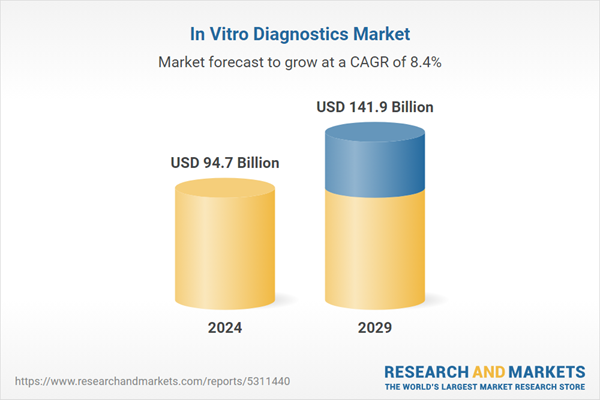
Core Insights - The In Vitro Diagnostics (IVD) market was valued at USD 94.7 billion in 2024 and is projected to reach USD 141.9 billion by 2029, with a compound annual growth rate (CAGR) of 8.40% [1][13]. Market Overview - The report covers IVD technologies and devices used in hospitals and point-of-care facilities for disease diagnosis, detailing current and future market potential, competitive environment, and market dynamics [2][5]. - IVDs are crucial in the healthcare industry, encompassing analyzers, reagents, and software products, and are used for diagnosing infectious and chronic diseases [5][6]. Market Segmentation - The immunochemistry segment was valued at USD 31.1 billion in 2023, with an estimated growth rate of 5.5% CAGR, attributed to increased diagnostic procedures and demand for blood sample analysis [4]. - The report includes market analysis by technology, application, end user, and region, highlighting segments such as molecular diagnostics, hematology, and point-of-care testing [17]. Market Drivers and Trends - Key drivers for market growth include aging demographics, rising healthcare demands in developing countries, and a shift towards preventive healthcare [7]. - Emerging segments like companion diagnostics and next-generation sequencing are expected to significantly contribute to market growth [7]. Competitive Landscape - North America is the largest market for IVDs, with emerging markets in India, China, Russia, and Brazil expected to grow at double-digit rates due to increasing healthcare budgets and health awareness [9]. - The report assesses the competitive landscape, including market shares of key players such as F. Hoffmann-La Roche Ltd., Abbott, and Siemens Healthineers AG [12][22]. Regulatory and Technological Developments - The report discusses the regulatory landscape for IVD products across different countries and highlights the importance of FDA approvals for new technologies [17]. - Technological advancements, including artificial intelligence and lab automation, are shaping the future of IVDs, enhancing diagnostic capabilities and efficiency [17].
China Healthcare_ Medical Devices_ Accelerating VBP expansion; focus on targets for next round, with direction likely to remain consistent
2025-03-14 04:56
Summary of the Conference Call on China Healthcare: Medical Devices Industry Overview - The report focuses on the **China Healthcare** sector, specifically the **Medical Devices** industry, and discusses the impact of **Volume-Based Procurement (VBP)** policies on various product categories from 2025 onwards [1][2]. Key Points and Arguments VBP Expansion and Product Coverage - VBP has expanded significantly since its initiation in 2020, now covering a majority of product categories including medical consumables, IVD, insulin, and TCM products [2][11]. - The **6th batch of national VBP** is set to launch in the second half of 2025, which may include high-value consumables and TCM products [2][11]. Policy Maturity and Pricing Impact - The VBP policy has matured, with established rules for initial coverage and renewals, including grouping, ceiling prices, and revival mechanisms [3][14]. - The impact on ex-factory prices for consumables is expected to be largely one-time, focusing on regulating channel markups rather than ongoing price erosion [3][19]. Market Dynamics and Consolidation - Leading domestic players are positioned to consolidate market share post-VBP, benefiting from increased hospital coverage and better alignment with incentives compared to multinational corporations (MNCs) [4][31]. - Smaller players are likely to lose market share due to the competitive pressures from larger domestic firms [4][31]. Stock Implications - Preference is given to companies where the VBP impact is already priced in, with expectations of normalized growth and market share gains, such as **Eyebright**, **SNIBE**, **AK Medical**, and **Weigao** [5]. Earnings Volatility and Inventory Management - Near-term earnings volatility is anticipated for products with high channel inventory, particularly in categories like artificial joints [21]. - Companies like **AK Medical** have issued profit warnings due to inventory destocking and impairment losses [21]. Pricing Trends and Margin Stability - Historical data shows that pricing cuts from VBP have become more moderate over time, with average cuts decreasing from 76% in 2020 to 41% in 2023 for drug-eluting stents [19][30]. - Post-VBP margins for Chinese players have stabilized at 15-20%, comparable to global peers [20][30]. Product Upgrades and Market Share Changes - There is a trend towards product upgrades post-VBP, with higher-end products gaining market share due to increased affordability and reimbursement coverage [32][34]. - MNCs have seen a decline in market share across various product categories, while domestic players have gained significantly [34][36]. Future Considerations - The report highlights the need for clarity on the impact of VBP on large-scale imaging equipment and the upcoming DRG/DIP rules set to roll out in 2025 [46][49]. - Potential savings from VBP are estimated at **Rmb 80 billion** for the insurance fund, contributing to overall healthcare expense reductions [50][53]. Additional Important Insights - The report emphasizes the importance of strategic shifts by MNCs, such as J&J's move to direct sales, which has not yielded expected results [31]. - Companies are advised to monitor the evolving landscape of VBP and its implications for pricing strategies and market positioning [59][64]. This summary encapsulates the critical insights from the conference call regarding the current state and future outlook of the medical devices sector in China, particularly in relation to VBP policies and their implications for market dynamics and company performance.
Acacia(ACTG) - 2024 Q4 - Earnings Call Transcript
2025-03-13 19:52
Financial Data and Key Metrics Changes - For Q4 2024, consolidated revenue was $48.8 million, with total company adjusted EBITDA of $4.9 million and operated segment adjusted EBITDA of $9.6 million [14][29] - For the full year 2024, consolidated revenue was $122.3 million, down from $125.1 million in 2023, with total company adjusted EBITDA of $17 million [36][40] - The net loss for Q4 2024 was $13.4 million, or $0.14 per share, compared to a net income of $74.8 million, or $0.75 per share in Q4 2023 [34][36] Business Line Data and Key Metrics Changes - Energy operations generated $17.3 million in revenue for Q4 2024, significantly up from $0.8 million in the same quarter last year [29] - Manufacturing operations, following the acquisition of Deflecto, generated $23.2 million in revenue for Q4 2024 [30] - Industrial operations generated $8.2 million in revenue for Q4 2024, a slight decrease from $8.6 million in the same quarter last year [30] - Intellectual property operations generated $0.1 million in licensing revenue during Q4 2024, down from $82.8 million in the same quarter last year [30][26] Market Data and Key Metrics Changes - The energy vertical reported Benchmark's highest ever revenue this quarter, demonstrating effective operational strategies [19] - The manufacturing operations are expected to improve earnings leverage as market conditions rebound [24] Company Strategy and Development Direction - The company aims to maximize value through disciplined capital allocation and strategic acquisitions, focusing on operational efficiencies and integration of acquired businesses [9][45] - The strategy includes evaluating potential acquisition targets in both private and public markets while maintaining a strong balance sheet [46][47] Management's Comments on Operating Environment and Future Outlook - Management expressed confidence in navigating macroeconomic uncertainties and highlighted the stability offered by the company's diversified asset base [47] - The company plans to continue optimizing existing assets and exploring new acquisition opportunities to unlock shareholder value [48] Other Important Information - The company repurchased $20 million of stock at an average price of $4.61 per share, reflecting a strategic use of shareholder capital [16] - Cash, cash equivalents, and equity securities totaled $297 million at year-end 2024, down from $403.2 million at the end of 2023, primarily due to acquisitions and stock repurchases [41][42] Q&A Session Summary Question: Thoughts on the overall economy and tariffs - Management indicated that the company is insulated from tariffs due to its market position and has plans to adjust manufacturing operations if necessary [52][54] Question: Acquisition of more wells and Cherokee play potential - Management confirmed ongoing evaluation of asset packages for acquisition, focusing on operational scalability rather than geographical expansion [61][64] Question: Deflecto's gross margin performance - Management acknowledged that the fourth quarter is seasonally weak but remains committed to achieving the targeted gross margin of 15% [66] Question: Cash levels and acquisition strategy - Management clarified that the increase in cash levels is due to effective cash flow generation from acquired businesses [92] Question: Flexibility in private equity pricing - Management noted that while private equity firms typically seek high prices, there are opportunities for reasonable valuations, especially for businesses that may not fit traditional private equity models [96][97]

Membrane Chromatography Market Analysis Report 2025-2030, with 3M, Asahi Kasei, Danaher, Merck, Cole-Parmer Instrument, Thermo Fisher Scientific, Sartorius, Air Products, Purilogics and Restek
Globenewswire· 2025-03-13 16:13
Core Insights - The global membrane chromatography market is projected to grow from an estimated USD 324.4 million in 2024 to USD 779.3 million by 2030, with a compound annual growth rate (CAGR) of 16.0% from 2025 to 2030 [3][7]. Market Overview - The growth of the membrane chromatography market is primarily driven by the increasing demand for biopharmaceuticals and a heightened regulatory focus on cleaning validation for downstream purification processes [3][4]. - Membrane chromatography offers significant advantages over traditional column chromatography, including higher binding capacities and reduced buffer consumption, which are critical for optimizing biopharmaceutical production [3][4]. Regulatory Environment - Regulatory approvals for biopharmaceutical manufacturing are fueling market growth, as evidenced by Boehringer Ingelheim Biopharmaceuticals China's successful pre-approval inspections by the European Medicines Agency and the U.S. Food and Drug Administration in April 2024 [5]. - The increasing endorsement of biopharmaceuticals by regulatory bodies is driving demand for membrane chromatography [5]. Research and Development - The biopharmaceutical industry's annual R&D spending exceeds USD 202 billion, significantly outpacing other sectors, which underscores the commitment to innovation and the growing number of product launches [6]. - Innovations such as Waters Corporation's introduction of the XBridge Premier GTx BEH SEC columns in August 2023 for gene therapy applications exemplify advancements in membrane chromatography technology [6]. Market Segmentation - The report segments the global membrane chromatography market based on product, technique, end use, and region, providing a comprehensive analysis of trends and forecasts from 2018 to 2030 [2][8]. - Key product segments include capsules, cassettes, cartridges, syringe filters, and membrane filters, among others [8][10]. Competitive Landscape - The competitive landscape includes major players such as 3M, Asahi Kasei, Danaher, Merck, and Thermo Fisher Scientific, highlighting the diverse market participants and their strategic positioning [10][12].

海外CXO/生命科学上游2024和4Q24业绩剖析:C(D)MO和生命科学上游表现亮眼,临床CRO需求滑坡
Zhao Yin Guo Ji· 2025-03-12 11:04
Investment Rating - The report rates Thermo Fisher as "Buy" with a target price indicating a potential upside of 31.8% [2] Core Insights - The performance of C(D)MO and life sciences upstream companies is showing positive trends, while clinical CRO companies are experiencing a decline in demand [1][4] - The overall revenue and profit growth for the tracked companies in 2024 remains under pressure, but half of them showed improvement in the second half of 2024 compared to the first half [6][7] - The demand outlook for 2025 varies significantly across different segments, with C(D)MO and life sciences upstream companies being optimistic, while clinical CRO companies maintain a cautious stance [1][4][38] Summary by Sections Profit Recovery - Profit recovery is outpacing revenue recovery, with the median and average profit growth rates for the industry in 2024 at +2.4% and +3.5%, respectively, compared to -6.2% and -7.2% in 2023 [7][24] - The average gross margin for the tracked companies decreased from 46.4% in 2022 to 41.7% in 2024, indicating pressure from demand weakness [24][25] Demand Trends - C(D)MO companies are witnessing strong commercial production demand, with Lonza and Samsung Bio reporting significant growth in their C(D)MO revenues [38][39] - Life sciences upstream companies are benefiting from the completion of inventory destocking by downstream clients, leading to a recovery in demand [39][40] 2025 Performance Guidance - C(D)MO and life sciences upstream companies are providing improved performance guidance for 2025, while clinical CRO companies are showing a notable deterioration in their outlook [1][4][39] - Lonza expects its C(D)MO revenue growth to approach 20% in 2025, while Samsung Bio anticipates a continued growth of 20-25% [1][4] Long-term Growth Support - The global healthcare financing is stabilizing, with a 1.4% year-on-year increase in 2024, marking the first positive growth since 2021 [1][4] - Pharmaceutical companies' strong free cash flow will continue to support innovation and research and development [1][4] Market Reactions - Following the 4Q24 earnings releases, stock price reactions varied significantly across different segments, with C(D)MO and clinical pre-CRO stocks performing better than life sciences upstream and clinical CRO stocks [30][31]


