
MediaTek

Search documents
全球智能手机 AP-SoC 市场份额:按季度分析(2023 年 Q2 - 2024 年 Q4)
Counterpoint Research· 2025-03-27 03:49
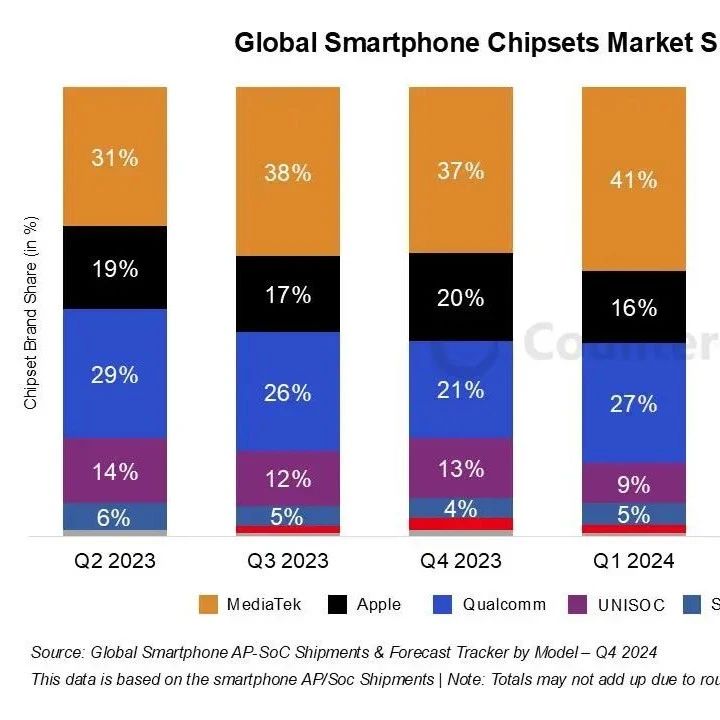
Core Insights - The global smartphone chip market is experiencing shifts in market share among key players, with MediaTek leading in Q2 2023 and projected to maintain a strong position through Q4 2024 [4][5] - Apple is expected to see an increase in chip shipments in Q4 2024 due to the launch of the A18 series [6] - Qualcomm's chip shipments are projected to decline slightly in Q4 2024, but revenue growth is anticipated due to strong demand in the high-end market [6] Market Share Overview - MediaTek's market share is projected to fluctuate from 31% in Q2 2023 to 34% in Q2 2024, with a peak of 41% in Q1 2024 [4] - Apple's market share is expected to decrease from 19% in Q2 2023 to 13% in Q2 2024, with a rebound to 23% in Q4 2024 [4] - Qualcomm's share is forecasted to drop from 29% in Q2 2023 to 30% in Q2 2024, but will decline to 21% by Q4 2024 [4] - UNISOC is projected to increase its share from 14% in Q2 2023 to 15% in Q2 2024, maintaining a steady presence [4] - Samsung's market share is expected to remain low, fluctuating between 4% and 6% throughout the forecast period [4] Company-Specific Developments - MediaTek is set to increase overall shipments in Q4 2024, driven by the launch of new high-end chips and stable LTE chip shipments [6] - Qualcomm anticipates a slight decline in shipments but expects revenue growth from the Snapdragon 8 Elite, which is in demand among multiple smartphone brands [6] - Samsung's Exynos chip shipments are expected to remain stable, with growth in specific models like Exynos 2400 and Exynos 1480 due to new product launches [6] - UNISOC is expanding its presence in the low-end market, benefiting from the adoption of its LTE chips by leading manufacturers [6]

TrendForce:英伟达已成IC设计霸主
半导体芯闻· 2025-03-17 10:42
Core Insights - The article highlights the significant growth in the semiconductor industry driven by the AI boom, with the top ten IC design companies projected to generate a combined revenue of approximately $249.8 billion in 2024, marking a 49% year-over-year increase [1][5]. Group 1: Market Overview - The AI trend is leading to a monopolistic situation in the semiconductor IC industry, as high-end chips require substantial capital and advanced technology, creating high entry barriers for new players [2]. - NVIDIA is expected to dominate the market with a projected revenue of $124.4 billion in 2024, reflecting a staggering 125% growth, capturing 50% of the top ten companies' revenue [5]. Group 2: Key Players and Performance - Broadcom is anticipated to achieve a semiconductor revenue of $30.6 billion in 2024, an 8% increase, with over 30% of its semiconductor solutions coming from AI chips [2]. - AMD's revenue is projected to reach $25.8 billion in 2024, a 14% increase, driven by significant growth in its server CPU business, which is expected to grow by 94% [3]. - Qualcomm's revenue is expected to be $34.9 billion in 2024, a 13% increase, as it focuses on AI PC and edge computing devices [3]. - MediaTek is projected to generate $16.5 billion in revenue in 2024, a 19% increase, with expectations of a 65% penetration rate in the 5G smartphone market by 2025 [3]. Group 3: Rankings and Revenue Changes - Realtek is expected to achieve a revenue of approximately $3.5 billion in 2024, a 16% increase, with growth driven by PC and automotive-related shipments [4]. - Will Semiconductor's revenue is projected to reach $3.0 billion in 2024, a 21% increase, benefiting from the rising demand for high-end CIS in Android smartphones and electric vehicle applications [4]. - MPS is anticipated to generate $2.2 billion in revenue in 2024, a 21% increase, due to its PMIC products entering the AI server supply chain [4].

The 720_ Global Views, MediaTek, BEKE, Coupang, China Spirits, US Internet
2025-03-14 04:56
Summary of Key Points from Conference Call Industry Overview - **US GDP Growth Forecast**: The 2025 US GDP growth forecast has been downgraded from 2.4% to 1.7% on a Q4/Q4 basis, marking the first below-consensus forecast in 2.5 years. This downgrade is attributed to more adverse trade policy assumptions rather than recent economic data, which remains relatively strong [1][1][1]. Company-Specific Insights MediaTek - **Automotive Sector Growth**: MediaTek's earnings estimates have been raised due to expected growth in the automotive Total Addressable Market (TAM). By 2026E/2027E, the automotive business is projected to contribute 3.6%/6.8% to total revenue, up from 1.8% in 2025E. This growth is driven by market share gains in automotive cockpit SoC solutions and upgrades to mid to high-end segments with higher Average Selling Prices (ASPs) [2][4][4]. BEKE (KE Holdings) - **Southbound Connect Inclusion**: KE Holdings' H-shares have been included in the Southbound Connect, which is expected to support share price growth. Southbound turnover share in the Hong Kong exchange has increased to over 20% year-to-date, with southbound holdings averaging 8% of total share count. The company is also seeing strong secondary home transaction momentum post-Chinese New Year [4][4][4]. Coupang - **Earnings Growth and Operating Leverage**: Coupang is expected to achieve over 20% top-line growth in 2025E, driven by Product Commerce and Developing Offerings. The company anticipates significant operating leverage from 2027, with a potential to reach over 10% adjusted EBITDA margin by that year [4][4][4]. GDS - **P-REIT Issuance**: GDS announced its first monetization of data center assets in China through a sale to a private REIT, receiving Rmb1.2 billion in net cash proceeds. This transaction is seen as a step towards recycling capital for further investments in AI infrastructure [5][5][5]. China Spirits - **Sales Management Measures**: Leading spirits companies, including Wuliangye, are implementing sales management measures that are expected to lead to positive sales growth in 2025. Channel inventory has decreased significantly, and wholesale prices have increased during the Lunar New Year [8][8][8]. Macro Insights - **High-tech Manufacturing in China**: High-tech manufacturing has been a significant growth driver in China, contributing an average of 1.1 percentage points to annual real GDP growth over the last decade. The sector is expected to continue outperforming the broader manufacturing sector, contributing an average of 1.0 percentage point to GDP growth from 2025 to 2029 [9][9][9]. Additional Notes - **US Internet Sector**: The Q4'24 earnings review highlights key themes such as investment in AI and consumer health, with several large-cap stocks rated as Buys [10][10][10]. - **Germany's Fiscal Shift**: Political changes in Germany are expected to unlock significant public spending, potentially benefiting various sectors beyond defense [12][12][12]. This summary encapsulates the critical insights from the conference call, focusing on industry trends, company-specific developments, and macroeconomic factors that could influence investment decisions.
NVIDIA (NVDA) Conference Transcript
2023-06-12 17:02
Summary of NVIDIA Conference Call - June 12, 2023 Company and Industry Overview - **Company**: NVIDIA (NVDA) - **Industry**: Automotive technology, specifically focusing on autonomous vehicles (AV) and related software solutions Key Points and Arguments 1. **NVIDIA's Unique Automotive Strategy**: NVIDIA provides an end-to-end platform for automotive partners, which includes tools for car design, AI model training, and simulation of AV stacks, differentiating itself from competitors who only sell chips [4][5][6] 2. **Ecosystem Approach**: NVIDIA aims to support the entire automotive ecosystem, collaborating with software companies and OEMs to enhance the development of self-driving software [6][7] 3. **Increasing Compute Requirements**: The demand for higher compute capabilities in AVs is growing due to advancements in sensor technology and the complexity of networks, necessitating a flexible, programmable architecture [10][11] 4. **Modular Architecture**: NVIDIA's architecture allows for easy upgrades and compatibility across different generations of hardware, ensuring that software can run seamlessly on newer models [12] 5. **Centralization Trend**: The industry is moving towards centralizing computing power in vehicles, reducing the number of computers needed and improving efficiency and security [13][14] 6. **Partnerships and Ecosystem Expansion**: NVIDIA is expanding its ecosystem through partnerships, such as with MediaTek, to integrate its software capabilities into third-party SoCs [15][16] 7. **Revenue Model**: NVIDIA's revenue from automotive is not solely from chip sales; software and services can represent a significant portion of revenue, especially for full-stack solutions [21][22][24] 8. **Open Ecosystem**: NVIDIA is open to working with various hardware solutions, allowing OEMs to use non-NVIDIA chips while still benefiting from NVIDIA's software and cloud services [32][34] 9. **Pipeline and Future Growth**: NVIDIA has a projected pipeline of $14 billion over the next six years, with various OEMs ramping production of new models [17][19] 10. **Cost Competitiveness**: NVIDIA's cost positioning is competitive in the L2+ and higher segments, with a focus on scalable architectures that allow customers to choose their sensor sets [60][62][64] Additional Important Insights 1. **Long-Term OEM Strategy**: OEMs are expected to develop in-house competencies for software in the long term, but many currently lack the resources and expertise to do so [52][54][57] 2. **Cautious Approach to AV Rollout**: The rollout of fully autonomous vehicles is anticipated to take longer than expected, with initial trials likely focusing on commercial goods delivery rather than passenger cars [66][68][70] 3. **Simulation Importance**: Simulation is critical for validating AV technology, as it allows for testing various scenarios without real-world risks [70] This summary encapsulates the core discussions and insights from the NVIDIA conference call, highlighting the company's strategic positioning within the automotive technology sector and its approach to fostering partnerships and innovation in autonomous vehicle development.