
China

Search documents
X @Balaji
Balaji· 2026-01-18 17:56
WHO LOST CANADA?It was obvious that China/Canada would happen. Here's how it happened, and what may happen next.(1) First, in early 2025 it looked like Canadian conservative Pierre Poilievre was a straight shot to win Canada. Instead, all the MAGA posts about annexing Canada undercut Pierre, boosted left nationalism, and turned what looked like a sure thing into an epic defeat. The result was Mark Carney:(2) Carney is on the left but is far more intelligent than his predecessor, Justin Trudeau. He's also th ...
India's exports to China surge in December while shipments to U.S. decline as Trump tariffs bite
CNBC· 2026-01-16 03:31
Core Insights - India's exports to China increased significantly by 67% in December, reaching $2 billion, while exports to the U.S. decreased by 1.8% to $6.8 billion [1] - The U.S. imposed 50% tariffs on India, affecting trade relations and prompting India to seek alternative markets [2] - India's exports to mainland China rose nearly 37% in the first nine months of the fiscal year ending March 2026, with Hong Kong shipments increasing over 25% [2] Trade Relations - China has become India's largest goods trading partner, with trade worth $110.20 billion from April to December 2025, surpassing the U.S. at $105.31 billion [4] - India has a trade surplus with the U.S. of over $26 billion, while the trade deficit with China has reached $81.7 billion during the same period [5] - In fiscal year 2025, India traded goods worth $131.84 billion with the U.S. and $127.71 billion with China, excluding Hong Kong [5] Diplomatic Engagements - India's Foreign Secretary met with a Chinese official to discuss improving bilateral ties, focusing on business and people-centric engagements [3] - Relations between India and China have been improving since a meeting between Prime Minister Modi and President Xi Jinping in September [3]


Trump says any country doing business with Iran will be hit with a 25% tariff
Business Insider· 2026-01-12 22:17
Group 1 - President Trump announced a 25% tariff on any country doing business with Iran, effective immediately [1] - The White House has not provided details on the implementation of the tariff or which countries will be affected [1] - China and the United Arab Emirates are identified as major trading partners of Iran [2] Group 2 - Trade volume between China and Iran reached $13.37 billion in 2024, with China exporting $8.93 billion and importing $4.44 billion [3] - Recent data indicates that in October 2025, China exported $456 million and imported $208 million from Iran [3] - The Trump administration is attempting to negotiate a trade deal with China following a previous tariff war [3] Group 3 - The announcement of the tariff coincides with mass protests in Iran against the government, which have resulted in significant casualties and arrests [4] - Trump has expressed support for the Iranian protesters and suggested potential U.S. involvement [4] - The legality of the tariffs is under review by the Supreme Court, which could have significant financial implications for the federal government [5]
Why does the Venezuela crisis matter to China? | FT #shorts
Financial Times· 2026-01-12 05:00
So what does China have at stake in the Venezuela crisis. The first thing is geopolitical influence. Since 1999 when Hugo Chavez took power in Venezuela, the country has been a springboard for China into Latin America.Today, China's bilateral trade with Latin America exceeds 500 billion with China buying commodities ranging from copper to iron ore and of course oil. But after it kidnapped Venezuelan President Nicholas Maduro, the US has made clear that the Western Hemisphere is off limits for its adversarie ...

欧元区 2026 年展望:周期性提振、结构性拖累,利率维持不变-t_ Euro Area Outlook 2026_ Cyclical Boost, Structural Drag, Unchanged Rates
2026-01-06 02:23
Summary of Euro Area Outlook 2026 Industry Overview - The report focuses on the Euro area economy and its outlook for 2026, highlighting both cyclical improvements and structural challenges. Key Points Economic Growth Forecast - Euro area growth is forecasted at **1.3%** for 2026, with a slight increase to **1.4%** on a Q4/Q4 basis, up from **1.3%** last year, aligning with consensus expectations [3][6][34] Factors Driving Cyclical Improvement 1. **German Fiscal Stimulus**: - Germany's fiscal expansion is expected to provide a significant boost, with the deficit projected to rise to **3.7%** of GDP in 2026, contributing **0.5 percentage points** to growth [9][12] 2. **Diminished Global Trade Tensions**: - The negative impact from global trade tensions is anticipated to lessen, with a previous **0.4%** hit to real GDP from tariffs expected to fade [15][19] 3. **Robust Consumer Spending**: - Real household income growth is projected at **1.5%**, with consumption growth also expected at **1.5%** in 2026, supported by lower energy prices [19][44] Structural Headwinds - Despite cyclical improvements, significant structural challenges remain: - Increased competition from China's renewed export push is expected to negatively impact European trade, particularly affecting Germany (estimated **0.9%** hit to GDP) and Italy (estimated **0.6%**) [23][30] - High energy costs, underinvestment in high-tech sectors, regulatory burdens, and demographic shifts are identified as ongoing domestic challenges [27][30] Labour Market and Inflation - Unemployment rates are expected to remain near historic lows, with wage growth projected to slow to **2.9%** by the end of 2026, aligning with a medium-term inflation target of **2%** [37][41] - Core inflation is expected to dip slightly below **2%** by the end of 2026, influenced by a stronger Euro and lower energy prices [44][50] Monetary Policy Outlook - The European Central Bank (ECB) is expected to maintain current rates in 2026, with potential cuts requiring a clear catalyst, such as a significant economic downturn or a pronounced inflation undershoot [48][51] - A return to rate hikes would depend on demand-driven inflationary pressures or significant shocks leading to deviations from inflation targets [55][56] Country-Specific Focus - **Germany**: Monitoring the quality of public spending and reform agenda is crucial for improving medium-term growth [62] - **France**: Political and fiscal risks remain, with a projected government deficit reduction from **5.4%** to **5.1%** of GDP in 2026 [66] - **Southern Europe**: Continued economic resilience is noted, with structural transformations in Spain, Portugal, and Greece [71] Policy Initiatives - EU policymakers have an opportunity to implement reforms that could enhance economic performance, focusing on reducing vulnerabilities and building a single market [74] Additional Insights - The report emphasizes the importance of monitoring fiscal policies and structural reforms across member states to sustain the cyclical recovery and address long-term challenges [4][61]

新兴市场股票策略指南:下调中国市场评级-EM_Equity_Strategy_Compass_Tailwinds_Aligning-EM_Equity_Strategy_Compass
2025-12-24 02:32
Summary of Key Points from the EM Equity Strategy Compass Industry Overview - The report focuses on Emerging Market (EM) equities, specifically the MSCI EM index, projecting a price target of 1,540 by the end of 2026, indicating approximately 13% upside from current levels [2][11]. Core Insights 1. Solid Fundamentals - EM is expected to achieve the highest EPS growth among major regions at +17% for 2026, up from +15% in 2025 [3][14]. - Valuations are currently at the 94th percentile compared to a 25-year history, suggesting that while they are stretched, they may be justifiable given the anticipated earnings growth [18][33]. 2. Federal Reserve Easing - Historical trends indicate that Fed easing typically benefits global equities, particularly in "soft landing" scenarios where economic growth continues without recession [4][21]. - EM and ex-US equities have historically performed well during such periods, suggesting potential for continued upside [24]. 3. AI Exposure - The AI thematic remains a significant driver for global equities, with EM stocks linked to AI expected to grow EPS by approximately 40% in 2026, compared to around 20% for major US companies [25][26]. - Despite recent volatility, EM AI stocks are still seen as offering attractive valuation-to-growth tradeoffs [26]. Country Allocation Adjustments - The EM country allocation is cyclically tilted with a focus on AI leverage: - **Upgrades**: Taiwan (to Overweight), UAE (to Overweight) - **Downgrades**: China (to Neutral), Poland (to Neutral), Chile (to Underweight) [6][51][53]. - Korea is highlighted as having the most bullish target with a potential upside of 37% [44]. Risks to the Outlook - Key risks include potential cracks in AI optimism, a slowdown in US economic growth, and ongoing trade tensions, particularly with China [28]. - A stronger USD could also pose challenges for EM equities, despite a weakening relationship between the dollar and EM performance [28]. Market Setup Macro Environment - The global economy is expected to maintain a "Goldilocks" scenario with resilient growth around 3%, projected to expand by 2.7% in 2026 and 2.8% in 2027 [29][30]. - EM growth is anticipated to slow slightly in 2026, primarily due to high base effects in tech exports, but regions outside Asia are expected to show solid growth [30]. Valuations - EM equities have re-rated significantly, trading above historical medians, yet still present a valuation discount compared to developed markets [33]. - Specific markets like LatAm are viewed as relatively cheap, while Asia is considered more expensive [33]. EPS Growth Projections - All major EM countries are expected to see EPS expansion in 2026, with Korea projected to lead at approximately +40% growth [35]. - The report indicates that the EPS growth and revision picture remains stronger in Taiwan, while China faces a lackluster macro outlook [51]. Conclusion - The overall outlook for EM equities remains constructive, supported by solid fundamentals, favorable macro conditions, and significant AI exposure, despite the presence of notable risks and valuation concerns [11][28].
X @Bloomberg
Bloomberg· 2025-12-23 19:42
RT Bloomberg Opinion (@opinion)Remember China’s DeepSeek moment? China had moments like that in biotech and defense in 2025, too, @shuli_ren explains.That’s why underestimating the country is a huge mistake 🎥 https://t.co/5lFbe4LWR9 ...
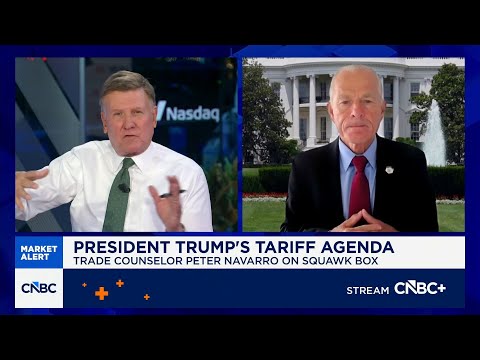
Watch CNBC's full interview with White House senior trade counselor Peter Navarro
CNBC Television· 2025-12-23 13:23
Tariffs and Trade Policy - The administration believes tariffs are not a tax on U S companies but a form of leverage against foreign countries that depend on the U S market [7][8][24] - The administration argues that countries with trade deficits with the U S depend on the U S economy and therefore bear the cost of tariffs by reducing prices [9][25] - The administration asserts that tariffs are a tool to rebalance global trade and bring back manufacturing and supply chains to the U S [19][5][14] - The administration views tariffs as a "beautiful thing" and a "dial for leverage" to negotiate trade deals and address non-tariff barriers [18][20][21] - The administration claims that tariffs have not caused inflation and are bringing investment into the U S [11][26] Manufacturing and Supply Chains - The administration acknowledges that bringing back manufacturing and supply chains takes time, similar to the time it took for China to build its manufacturing base [4][13][14] - The administration aims to bring back both factories and supply chains to the U S, emphasizing the national security aspects of domestic production [5][14] - The administration suggests that construction jobs will come first, followed by manufacturing jobs, as investment increases [6] Economic Outlook - The speaker expressed optimism about the economy, predicting the Dow Jones Industrial Average would reach 50,000 [16] - The administration is focusing on reducing inflation by addressing key areas such as housing, healthcare, and food [17] - The administration anticipates a great year in 2026, with tariffs playing a significant role in bringing investment [17][18]
X @The Economist
The Economist· 2025-12-23 12:20
The power of China’s industrial chokeholds was shown in 2025. The country’s share of global manufacturing value added exceeds one-third, giving it the power to disrupt supply chains overnight https://t.co/dOV5xb52l5 ...
X @The Wall Street Journal
The Wall Street Journal· 2025-12-23 09:43
China has an ace to play in the global AI contest: the biggest power grid the world has ever seen https://t.co/iZpeGMIczT ...