Vanguard

Search documents
Think You Missed the Boat? Why These ETFs Are Poised for a Run.
The Motley Fool· 2025-08-18 08:03
Core Insights - The article highlights that certain ETFs, specifically the Invesco QQQ Trust, Vanguard Growth ETF, and Vanguard S&P 500 ETF, have shown strong returns over the past year and are expected to continue delivering attractive returns in the future due to ongoing innovation and growth in their underlying companies [1][2]. Group 1: Invesco QQQ Trust - The Invesco QQQ Trust tracks the Nasdaq-100 Index, which includes the 100 largest non-financial stocks on the Nasdaq, with these companies investing approximately 11% of their annual sales in R&D over the past three years [4]. - Companies within the Nasdaq-100 have achieved compound annual growth rates of 10% or greater for revenue, earnings, and dividends over the last decade, significantly outperforming S&P 500 companies [4]. - Over the past 10 years, the Invesco QQQ Trust has gained nearly 450%, turning a $10,000 investment made a decade ago into over $54,500 today [5][6]. Group 2: Vanguard Growth ETF - The Vanguard Growth ETF tracks the CRSP US Large Cap Growth Index and currently holds 165 stocks, providing greater exposure to the fastest-growing large companies in the U.S. [7]. - The fund has produced strong returns, with a 1-year return of 24.5%, a 3-year return of 22.5%, and a 10-year return of 16.3%, turning a $10,000 investment made at inception into over $93,000 today [8]. - The Vanguard Growth ETF is well-positioned for continued strong returns due to its focus on innovation and new financial technologies [9]. Group 3: Vanguard S&P 500 ETF - The Vanguard S&P 500 ETF is the largest ETF globally by assets under management, exceeding $700 billion, and tracks the performance of the 500 largest publicly traded companies in the U.S. [10]. - Historically, the S&P 500 has averaged a 10% annual return over the past 50 years, allowing the ETF to double an investor's money approximately every seven years [11]. - While the S&P 500 may deliver lower returns compared to QQQ and VUG due to its diversification and inclusion of slower-growing companies, it offers a lower risk profile, making it an ideal long-term investment to complement higher-risk funds [12]. Group 4: Investment Outlook - The Invesco QQQ Trust, Vanguard Growth ETF, and Vanguard S&P 500 ETF are recommended as top ETFs for long-term investment, driven by ongoing economic expansion and innovation [13].


X @Investopedia
Investopedia· 2025-08-17 20:00
Thanks partly to Bogle, Buffett once won a $1 million bet that a Vanguard S&P index fund would outperform a selection of top hedge funds. https://t.co/CaC42YxT7v ...
3 ETFs That Could Generate $1 Million in Passive Income
The Motley Fool· 2025-08-16 08:15
Core Insights - Achieving $1 million in passive income is challenging, but generating smaller amounts is more feasible [5][6] - Retirement income may require selling assets or generating passive income through investments like ETFs [2][3] Portfolio Analysis - Typical dividend yields for blue-chip companies range from 2% to 4%, with some companies yielding 5% or 6% [6] - To generate $1 million annually at a 3% yield, a portfolio of approximately $33.33 million is needed, while a 6% yield requires about $16.67 million [6][8] ETF Recommendations - Three ETFs with solid dividend yields and historical returns include: - Schwab U.S. Dividend Equity ETF (SCHD) with a yield of 3.9% and 5-year average return of 11.49% [9] - Fidelity High Dividend ETF (FDVV) with a yield of 3.1% and 5-year average return of 17.56% [9] - Vanguard High Dividend Yield ETF (VYM) with a yield of 2.6% and 5-year average return of 13.79% [9] - For higher yields, the iShares Preferred & Income Securities ETF (PFF) offers a yield of 6.5%, though with lower average annual gains [10] - Covered-call ETFs like JPMorgan Equity Premium Income ETF (JEPI) and JPMorgan Equity Premium Income ETF (JEPQ) yield 8.4% and 11.2% respectively [11]

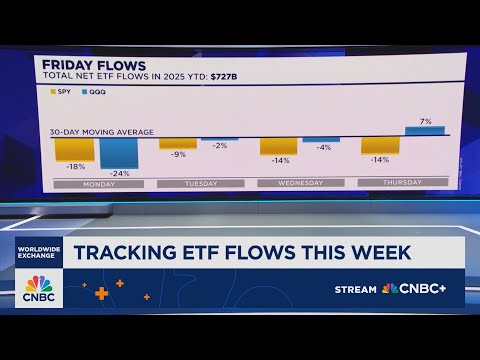
ETF Flows Shift Beyond Mag 7 as Investors Eye AI Infrastructure Opportunity
CNBC Television· 2025-08-15 13:29
All right, welcome back to Worldwide Exchange. We're tracking ETF net flows that are now over $727 billion year to date. We're also tracking the moves above and below the 30-day moving averages for the popular index funds, the SPY and the Triple Q's.This week, for the most part, investors moving away from the MAG 7 heavy ETFs. The ARC Innovation Fund uh seeing the top inflows this week as investors look for gains in tech outside of the MAG 7 again as the major indices hit record highs. two Vanguard bond foc ...
Is Nuveen ESG Large-Cap Value ETF (NULV) a Strong ETF Right Now?
ZACKS· 2025-08-15 11:20
Core Viewpoint - The Nuveen ESG Large-Cap Value ETF (NULV) is a smart beta ETF launched on December 13, 2016, providing broad exposure to the large-cap value market segment [1] Fund Overview - NULV is sponsored by Nuveen and has accumulated assets exceeding $1.78 billion, categorizing it as an average-sized ETF in the large-cap value space [5] - The fund aims to replicate the performance of the TIAA ESG USA Large-Cap Value Index, which includes equity securities from large-cap companies listed on U.S. exchanges [5] Cost Structure - NULV has an annual operating expense ratio of 0.26%, which is competitive within its peer group [6] - The fund's 12-month trailing dividend yield is reported at 1.93% [6] Sector Allocation and Holdings - The ETF has a significant allocation in the Financials sector, comprising approximately 22.2% of the portfolio, followed by Healthcare and Industrials [7] - Procter & Gamble Co (PG) represents about 2.61% of total assets, with Bank of America Corp (BAC) and International Business Machines (IBM) also among the top holdings [8] - The top 10 holdings account for roughly 22.35% of total assets under management [8] Performance Metrics - As of August 15, 2025, NULV has gained approximately 8.46% year-to-date and about 11.83% over the past year [10] - The fund has traded between $36.02 and $43.28 in the last 52 weeks, with a beta of 0.88 and a standard deviation of 14.28% over the trailing three-year period [10] Alternatives - Other ETFs in the large-cap value space include Vanguard ESG U.S. Stock ETF (ESGV) with $11.13 billion in assets and iShares ESG Aware MSCI USA ETF (ESGU) with $14.28 billion [12] - ESGV has an expense ratio of 0.09%, while ESGU charges 0.15%, presenting lower-cost options for investors [12]

Should Janus Henderson Small Cap Growth Alpha ETF (JSML) Be on Your Investing Radar?
ZACKS· 2025-08-15 11:20
Core Viewpoint - The Janus Henderson Small Cap Growth Alpha ETF (JSML) provides broad exposure to the Small Cap Growth segment of the US equity market, with a focus on small-cap companies that have high growth potential but also higher risks [1][2]. Group 1: Fund Overview - JSML is a passively managed ETF launched on February 23, 2016, and has accumulated assets over $207.21 million, positioning it as an average-sized ETF in its category [1]. - The ETF has annual operating expenses of 0.3% and a 12-month trailing dividend yield of 1.63%, making it competitive with peer products [4]. Group 2: Investment Characteristics - Small cap companies, defined as those with market capitalizations below $2 billion, typically exhibit higher growth potential compared to larger companies, albeit with increased risk [2]. - Growth stocks, which JSML targets, are characterized by faster growth rates, higher valuations, and above-average sales and earnings growth, but they also come with higher volatility [3]. Group 3: Sector Exposure and Holdings - The ETF has a significant allocation to the Industrials sector, comprising about 21.9% of the portfolio, followed by Information Technology and Financials [5]. - The top holding, Sterling Infrastructure Inc. (STRL), accounts for approximately 2.23% of total assets, with the top 10 holdings representing about 18.94% of total assets under management [6]. Group 4: Performance Metrics - As of August 15, 2025, JSML has gained approximately 8.61% year-to-date and 18.23% over the past year, with a trading range between $54.00 and $73.60 in the last 52 weeks [8]. - The ETF has a beta of 1.24 and a standard deviation of 23.03% over the trailing three-year period, indicating a diversified approach to mitigate company-specific risk [8]. Group 5: Alternatives - Other ETFs in the small-cap growth space include the iShares Russell 2000 Growth ETF (IWO) with $12.12 billion in assets and the Vanguard Small-Cap Growth ETF (VBK) with $19.65 billion, offering lower expense ratios of 0.24% and 0.07%, respectively [11]. Group 6: Market Trends - There is a growing trend among retail and institutional investors towards passively managed ETFs due to their low costs, transparency, flexibility, and tax efficiency, making them suitable for long-term investment strategies [12].

Is WisdomTree U.S. LargeCap Dividend ETF (DLN) a Strong ETF Right Now?
ZACKS· 2025-08-15 11:20
Core Viewpoint - The WisdomTree U.S. LargeCap Dividend ETF (DLN) is a smart beta ETF that aims to provide broad exposure to the large-cap value segment of the market, with a focus on dividend-paying stocks [1][5]. Fund Overview - DLN was launched on June 16, 2006, and has accumulated over $5.22 billion in assets, positioning it as one of the larger ETFs in its category [1][5]. - The fund seeks to match the performance of the WisdomTree U.S. LargeCap Dividend Index, which is fundamentally weighted and measures the performance of large-cap U.S. dividend-paying stocks [5]. Cost and Performance - The annual operating expenses for DLN are 0.28%, which is competitive within its peer group [6]. - The ETF has a 12-month trailing dividend yield of 1.90% [6]. - Year-to-date, DLN has gained approximately 10.24%, and it has increased about 15.77% over the past year, with a trading range between $70.70 and $84.97 in the last 52 weeks [8]. Risk Profile - DLN has a beta of 0.81 and a standard deviation of 13.50% over the trailing three-year period, indicating a medium risk profile [9]. - The fund holds approximately 307 stocks, which helps to diversify company-specific risk [9]. Sector Exposure and Holdings - The fund's assets are primarily in U.S. dollars, with major holdings including Microsoft Corp (MSFT) and JPMorgan Chase & Co (JPM) [7]. - The top 10 holdings account for about 125.52% of total assets under management, indicating a concentrated investment strategy [7]. Alternatives - Other ETFs in the large-cap value space include Schwab U.S. Dividend Equity ETF (SCHD) and Vanguard Value ETF (VTV), which have significantly larger asset bases and lower expense ratios [11].

Even at an All-Time High, The Vanguard S&P 500 ETF Isn't as Expensive as It Seems
The Motley Fool· 2025-08-14 19:22
Core Viewpoint - The elevated valuation of the S&P 500 is supported by logical factors, suggesting that it may still represent a good investment opportunity despite its all-time high levels [2][14]. Valuation Analysis - The Vanguard S&P 500 ETF is the largest S&P 500 fund with over $1.5 trillion in assets and has seen an 8.5% increase year-to-date and a 66.4% increase since the start of 2023 [1][2]. - The S&P 500's price appreciation has outpaced its operating earnings per share (EPS), leading to an expanded valuation, with the index rising 10.7% over the past year compared to a 3.5% increase in operating EPS [6][4]. - The forward price-to-earnings (P/E) ratio of the S&P 500 is currently 22.2, which is a 20% premium over its 10-year average of 18.5, indicating a perception of overvaluation [8]. Factors Supporting Valuation Expansion - Increased efficiency in business operations due to technological advancements, such as the internet and AI, is expected to enhance company performance and justify higher valuations over time [9][10]. - The growing proportion of growth-focused companies within the S&P 500 is likely to contribute to a natural rise in the index's valuation as these companies reinvest profits for future growth [11]. Market Dynamics - The current market environment, characterized by growth-driven companies, has improved the quality of S&P 500 earnings and projected growth rates, although it may also lead to increased market volatility [13]. - The S&P 500 is argued to deserve a higher valuation than historical averages, suggesting that ETFs tracking the index may not be as overvalued as they appear [14].

澳洲ETF基金规模创历史新高 距3000亿澳元大关仅一步之遥 比特币再创历史新高 有望攀升至15万美元
Sou Hu Cai Jing· 2025-08-14 11:45
Group 1: Wage Growth in Australia - Australia's wage price index (WPI) increased by 0.8% quarter-on-quarter and 3.4% year-on-year in Q2 2023, matching the year-on-year growth rate of Q1 but lower than the 4.1% recorded in the same period last year [1] - Private sector wages rose by 0.8% quarter-on-quarter and 3.4% year-on-year, while public sector wages increased by 1.0% quarter-on-quarter and 3.7% year-on-year [1] Group 2: ETF Market Growth - The total size of Australian exchange-traded funds (ETFs) reached a record high of AUD 289.2 billion in July 2023, just shy of the AUD 300 billion mark [1] - Net inflows into ETFs amounted to AUD 5.82 billion in July, surpassing the previous record by AUD 1 billion, with a total increase of AUD 8.7 billion, representing a 3.1% growth [1] - Year-on-year, the ETF market grew by AUD 73.6 billion, reflecting a 34.1% increase [1] Group 3: Bitcoin and Cryptocurrency Market - Bitcoin has reached a new all-time high of USD 123,624, surpassing the previous record of USD 123,236 [5] - Analysts suggest that if Bitcoin breaks the USD 125,000 mark, the next target could be USD 150,000, while Ethereum may rise to USD 5,500 if it surpasses its historical high [5] Group 4: Healthcare Sector Developments - Luye Medical Group is restarting the sale of its Australian mental health service provider, Aurora Healthcare, which it acquired for approximately AUD 938 million in 2016 [6] - The sale was previously halted due to a challenging operating environment post-pandemic, with a notable decline in patient numbers [6] Group 5: CBA and OpenAI Collaboration - Commonwealth Bank of Australia (CBA) has signed a partnership with OpenAI to develop AI services for customers and employees [10] - The collaboration aims to enhance fraud detection capabilities and provide personalized services, while also focusing on training employees in AI applications [10]

Should WisdomTree U.S. SmallCap ETF (EES) Be on Your Investing Radar?
ZACKS· 2025-08-14 11:21
Core Viewpoint - The WisdomTree U.S. SmallCap ETF (EES) provides broad exposure to the Small Cap Value segment of the US equity market, with assets exceeding $624.15 million, making it a mid-sized ETF in this category [1]. Group 1: Small Cap Value Characteristics - Small cap companies are defined as those with market capitalizations below $2 billion, typically presenting higher potential but also higher risk compared to larger companies [2]. - Value stocks are characterized by lower price-to-earnings and price-to-book ratios, but they also exhibit lower sales and earnings growth rates. Historically, value stocks have outperformed growth stocks in most markets, although growth stocks tend to perform better in strong bull markets [3]. Group 2: Costs and Performance - The ETF has an annual operating expense ratio of 0.38%, which is competitive within its peer group, and it offers a 12-month trailing dividend yield of 1.31% [4]. - EES aims to match the performance of the WisdomTree U.S. SmallCap Earnings Index, which focuses on earnings-generating companies in the small-cap segment [7]. - As of August 14, 2025, the ETF has gained approximately 2.5% year-to-date and 13.06% over the past year, with a trading range between $42.54 and $58.78 in the last 52 weeks. It has a beta of 1.10 and a standard deviation of 22.14% over the trailing three years, indicating medium risk [8]. Group 3: Sector Exposure and Holdings - The ETF has a significant allocation to the Energy sector, with the top three sectors being Energy, Industrials, and Materials [5]. - The top holdings include Valaris Ltd and Brighthouse Financial Inc, with the top 10 holdings accounting for approximately 106.07% of total assets under management [6]. Group 4: Alternatives and Market Position - The WisdomTree U.S. SmallCap ETF holds a Zacks ETF Rank of 3 (Hold), indicating a favorable option for investors seeking exposure to the Small Cap Value area [9]. - Alternative ETFs in this space include the iShares Russell 2000 Value ETF (IWN) with $11.46 billion in assets and the Vanguard Small-Cap Value ETF (VBR) with $31.09 billion in assets, both of which have lower expense ratios compared to EES [10]. Group 5: Investment Appeal - Passively managed ETFs like EES are popular among both institutional and retail investors due to their low costs, transparency, flexibility, and tax efficiency, making them suitable for long-term investment strategies [11].