Vanguard

Search documents
1 No-Brainer Vanguard ETF to Invest $1,000 Into This July
The Motley Fool· 2025-07-20 13:10
Core Viewpoint - The Vanguard S&P 500 ETF is presented as a strong investment option for passive investors, providing exposure to the performance of the S&P 500 and benefiting from the growth of large U.S. companies [4][5][6]. Group 1: ETF Overview - The Vanguard S&P 500 ETF (VOO) tracks the S&P 500, which includes 500 large and profitable U.S. businesses, serving as a benchmark for market performance [4]. - The ETF offers immediate diversification across all sectors of the economy, with a significant concentration in the largest companies, including Nvidia, Microsoft, Apple, Amazon, and Meta Platforms, which together account for 27.2% of the asset base [6]. Group 2: Performance Metrics - Over the past decade, the Vanguard S&P 500 ETF has achieved a total return of 254%, meaning a $1,000 investment would have grown to $3,540 by July 15 [7]. - Key factors driving past gains include low interest rates, increased capital inflow into passive investment vehicles, and the rise of powerful technology companies [8]. Group 3: Investment Strategy - The ETF is characterized by a low expense ratio of 0.03%, making it a cost-effective option for investors looking to grow their savings without extensive research [9]. - Despite market volatility, the S&P 500 is trading at record levels as of July 15, and the article emphasizes the importance of investing early and consistently rather than trying to time the market [10][12].


The Smartest S&P 500 ETF to Buy With $1,000 Right Now
The Motley Fool· 2025-07-20 08:50
Core Insights - The article emphasizes the potential benefits of investing in an S&P 500 equal-weight index fund over traditional cap-weighted index funds, suggesting that this strategy may yield better long-term results [1][10]. Investment Strategy - Index investing has gained popularity due to its simplicity and low fees, with Warren Buffett advocating for low-fee S&P 500 index funds as a smart investment choice [2][3]. - Investors are encouraged to consider the Invesco S&P 500 Equal Weight ETF, which charges a higher expense ratio of 0.2% compared to the 0.03% of cap-weighted index funds, as it may provide better exposure to smaller companies [11]. Market Dynamics - The S&P 500 is currently dominated by a few large companies, with the top 10 accounting for over 37% of the index's value, while in the equal-weight index, these companies only represent 2% [7]. - The forward P/E ratio for the S&P 500 is over 22, significantly above the historical average, while the equal-weight index has a more reasonable forward P/E of 17.6 [9]. Performance Outlook - Historically, the equal-weight index has outperformed the cap-weighted index, although this trend has not held true in the last decade. However, market reversion suggests that the equal-weight index may outperform again in the long run [10]. - The Invesco fund has not produced capital gains distributions since inception, minimizing tax implications for investors [12].
The S&P 500 Is Soaring: 3 No-Brainer Vanguard ETFs to Buy Right Now
The Motley Fool· 2025-07-20 08:44
Core Insights - The article emphasizes that successful investing relies on time in the market rather than timing the market, highlighting that new market highs are common and often lead to sustained growth [1][2] Investment Strategies - Dollar-cost averaging is recommended as a key strategy for building long-term wealth, particularly through the use of exchange-traded funds (ETFs) [2] - Vanguard ETFs are highlighted as a cost-effective option for investors looking to implement this strategy [2] Recommended ETFs - **Vanguard S&P 500 ETF**: - Provides exposure to the 500 largest U.S. companies, including major players like Apple, Microsoft, Nvidia, Alphabet, and Amazon, which together account for nearly 25% of the index [4][6] - The ETF has an average annual return of 13.6% over the past 10 years and a low expense ratio of 0.03% [6] - **Vanguard Growth ETF**: - Focuses on large-cap companies with strong earnings and sales growth, primarily in tech and consumer sectors [7][9] - It has produced an annual average return of 16.2% over the past decade, with an expense ratio of 0.04% [9] - **Vanguard Information Technology ETF**: - Concentrates on leading tech companies, particularly in semiconductors, software, cloud computing, and artificial intelligence [10][12] - This ETF has generated an average return of 21.4% annually over the past 10 years and has a low expense ratio of 0.09% [12]
澳洲年度十大增长型养老金基金揭晓
Sou Hu Cai Jing· 2025-07-20 01:46
Core Insights - Legal Super has emerged as the best-performing growth superannuation option for the past financial year, achieving a 12.9% annual return [1] - Following closely is Vanguard with an 11.8% return, while Colonial First State and Australian Retirement Trust both recorded 11.2% [1] - The annual ranking was published by research firm Chant West, which defines "growth options" as superannuation products with 61% to 80% allocated to growth assets [1] Performance Summary - Legal Super MySuper Balanced: 12.9% [2] - Vanguard Super SaveSmart Growth: 11.8% [2] - Colonial First State FirstChoice Growth: 11.2% [2] - Australian Retirement Trust Balanced: 11.2% [2] - NGS Super Diversified (MySuper): 11.2% [2] - smartMonday Balanced Growth: 11.1% [2] - AMP Future Directions Balanced: 11.0% [2] - UniSuper Growth: 11.0% [2] - Aware Super Balanced: 10.9% [2] - Brighter Super My Super: 10.9% [2] Market Drivers - Legal Super's CEO, Luke Symons, attributes the fund's success to strong performance in the U.S. market, employing strategies such as risk-controlled portfolios and active allocation in mid-cap tech stocks [3] - The median return for growth superannuation options was 10.5%, an increase from 9.1% in the previous financial year [3] - Strong performances in both international and Australian stocks, which recorded returns of 13.7%, and double-digit returns from infrastructure investments contributed to overall market gains [3] Asset Allocation Insights - International stocks constitute the largest portion of growth superannuation portfolios, approximately 31%, with about 70% being unhedged investments [6] - The depreciation of the Australian dollar has significantly boosted returns, with unhedged international stock returns reaching 18.6% [6] - Non-listed property is expected to rebound in the 2024-25 financial year, with returns projected between 2% and 5% [6] Long-term Performance Outlook - Hostplus leads the balanced option category with an average annual return of 8.3%, followed by Australian Retirement Trust at 8.2% and AustralianSuper at 8.0% [7] - Despite a cumulative growth of over 30% in the past three years, this performance should not be considered the norm [7] - The long-term goal for growth superannuation is to outperform inflation by 3.5 percentage points, equating to an annual return of around 6% [7] - AMP's chief economist Shane Oliver suggests that after three consecutive years of 9-10% growth, returns may revert to a more sustainable range of 6-7%, especially given high stock market valuations [7]
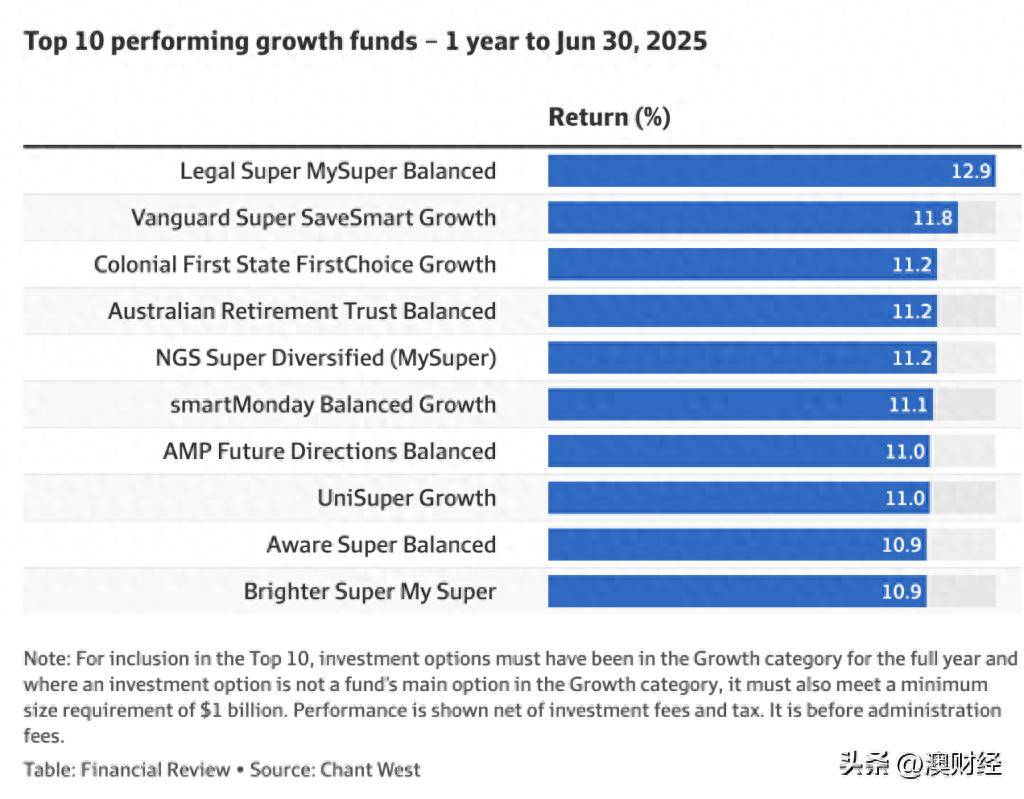
1 Unstoppable Vanguard Fund That Can Turn $50,000 Into $1 Million
The Motley Fool· 2025-07-19 14:00
Core Viewpoint - A simple buy-and-hold investing strategy, particularly in growth stocks through ETFs, can yield significant returns over time with minimal effort [1][2]. Group 1: Investment Strategy - Investing $50,000 in an ETF that tracks growth stocks can potentially double the investment in just over seven years, assuming a long-term average return of 10% [2]. - The Vanguard Growth Index Fund ETF (VUG) is highlighted as a strong option for long-term investment, with the potential to turn a $50,000 investment into over $1 million [3][12]. Group 2: Fund Characteristics - Vanguard funds are known for low fees and excellent diversification, with the Vanguard Growth Index Fund having an expense ratio of 0.04% and a yield of around 0.4% [5]. - The ETF focuses on large growth stocks in the U.S., with technology making up nearly 60% of its holdings, which includes major companies like Apple, Nvidia, and Microsoft [6][7]. Group 3: Growth Potential - The fund could take approximately 32 years to grow a $50,000 investment to over $1 million at a 10% average annual return, with the possibility of reaching this milestone faster if returns exceed 10% [11]. - The potential for significant growth exists due to the strong performance of the stocks within the fund and its low fees, positioning it well for long-term market outperformance [12].

4 Vanguard ETFs to Buy With $2,000 and Hold Forever
The Motley Fool· 2025-07-19 09:10
Core Viewpoint - The article emphasizes the importance of creating a balanced investment portfolio by mixing stocks and bonds, suggesting a typical allocation of 60% in stocks and 40% in bonds, with variations based on individual risk tolerance [1][2][4]. Group 1: Stock Investments - A balanced portfolio should include both U.S. and international dividend-paying stocks, with the Vanguard High Dividend Yield ETF (VYM) focusing on U.S. stocks and the Vanguard International High Dividend Yield ETF (VYMI) covering international stocks [5][7]. - The Vanguard High Dividend Yield ETF consists of over 580 U.S. dividend-paying companies, with a dividend yield of 2.8%, which is more than double that of the S&P 500 index [6]. - The Vanguard International High Dividend Yield ETF includes over 1,500 international stocks, offering a higher dividend yield of 4.1% [7]. Group 2: Bond Investments - The bond market is larger and more complex than the stock market, making bond ETFs a suitable choice for most investors. The Vanguard Total Bond Market ETF (BND) provides exposure to the entire U.S. bond market [9]. - The Vanguard Total International Bond Market ETF (BNDX) complements the U.S. bond exposure by offering a diversified global bond portfolio, with yields of approximately 3.8% for BND and 4.2% for BNDX [10]. - A recommended allocation for bonds is to keep 60% to 75% in domestic bonds and the remainder in international bonds, ensuring diversification across the bond market [11]. Group 3: Portfolio Management - The proposed portfolio consisting of four ETFs is designed for long-term income and capital appreciation, requiring minimal management with only four trades to start and annual rebalancing [12].
The Glaring Reason Why Warren Buffett Isn't Buying His Favorite ETF Right Now
The Motley Fool· 2025-07-19 08:47
Core Viewpoint - Warren Buffett advocates for investing in funds rather than individual stocks, emphasizing the need for extensive research to understand businesses before investing [1] Group 1: Buffett's Favorite ETF - Buffett's favorite ETF is implied to be the Vanguard S&P 500 ETF, based on clues from his past shareholder letters and investment choices [4][5] - He has indicated that a low-cost S&P 500 index fund is suitable for non-professional investors, suggesting Vanguard's fund specifically for his family's inheritance [4] Group 2: Current Investment Position - Berkshire Hathaway completely exited its position in the Vanguard S&P 500 ETF in Q4 2024, selling all shares of both the Vanguard and SPDR S&P 500 ETFs [7] - Despite not buying the ETF recently, Buffett's long-term view on S&P 500 index funds remains positive, with concerns primarily focused on current valuations [8] Group 3: Valuation Concerns - The Buffett indicator, which measures total market capitalization of U.S. stocks as a percentage of U.S. GDP, currently stands at nearly 209%, indicating high market valuations [9][10] - Buffett has previously warned that when this indicator approaches 200%, it signifies a risky investment environment [10] Group 4: Investment Strategy Recommendations - Investors are advised to consider long-term holding of the Vanguard S&P 500 ETF, despite Buffett's current lack of purchases, as future valuations may be higher [12] - Buffett suggests a strategy of accumulating shares over time and avoiding selling during market downturns to achieve satisfactory investment results [14]

Understanding VT: Vanguard's All-In-One Global Stock ETF
Seeking Alpha· 2025-07-18 18:11
Group 1 - Vanguard Total World Stock Index Fund ETF (NYSEARCA: VT) aims to track the FTSE Global All Cap Index, providing exposure to nearly the entire global stock market, including both developed and emerging markets [1] - The focus of the analysis is primarily on small- to mid-cap companies, which are often overlooked by many investors, while also occasionally examining large-cap companies for a broader market perspective [1]

Is First Trust Energy AlphaDEX ETF (FXN) a Strong ETF Right Now?
ZACKS· 2025-07-18 11:21
Core Insights - The First Trust Energy AlphaDEX ETF (FXN) is a smart beta ETF that provides broad exposure to the Energy sector, having debuted on May 8, 2007 [1] - The ETF industry has been traditionally dominated by market capitalization weighted indexes, but smart beta strategies aim to outperform through stock selection based on fundamental characteristics [2][3] - FXN is sponsored by First Trust Advisors and has assets totaling approximately $278.76 million, positioning it as an average-sized ETF in the Energy category [5] Fund Structure and Strategy - FXN seeks to match the performance of the StrataQuant Energy Index, which is a modified equal-dollar weighted index designed to identify stocks from the Russell 1000 Index that may generate positive alpha [6] - The fund has an annual operating expense ratio of 0.61% and a 12-month trailing dividend yield of 2.92%, which is competitive within its peer group [7] Sector Exposure and Holdings - The fund has a significant allocation to the Energy sector, representing 93.5% of its portfolio [8] - First Solar, Inc. (FSLR) is the largest holding at approximately 5.8%, with the top 10 holdings accounting for about 41.17% of total assets [9] Performance Metrics - Year-to-date, FXN has experienced a loss of approximately -3.71%, and over the last 12 months, it is down about -14.12% as of July 18, 2025 [11] - The fund has a beta of 0.90 and a standard deviation of 28.29% over the trailing three-year period, indicating a higher risk profile compared to peers [11] Alternatives in the Market - For investors seeking to outperform the Energy ETFs segment, alternatives such as the Vanguard Energy ETF (VDE) and the Energy Select Sector SPDR ETF (XLE) are available, with VDE having $7.15 billion in assets and XLE at $27.57 billion [13] - VDE and XLE have lower expense ratios of 0.09% and 0.08% respectively, making them more attractive options for cost-conscious investors [13]




Should Vanguard Large-Cap ETF (VV) Be on Your Investing Radar?
ZACKS· 2025-07-18 11:21
Core Viewpoint - The Vanguard Large-Cap ETF (VV) is a significant player in the Large Cap Blend segment of the US equity market, with over $43.08 billion in assets, making it one of the largest ETFs in this category [1]. Group 1: Fund Overview - The Vanguard Large-Cap ETF was launched on January 27, 2004, and is passively managed [1]. - It targets companies with a market capitalization above $10 billion, which are generally stable and less volatile compared to mid and small cap companies [2]. Group 2: Costs and Performance - The ETF has an annual operating expense ratio of 0.04%, positioning it as one of the least expensive options in the market [3]. - It has a 12-month trailing dividend yield of 1.17% [3]. - As of July 18, 2025, the ETF has gained approximately 8.15% year-to-date and 14.79% over the past year, with a trading range between $228.25 and $289.94 in the last 52 weeks [6]. Group 3: Sector Exposure and Holdings - The ETF has a significant allocation of about 34% to the Information Technology sector, followed by Financials and Consumer Discretionary [4]. - Major holdings include Microsoft Corp (MSFT) at 6.80% of total assets, along with Nvidia Corp (NVDA) and Apple Inc (AAPL) [5]. Group 4: Risk Profile - The ETF aims to match the performance of the CRSP US Large Cap Index, which includes the top 85% of investable market capitalization in the US [6]. - It has a beta of 1.01 and a standard deviation of 17.25% over the trailing three-year period, indicating a medium risk profile [7]. Group 5: Alternatives - The Vanguard Large-Cap ETF holds a Zacks ETF Rank of 2 (Buy), indicating strong expected performance based on various factors [8]. - Other comparable ETFs include the SPDR S&P 500 ETF (SPY) with $642.71 billion in assets and the Vanguard S&P 500 ETF (VOO) with $693.52 billion [9].