Ellington Financial Inc.

Search documents
Big Dividend Yielders At A Glance
Seeking Alpha· 2025-06-09 22:05
Core Insights - The article emphasizes the importance of preferred shares and baby bonds for achieving strong risk-adjusted returns, alongside the positive performance of Business Development Companies (BDCs) [1][19] - It highlights the irrational behavior of the market, where some investors continue to buy underperforming stocks despite deteriorating fundamentals [2] - The article discusses the current favorable environment for agency mortgage REITs to issue new shares due to high price-to-book ratios, while hybrid mortgage REITs are struggling [3][6] Agency Mortgage REITs - AGNC Investment (AGNC) maintains a high price-to-book ratio, allowing it to issue new shares effectively [3] - The top three agency mortgage REITs, Dynex Capital (DX), Annaly Capital (NLY), and AGNC, have the highest price-to-book ratios and are expected to capitalize on this by issuing additional shares [4] - A projection indicates that agency mortgage REITs will see a decline in book value in Q2 2025, affecting their price-to-book ratios [5] Hybrid Mortgage REITs - The environment is unfavorable for hybrid mortgage REITs, with only Ellington Financial (EFC) trading close to its projected book value [6] Business Development Companies (BDCs) - Main Street Capital (MAIN) is recognized as a leading BDC, but it is challenging to find it at a bargain valuation [7] - MAIN's Total Economic Return (TER) reflects its performance through changes in book value and dividends, with share issuance above NAV enhancing its value [7][9] - The article notes that MAIN's ability to drive NAV per share higher is attributed to successful investments and effective management [13] Preferred Shares - There are emerging opportunities in preferred shares, which have historically provided strong risk-adjusted returns [14] Market Outlook - The year 2025 is identified as a prime opportunity for investing in REITs, preferred shares, and BDCs due to increasing demand and insufficient supply in key real estate sectors [19]






瑞银:美股行情延续,阿尔法机会升温
Zhi Tong Cai Jing· 2025-05-22 04:28
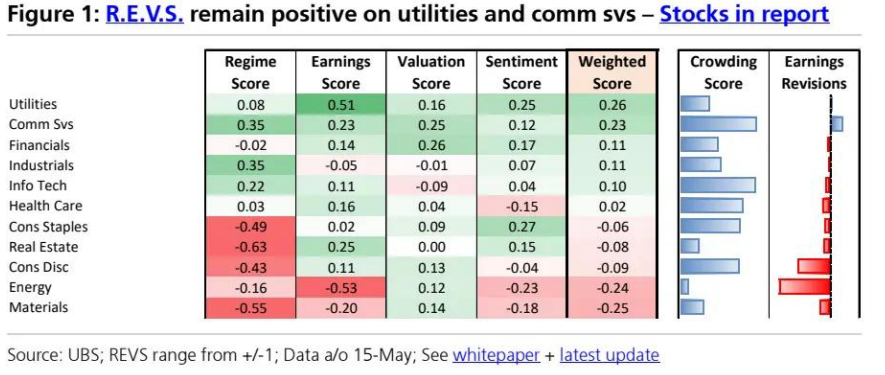
Group 1: Market Trends - After the tariff announcement on April 2, the US stock market quickly priced in a recessionary regime, eliminating the possibility of a "Goldilocks" (moderate growth) scenario. This trend has since reversed, with the probability of the Goldilocks regime returning to March's average level [1] - The Purchasing Managers' Index (PMIs) continues to decline, while OECD leading indicators show the economy remains in a late cycle but has not yet exited the expansion phase. The REVS regime favors late-cycle defensive sectors like communication services, but as leading indicators weaken, preferences may shift more towards utilities [2] Group 2: Earnings Adjustments - Almost all sectors have seen downward revisions in sales and earnings expectations, but the pace of these adjustments has slowed. The sectors with the largest downward revisions include automotive, durable goods, and building materials. The dispersion in earnings scores indicates the presence of alpha opportunities in the market [3] Group 3: Valuation Insights - Forward price-to-earnings ratios have mostly rebounded, returning to a "growth optimism" range. The US stock market's valuation remains higher than other global regions, with dollar-denominated earnings outperforming Europe by 10%, exceeding long-term trends [4] Group 4: Sentiment Analysis - Utilities and consumer staples sectors maintain positive sentiment. UBS crowding data indicates a persistent overweight position in the US market, although it has decreased from March's peak. The significant rotation from cyclical consumer stocks (durable goods and automotive) to defensive sectors (like consumer staples) has not fully normalized [5] Group 5: Top and Bottom Rated Stocks - The highest-rated stocks based on the REVS framework include Intercontinental Exchange, Virtu Financial, and Broadcom, with price changes since March 31 ranging from 10.9% to 37.3% [6] - The lowest-rated stocks include Ziprecruiter, Bioxcel Therapeutics, and Jetblue Airways, with price changes since March 31 ranging from 0% to 3.6% [7]