LPL Financial

Search documents
From software to real estate, US sectors gripped by AI scare trade
BusinessLine· 2026-02-13 18:10
Market Overview - Wall Street is experiencing significant disruption concerns due to AI, leading to a sell-off in various sectors, particularly software companies, which has resulted in sharp losses in U.S. stocks this week [1][2]. Software Sector - The S&P 500 Software & Services index has lost approximately $2 trillion in value since its peak in October, with half of this loss occurring in the past two weeks due to fears that AI could disrupt traditional subscription and enterprise tools [2]. - Notable declines in the Nasdaq 100 include Atlassian down 47%, Intuit down 40%, and Workday down 33% [4]. - The U.S. software sector is facing its worst drawdown in over three years, impacting alternative asset managers with exposure to software-related loans, with firms like Ares, Blackstone, and KKR seeing declines between 13% and 24% this year [5]. Financial Brokerage, Data Analytics & Legal Services - The financial industry, especially brokerages and data analytics firms, has been negatively affected after Altruist introduced AI-enabled tax planning features, raising fears about the viability of their business models [6]. - Shares of brokers such as LPL Financial and Charles Schwab fell over 7%, while S&P Global's shares dropped more than 25% in February, marking its worst month since 2009 [7]. Real Estate Services - Commercial real estate and investment managers have suffered as investors shift away from high-fee, labor-intensive business models perceived as vulnerable to AI disruption, with CBRE Group and Jones Lang LaSalle each dropping about 12% [8]. Insurance Sector - Insurance stocks have experienced a significant decline, with the S&P 500 insurance index falling 3.9% on a single day, its largest drop since mid-October, following the release of an AI-powered comparison tool by Insurify [10]. - Shares of Willis Towers Watson have decreased by 15% this week, while Aon and Arthur J. Gallagher fell by 9% and 15%, respectively [11]. Trucking & Logistics - The trucking and logistics sector saw unexpected declines, with stocks like Landstar System and C.H. Robinson dropping sharply after Algorhythm Holdings reported a significant increase in freight volumes without a corresponding rise in operational headcount [13].



X @BSCN
BSCN· 2026-02-12 20:26
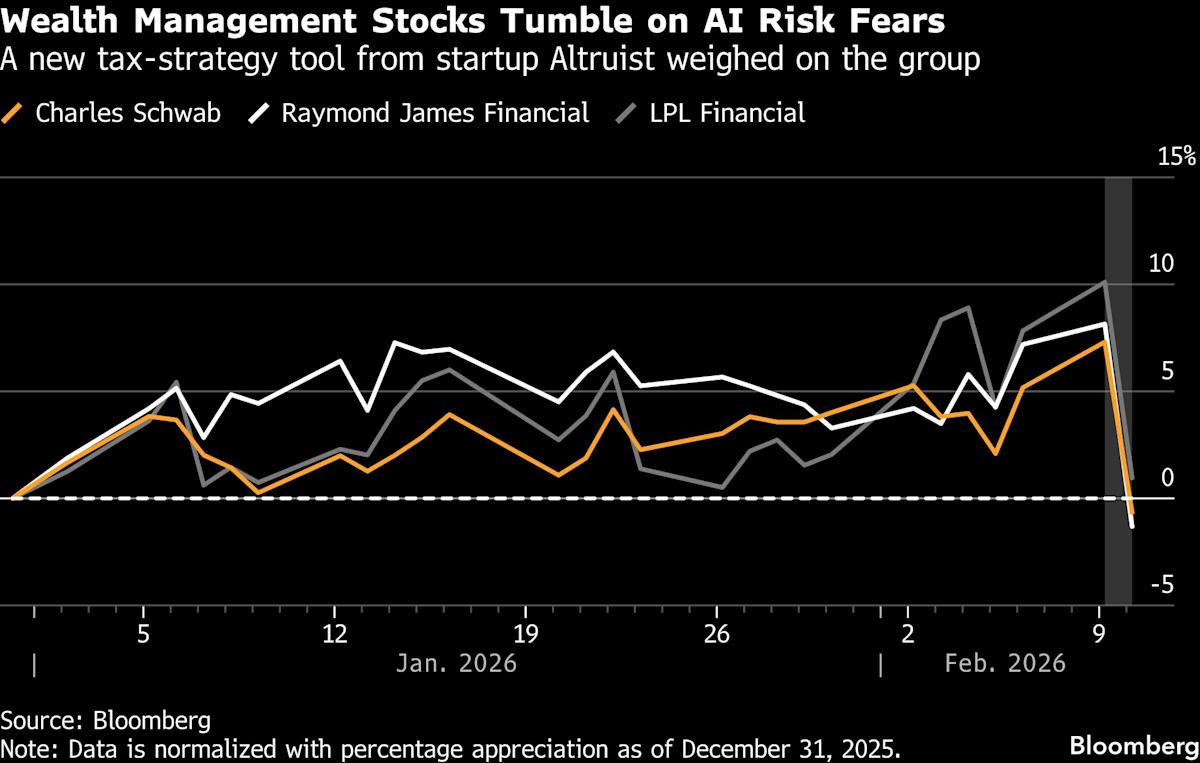
🚨 BREAKING: AI FEARS PUMMEL WEALTH MANAGEMENT STOCKS: SCHWAB DROPS 7%, RAYMOND JAMES CRASHES 9%The selloff was triggered by fintech startup Altruist launching an AI powered tax planning tool that automates personalized strategies.$SCHW fell 7.4%, @RaymondJames -8.8% (worst day since March 2020), LPL Financial -8.3%, @MorganStanley -4%, Ameriprise -7%.@CharlesSchwab CEO Rick Wurster called the selloff "disappointing and surprising," arguing AI will enhance advisors, not replace them.At $95.50, $SCHW now trad ...

For stock market, AI turns from lifting all boats to sinking ships
Reuters· 2026-02-12 16:10
Core Viewpoint - The artificial intelligence (AI) landscape is becoming increasingly volatile, shifting from a broad market uplift to specific stock declines, particularly affecting technology and related sectors [1][2]. Group 1: Market Dynamics - Enthusiasm for AI has driven a bull market in the U.S., particularly benefiting technology companies and those involved in data center infrastructure [2]. - Concerns regarding AI's disruptive potential are causing investors to reassess valuations in various industries, including software and wealth management [3]. - Major companies like Amazon and Microsoft are facing pressure on their share prices due to scrutiny over their significant AI capital expenditures [4]. Group 2: Stock Performance - The S&P 500 software and services index has seen a decline of 15% since the end of January 2026, influenced by AI-related news [4]. - Shares of U.S. brokerages and insurance companies have dropped significantly, with firms like LPL Financial and Charles Schwab each falling by at least 7% following the introduction of AI features by competitors [5]. - Microsoft shares are down 16% and Amazon over 11% this year, reflecting concerns about their high capital spending on AI [7]. Group 3: Investment Opportunities - Some investors view the current market as a buying opportunity, with the forward price-to-earnings ratio for the software and services index falling to 22.7 times, the lowest in nearly three years [9]. - JPMorgan equity strategists recommend increasing exposure to higher-quality, "AI-resilient" software companies, suggesting a potential rebound in the market [9]. - Economic "moats" are highlighted as a means for investors to identify strong companies amidst the volatility, as indiscriminate selling creates investable opportunities [9]. Group 4: Future Outlook - The S&P 500 is projected to see earnings rise over 14% in 2026, with expectations of further interest rate easing by the Federal Reserve [11]. - However, AI-driven volatility is complicating stock selection, with S&P 500 constituents that are down averaging a 10.6% decline, compared to a 5.9% decline for the same period last year [12].

LPL Financial Welcomes Sound Wealth
Globenewswire· 2026-02-12 13:55
Core Insights - LPL Financial LLC has welcomed financial advisors Curt Pederson and Britt Saylor from Sound Wealth, who manage approximately $420 million in advisory, brokerage, and retirement plan assets [1][2] Group 1: Company Overview - LPL Financial Holdings Inc. is one of the fastest-growing wealth management firms in the U.S., supporting over 32,000 financial advisors and approximately 1,200 financial institutions [6] - The firm services and custodies around $2.4 trillion in brokerage and advisory assets for approximately 8 million Americans [6] - LPL offers a variety of advisor affiliation models, investment solutions, fintech tools, and practice management services, allowing advisors to choose the business model and technology resources they need [6] Group 2: Advisor Background - Pederson and Saylor have a combined experience of 40 years and are based in Seattle and Phoenix [2] - The team specializes in serving high-net-worth individuals, families, and multigenerational households with complex financial planning needs, including inheritance planning and advanced executive compensation planning [2] Group 3: Reasons for Transition - Sound Wealth chose LPL for its support of a highly customized service model, open architecture, and commitment to innovation, including advancements in AI and expanded investment solutions [3][4] - The advisors were impressed by LPL's leadership in technology and the flexibility to tailor strategies uniquely for each client [4]


AI Worries Led to Piper Sandler’s Downgrade on Vertex
Yahoo Finance· 2026-02-11 16:59
Company Overview - Vertex Inc. (NASDAQ:VERX) is a provider of tax compliance software solutions for enterprises and mid-market companies, established in 1978 and located in King of Prussia, Pennsylvania [4]. Recent Developments - Piper Sandler downgraded Vertex's rating from Overweight to Neutral on February 3, cutting the target price by 37.5% to $20 from $32 due to concerns about seat compression related to artificial intelligence [1]. - The stock price of Vertex fell by 20.3% to $14.78 from $18.55 following the news, before slightly rebounding to $15.73 [3]. Market Context - The release of AI-related plugins by Anthropic on January 30 led to a significant market reaction, erasing $285 billion in market capitalization for software, financial services, and asset management stocks [3]. - Despite the downgrade and sell-off, analysts maintain a positive outlook on Vertex, with a median target price of $25.50, indicating a potential upside of 62.11% [3].

美国合众银行股价近期波动,受AI工具冲击及财报影响
Jing Ji Guan Cha Wang· 2026-02-11 16:34
Group 1 - Altruist launched an AI tax planning tool, raising concerns among investors about the risks to financial stocks, leading to declines in companies like LPL Financial and Charles Schwab [1] - The U.S. retail sales data for December showed no month-over-month growth, falling short of the expected 0.4% increase, contributing to negative sentiment in the banking sector [1] - Market strategist Anthony Saglimbene noted a rotation of funds into sectors less affected by AI, creating short-term pressure on the banking sector [1] Group 2 - Over the past week (February 5 to 11, 2026), the stock price of U.S. Bancorp (USB.N) increased by 1.19% with a volatility of 4.38%, showing a significant single-day increase of 2.67% on February 6 [2] - The stock closed at $60.13 after experiencing declines of 0.56% and 0.69% on February 9 and 11, respectively, while the average daily trading volume was approximately $514 million [2] - The broader banking sector declined by 0.27%, with the Dow Jones index slightly down by 0.16%, indicating that U.S. Bancorp's performance was slightly stronger than the industry average [2] Group 3 - For the fiscal year 2025, U.S. Bancorp reported total revenue of $28.54 billion, reflecting a year-over-year growth of 4.41%, with a net profit of $7.19 billion and diluted earnings per share of $4.62 [3] - Wealth management and commercial banking contributed over 70% of the total revenue, highlighting the importance of these segments to the company's financial performance [3] - Recent insider trading disclosures were made on February 3, but no new financial report events were noted [3] Group 4 - As of February 2026, 50% of 26 institutions rated U.S. Bancorp as buy/hold, with a target price range of $59 to $77, averaging $63.50 [4] - Wells Fargo and Oppenheimer maintained buy ratings and some raised their target prices, suggesting that economic improvement and a potential rate cut cycle could support bank profitability [4]

Wall Street’s New Trade Is Dumping Stocks in AI’s Crosshairs
Yahoo Finance· 2026-02-11 16:09
Core Viewpoint - Rising fears about artificial intelligence (AI) are negatively impacting shares of companies perceived to be at risk, leading to significant sell-offs across various sectors, particularly in software and wealth management [1][2][3]. Group 1: Market Reactions - The latest selloff was triggered by a tax-strategy tool from Altruist Corp, causing shares of Charles Schwab Corp., Raymond James Financial Inc., and LPL Financial Holdings Inc. to drop by 9% or more over two days [2]. - This decline represents the deepest slide for some stocks since the trade-war meltdown in April, reflecting a sell-first, ask-questions-later mentality among investors [3]. - The software industry has been particularly affected, with new AI tools from companies like Anthropic PBC leading to a rout in stocks across various sectors, including financial services and legal services [8]. Group 2: Investor Sentiment - Investors are shifting from identifying potential winners in the AI space to avoiding companies that may be displaced by AI advancements [6]. - The narrative has changed from believing in AI and searching for use cases to recognizing the disruptive potential of newly discovered applications [7]. - Concerns about AI's impact have spread beyond the software industry, affecting US insurance brokers and wealth-management stocks due to new applications that leverage AI technology [9].
US stock market | Wall Street’s new trade is dumping any stock in AI’s crosshairs
The Economic Times· 2026-02-11 07:53
Core Viewpoint - The recent selloff in the stock market, particularly affecting companies at risk of disruption from AI technologies, reflects a growing anxiety among investors about the potential impact of AI on various industries [1][14]. Group 1: Market Reaction - The selloff was triggered by the launch of a tax-strategy tool by Altruist Corp., which caused shares of major firms like Charles Schwab Corp. to drop by 7% or more, marking the deepest decline since the trade-war meltdown in April [1][14]. - Investors are adopting a "sell-first, ask-questions-later" mentality, leading to indiscriminate selling of companies perceived to have any disruption risk [2][14]. - The stock market's reaction has wiped billions of dollars off the market values of several investment firms, indicating a strong signal about the competitive threat posed by new AI products [8][14]. Group 2: Industry Impact - The software industry has been particularly affected, with fears spreading to sectors such as financial services, asset management, and legal services following the introduction of new AI tools [6][14]. - The launch of Insurify's application using ChatGPT to compare auto-insurance rates also negatively impacted shares of US insurance brokers [7][14]. - Altruist's product, Hazel, which personalizes strategies for financial advisers, exemplifies how AI can potentially replace entire teams in wealth management for a fraction of the cost [9][14]. Group 3: Investor Sentiment - Investors are now more focused on avoiding companies that could be displaced by AI rather than identifying potential winners in the market [5][14]. - There is skepticism about the speed at which AI will disrupt industries, with some experts suggesting that tech disruption often takes longer to materialize than anticipated [10][11]. - The recent pullbacks in stock prices may also reflect broader concerns about high valuations following a rally driven by AI spending and a resilient US economy [11][12].


Wall Street’s mood swing turns AI disruption into a sell signal
BusinessLine· 2026-02-11 01:41
Core Viewpoint - Rising fears about artificial intelligence (AI) are negatively impacting the stock prices of companies perceived to be at risk, including both small software firms and large wealth-management companies [1][2]. Market Reaction - A recent selloff was triggered by a tax-strategy tool from Altruist Corp., causing shares of Charles Schwab Corp., Raymond James Financial Inc., and LPL Financial Holdings Inc. to drop by 7% or more [1]. - This decline represents the most significant drop for these stocks since the trade-war market meltdown in April [2]. Investor Sentiment - Investors are shifting from identifying potential winners in the AI space to avoiding companies that may be displaced by AI advancements [5]. - The mood among investors has changed dramatically, with a focus on potential disruption rather than growth opportunities [4][5]. Industry Impact - The software industry has been particularly affected, with fears of AI disruption spreading to financial services, asset management, and legal services [6]. - New AI tools have led to significant stock declines across various sectors, including a notable impact on US insurance brokers following the launch of an application by Insurify [7]. Competitive Threats - Altruist's CEO noted the unexpected scale of the market's reaction, indicating a strong signal regarding the competitive threat posed by AI in wealth management [8]. - The architecture used to build Altruist's product, Hazel, is seen as capable of replacing traditional jobs in wealth management, which typically require entire teams [9]. Broader AI Adoption - Companies like OpenAI and Anthropic are making strides in software engineering and are beginning to penetrate other industries [9]. - There are ongoing questions about how quickly and effectively AI technology will be adopted across various sectors, including banking [10]. Valuation Concerns - The recent pullbacks in stock prices may reflect broader anxieties about inflated valuations resulting from the AI spending boom and a resilient US economy [11]. - Investors are becoming increasingly sensitive to negative market signals, leading to significant sell-offs in response to perceived risks [12]. Future Outlook - Some industry experts believe that concerns about AI's disruptive potential may be premature, as the market is still in the early stages of understanding AI's long-term implications [13].

The AI threat wrecked software stocks. Now broker stocks look next with LPL down 11%
CNBC· 2026-02-10 19:10
Core Viewpoint - The launch of a new AI-powered tax planning tool has led to significant declines in shares of financial services firms, indicating potential disruption in the industry. Group 1: Market Reaction - Shares of financial services firms experienced a sharp decline, with LPL Financial falling nearly 11% and both Charles Schwab and Raymond James Financial dropping over 9% [1] - Morgan Stanley's shares also decreased by 4%, reflecting widespread concern about the impact of AI on the financial services sector [1] Group 2: AI Tool Overview - Altruist introduced an AI platform named Hazel, which assists advisors in creating personalized tax strategies by analyzing various client data sources, including 1040s, paystubs, and account statements [2] - The tool applies deep tax logic to its analysis, enhancing the efficiency and effectiveness of tax planning for financial advisors [2]