
Hazel

Search documents
$4B Gerber Kawasaki to Use Altruist for New Business
Yahoo Finance· 2026-02-24 19:52
Core Viewpoint - Gerber Kawasaki Wealth & Investment Management has partnered with Altruist as a custodian to enhance its operational efficiency and support its growth strategy towards reaching $10 billion in client assets [1][3]. Group 1: Company Strategy - The firm will route all new business to Altruist, leveraging its infrastructure and self-clearing model to streamline operations [2][3]. - Gerber Kawasaki currently manages over $4 billion in client assets and aims to accelerate its growth trajectory by utilizing Altruist's capabilities [1][3]. Group 2: Technology Integration - The firm will utilize Hazel, Altruist's AI platform, which provides real-time answers regarding account data and financial information [4]. - Hazel's recent launch of AI-powered tax planning tools allows advisors to create personalized tax strategies, impacting traditional wealth management stocks negatively [5]. Group 3: Industry Impact - The partnership with Altruist signals a potential disruption in the wealth management industry, as noted by industry experts [6]. - Altruist's self-clearing platform and acquisition of SSG, which added over 1,600 advisors, positions it as a full-service custodian [6].
Week’s Best: This Is Hazel, the AI Tool That Rocked Markets
Barrons· 2026-02-20 18:01
Week's Best: This Is Hazel, the AI Tool That Rocked Markets - Barron'sSkip to Main ContentThis copy is for your personal, non-commercial use only. Distribution and use of this material are governed by our Subscriber Agreement and by copyright law. For non-personal use or to order multiple copies, please contact Dow Jones Reprints at 1-800-843-0008 or visit www.djreprints.com.---# Week's Best: This Is Hazel, the AI Tool That Rocked Markets## Here's our weekly roundup of the most-read articles at Barron's Adv ...
瑞杰金融股价受AI工具冲击大跌,机构对影响看法不一
Jing Ji Guan Cha Wang· 2026-02-13 21:37
Core Viewpoint - The recent volatility in RJF.N's stock price is primarily driven by concerns over AI tools disrupting the wealth management sector, particularly following the launch of Altruist's AI-driven tax planning tool, Hazel [1] Stock Performance - RJF.N's stock exhibited a volatility of 12.84% over the past week, with a peak price of $174.14 on February 10 and a low of $152.03 on February 12 [2] - On February 10, trading volume surged to $672 million, with a turnover rate of 2.12%, before dropping to $201 million on February 13, with a volume ratio of 0.53 [2] - As of February 13, the stock closed at $158.68, reflecting a cumulative decline of 7.82% over five days [2] Financial Report Analysis - During the earnings call on February 11, RJF.N projected a 6.5% quarter-over-quarter growth in asset management and related management fees for Q1 of fiscal year 2026, while maintaining a target of over 20% for adjusted pre-tax profit margin [3] - The company plans to increase investments in AI technology, expand its financial advisor recruitment, and advance the acquisition and integration of boutique investment bank Greensledge to adapt to industry changes [3] Institutional Perspectives - Analysts have differing views on the impact of AI disruption; Citizens analysts suggest that the sell-off may be an overreaction to short-term sentiment, indicating that AI is more likely to expand rather than completely replace human advisory services [4] - Royal Bank of Canada maintained a "Buy" rating for RJF.N on February 14, raising the target price from $168.2 to $182.16, highlighting the company's long-term growth potential [4]
多只地产服务商一夜暴跌 AI“狼人杀”还没结束:点谁谁崩
Feng Huang Wang· 2026-02-13 02:14
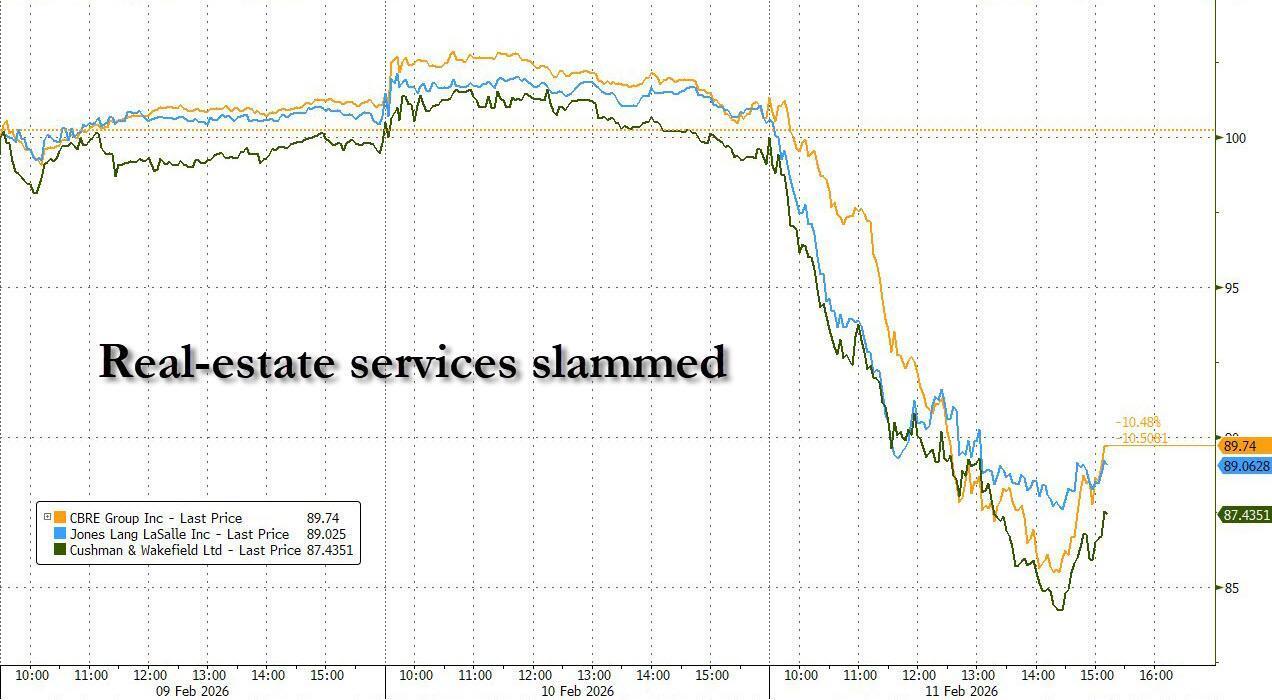
Core Viewpoint - The recent sell-off in the U.S. stock market, particularly affecting real estate service stocks, is driven by investor fears regarding the disruptive potential of AI applications in various industries [1][3]. Group 1: Market Impact - Several real estate service stocks, including CBRE Group and JLL, experienced significant declines, with CBRE dropping 12% and JLL falling 14%, marking their largest single-day drops since the COVID-19 pandemic [3]. - The commercial real estate sector is facing renewed challenges, exacerbated by the pandemic's impact on office demand and high interest rates affecting transaction volumes [3]. - Investors are increasingly withdrawing from high-fee, labor-intensive business models perceived as vulnerable to AI disruption, as noted by analysts [3][4]. Group 2: Broader Industry Concerns - The sell-off has extended beyond real estate, affecting SaaS, insurance brokerage, and wealth management stocks, indicating a widespread concern about AI's potential to disrupt various sectors [4][5]. - Companies like CBRE and JLL are attempting to mitigate downward pressure by diversifying into property management and valuation across various sectors, including hotels and life sciences [4]. - Analysts express that the recent stock price declines may be overreactions, as the risks associated with AI disruption have been present for some time and are not new [4][5]. Group 3: AI Disruption Debate - The introduction of AI tools, such as those by Anthropic, has intensified fears of industry-wide disruption, leading to a "sell first, ask questions later" mentality among investors [4][6]. - Concerns about AI's impact on employment and commercial real estate demand are prevalent, but some analysts argue that the actual threat to leasing and capital markets is limited [4][6]. - The market's reaction reflects a broader anxiety about potential reversals in stock valuations, driven by recent AI spending and a resilient U.S. economy [6][7].

瑞杰金融股价下跌受AI工具冲击财富管理板块及市场情绪影响
Jing Ji Guan Cha Wang· 2026-02-12 22:55
Core Viewpoint - The stock price of Raymond James Financial (RJF.N) has declined by 2.89% to $154.01 as of February 12, 2026, primarily due to market concerns over AI-driven financial tools potentially replacing traditional financial advisory services [1] Stock Performance - On February 10, 2026, the launch of Altruist's AI-driven tax planning tool, Hazel, led to a collective sell-off in the wealth management sector, causing Raymond James Financial's stock to drop by 8.75% [1] - The stock's decline on February 12 is a continuation of the negative sentiment, with a daily trading volume of approximately $189 million and a price fluctuation of 5.01% [1] - The overall asset management sector saw a decline of 3.40% on February 12, exacerbated by a broader market downturn, with the Nasdaq index falling by 1.41% [2] Institutional Perspectives - During the earnings call on February 11, 2026, Raymond James Financial projected a 6.5% quarter-over-quarter increase in management fees and announced plans to increase investments in AI technology [3] - Some institutions, such as Citizens, believe that the current sell-off may be an overreaction to short-term sentiments, suggesting that AI is more likely to expand rather than completely replace human advisory services [3]
Separating The Winners And Losers Of The AI Disruption
Seeking Alpha· 2026-02-12 12:25
Group 1: Job Market and Economic Outlook - The recent jobs report showed a surprising increase in non-farm payrolls, leading to discussions about potential rate cuts and analyst reactions [3] - The Congressional Budget Office (CBO) has raised the 10-year U.S. deficit outlook by $1.4 trillion, indicating a worsening economic picture [10] Group 2: Technology and AI Disruption - The Software-as-a-Service (SaaS) industry is experiencing significant pressure, with companies like CBRE Group, Jones Lang LaSalle, and Cushman & Wakefield seeing their shares drop by more than 12%, marking their largest daily decline since the COVID pandemic [5] - The introduction of AI tools, such as Anthropic's Claude Cowork, has led to declines in shares of companies in the legal and financial sectors, including LegalZoom and Intuit [5] - The current technology cycle is described as "very violent," with traditional high-fee businesses being vulnerable to disruption from AI and automation [6] Group 3: Investment Opportunities - Neuberger Berman suggests that while some incumbents may falter, others will adapt by integrating AI, creating selective investment opportunities for those who can differentiate between resilient and fragile business models [7] - Companies that are fundamentally sound and capable of adapting to changes in the market may present opportunities for investors during this period of structural change [7] Group 4: Company Developments - Amazon Pharmacy is set to offer same-day delivery in 4,500 cities, expanding its service capabilities [8] - Kraft Heinz has paused its separation plans to focus on growth and profitability [9]

Why Altruist’s New AI Tax Tool Spooked Investors in Schwab, LPL, Raymond James
Yahoo Finance· 2026-02-12 05:01
Core Insights - The launch of Altruist's AI-powered tool, Hazel, has negatively impacted the stock prices of major wealth management firms, indicating market sensitivity to AI developments [2][6] - Experts suggest that the market reaction may be an overreaction, and the true impact of AI tools on wealth management firms will depend on their adoption rates [2][5] Group 1: AI Tool Launch and Market Reaction - Altruist introduced Hazel, an AI tool that creates tax strategies based on client documents, leading to stock declines for firms like LPL Financial and Charles Schwab [2][6] - The stock prices of LPL Financial and Charles Schwab fell by 5.7% and 4%, respectively, with other firms like Stifel Financial and Piper Sandler also experiencing declines [6] Group 2: Industry Expert Opinions - Bill Harris, CEO of Evergreen Wealth, emphasized that Hazel is part of a broader trend of AI tools that will transform the wealth management industry [3][4] - Kyle Mostransky, CEO of Mostransky & Associates, argued that while AI can optimize financial calculations, the human element remains crucial for interpreting financial decisions [5] - Harris noted that the introduction of AI tools could lead to a reduction in fees for human financial advisors, which currently average around 1% of assets [5]




华尔街年初热门交易 全军覆没
Sou Hu Cai Jing· 2026-02-11 16:49
Market Sentiment Shift - The recent market turmoil is not caused by a single factor, indicating a significant shift in sentiment on Wall Street compared to the panic sell-off triggered by tariff policies last April [1] - Earlier predictions suggested that the U.S. stock market would experience its longest rally in nearly two decades, driven by expectations of sustained AI momentum, unexpectedly strong economic resilience, and gradual interest rate cuts by the Federal Reserve [1][6] AI Disruption Concerns - Concerns about AI potentially disrupting or reshaping certain U.S. industries and companies have emerged as investors worry about the transition of AI investments into commercial products [1][2] - The launch of a new tool by startup Altruist aimed at helping financial advisors has sparked fears of automation threatening the wealth management sector, leading to significant stock declines for firms like Raymond James Financial Inc. (down 8.8%) and Charles Schwab Corp. (down 7.4%) [2] Broader Market Impact - The sell-off affected not only tech stocks but also other previously popular trades on Wall Street, with the S&P 500 software and services index losing nearly 8% over the week, marking its worst weekly performance since March 2020 [6] - The S&P 500 insurance index dropped 3.9%, the largest single-day decline since October of the previous year, reflecting the broader impact of AI-related concerns on various sectors [2] Investment Strategy Shift - Analysts suggest a shift in investment focus from "AI enablers" to "AI beneficiaries," indicating a potential change in which companies will benefit from AI advancements [3][4] - Despite the recent volatility, some analysts believe the market's reaction may be an overreaction, with the fundamentals still supporting a stable growth outlook [8][9] Economic Indicators - The ISM manufacturing PMI showed better-than-expected performance, indicating potential for stable growth and avoidance of inflationary pressures, which is crucial for the stock market and the Federal Reserve [8] - Recent strong earnings reports from various companies have reinforced the initial positive expectations, although concerns about the sustainability of high valuations in tech and other sectors remain [7]
Wall Street’s New Trade Is Dumping Stocks in AI’s Crosshairs
Yahoo Finance· 2026-02-11 16:09
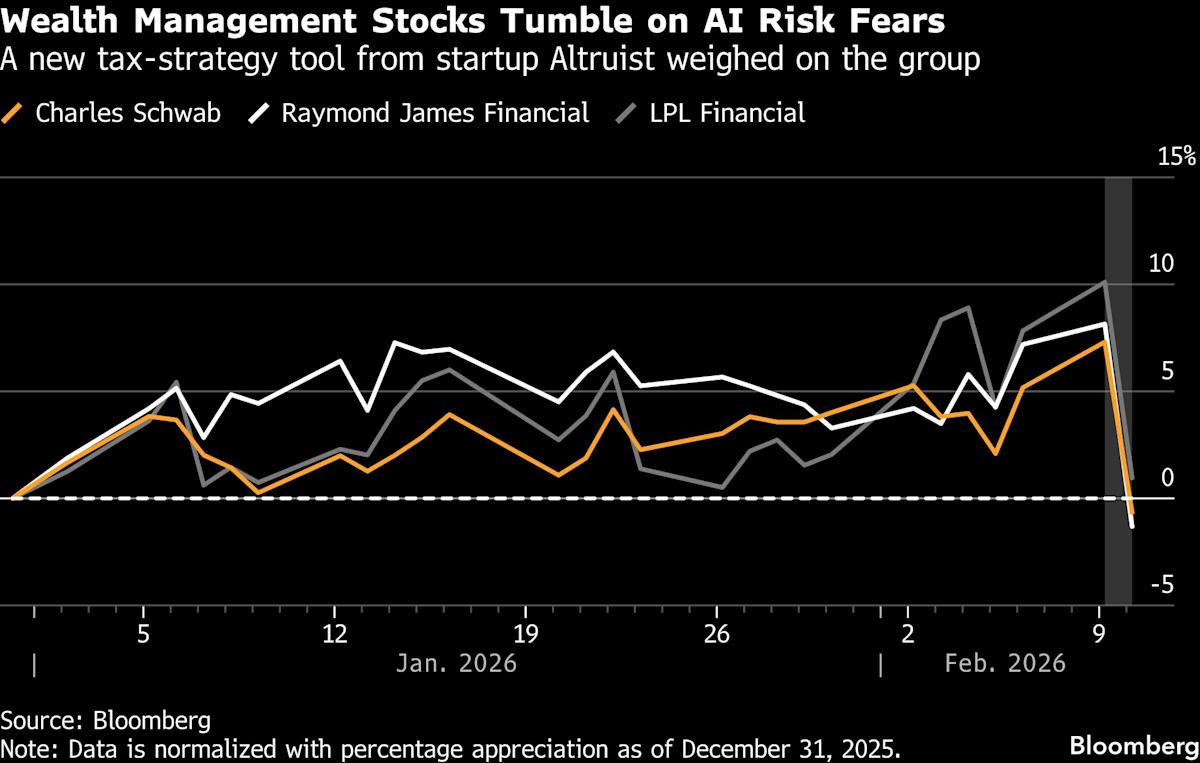
Core Viewpoint - Rising fears about artificial intelligence (AI) are negatively impacting shares of companies perceived to be at risk, leading to significant sell-offs across various sectors, particularly in software and wealth management [1][2][3]. Group 1: Market Reactions - The latest selloff was triggered by a tax-strategy tool from Altruist Corp, causing shares of Charles Schwab Corp., Raymond James Financial Inc., and LPL Financial Holdings Inc. to drop by 9% or more over two days [2]. - This decline represents the deepest slide for some stocks since the trade-war meltdown in April, reflecting a sell-first, ask-questions-later mentality among investors [3]. - The software industry has been particularly affected, with new AI tools from companies like Anthropic PBC leading to a rout in stocks across various sectors, including financial services and legal services [8]. Group 2: Investor Sentiment - Investors are shifting from identifying potential winners in the AI space to avoiding companies that may be displaced by AI advancements [6]. - The narrative has changed from believing in AI and searching for use cases to recognizing the disruptive potential of newly discovered applications [7]. - Concerns about AI's impact have spread beyond the software industry, affecting US insurance brokers and wealth-management stocks due to new applications that leverage AI technology [9].
华尔街新交易逻辑:抛售处于AI冲击范围内的股票
Xin Lang Cai Jing· 2026-02-11 09:52
Core Viewpoint - Concerns about artificial intelligence (AI) are escalating on Wall Street, leading to significant sell-offs across various sectors, particularly in companies perceived to be at risk of disruption by AI technologies [1][14]. Group 1: Market Reactions - A recent sell-off was triggered by the launch of a tax strategy tool by Altruist Corp, resulting in stock price declines of over 7% for major financial firms like Charles Schwab and Raymond James [1][14]. - The sell-off extended to European wealth management firms, with companies like AJ Bell and St. James's Place experiencing simultaneous declines [1][14]. - This downturn is noted as one of the most significant since the market turmoil in April, reflecting a "sell first, ask questions later" mentality among investors [1][14]. Group 2: Investor Sentiment - Investors are shifting focus from identifying potential winners to avoiding any companies that exhibit even a slight risk of being replaced by AI [4][17]. - The narrative around AI has evolved from skepticism about its practical applications to a recognition of its disruptive potential, as evidenced by the rapid deployment of powerful AI tools [6][20]. - The market's reaction indicates a heightened sensitivity to negative news, with stock prices plummeting by 10% on minor adverse signals, a phenomenon unlikely to occur in markets with lower valuations [27]. Group 3: Industry Implications - The software industry has been particularly affected by AI-related anxieties, with fears spreading to other sectors such as finance, insurance, and legal services following the introduction of new AI tools [8][21]. - Altruist's CEO noted the unexpected market reaction, which resulted in the evaporation of billions in market value for several investment firms, highlighting the competitive threat posed by their new product [22][21]. - The architecture used to develop Altruist's tool is perceived as capable of replacing roles within the wealth management industry, suggesting a significant shift in operational dynamics [10][24]. Group 4: Future Outlook - Experts express uncertainty about the future impact of AI, with some suggesting that the actual disruption may occur more slowly than anticipated [25][26]. - The current market environment reflects a broader anxiety about the sustainability of high valuations driven by AI investments and the resilience of the U.S. economy [27][12]. - The ongoing developments in AI are still in their infancy, and making definitive predictions about their long-term effects remains challenging [13][12].