LexisNexis Risk Solutions

Search documents
LexisNexis Risk Solutions Data Services CEO Dean Curtis Awarded Top Spot on INvolve Heroes Role Model List
Prnewswire· 2025-09-30 14:00
Core Insights - LexisNexis Risk Solutions Data Services CEO Dean Curtis has been recognized as 1 on INvolve's Heroes Advocates Role Model List for his leadership in promoting gender equity and inclusive workplace practices [1][2][3] - The Heroes Advocate Role Model List is an annual recognition that highlights leaders who advocate for gender diversity and the success of women in business [2][4] - Dean Curtis has been a five-year veteran of the Heroes Role Model list and has implemented programs to foster community, mentoring, and inclusivity, particularly for women in the industry [3] Company Overview - LexisNexis Risk Solutions utilizes data, analytics, and technology to provide insights that help businesses and governmental entities reduce risk and improve decision-making [4] - The company is headquartered in metro Atlanta, Georgia, and is part of RELX, a global provider of information-based analytics and decision tools [4]



Home Claims Insights from LexisNexis Risk Solutions Helps Empower U.S. Property Insurance Executives with Market Visibility and Operational Benchmarks
Prnewswire· 2025-09-24 17:00
Core Insights - A new dashboard has been introduced to assist U.S. property insurers in navigating market shifts and benchmarking claims performance [1] - The tool aims to accelerate decision-making processes and address the increasing severity of claims with enhanced confidence [1] Group 1 - The dashboard provides insights that help insurers adapt to changing market conditions [1] - It enables insurers to benchmark their claims performance against industry standards [1] - The tool is designed to improve the speed and confidence of decision-making in response to rising claim severities [1]
LexisNexis® Risk Solutions Study Reveals SNAP Fraud Costs Surge to $4.14 Per $1 Lost as Digital and EBT Schemes Escalate
Prnewswire· 2025-09-23 14:13
Core Insights - The volume of fraudulent cases in the Supplemental Nutrition Assistance Program (SNAP) has doubled since 2024, driven by increased digital access and complex eligibility systems [1][4] - For every $1 lost to fraud in SNAP, agencies now incur $4.14 in total costs, an increase from $3.93 the previous year [1] Fraud Trends - Digital channels account for nearly half of all fraud costs, with high volumes of online and mobile applications leading to disproportionately higher fraud losses [5] - Fraud costs rise to $4.18 per $1 lost in multi-program systems, and can reach as high as $4.55 when five or more programs are integrated [5] Operational Challenges - Agencies are facing delays and errors due to overwhelming application volumes, staffing shortages, and outdated systems, with 74% reporting increased errors [5] - Nearly half of the agencies report lower productivity, undermining confidence in eligibility decisions [5] Human Impact - Delayed approvals can lead to hunger, malnutrition, and financial stress for households in need, while also affecting staff morale and increasing turnover [5] Recommendations - Agencies that invest in advanced fraud detection and integrate systems report lower fraud costs of $3.98 per $1 lost and fewer errors [5] - Leveraging real-time data and identity verification can help agencies combat fraud while ensuring timely benefits for those in need [2][4]
Consumers love buy now, pay later loans. Here's why banks and credit card companies are wary of them
CNBC· 2025-09-14 16:04
Core Insights - Buy now, pay later (BNPL) plans are gaining popularity as an alternative to credit cards, allowing consumers to make purchases in short-term, typically interest-free installments [1] - An estimated 86.5 million Americans utilized BNPL loans in 2024, with projections indicating an increase to 91.5 million in 2025 [1] - Nearly half of Americans have used BNPL services at least once, with 11% having used them six or more times [1] Industry Impact - BNPL is seen as a threat to the credit card industry, as it caters to consumers who either prefer not to use credit cards or have limited credit availability [2] - Each purchase financed through BNPL represents a potential loss of transaction activity for credit cards, impacting major revenue drivers for banks and financial institutions [2] - The rise of BNPL services raises concerns among traditional lenders regarding consumer credit quality, as it creates a gap in understanding consumer credit profiles [3]

LexisNexis Risk Solutions Appoints Katie James to Lead DMV Digital Transformation Nationwide
Prnewswire· 2025-09-02 14:13
Core Insights - LexisNexis Risk Solutions Government has appointed Katie James as the new Head of DMV Solutions, emphasizing the company's commitment to digital transformation and operational excellence in motor vehicle agencies nationwide [1][4] - James will focus on solution development and customer engagement, particularly in fraud prevention, payment processing, and modernization of vital records [1][4] Company Overview - LexisNexis Risk Solutions utilizes data and advanced analytics to provide insights that help businesses and government entities reduce risk and improve decision-making across various industries, including insurance, financial services, healthcare, and government [5] - The company is headquartered in metro Atlanta, Georgia, and is part of RELX, a global provider of information and analytics [5] Industry Context - Katie James brings over twenty years of experience in the government sector, recognized for her role in innovation, modernization, and cross-agency collaboration [2] - She has a strong background in leading technology initiatives that enhance service, security, and trust within DMVs and related organizations [2][3] Leadership Perspective - Haywood Talcove, CEO of LexisNexis Risk Solutions – Government, highlighted James's strategic vision and deep relationships with agency leaders as key assets that will accelerate the company's mission to enhance DMV security and efficiency [4]
New Data from LexisNexis Risk Solutions Highlight Regional Imbalance in Mental Health Provider Availability
Prnewswire· 2025-07-15 13:30
Core Insights - The total number of mental health providers in the U.S. increased by 11.4% from January 2020 to January 2024, with Montana experiencing the highest increase at 209.6% due to recent legislative changes [3][4] - There is significant variation in patient-to-provider ratios across states, impacting access to mental health care [3][4] - Nearly 24% of providers with prescribing privileges had changes in their license or contact information from January 1 to March 31, 2025, which can affect patient access to care [5][6] Provider Density Trends - The analysis utilized data from LexisNexis® Provider Data MasterFile™ and U.S. Census population data to identify states with the greatest changes in mental health provider volume and ratios [2] - Nine states saw a decrease in the number of mental health providers, with Nevada experiencing the largest decline at -45.2% [3][7] - Montana's ratio of mental health providers per capita improved by 65.6%, while Nevada's ratio deteriorated by 96.2% [8] Policy Impact - States with strong mental health policies are witnessing improvements in provider ratios, which can alleviate clinician burnout and enhance patient access [4] - The need for up-to-date provider data is emphasized to reduce inefficiencies and improve patient care, especially in underserved areas [6]

LexisNexis Risk Solutions Launches Location Intelligence: A First-of-Its-Kind Underwriting Solution for U.S. Commercial Property Risk Assessment
Prnewswire· 2025-06-19 14:00
Core Insights - LexisNexis Risk Solutions has launched a new commercial property risk assessment solution called LexisNexis Location Intelligence for Commercial, which enhances predictive modeling capabilities in the U.S. commercial insurance sector [1][3] Industry Challenges - The frequency and severity of severe weather events are increasing, contributing to over 65% of all U.S. property losses, which poses significant challenges for commercial insurers in underwriting, pricing, and portfolio management [2] Solution Features - The Location Intelligence for Commercial solution combines industry loss data, weather forensics, and granular property characteristics to create predictive modeling risk scores, enhancing the accuracy of risk assessments [3][4] - The solution utilizes proprietary claims information and neural network-driven risk propensity models to provide actionable insights directly into commercial insurance workflows [3][4] Competitive Advantage - The new solution can deliver over 20 times the predictive modeling lift compared to traditional models, allowing insurers to identify the 10% of properties that could account for 34% of weather-related losses in the upcoming year [6] - It integrates various data sources, including aerial imagery and comprehensive claims data, to create a more complete risk profile, moving beyond basic weather data [6] Operational Efficiency - The solution supports automation and efficiency by integrating seamlessly into underwriting and renewal workflows, enabling more targeted risk control strategies [6] - It promotes transparency in risk assessment, helping insurers adapt to regulatory changes and communicate effectively with business owners regarding their property risks [6]

U.S. Auto Insurance Trends Report Highlights Increases in Driving Violations and Shifting Consumer Demographics in Insurance Shopping
Prnewswire· 2025-06-12 14:30
Core Insights - The 2025 LexisNexis® U.S. Auto Insurance Trends Report provides critical data for insurers to make informed rating decisions and adapt to evolving risk segments in the auto insurance market [1][2] Market Trends - The auto insurance market is experiencing a softening phase, with profitability returning as insurers adapt to a consumer base increasingly willing to shop for better deals [3][5] - Direct written premiums grew by 13.6% to $359 billion in 2024, indicating improved profitability for insurers [6][7] - Rate increases have begun to ease, with a 10% year-over-year rise in 2024 compared to a 15% increase in 2023, reflecting changing market conditions [6][7] Driving Violations and Claims - All driving violations increased by 17% year-over-year, surpassing 2019 levels, with major speeding violations rising by 16% and minor speeding violations by 25% [6][7] - Bodily injury severity jumped by 9.2%, while property damage severity climbed by 2.5% year-over-year; however, collision severity declined by 2.5% [6][7] Consumer Behavior - Policy shopping reached an all-time high, with over 45% of policies in force being shopped at least once by the end of 2024 [6][11] - Older consumers (aged 66 and older) are leading the shopping trend, with a 35% year-over-year increase in shopping among long-tenured customers [6][11] - The rate of high-survivability shoppers reached 40% by the end of 2024, indicating a shift in consumer behavior towards more competitive shopping [6][11] Emerging Risks - The transition to electric vehicles (EVs) is introducing new risks, with a 14% rise in claim frequency for drivers moving from internal combustion engine vehicles to EVs [6]

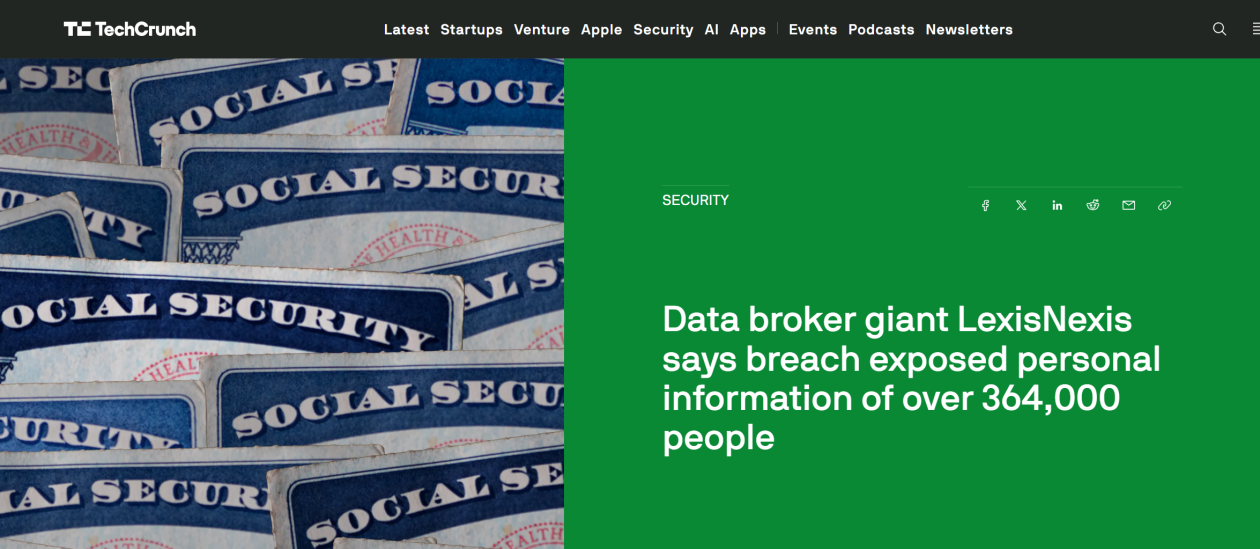
美国数据管理公司LexisNexis发生信息泄露事件 超36.4万人个人信息遭泄露
Huan Qiu Wang· 2025-05-29 03:32
Group 1 - A significant data breach has occurred at LexisNexis Risk Solutions, affecting over 364,000 individuals' personal sensitive information [1][3] - The breach is traced back to December 25, 2024, when a hacker accessed the company's GitHub account through a third-party platform [3] - The stolen data includes names, birth dates, phone numbers, postal and email addresses, social security numbers, and driver's license numbers [3] Group 2 - The specific cause of the data breach remains unclear, with the company receiving a report from an unknown third party on April 1, 2025, regarding unauthorized access to certain information [3] - The data brokerage industry, to which LexisNexis belongs, is valued at billions of dollars, profiting from the collection and sale of personal and financial data of Americans [3] - LexisNexis utilizes extensive consumer information to assist businesses in detecting potential fraudulent transactions and conducting risk assessments [3]
LexisNexis® U.S. Insurance Demand Meter Shows Steady Momentum with "Sizzling" U.S. Consumer Auto Shopping and "Hot" New Policy Growth
Prnewswire· 2025-05-20 18:30
Core Insights - U.S. consumer auto insurance shopping remains elevated in Q1 2025, with shopping growth at 16% and new policy growth at 8.4%, indicating a slight cooling from Q4 2024 [1][9] Group 1: Market Dynamics - Macro factors such as tax refund season and tariff concerns are significantly influencing consumer auto insurance shopping behavior [2] - Direct channel shoppers contributed to growth across all age groups, with a 34% year-over-year increase, outpacing independent and exclusive agent channels [3] - The non-standard market segment experienced a 30% growth, driven by uninsured shoppers entering the market with tax refunds [3] Group 2: Regional Trends - Despite a shorter calendar in February 2025, many regions reported elevated shopping growth, with 10 states showing increases of 20% or more, including Hawaii (59%) and New Jersey (43%) [4] - New policy growth was bolstered by tax refunds and increased vehicle sales, with states like Nevada (39%) and New Jersey (31%) reporting new policy growth of 20% or higher [5] Group 3: Consumer Behavior - Average policy retention dropped to 78% by the end of Q1 2025, down from 83% in early 2022, indicating a faster churn rate [6] - Historically loyal segments, such as policyholders aged 66 and older, are now more active in shopping and switching behavior, highlighting the need for proactive retention strategies [7][8] Group 4: Future Outlook - The full impact of proposed tariffs may not be felt until later in 2025, but current tariffs are already shaping the market, prompting consumers to fast-track purchases [10] - Insurers may need to refine their acquisition and retention strategies as auto and home policy activities increasingly influence one another [10] - Carriers face significant retention challenges, with declining rates potentially straining business models, necessitating disciplined underwriting approaches [11]