Tata Electronics

Search documents
India's Tata signs up Intel as first major customer for $14 billion chip foray
Reuters· 2025-12-08 13:27
Core Insights - Tata Electronics has secured Intel as its first prospective customer for upcoming chip facilities, indicating a significant endorsement of India's manufacturing capabilities by a major U.S. chipmaker [1] Company Summary - Tata Electronics is positioning itself in the semiconductor manufacturing sector, with Intel's interest suggesting a potential boost in credibility and investment in India's chip production [1] Industry Summary - The collaboration between Tata Electronics and Intel may reflect a broader trend of U.S. companies seeking to diversify their supply chains and invest in semiconductor manufacturing in India, aligning with global shifts in the tech industry [1]


Dixon to Tata Electronics: How India’s electronics manufacturers are rewiring strategies
MINT· 2025-11-14 09:36
Core Insights - India's electronics manufacturing sector is experiencing aggressive expansion through new product categories and acquisitions, despite facing thin margins [1][2][19] - Companies are focusing on increasing margins by venturing into industrial electronics, which offers higher value-added margins compared to high-volume electronics assembly [2] Company Summaries Dixon Technologies - Dixon reported ₹14,855 crore in revenue for the September quarter and achieved a 6.2% operating margin, up from 2.8% a year ago [4] - The company invested ₹803 crore in two acquisitions and a joint venture, including ₹553 crore for a joint venture with Kunshan Q Tech Microelectronics and ₹250 crore for a 74% stake in a joint venture with Chongqing Yuhai [5][6] - Dixon plans to invest ₹3,000 crore in display and camera modules, having applied for incentives under the electronics components manufacturing scheme [7][8] - The company anticipates increasing smartphone camera module production from 40 million units to 190-200 million units annually, with revenues projected to rise to ₹6,000-7,000 crore [9] Syrma SGS - Syrma SGS spent ₹235 crore to acquire a 60% stake in Elcome Integrated Systems, which specializes in electronics systems for defense and maritime clients [10] - The company expects this acquisition to contribute ₹100 crore to its top line this fiscal year, with an operating margin of 7.8% during the July-September quarter, up from 6% a year ago [11] Kaynes Technology - Kaynes Technology raised ₹1,575 crore from institutional investors and plans to allocate ₹160 crore for acquisitions [12] - The company recorded a 16.7% operating margin for Q2FY26, an increase from 14.8% a year ago, as it focuses on backward integration into PCB manufacturing and semiconductor packaging [13] Amber Enterprises - Amber Enterprises generated ₹1,647 crore in revenue for the quarter ended September, with electronics manufacturing accounting for a quarter of this revenue [14] - The company spent ₹693 crore on two acquisitions, including a 40% stake in Unitronics for ₹431 crore and ₹262 crore in Power-One Micro Systems [15] - Amber's operating margin was 2.2% in Q2, down from 4.4% a year ago, indicating a need for margin improvement [15] Tata Electronics and Foxconn - Tata Electronics reported ₹66,602 crore in revenue for FY25, making it the largest player in the industry, and announced a ₹91,000 crore investment in semiconductor manufacturing [16][17] - Foxconn's India arm, Bharat FIH, is expanding into electronics components manufacturing with a ₹15,000 crore investment [17] Industry Outlook - The overall electronics production in India is projected to reach ₹11 trillion by the end of 2025 and scale up to ₹44 trillion by 2030 [20] - Companies are increasingly focusing on component manufacturing as a key driver for future growth, with joint ventures and acquisitions being essential strategies [19]
苹果计划将所有美国 iPhone 的供应转向印度,摆脱对中国的依赖
2025-04-27 03:55
Summary of Apple Inc. Conference Call Company Overview - **Company**: Apple Inc. - **Industry**: Technology, specifically smartphone manufacturing Key Points 1. **Shift in Production Location**: Apple plans to shift the assembly of all iPhones sold in the US to India as soon as next year, moving away from reliance on China due to trade tensions initiated by former President Donald Trump [2][4] 2. **Long-term Goals**: The company aims to source all more than 60 million iPhones sold annually in the US from India by the end of 2026, indicating a significant acceleration in its supply chain diversification strategy [5] 3. **Production Capacity Increase**: Achieving this target would require Apple to double its iPhone output in India, a notable shift after nearly two decades of heavy investment in Chinese manufacturing [6] 4. **Current Manufacturing Landscape**: Currently, the majority of iPhones are manufactured in China through third-party suppliers like Foxconn, which have been impacted by aggressive tariffs imposed by the US [7][10] 5. **Market Value Impact**: Following Trump's tariff announcements, Apple experienced a market value loss of $700 billion, prompting the company to expedite the export of Indian-manufactured iPhones to the US to mitigate tariff impacts [8] 6. **Component Sourcing**: Despite the shift in assembly, Apple remains heavily reliant on Chinese suppliers for hundreds of components necessary for iPhone production [10] 7. **Tariff Context**: The US has imposed a 20% tariff on all imports from China, while India faced a reciprocal tariff of 26%, which is currently paused as negotiations for a bilateral trade agreement progress [11] 8. **US Market Share**: The US accounted for approximately 28% of Apple's global iPhone shipments, valued at $232.1 billion in 2024, highlighting the importance of the US market for Apple's overall sales [12] 9. **Increased Capacity Needs**: To fulfill all US orders from India, Apple will need to further increase its manufacturing capacity in the country [12] 10. **Strategic Importance**: Industry experts believe this move is crucial for Apple to maintain its growth and momentum amidst tariff risks, showcasing the company's agility in responding to market challenges [14] 11. **Upcoming Earnings Report**: Apple is set to report quarterly earnings soon, with investors keen to understand the implications of the tariff situation on the company's financial performance [15] 12. **Executive Engagement**: CEO Tim Cook has maintained regular communication with Trump and his administration since the inauguration, indicating the company's proactive approach to navigating trade issues [15] Additional Insights - **Component Import Strategy**: In efforts to boost production in India, Foxconn and Tata have started importing pre-assembled component sets from China, reflecting a transitional strategy as Apple ramps up local assembly [13] - **No Official Comments**: Apple has declined to comment on the specifics of its production strategy or the impact of tariffs [16][17]

Counterpoint:2024 年“印度制造”智能手机出货量同比增长6%
智通财经网· 2025-03-27 08:49
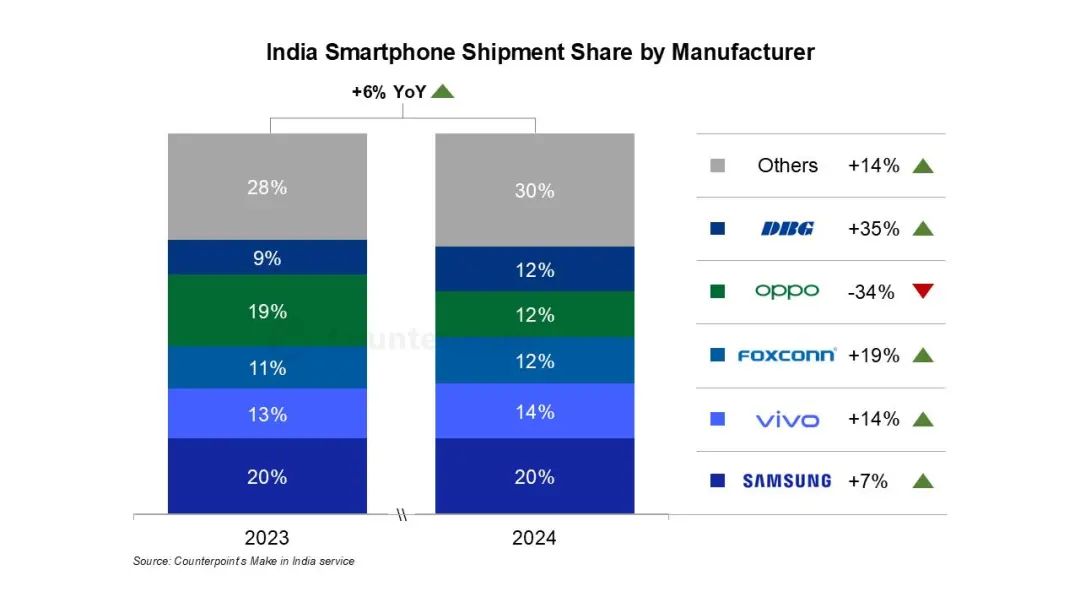
Core Insights - The "Make in India" initiative is projected to see a 6% year-on-year growth in smartphone shipments in 2024, driven primarily by the export growth of Apple and Samsung, which together account for approximately 94% of India's smartphone exports [1][5] - The Indian government's Production-Linked Incentive (PLI) policy is encouraging global manufacturers to establish or expand production bases in India, contributing to local manufacturing growth [1][5] Manufacturer Performance - Samsung is expected to maintain its leading position in India's electronics manufacturing sector, with a 7% year-on-year increase in shipments driven by export growth [6] - Vivo ranks second with a 14% year-on-year growth, achieving a market share of 14%, largely due to the expansion of offline retail channels and distribution networks [6] - Foxconn, supported by Apple, anticipates a 19% year-on-year increase in manufacturing volume, with plans to establish smartphone display module assembly operations to enhance local manufacturing capabilities [6] - Tata Electronics is the fastest-growing manufacturer in 2024, with a 107% year-on-year increase, attributed to strong shipments of iPhone 15 and iPhone 16, alongside the establishment of semiconductor manufacturing facilities [6] - OPPO's manufacturing ranking has dropped to fourth place, with a 34% year-on-year decline in shipments due to intense market competition and increased reliance on contract manufacturing [6] - DBG has achieved double-digit growth in 2024 due to collaborations with Xiaomi and realme [6] Overall Market Dynamics - Dixon leads the overall mobile device market, including smartphones and feature phones, with strong shipment performance driven by Transsion's brands and Motorola [7] - In the smartphone sector, Dixon has experienced a 39% year-on-year growth, supported by new partnerships with Transsion and realme [7]
2024 年,“印度制造”智能手机出货量同比增长 6% ,出口创历史新高
Counterpoint Research· 2025-03-27 03:49
根据 Counterpoint 的 《印度制造服务报告》, 2024 年"印度制造"智能手机出货量同比增长 6% ,主 要受到 Apple 和 Samsung 出口增长的推动。 Apple 和 Samsung 两大品牌合计占印度智能手机出口 量的约 94% 。 2024 年,Samsung 继续保持印度智能手机制造商的头部地位,其智能手机出货量取得 7 % 的 同比增长,这得益于其出口量同比增长 13 %。 Foxconn Hon Hai在印度的出货量同比增长 19% ,主要受 iPhone 14 、iPhone 15 和 iPhone 13 机 型出货量增长的带动。 Tata Electronics(原纬创)是 2024 年印度增长最快的智能手机制造商,同比增长 107% ,其中 iPhone 15 和 iPhone 16 机型贡献了主要出货量。 在整个手机市场(包括智能手机和功能机)中,Dixon 成为 2024 年印度最大的制造商。 受政府推动以及品牌加速供应链多元化的影响,预计 2025 年"印度制造"智能手机的出货量将 实现两位数增长。 数据来源:Counterpoint "印度制造"服务 分析师观 ...
2024 年,“印度制造”智能手机出货量同比增长 6% ,出口创历史新高
Counterpoint Research· 2025-03-27 03:49
Core Viewpoint - The "Make in India" initiative is driving a 6% year-on-year growth in smartphone shipments in 2024, primarily fueled by the export growth of Apple and Samsung, which together account for approximately 94% of India's smartphone exports [1][4]. Group 1: Market Dynamics - Samsung maintains its leading position in India's smartphone manufacturing with a 7% year-on-year growth in shipments, supported by a 13% increase in exports [4][7]. - Foxconn Hon Hai's shipments in India grew by 19% year-on-year, driven by the strong performance of iPhone 14, iPhone 15, and iPhone 13 models [4][7]. - Tata Electronics emerged as the fastest-growing smartphone manufacturer in India in 2024, with a remarkable 107% year-on-year growth, largely attributed to the iPhone 15 and iPhone 16 [4][7]. Group 2: Future Projections - The Indian smartphone manufacturing sector is expected to achieve double-digit growth in 2025, bolstered by government initiatives and the diversification of global supply chains [5][6]. - The local value addition in smartphone manufacturing is anticipated to increase continuously, making India an attractive manufacturing hub due to its large domestic market and low labor costs [5][6]. Group 3: Competitive Landscape - Vivo ranks second in the market with a 14% year-on-year growth, benefiting from the expansion of offline retail channels and a strengthened distribution network [7]. - OPPO faced challenges in 2024, with a 34% decline in shipments due to intense market competition and increased reliance on contract manufacturing [7]. - Dixon became the largest manufacturer in the overall mobile device market, driven by partnerships with Transsion and Motorola, achieving a 39% year-on-year growth in smartphone shipments [8].