
Ripple

Search documents
全球数字资产: 市场回调 监管博弈
Sou Hu Cai Jing· 2026-02-10 16:40
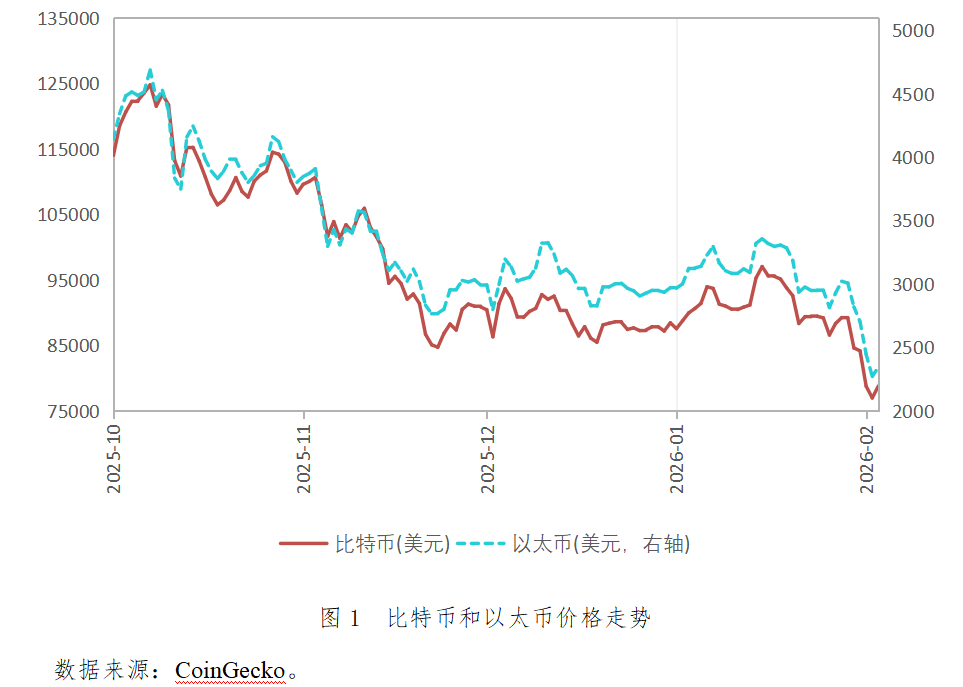
Group 1: Digital Asset Market Overview - The digital asset market experienced a significant downturn in Q4 2025, with a total market capitalization of approximately $2.93 trillion as of January 31, 2026, reflecting a decline of about 27.1% from the end of Q3 2025 [3][4] - Bitcoin's closing price was $84,100, down approximately 26.4%, while Ethereum fell to around $2,702, a decrease of about 35.9% [3][4] - The market adjustment was influenced by changes in liquidity expectations, delays in key regulatory legislation in the U.S., and a shift in market sentiment towards caution [3][4] Group 2: Stablecoin Market Dynamics - The stablecoin market showed a significant slowdown in growth, with a total market capitalization of $293.29 billion as of January 31, 2026, representing a mere 2.3% increase from the previous quarter [5] - The dominance of USD stablecoins remains strong, with USDT and USDC maintaining a duopoly, accounting for approximately 59.7% and 22.8% of the market, respectively [5] Group 3: Regulatory Developments - The U.S. regulatory landscape for digital assets is characterized by a dual focus on institutional integration and risk prevention, with the legislative process for the "CLARITY Act" stalled due to industry conflicts [2][8] - The People's Bank of China has initiated a new generation of the digital RMB system, marking a transition towards a more systematic development phase [2][13] - The U.S. Office of the Comptroller of the Currency (OCC) has granted temporary national bank charters to several stablecoin issuers, integrating them into the federal banking regulatory framework [7] Group 4: Real World Assets (RWA) Growth - The market capitalization of Real World Assets (RWA) grew by 41.1% from the end of Q3 2025 to approximately $23.7 billion as of January 31, 2026, with U.S. Treasury RWA accounting for 40% of this total [15][16] - Traditional financial institutions are actively promoting the tokenization of compliant products, indicating a shift towards integrating RWA into blockchain ecosystems [16] Group 5: Future Regulatory Scenarios - The ongoing negotiations surrounding the "CLARITY Act" may lead to three potential outcomes: a conservative version favoring banking interests, a middle-ground version facilitating compliance for crypto-native platforms, or a complete failure of the act, resulting in continued regulatory uncertainty [11][12] - The Chinese regulatory framework has clarified the definition and stance on RWA, emphasizing compliance and the need for regulatory approval for tokenization activities [17][18]
X @🚨BSC Gems Alert🚨
🚨BSC Gems Alert🚨· 2026-02-10 14:21
RT 🚨BSC Gems Alert🚨 (@BSCGemsAlert)$PEPE Or $XRP : You Can Only Choose One. https://t.co/N5z4wng9yx ...
X @Whale Alert
Whale Alert· 2026-02-10 12:50
🚨 🚨 🚨 50,000,000 #XRP (70,378,108 USD) transferred from unknown wallet to #Bybithttps://t.co/VW8t5Q2Mgt ...
Davos WEF 2026: Crypto Enters Its Execution Phase
Yahoo Finance· 2026-02-10 12:46
Group 1 - The core perspective at the World Economic Forum 2026 is that crypto is evolving from a parallel financial system to an emerging institutional infrastructure, shaped by regulation and market structure [1][2] - The discussions at Davos have shifted from hype to execution, focusing on what can realistically be achieved in 2026 under specific rules and expected returns on capital [1][4] - Crypto is now being evaluated based on compliance, governance, and measurable outcomes rather than narratives, indicating a significant shift in perception [3] Group 2 - Stablecoins have emerged as the most deployable use case in the crypto space, with institutional demand and regulatory attention aligning [5] - Tokenization is being viewed as a targeted efficiency upgrade rather than a sweeping transformation, emphasizing faster settlement and improved operational risk management [5] - The competition for executive capital in 2026 is intense, with crypto now contending with AI, cybersecurity, and operational resilience for attention [6] Group 3 - At Bloomberg House, the focus was on legislative constraints affecting crypto, particularly the stalled Clarity Act, which has implications for tokenized equities and DeFi [8] - The delay in legislative progress highlights that policy details are currently more critical to adoption than technological advancements [8] - The debate surrounding stablecoins involves yield, consumer protection, and financial stability, indicating active fault lines in the regulatory landscape [8][9]

How to Buy XRP in Singapore (Simple 2026 Guide)
InvestingHaven· 2026-02-10 12:17
Core Insights - XRP is a significant digital asset in Singapore, utilized for cross-border payments and liquidity, with regulatory clarity provided by the Monetary Authority of Singapore (MAS) [1][35] - Singapore does not impose capital gains tax on personal crypto investments, although income tax may apply if trading is considered a business [2][40] - The MAS regulates crypto platforms under the Payment Services Act, ensuring compliance with KYC, AML, and custody standards [35][36] Exchange Recommendations - Coinhako is a popular MAS-regulated exchange for buying XRP with SGD, offering direct SGD deposits and a user-friendly interface [3][8] - Crypto.com supports XRP and provides various funding methods, suitable for both casual buyers and active traders [4][16] - Independent Reserve offers direct SGD on-ramps and an OTC desk for larger purchases, appealing to both retail and institutional investors [10][15] Fees and Costs - Local exchanges typically offer free PayNow and FAST deposits, while card deposits incur higher fees ranging from 2% to 4% [38] - Trading fees for XRP generally range from 0.1% to 1%, with lower fees for limit orders compared to instant buys [38][39] - Each new XRP wallet requires a reserve of 1 XRP, which affects the amount available for transactions [39][42] Security and Wallet Options - Users are advised to enable two-factor authentication and securely store recovery phrases to protect their XRP [41][42] - Custodial wallets are convenient for trading but offer less control, while non-custodial wallets provide more security for long-term holdings [27][30] - Hardware wallets are recommended for long-term storage due to their offline nature, minimizing exposure to online threats [30][31] Regulatory Environment - The MAS provides a clear regulatory framework for crypto in Singapore, enhancing access to compliant exchanges while imposing certain product limits [35][36] - Retail users benefit from better access to regulated platforms, although some services may be restricted for Singapore accounts [36][37]

LMAX推出全新交易平台 打破加密货币与外汇之间的壁垒
Xin Lang Cai Jing· 2026-02-10 11:59
Core Insights - LMAX Group has launched the Omnia exchange, designed to allow users to seamlessly exchange foreign exchange, cryptocurrencies, stablecoins, and other digital assets on a single platform [1][3] - Omnia is positioned as a "unified multi-asset infrastructure layer," enabling users to trade any asset directly 24/7 without restrictions on transaction size or asset type, with settlement options through traditional payment channels or instant blockchain settlement [1][3] - LMAX's cryptocurrency business has been a major player in the institutional crypto trading space, with an institutional trading volume of $8.2 trillion last year [1][3] Company Developments - LMAX Digital focuses on cryptocurrency/foreign exchange trading pairs as an institutional crypto execution and custody platform, while Omnia aims to integrate foreign exchange, cryptocurrencies, stablecoins, and other digital assets into a single system [1][3] - CEO David Mercer stated that Omnia bridges the gap between traditional markets and digital asset markets [4] - The recent partnership with Ripple to integrate its stablecoin RLUSD reflects the growing role of stablecoins as a universal tool for institutions entering the market, beyond just the crypto-native space [4]
Ripple Just Did Something That Could Supercharge XRP This Year and Beyond
Yahoo Finance· 2026-02-10 11:39
Ripple is aiming to use XRP (CRYPTO: XRP) to do something that crypto rarely pulls off: make decentralized finance (DeFi) usable -- and useful -- for financial institutions. And in service of that goal, on Feb. 4, the company announced that its Ripple Prime platform now supports integration with Hyperliquid (CRYPTO: HYPE), a major crypto exchange for financial derivatives and tokenized real-world assets. This is the kind of move that could potentially supercharge XRP's price for quite some time. Here's wh ...
全球数字资产:市场回调,监管博弈
Di Yi Cai Jing· 2026-02-10 11:02
Market Overview - The digital asset market experienced a significant downturn in Q4 2025, with the total market capitalization dropping approximately 27.1% to $2.93 trillion by January 31, 2026 [1][3] - Bitcoin's closing price was $84,100, reflecting a decline of about 26.4%, while Ethereum fell to approximately $2,702, down 35.9% [1][3] - The contraction in the market was influenced by changes in liquidity expectations, delays in key regulatory legislation in the U.S., and a cautious shift in market sentiment [1][3] Stablecoin Market - The stablecoin market saw a slowdown in growth, with total market capitalization increasing only 2.3% to $293.29 billion by January 31, 2026 [1][5] - USDT and USDC continue to dominate the market, with USDT's market cap at approximately $184.8 billion, accounting for about 59.7% of the total [1][5] Regulatory Developments - Global regulatory frameworks are evolving to integrate digital assets while simultaneously addressing risk prevention [1][8] - The U.S. legislative process for the Digital Asset Market Structure Bill (CLARITY Act) has been stalled due to industry conflicts, highlighting the struggle for control over market infrastructure between new crypto entities and traditional financial capital [1][10] - The U.K. has proposed new regulations to align digital assets with traditional securities, indicating a move towards stricter compliance for crypto service providers [1][9] Real World Assets (RWA) - The market for Real World Assets (RWA) has seen a substantial increase, with a 41.1% growth to approximately $23.7 billion from Q3 2025 to January 31, 2026 [2][17] - U.S. Treasury securities represent the largest segment of RWA, accounting for 40% of the total [2][17] Digital Currency Developments in China - The People's Bank of China has initiated a new generation of the digital yuan, transitioning from digital cash to digital deposit currency, marking a significant development in its operational framework [1][15] - The new system emphasizes a dual-layer operational structure involving central banks and commercial institutions, enhancing the integration of digital currency into the existing financial system [1][15][16]
Down 31% in 7 Days, Is XRP Still a Buy?
Yahoo Finance· 2026-02-10 10:50
Core Viewpoint - XRP has experienced a significant price decline of 31% over the past week, with a notable drop of 21% on February 5, attributed to a broader downturn in the cryptocurrency market [1][3]. Group 1: Price Performance and Market Conditions - The decline in XRP's price is not due to any issues with the cryptocurrency itself, its blockchain, or its issuer, Ripple [2]. - The overall crypto market is facing a malaise, exacerbated by investors pulling back from previously successful trades, particularly in AI stocks and precious metals [3]. - Geopolitical and macroeconomic challenges are contributing to the downturn, although cryptocurrencies were already struggling prior to these events [3]. Group 2: Investment Thesis - Despite the current market conditions, the long-term investment thesis for XRP remains valid, as it is still viewed as a strong fintech coin [4][5]. - Ripple is developing the XRP Ledger (XRPL) to serve as a low-cost and efficient platform for financial institutions, aiming to create an integrated system for managing on-chain capital and liquidity [6]. - The use of XRP within the XRPL ecosystem is expected to drive demand and potentially increase its price as users need to fund accounts and transact with XRP [6]. Group 3: Future Outlook - While the bullish case for XRP is strong, there are no guarantees that the price will stabilize in the near term, especially if macroeconomic sentiment continues to decline [7]. - Investors are advised to consider their risk tolerance, as further price drops could lead to panic selling [7].
XRP Panic Selling? Key On-Chain Metric Flips Bearish to Levels Last Seen in 2022
Yahoo Finance· 2026-02-10 10:24
Core Insights - XRP has experienced a significant decline, trading over 60% lower than its all-time high, with current prices around $1.44 as of February 10, 2026 [1][6] - On-chain indicators reveal increased panic among XRP holders, with a notable rise in exchange inflows indicating potential selling pressure [1] - The Spent Output Profit Ratio (SOPR) for XRP has fallen below 1, indicating that holders are realizing losses, which is often associated with capitulation and bearish market conditions [2][3][7] Market Sentiment - The SOPR metric, which measures the profitability of transactions, has dropped from 1.16 in July 2025 to 0.96 in early February 2026, reflecting negative aggregate holder profitability [3][4] - The realized price of XRP is currently $1.48, similar to levels seen in April 2022, suggesting a bearish market environment [4] - Analysts are divided on future price predictions, with some forecasting a range of $5–$15 by year-end, while others, including Ripple's CTO, express skepticism about reaching $50–$100 in the near term [7] Price Performance - XRP's price has continued to decline, with a recent drop of over 10% amid heavy liquidations, trading at approximately $1.44 [6][7] - Historical data indicates a sharp decline from $1.65 on January 31 to $1.29 by February 5, marking a 16% drop in a single day, coinciding with a 7% decline in Bitcoin [8]