
Sarepta Therapeutics

Search documents
Sarepta Therapeutics, KULR Technology Group And Other Big Stocks Moving Lower In Monday's Pre-Market Session
Benzinga· 2025-06-16 12:38
Group 1 - U.S. stock futures are higher, with Dow futures gaining over 150 points [1] - Sarepta Therapeutics, Inc. shares fell 31.4% to $24.86 after suspending ELEVIDYS shipments and pausing ENVISION trial due to a second fatal liver failure in non-ambulatory Duchenne patients [1] Group 2 - KULR Technology Group, Inc. shares fell 21.9% to $0.8980 following a 1-for-8 reverse stock split [4] - Gold Royalty Corp. shares dipped 14.7% to $1.95, despite Canaccord Genuity initiating a Buy rating with a $3 price target [4] - Solid Biosciences Inc. shares fell 8% to $4.15, with JMP Securities reiterating a Market Outperform rating and maintaining a $15 price target [4] - Omada Health, Inc. shares declined 5.4% to $16.18 [4] - Repligen Corporation shares decreased 4% to $122.50 [4] - IonQ, Inc. shares slipped 3.2% to $36.65 [4] - Tango Therapeutics, Inc. shares declined 3.2% to $4.54 [4]







Sarepta Therapeutics: Rebuilding The Thesis After Hitting Rock Bottom
Seeking Alpha· 2025-06-16 05:57
Core Insights - The article discusses the performance and investment potential of Sarepta Therapeutics (NASDAQ: SRPT), noting that the stock was trading near $160 per share nearly a year ago following a significant FDA approval [1]. Group 1 - Sarepta Therapeutics experienced a notable rise in stock price due to the FDA's expanded approval, which is a key factor in its investment appeal [1]. - The author emphasizes a focus on innovative companies in the biotech sector that are developing breakthrough therapies, indicating a strategic investment approach [1]. Group 2 - The article is part of a subscription marketplace service called Compounding Healthcare, which offers various resources for healthcare investors, including model portfolios and newsletters [1].

[Ad hoc announcement pursuant to Art. 53 LR] Roche provides safety update on Elevidys™ gene therapy for Duchenne muscular dystrophy in non-ambulatory patients
Globenewswire· 2025-06-15 05:00
Core Viewpoint - Roche has implemented new dosing restrictions for Elevidys™ (delandistrogene moxeparvovec) for non-ambulatory Duchenne muscular dystrophy (DMD) patients due to two cases of fatal acute liver failure, leading to a reassessment of the benefit-risk profile as unfavorable for this patient group [1][2][4][7]. Group 1: Dosing Restrictions - Effective immediately, non-ambulatory patients will no longer receive Elevidys in commercial settings, and dosing for these patients in clinical trials is paused until additional risk mitigation measures are established [1][7]. - The new restrictions do not affect ambulatory DMD patients, where the benefit-risk ratio remains positive [2][7]. Group 2: Clinical Context - The two fatal cases of acute liver failure occurred among approximately 140 non-ambulatory patients treated with Elevidys globally [4]. - European regulators have requested temporary clinical holds on several Elevidys studies following the incidents [4]. Group 3: Product Overview - Elevidys is the first approved gene therapy for DMD, designed to deliver new instructions to cells to produce dystrophin, aiming to slow disease progression [10][11]. - The treatment has been approved in eight territories, including Bahrain, Brazil, and Japan, and Roche collaborates with Sarepta Therapeutics for its commercialization [5][11]. Group 4: Disease Background - Duchenne muscular dystrophy is a rare genetic disease primarily affecting males, with a prevalence of 1 in 5,000 boys born worldwide, leading to progressive muscle weakness and loss of mobility [3][12]. - The average life expectancy for individuals with Duchenne is only 28 years, highlighting the critical need for effective treatments [12][16].

FDA Grants Platform Technology Tag to Sarepta's Gene Therapy Vector
ZACKS· 2025-06-05 15:06
Core Insights - The FDA has granted platform-technology designation to Sarepta Therapeutics' rAAVrh74 viral vector, which is used in the investigational gene therapy SRP-9003 for limb-girdle muscular dystrophy (LGMD) [1][7] - This designation allows Sarepta to reuse clinical and manufacturing data across multiple therapies utilizing the same viral vector, potentially expediting development timelines [2][3] Company Developments - SRP-9003 is currently in a phase III EMERGENE study targeting LGMD type 2E/R4, with primary endpoints focused on beta-sarcoglycan protein expression [4] - Positive data from the ongoing study could lead to a regulatory filing for accelerated approval by the end of the year [5] - Despite the potential for SRP-9003, Sarepta's stock has seen a significant decline of 68% year-to-date, contrasting with a 4% decline in the industry [6] Recent Challenges - Sarepta faces negative sentiment due to safety concerns surrounding its gene therapy Elevidys, which is the first one-time treatment for Duchenne muscular dystrophy (DMD) [9] - A recent incident involving a patient's death post-treatment has led to a clinical hold on Elevidys studies by the EMA, raising apprehensions about market adoption [10][12] - Elevidys has generated approximately $821 million in sales for 2024, a substantial increase from $200 million the previous year, but safety concerns have prompted a revision of 2025 sales guidance to $2.3–2.6 billion from an earlier forecast of $2.9–3.1 billion [11][13] Strategic Partnerships - Elevidys was developed in collaboration with Roche, which holds exclusive rights to market the therapy outside the U.S. [14]


Sarepta Therapeutics(SRPT) - 2025 FY - Earnings Call Transcript
2025-06-05 15:00
Financial Data and Key Metrics Changes - The company held its Annual Meeting of Stockholders on June 5, 2025, but specific financial data and key metrics were not disclosed during the meeting [1][2][3] Business Line Data and Key Metrics Changes - No specific data or key metrics related to individual business lines were provided in the meeting [1][2][3] Market Data and Key Metrics Changes - There was no mention of market data or key metrics changes during the meeting [1][2][3] Company Strategy and Development Direction and Industry Competition - The meeting focused on the election of directors and approval of various proposals, indicating a commitment to governance and strategic planning, but specific strategic directions or competitive insights were not discussed [1][2][3][8][9] Management's Comments on Operating Environment and Future Outlook - Management did not provide comments on the operating environment or future outlook during the meeting [1][2][3] Other Important Information - The company proposed amendments to its equity incentive plan and employee stock purchase plan, reflecting ongoing efforts to align compensation with shareholder interests [10][11][27][32] Q&A Session All Questions and Answers Question: What were the results of the proposals voted on? - Proposal one: Election of directors was approved [14][30] - Proposal two: Advisory vote on executive compensation was approved [14][31] - Proposal three: Amendment to the equity incentive plan was approved [14][32] - Proposal four: Amendment to the employee stock purchase plan was approved [14][32] - Proposal five: Selection of KPMG as the independent auditor for 2025 was ratified [14][32]
Sarepta Therapeutics Inc. (SRPT): 根据CBER主任的评论,Elevidys的完全批准可能保持不变
Goldman Sachs· 2025-05-30 02:35
Investment Rating - The investment rating for Sarepta Therapeutics Inc. (SRPT) is "Buy" with a 12-month price target of $100, indicating a potential upside of 160.8% from the current price of $38.35 [8][9]. Core Insights - The commentary from the newly-appointed FDA CBER Director, Dr. Vinay Prasad, suggests that the full approval of Elevidys for ambulatory patients is likely to remain intact, barring any serious safety events [1][6]. - There is a risk to Elevidys' accelerated approval in non-ambulatory patients, which constitutes approximately half of the market, depending on confirmatory data expected in 2027 [1][6]. - The company has projected $13 billion in free cash flow by the end of 2030 and is focusing on pipeline diversification, including early Phase 1 data in other muscular dystrophies [1]. Financial Projections - Revenue projections for SRPT are estimated to grow from $1.9 billion in 2024 to $4.3 billion by 2027 [9]. - The EBITDA is expected to improve significantly, moving from a loss of $102.6 million in 2025 to a profit of $2.1 billion by 2027 [9]. - The forecasted Free Cash Flow yield is projected to increase from -2.8% in 2024 to 64.0% by 2027 [9]. Regulatory Environment - The new CBER Director emphasized the importance of regulatory flexibility in rare diseases and gene therapy, indicating a supportive stance towards maintaining previous approvals unless new safety concerns arise [2][6]. - The Director's approach suggests that accelerated approval pathways will continue to be utilized, particularly in the context of rare diseases and oncology [6]. Market Context - The market capitalization of SRPT is currently $3.7 billion, with an enterprise value of $3.3 billion [9]. - The company is facing competitive risks as other firms are also developing treatments for Duchenne muscular dystrophy (DMD), including RNA-based therapies and gene therapies [8].
股价跌超60%!Rocket基因疗法致患者死亡,FDA紧急叫停
Ge Long Hui· 2025-05-28 02:33
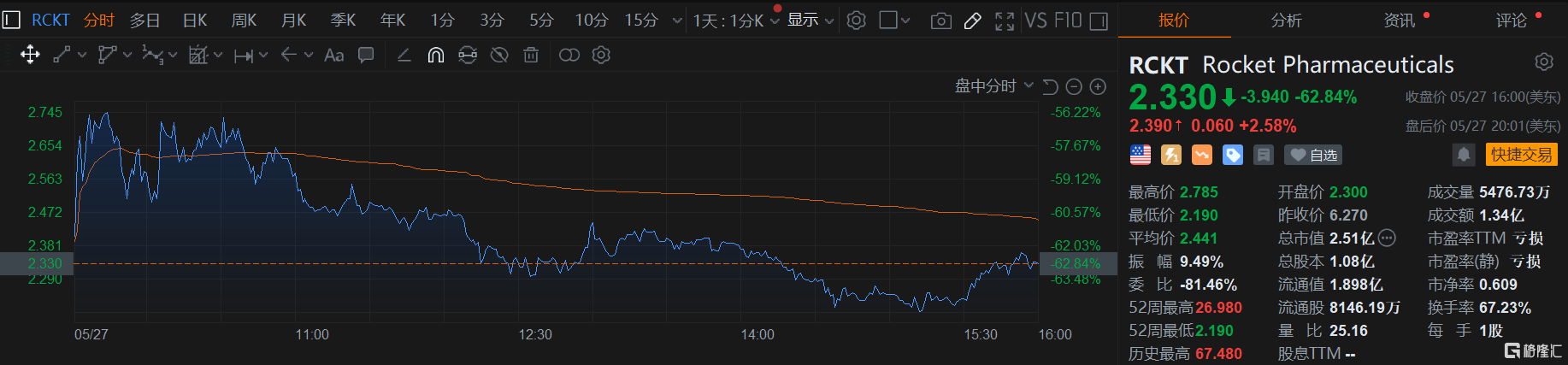
Core Viewpoint - The FDA has paused Rocket Pharma's critical Phase 2 clinical trial for its gene therapy RP-A501 targeting Danon disease due to a serious adverse event resulting in a patient's death [1][2][3]. Group 1: Clinical Trial Impact - A serious adverse event occurred during the Phase 2 trial, leading to the death of a patient from complications related to capillary leak syndrome [2]. - The FDA issued a clinical hold on May 23, requiring further investigation into the cause of the event [2]. - Rocket Pharma is collaborating with the FDA, independent data safety monitoring boards, and clinical researchers to ensure patient safety and aims to resume the trial as soon as possible [5]. Group 2: Financial and Market Reaction - Following the announcement, Rocket's stock price plummeted over 62% in a single day, marking an over 80% decline year-to-date [3]. - Analysts estimate Rocket's quarterly cash burn to be between $40 million to $50 million, with the clinical hold expected to pressure the company's financial situation [7]. - As of the end of Q1, Rocket reported cash and cash equivalents totaling $318.2 million, which is projected to sustain operations until 2027, excluding potential revenues from expedited review vouchers for certain therapies [7]. Group 3: Industry Context - Other companies in the industry have also faced patient deaths in clinical trials, raising concerns about the long-term impact on gene therapy investments [6][7]. - Jefferies analysts suggest that the recent death has damaged the risk-benefit profile of the Danon project, while BMO Capital Markets remains optimistic about the potential efficacy of RP-A501 given the poor prognosis of Danon disease patients [7].
Arrowhead Pharmaceuticals (ARWR) 2025 Conference Transcript
2025-05-20 19:37
Summary of Arrowhead Pharmaceuticals (ARWR) 2025 Conference Call Company Overview - Arrowhead Pharmaceuticals is focused on developing RNAi-based therapeutics with a strong pipeline aimed at addressing severe diseases, particularly in the areas of hypertriglyceridemia and alpha-1 antitrypsin deficiency [2][3] Key Developments - The company has solidified its balance sheet and has capital projected to last until 2028, which is crucial for upcoming drug launches [3][4] - Planned drug launches include: - **Plazasiran** for familial chylomicronemia syndrome (FCS) expected in late 2025 - **Fazisiran** for alpha-1 antitrypsin deficiency (AAT) in 2027-2028 - **Olpassiran** with Amgen also anticipated around the same timeframe [4] Drug Pipeline Insights - **Plazasiran**: - First drug from Arrowhead's pipeline expected to receive FDA approval with a PDUFA date set for November 18, 2025 - Demonstrated significant triglyceride reduction in clinical trials, with 100% of patients showing lowered triglycerides and an average reduction of around 80% from baseline [6][7] - Safety profile appears favorable, with no anticipated advisory committee meeting [6][7] - **Shasta Five Trial**: - A dedicated trial to assess the acute pancreatitis benefit of plazasiran, targeting patients with triglycerides above 1000 mg/dL and a history of pancreatitis [24][25] - This trial is not required for regulatory approval but is seen as beneficial for payer acceptance [25] Competitive Landscape - The market for severe hypertriglyceridemia is viewed as underserved, with Arrowhead positioned to be among the first to provide effective treatments [16][17] - The company acknowledges competition but believes that having multiple players will enhance market education and acceptance [19] Safety and Efficacy Considerations - Concerns regarding HbA1c levels were addressed, with the company viewing any increases as a biological signal rather than a safety issue [22][23] - The company is focused on ensuring that the drug's efficacy translates into meaningful clinical benefits for patients [22][23] Obesity Pipeline - Arrowhead is pursuing dual targets (inhibin E and ALK7) for obesity treatment, with the rationale that both pathways could induce lipolysis and fat burning [28][30] - The company plans to evaluate which target performs better in human trials before advancing one into later-stage development [35] Alpha-1 Antitrypsin Program - The collaboration with Takeda is seen as transformative, with expectations for full enrollment in the pivotal trial by the end of the year [74][75] - The drug is anticipated to significantly impact the treatment landscape for alpha-1 antitrypsin deficiency, with a profit-sharing model in place [78] Business Development Strategy - Arrowhead aims to pursue additional business development deals to extend its runway, with a focus on maintaining a balance between new partnerships and internal drug development [79][80] - The company is open to exploring discovery components in future deals to enhance its pipeline [80] Conclusion - Arrowhead Pharmaceuticals is strategically positioned with a robust pipeline and a clear focus on addressing significant unmet medical needs in hypertriglyceridemia and alpha-1 antitrypsin deficiency, while also exploring opportunities in obesity treatment and maintaining a proactive approach to business development [2][3][4][79]

2024年十大畅销基因疗法,仅3款销售额超1亿美元
生物世界· 2025-05-17 06:32
Core Viewpoint - The current gene therapy market is characterized by both significant investment opportunities and notable challenges, reflecting a duality in its development landscape [2][3]. Investment Highlights - As of mid-April 2023, five gene therapy companies have collectively secured $534.4 million in venture capital funding, indicating strong investor interest in the sector [2]. - Notable funding rounds include Tune Therapeutics raising over $175 million in January, and Atsena Therapeutics completing a $150 million oversubscribed round in April [2]. Market Challenges - AmplifyBio, a CRO/CDMO focused on gene and cell therapies, shut down in April 2023 after four years of operation, highlighting funding shortages faced by early-stage biotech companies [3]. - Despite over ten gene therapies receiving FDA approval, only one is projected to exceed $1 billion in sales in 2024, with only three therapies expected to surpass $100 million in sales [3]. Top Gene Therapies by Projected Sales 1. **Zolgensma®**: Projected sales of $1.214 billion in 2024, developed by Novartis, for treating spinal muscular atrophy in children under 2 years old [12]. 2. **Elevidys®**: Projected sales of $820.791 million in 2024, developed by Sarepta Therapeutics, for treating Duchenne muscular dystrophy [13]. 3. **Vyjuvek®**: Projected sales of $290.5 million in 2024, developed by Krystal Biotech, for treating epidermolysis bullosa [13]. 4. **Adstiladrin®**: Projected sales of €70 million ($79 million) in 2024, developed by Ferring Pharmaceuticals, for treating high-risk non-muscle invasive bladder cancer [14]. 5. **Zynteglo™**: Projected sales of $62.273 million in 2024, developed by bluebird bio, for treating beta-thalassemia [14]. 6. **Roctavian®**: Projected sales of $26 million in 2024, developed by BioMarin Pharmaceutical, for treating severe hemophilia A [14]. 7. **Lenmeldy™ / Libmeldy™**: Projected sales of $224.54 million in 2024, developed by Orchard Therapeutics, for treating metachromatic leukodystrophy [14]. 8. **Luxturna®**: Projected sales of CHF 18 million ($20.9 million) in 2024, developed by Spark Therapeutics, for treating RPE65 mutation-associated retinal dystrophy [14]. 9. **Lyfgenia®**: Projected sales of $11.605 million in 2024, developed by bluebird bio, for treating sickle cell disease [16]. 10. **Skysona®**: Projected sales of $9.917 million in 2024, developed by bluebird bio, for treating cerebral adrenoleukodystrophy [16].

Sarepta Therapeutics (SRPT) 2025 Conference Transcript
2025-05-14 16:40
Summary of Sarepta Therapeutics (SRPT) Conference Call Company Overview - **Company**: Sarepta Therapeutics (SRPT) - **Event**: 2025 Conference at Bank of America Healthcare Conference - **Date**: May 14, 2025 Key Points Financial Performance - **Net Product Revenue**: $612 million for Q1, representing a 70% growth year-over-year [8] - **Elevatus Revenue**: $375 million, a 180% increase compared to the same quarter last year [8] - **GAAP Operating Income**: Approximately $2.75 million, a 70% increase from the previous quarter [9] - **Non-GAAP Basis**: $335 million, about 45% of sales, indicating strong financial performance [9] - **Revised Guidance**: Expected revenue for the year is between $2.3 billion and $2.6 billion, with profitability and cash flow positivity anticipated [13] Industry Context - **Biotech Market Condition**: The current biotech market is described as "chaotic" and "nearly uninvestable," with 30% of public biotechs trading below their cash value [10][12] - **Funding Challenges**: Over 90% of biotechs rely on equity markets for funding, leading to potential failures of many companies and their programs [12] Regulatory Environment - **FDA Interactions**: Positive interactions with the FDA regarding the limb girdle programs, with no delays or changes in perspective noted [24][31] - **Accelerated Approvals**: Discussions ongoing regarding the transition from accelerated to traditional approvals for PMOs, with a focus on totality of evidence [40] Safety Concerns - **Recent Safety Event**: A safety incident involving a patient death due to liver injury has impacted the company's operations and necessitated increased communication with families and physicians [51][52] - **Impact on Patient Enrollment**: The safety event has caused delays in patient enrollment and treatment initiation, with a longer cycle time from start form to infusion now expected [54][60] Pipeline and Product Development - **Innovative Approaches**: The company is focused on gene therapy and gene editing, with a strong pipeline for limb girdle muscular dystrophy (LGMD) treatments [14][30] - **Upcoming BLA Submission**: A Biologics License Application (BLA) for the 09/2003 program is expected to be submitted later this year, with potential approval in the first half of next year [29][30] Market Strategy - **Focus on Secondary Sites**: The company is working to increase patient access by focusing on secondary and tertiary sites to expedite treatment [61][66] - **Sales and Support Strategy**: A multidisciplinary approach is being employed to support sites, including education on efficacy and safety [66] Future Outlook - **Guidance for Q2 and Beyond**: Anticipated revenue decline in Q2 due to the safety event, with expectations for recovery in Q3 and Q4 [81] - **Seasonality Considerations**: Potential for increased patient enrollment during the summer months, but ongoing impacts from the safety event are expected to linger [80][81] Additional Insights - **Manufacturing Resilience**: All products are manufactured in the U.S., with minimal impact from tariffs [19][20] - **Long-term Patient Monitoring**: Emphasis on the need for long-term studies to assess the efficacy of therapies in degenerative diseases [39] This summary encapsulates the critical insights from the conference call, highlighting Sarepta Therapeutics' financial performance, industry challenges, regulatory interactions, safety concerns, and strategic focus moving forward.