Aberdeen Investments

Search documents
Aberdeen Investments Expands Active ETF Suite with Fixed Income and International Small Cap
Prnewswire· 2025-10-20 13:00
Core Insights - Aberdeen Investments has expanded its active ETF platform, converting two mutual funds into fully transparent ETFs, marking a significant milestone as its U.S. ETF franchise surpasses $18 billion in assets under management for the first time [2][5]. Group 1: ETF Conversions and New Offerings - The abrdn Ultra Short Municipal Income Active ETF (AMUN) aims to provide high after-tax current income while preserving capital, co-managed by Jonathan Mondillo and Miguel Laranjeiro [2][3]. - The abrdn International Small Cap Active ETF (ASCI) focuses on identifying growth opportunities among under-researched international small-cap companies, co-managed by Kirsty Desson and Liam Patel [3]. - The merger of the abrdn China A Share Equity Fund and the abrdn Focused Emerging Markets ex-China Fund into the abrdn Emerging Markets Dividend Active ETF (AGEM) has been announced [4]. Group 2: Strategic Commitment and Market Position - The conversions reflect Aberdeen's commitment to delivering cost-efficient investment solutions to U.S. investors, building on the success of previously launched ETFs [5]. - Jim O'Connor, CEO of Americas, emphasized that crossing $18 billion in assets demonstrates the strength and scalability of the U.S. platform, enhancing access to Aberdeen's expertise in various investment areas [5]. - Jonathan Mondillo highlighted the current municipal market's opportunities, stating that the Ultra Short Municipal Income Active ETF conversion addresses investor demand for active fixed income solutions [5]. Group 3: Company Overview and Asset Management - As of June 30, 2025, Aberdeen manages $709.2 billion in assets for clients, with $504.1 billion managed within its Investments business [13]. - The company focuses on client-led growth, leveraging extensive research and investment expertise to identify suitable investment opportunities [13].


Beyond gold: How to invest in Silver, Platinum and Palladium - the trio that could supercharge your portfolio
The Economic Times· 2025-10-10 19:19
Core Insights - Precious metals, including silver, platinum, and palladium, are gaining traction among investors as valuable portfolio additions alongside traditional gold [1][15][17] - Each metal serves unique industrial and investment purposes, which can help investors set realistic expectations regarding their performance and risks [2][17] Group 1: Silver - Silver is widely used for both investment and industrial applications, including electronics and solar panels, and is purchased in forms such as coins and jewelry [3][17] - The metal is characterized by lower liquidity and higher volatility compared to gold, making it more challenging to liquidate quickly [3][17] - Silver prices tend to rise during periods of increased industrial demand, supply constraints, and economic turmoil, providing inflation protection [3][16][17] Group 2: Platinum - Platinum is rarer than gold and silver, primarily used in jewelry and catalytic converters to reduce vehicle emissions [4][17] - Its value is more volatile due to fluctuations in industrial demand and limited supply, predominantly sourced from South Africa [4][17] - Platinum is viewed as a stabilizing trade with long-term value linked to energy conversion [5][17] Group 3: Palladium - Palladium is even scarcer than platinum and is utilized in jewelry and automotive manufacturing, often in conjunction with platinum in catalytic converters [7][17] - The pricing of palladium is heavily influenced by automotive demand and can react quickly to geopolitical events [7][17] - Due to its low liquidity and high volatility, palladium is considered a short-term investment option [7][14][17] Group 4: Investment Options - Investors can choose between digital and physical formats for investing in precious metals [9][10][11] - Digital options include basket funds and single-metal ETFs, while physical investments involve purchasing bullion, bars, coins, or jewelry [10][11][17] - Mining stocks represent another investment avenue, with companies like Hecla Mining and Sibanye-Stillwater focusing on silver and platinum/palladium, respectively [10][17] Group 5: Investment Strategies - Investment goals dictate how precious metals are approached, whether as long-term hedges or short-term trades [12][17] - Long-term investors can use these metals as a hedge against inflation, with recommendations to allocate 3% to 5% of their portfolio to precious metals [13][17] - For short-term gains, selling metals individually is an option, though it is riskier and more suited for experienced traders [14][17]

Gold alternatives? How to invest in silver, platinum, and palladium.
Yahoo Finance· 2025-10-10 14:59
Core Insights - Precious metals, including silver, platinum, and palladium, are gaining popularity as portfolio diversifiers alongside gold, which has historically been the primary investment metal [1][2] Group 1: Silver - Silver is utilized for both investment and industrial purposes, with physical forms including coins, jewelry, and flatware, and industrial applications in electronics, automotive components, medical devices, and solar panels [3] - The price of silver is more volatile than gold and has lower liquidity, making it harder to sell for cash [6] - Silver's value is driven by industrial demand, supply constraints, and economic uncertainty, providing inflation protection and industrial exposure [6][9] Group 2: Platinum - Platinum is rarer than both gold and silver, primarily used in jewelry and essential for catalytic converters that reduce gasoline emissions [4] - The price of platinum is more volatile than silver or gold, influenced by fluctuating industrial demand and limited supply from South Africa [6] - Platinum is viewed as a stabilizing asset with a promising long-term supply outlook, particularly in energy transformation [6] Group 3: Palladium - Palladium is rarer than platinum and is used in jewelry and industrial applications, particularly in catalytic converters alongside platinum [5] - The value of palladium is highly dependent on automotive demand and is sensitive to geopolitical risks, with lower liquidity and trading volumes compared to platinum [5] - Palladium is characterized as a short-term investment due to its low liquidity and high volatility, presenting opportunities during price spikes [10][14] Group 4: Investment Options - Investors can choose between digital and physical forms of precious metals, with physical options requiring storage, security, and possibly insurance [7][8] - Various investment vehicles include precious metals basket funds, single-metal ETFs, futures contracts, and mining stocks, each with different risk profiles and liquidity [11] Group 5: Investment Goals and Allocation - Common investment goals for precious metals include diversification and short-term gains, with long-term investors typically allocating 3% to 5% of their portfolio to these metals as an inflation hedge [9][13] - Short-term trading of precious metals is considered high-risk and should be approached with caution, particularly for palladium due to its volatility [14]
新政府上台,韩国股市强劲,外资对“韩特估”热情重燃
Hua Er Jie Jian Wen· 2025-06-08 01:20
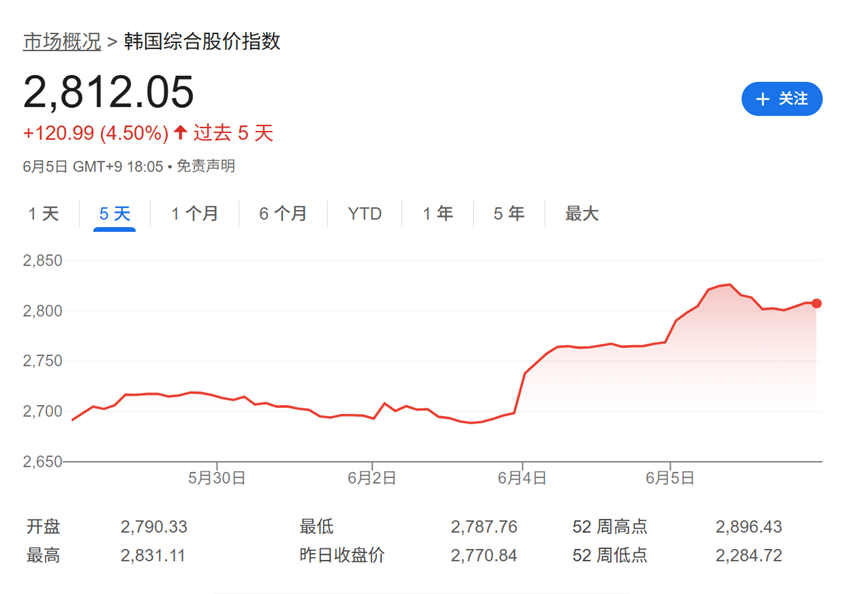
Core Viewpoint - Investors are betting on the new shareholder-friendly policies of South Korea's President Lee Jae-myung to drive the Korean stock market upward after years of underperformance [1][2] Group 1: Market Sentiment and Investment Actions - Global asset management firms like Aberdeen Investments, Pictet Wealth Management, and Franklin Templeton have recently increased their holdings in Korean stocks or upgraded their outlooks [1] - Aberdeen Investments has raised its allocation to Korean stocks to overweight in its $1.2 billion Asia ex-Japan fund [1] - Since President Lee's inauguration, the KOSPI index has risen over 4%, rebounding more than 20% from its April low, approaching a bull market [2] Group 2: Legislative Reforms and Corporate Governance - Legislative reforms are aimed at addressing the "Korean discount," a phenomenon where local stocks are priced below their book value and lower than overseas competitors [4] - The new administration is expected to enhance shareholder rights by revising commercial laws to expand board responsibilities to shareholders [4][5] - There has been a sevenfold increase in activist campaigns targeting companies from 2020 to 2024, indicating growing shareholder impatience [4] Group 3: Corporate Actions and Future Outlook - A total of 160 companies have announced value enhancement plans, although many lack details [6] - KOSPI component companies are projected to increase total dividend payments by 12% in 2024, reaching 44 trillion won ($32.4 billion) [6] - Stock buybacks are expected to more than double in 2024, reaching 18.7 trillion won [6] - Despite challenges, including potential U.S. tariff increases and economic contraction, there is optimism about a cultural shift in corporate governance in South Korea [6]
Why Are US-Listed Chinese Stocks Falling On Wednesday?
Benzinga· 2025-04-16 13:15
Group 1: Market Impact - U.S.-listed Chinese companies such as Alibaba, PDD Holdings, Baidu, NIO, Li Auto, and XPeng are experiencing a decline in stock prices due to new tariffs imposed by the Trump administration, which can reach as high as 245% on certain imports [1] - The trade war has led to a selloff of heavily foreign-owned Chinese tech stocks, with e-commerce firms being the most affected by the increased tariffs on small parcels [6] Group 2: Economic Growth and Forecasts - China's GDP grew by 5.4% in the first quarter, surpassing the analyst estimate of 5.2%, driven by consumer subsidies and strong export shipments [2] - Economists from major international banks, including UBS and Goldman Sachs, have reduced their forecasts for China's 2025 growth to approximately 4% or lower, indicating a potential struggle to meet the growth target of around 5% [4] Group 3: Tariff Dynamics - The tariff war began with a 20% tariff imposed by Trump, escalating to 104% and then to 125% in response to China's retaliatory actions, which included raising its tariffs by 84% [5][6] - The tariffs are expected to lead companies to increase product prices to maintain margins, which could negatively impact demand for lower-priced offerings from Chinese companies [5]