Moore Threads

Search documents
China's Nvidia challengers set for bumper IPOs amid tech self-sufficiency drive
Yahoo Finance· 2025-12-04 09:30
Core Viewpoint - The market debut of China's GPU makers Moore Threads and MetaX is highly anticipated, driven by domestic demand for home-grown graphics processing units amid Beijing's push for tech self-sufficiency [1] Group 1: Moore Threads - Moore Threads' IPO was oversubscribed by 4,000 times, raising 8 billion yuan (approximately US$1.13 billion) and is set to be listed on Shanghai's Star Market [2] - The subscription lottery for Moore Threads opened at 114.28 yuan per share, the highest pricing among A-share listings this year, resulting in a final allotment rate of just 0.036% for retail investors [3] - The company is focused on developing alternatives to Nvidia GPUs and aims to align with national strategic trends in emerging industries [7] Group 2: MetaX - MetaX has set its IPO pricing at 104.66 yuan, aiming to raise 4.2 billion yuan from the listing [4] - The flagship C600 GPU from MetaX is positioned between Nvidia's A100 and H100 chips in terms of performance, with risk production expected by the end of this year and full mass production in the first half of 2026 [5][6] - The next-generation C700 GPU is expected to rely entirely on a domestic supply chain and aims to significantly improve capabilities to rival Nvidia's H100, with manufacturing slated for the second half of 2026 [6]
Moore Threads' IPO frenzy energises China's home-grown GPU drive
Yahoo Finance· 2025-11-27 09:30
Core Insights - The IPO of Moore Threads, a Beijing-based GPU maker, has seen an overwhelming demand, with subscriptions exceeding 4,000 times the shares available, indicating a strong interest in AI chips among Chinese investors [1][3][4] - This demand reflects China's commitment to developing domestic alternatives to Nvidia's chips, which may lead to accelerated IPO plans for other local GPU companies [1][5] Company Overview - Moore Threads was founded in 2020 by James Zhang Jianzhong, a former Nvidia executive, and has attracted significant investment from major tech firms like Tencent and ByteDance [6][7] - The company raised approximately 8 billion yuan in its IPO, achieving a valuation of 53.7 billion yuan [4] Market Context - The IPO process for Moore Threads was notably swift, taking only 88 days from filing to approval, highlighting the Chinese government's support for technological self-sufficiency in the semiconductor sector [5] - Cambricon Technologies, another AI chipmaker in Shanghai, has also gained popularity, with its stock price expected to double in 2025, indicating a broader trend in the AI chip market [2]
What to know about Moore Threads, China's first domestic GPU maker
CNBC Television· 2025-11-26 19:22
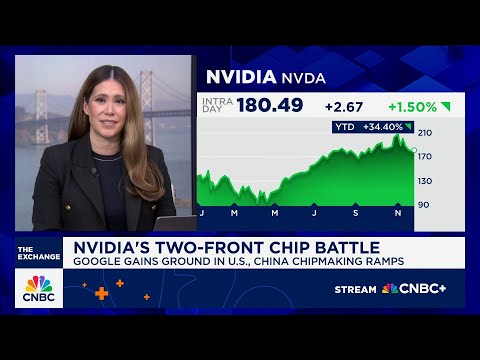
China's first ever domestic GPU maker, More Threads, is readying a public debut in Shanghai. Now, it was founded by former Nvidia employees now trying to take on the chip giant itself. Dear Drabosa has more in today's tech check.Uh, Deardra, this is all about GPUs and just what it can do in the domestic Chinese market. >> Yeah, and it's about a story I know we're going to talk to as well is securing China securing its own supply for Nvidia in particular. This could also be a two-front challenge.Google's TPU ...


X @Bloomberg
Bloomberg· 2025-09-26 09:43
Moore Threads, manufacture of equipment used in artificial intelligence and machine learning, received approval from the Shanghai Stock Exchange for its IPO on the Star Market https://t.co/gXev8bfIch ...
追踪中国半导体本土化进程_WAIC关键要点-中国人工智能半导体技术快速发展-Tracking China’s Semi Localization_ Shanghai WAIC key takeaways – rapid development of China AI semi technology
2025-08-05 03:20
Summary of Key Points from the Conference Call Industry Overview - The conference focused on the rapid development of China's AI and semiconductor localization efforts, particularly highlighted at the World AI Conference (WAIC) in Shanghai [1][5] - There is a strong demand for AI inference in China, with consumer-facing applications evolving beyond traditional chatbots [2] Core Company Insights - **Huawei**: - Unveiled the CloudMatrix 384 (CM384) server rack prototype, which is designed for AI large language model (LLM) training and competes with NVIDIA's offerings [3] - The CM384 integrates 384 Ascend 910C AI accelerators, delivering 215-307 PFLOPS of FP16 performance, surpassing NVIDIA's NVL72 [8][11] - Future plans include the next-generation CM384 A5, powered by Ascend 910D processors [8] - **Other Domestic AI Processors**: - Companies like MetaX, Moore Threads, and Alibaba T-Head are also making strides in AI processor development [4] - MetaX launched the C600 accelerator, fabricated using SMIC's 7nm process, supporting FP8 precision [8] - Moore Threads' AI processor enables LLM training at FP8 precision [8] Market Dynamics - The demand for AI inference is expected to grow, especially after the lifting of compute capacity restrictions [2] - Despite local advancements, Chinese AI developers still prefer NVIDIA's GPUs for training due to better software support [10] Semiconductor Equipment Trends - China's semiconductor equipment import value was $3.0 billion in June 2025, reflecting a 14% year-over-year increase [24] - The self-sufficiency ratio of China's semiconductor industry is projected to rise from 24% in 2024 to 30% by 2027, driven by advancements in local production capabilities [42][44] Stock Implications - Morgan Stanley maintains an Equal-weight rating on SMIC, noting that the launch of CM384 could enhance demand for SMIC's advanced nodes [10] - The performance of key Chinese semiconductor stocks has been strong, with SMIC and Hua Hong Semiconductor both seeing significant gains [29] Additional Insights - The CM384's architecture allows for pooled memory capacity, addressing constraints in LLM training [8] - The networking capabilities of CM384, while impressive, still lag behind NVIDIA's NVL72 in terms of speed [11] - The overall sentiment in the semiconductor market is positive, with expectations of stronger spending in the second half of the year [24] Conclusion - The conference highlighted significant advancements in China's AI and semiconductor sectors, with key players like Huawei leading the charge. The demand for AI inference is robust, and while local companies are making progress, they still face challenges in competing with established players like NVIDIA. The outlook for the semiconductor industry remains optimistic, with increasing self-sufficiency and investment opportunities.
Where is Nvidia? Chinese rivals take the limelight at major AI event in Shanghai
CNBC· 2025-07-28 08:53
Core Insights - Huawei showcased its Ascend chips and AI system at the World AI Conference in Shanghai, highlighting its competitive position in the AI chip market [1][4] - Nvidia, despite previous hopes of re-entering the Chinese market with its H20 chips, did not participate in the conference, indicating potential challenges in its relationship with China [2][3] Group 1: Huawei's Developments - Huawei presented its new computing system, the "Atlas 900 A3 SuperPoD," which connects 384 Ascend chips for AI model training [4] - The Ascend chips, while individually less powerful than Nvidia's Blackwell chips, compensate by utilizing five times more chips in their system compared to Nvidia's GB200 [4] Group 2: Competitive Landscape - Nvidia's absence at the conference contrasts with Huawei's prominent display, emphasizing the latter's growing influence in the Chinese AI market [2][3] - Other Chinese companies, such as Moore Threads and Yunsilicon, also participated in the AI expo, indicating a competitive environment in the semiconductor industry [5]