Novartis

Search documents
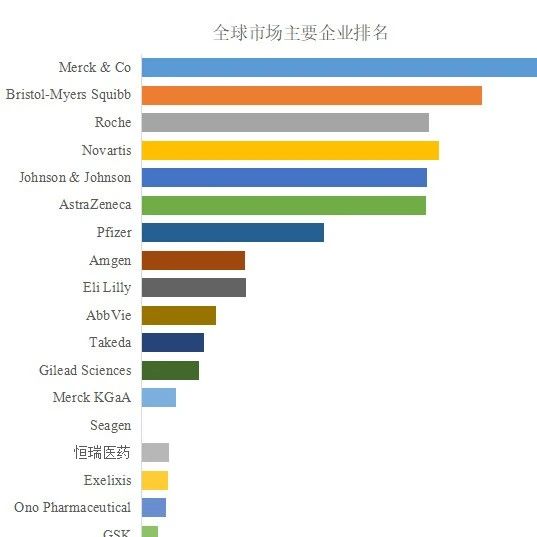
全球抗癌症药物市场前10强生产商排名及市场占有率
QYResearch· 2025-08-19 08:42
Core Viewpoint - The global cancer drug market is projected to reach $429.16 billion by 2031, with a compound annual growth rate (CAGR) of 11.1% in the coming years [1][11]. Market Overview - The major manufacturers in the global cancer drug market include Merck & Co, Bristol-Myers Squibb, Roche, Novartis, and Johnson & Johnson, which collectively hold approximately 55.0% of the market share in 2024 [5]. - Targeted therapy is the leading product type, accounting for about 55.1% of the market share [6]. - Blood-related cancers represent the largest demand source, making up approximately 22.3% of the market [9]. Market Drivers - The continuous rise in global cancer incidence and mortality rates, particularly for lung, breast, and colorectal cancers, drives the demand for effective treatment drugs [11]. - Increased health awareness and advancements in diagnostic technologies have led to earlier cancer detection, expanding the market size [11]. - Rapid developments in biotechnology have introduced revolutionary breakthroughs in cancer drug research, such as targeted therapies, immunotherapies, ADC drugs, and CAR-T cell therapies, significantly improving treatment outcomes and patient survival rates [11]. - Supportive government policies, including expedited drug reviews and incentives for rare disease medications, create a favorable environment for innovation [11]. - Growing investment enthusiasm in the capital market for innovative oncology drugs provides strong research and development motivation for small and medium-sized biotech companies [11]. Market Challenges - The cancer drug market faces challenges such as high research and development costs, long timelines, and high failure rates, with new drugs taking years to transition from the lab to clinical use [12]. - Despite the introduction of new drugs, many innovative treatments are expensive, and limited insurance coverage restricts accessibility and affordability in certain regions [12]. - Scientific issues like targeted resistance, tumor heterogeneity, and immune evasion remain unresolved, affecting the sustainability and broad applicability of treatment effects [12]. - Increasing regulatory scrutiny on clinical trial data quality, safety assessments, and ethical compliance raises the industry entry barriers [12]. Future Trends - The future development of cancer drugs will focus on more precise, individualized, and diversified approaches [13]. - Advances in genomics, transcriptomics, and proteomics will refine tumor molecular typing, shifting cancer treatment from traditional broad-spectrum therapies to targeted and precise models [13]. - Targeted drugs will continue to be developed for more mutation sites, such as KRAS, HER2, and EGFR, enabling precise interventions for specific patient populations [13]. - Immunotherapy will expand its application boundaries, with PD-1/PD-L1 inhibitors and CTLA-4 inhibitors being used in combination with other therapies to enhance efficacy and overcome immune tolerance issues [13]. - The concept of personalized treatment will be integrated throughout the drug development process, utilizing patient biomarkers and dynamic efficacy assessments to improve treatment outcomes and quality of life [13].

生物医疗外包需求:关于合同研发生产组织(CDMO)和合同研究组织(CRO)的关键讨论Demand for Outsourcing_ Key debates on CDMOs and CROs
2025-08-18 02:52
Summary of Conference Call Notes on CDMOs and CROs Industry Overview - The conference call discusses the Contract Development and Manufacturing Organizations (CDMOs) and Contract Research Organizations (CROs) within the life sciences and healthcare sector, focusing on their growth prospects and market dynamics [1][2][3]. Key Points on CDMOs - **Growth Visibility**: CDMOs exhibit higher growth visibility compared to CROs, with companies like Lonza, Wuxi Biologics, and Samsung Biologics raising their FY25 organic growth guidance [2][3]. - **Revenue Growth**: CDMOs typically achieve 10-15% revenue growth and trade at 30-40x forward P/E ratios, indicating strong market confidence [3]. - **Demand Drivers**: The demand for CDMO services is driven by an increasing trend towards outsourcing and a growing need for specialized manufacturing capabilities, particularly in biologics and monoclonal antibodies [4]. - **Capacity Utilization**: There is a noted tight supply condition in specialized segments of large molecule CDMOs, with significant capacity additions expected in the US due to potential pharma tariffs and regulatory changes [4]. Key Points on CROs - **Near-term Challenges**: The CRO industry faces challenges such as biotech funding constraints, regulatory uncertainties, and project delays, which may impact growth in the short term [5]. - **Long-term Outlook**: Despite current headwinds, a patent cliff expected between 2026-2030 may increase demand for CRO services as pharmaceutical companies advance trials [5]. - **Pricing Pressure**: CROs are experiencing pricing pressures due to reduced trial activity and increased competition, leading to a focus on cost optimization by clients [5]. Comparative Analysis - **Cyclical Nature**: Both CDMOs and CROs are cyclical, influenced by the drug launch cycles of Big Pharma and funding cycles in biotech [3]. - **Investor Sentiment**: While CDMOs are perceived as well-owned with execution risks, there is growing investor interest in CROs despite uncertainties in biotech funding and drug pricing regulations [9]. Additional Insights - **Market Trends**: The report highlights a recovery in RFP flows for CROs, indicating potential for future growth despite current challenges [9]. - **Capacity and Demand**: The commentary suggests that while CDMOs are experiencing strong demand, CROs may see a resurgence in demand as the industry navigates through its current challenges [5][9]. This summary encapsulates the critical insights from the conference call regarding the CDMO and CRO sectors, highlighting their growth trajectories, challenges, and market dynamics.
X @Bloomberg
Bloomberg· 2025-08-14 09:18
The Swiss government met with executives of Roche and Novartis to discuss the pharmaceutical industry’s situation in light of US tariffs https://t.co/AbOhsS7yha ...
Novartis announces both ianalumab Phase III clinical trials met primary endpoint in patients with Sjögren's disease
GlobeNewswire News Room· 2025-08-11 05:15
Core Insights - Novartis announced positive top-line results from Phase III trials for ianalumab (VAY736) in adults with active Sjögren's disease, meeting primary endpoints of statistically significant improvements in disease activity [2][3][8] - Ianalumab has the potential to be the first targeted treatment for Sjögren's disease, a chronic autoimmune condition with limited treatment options [3][8][11] Company Overview - Novartis is focused on innovative medicines, aiming to improve and extend lives, with a global reach impacting nearly 300 million people [13] - The company plans to present data from the NEPTUNUS trials at a medical meeting and submit ianalumab to health authorities worldwide [4][8] Product Details - Ianalumab is a fully human monoclonal antibody targeting B cell-driven autoimmune diseases, including Sjögren's disease, with a dual mechanism of action [5][11] - The drug demonstrated a favorable safety profile and was well tolerated in clinical trials [3][8] Clinical Trial Information - NEPTUNUS-1 and NEPTUNUS-2 are pivotal Phase III trials evaluating ianalumab's efficacy and safety in patients with active Sjögren's disease [6][7] - NEPTUNUS-1 involved 275 patients, while NEPTUNUS-2 included 504 patients, both trials assessing the drug's impact over 52 weeks [7][9] Disease Context - Sjögren's disease is a prevalent autoimmune disorder affecting approximately 0.25% of the population, with a significant number of cases undiagnosed [11] - The disease primarily affects exocrine glands, leading to symptoms like dry eyes and mouth, and can involve extraglandular manifestations [10][11]


X @Bloomberg
Bloomberg· 2025-08-10 12:48
The Swiss government has reached out to Roche and Novartis to discuss the tariff situation, after the country was hit with the highest US levies in the developed world https://t.co/rmfp98TW61 ...
Highest US Tariff Among Developed Nations Takes Effect in Switzerland
Bloomberg Television· 2025-08-07 17:27
Trade Relations & Tariffs - The US has imposed a 39% tariff on Switzerland, the highest tariff Washington has levied on any nation [1] - This tariff is a response to Switzerland's $385 billion (Note: There seems to be a typo in the original document, it should likely be $385 billion instead of $38.5% billion) trade surplus with the US in 2024 [1] - Other countries with trade surpluses, like Japan and South Korea, accepted 15% duties [2] - The EU, which Switzerland is not a part of, was also taxed at 15% [2] Impact on Swiss Economy - The 39% tariff impacts Swiss luxury exports such as watches, Nespresso, cheese, and chocolate [2] - If the 39% tariff is applied across the board, including pharmaceuticals, up to 1% of Switzerland's economic output could be at risk in the medium term [3] Pharmaceutical Industry - Pharmaceuticals are currently exempt from the tariff [3] - The US plans to announce tariffs on pharmaceutical imports, potentially reaching as high as 250% [4] - Switzerland is home to pharmaceutical giants Novartis and Roche [4] Diplomatic Efforts - The Swiss President made an emergency trip to Washington but was unable to secure a meeting or deal [3]

X @Bloomberg
Bloomberg· 2025-08-06 15:55
Mergers and Acquisitions - Novartis is considering acquiring Avidity Biosciences to strengthen its drug pipeline [1] - Avidity Biosciences focuses on rare diseases [1]
Will These 5 Pharma, Biotech Bigwigs Surpass Q2 Earnings Forecasts?
ZACKS· 2025-08-04 16:51
Industry Overview - The second-quarter earnings season for the drug and biotech sector is in full swing, with major companies like Pfizer, Eli Lilly, Amgen, Gilead Sciences, and Novo Nordisk set to announce results [1] - The earnings season began mid-July with Johnson & Johnson reporting strong results, exceeding estimates for both earnings and sales [1] Company Performance Pfizer (PFE) - Pfizer has consistently exceeded earnings expectations in the last four quarters, with an average earnings surprise of 43.49% [6] - The Zacks Consensus Estimate for second-quarter sales and earnings is $13.78 billion and 58 cents per share, respectively [6] - Higher sales from products like Vyndaqel and Padcev are expected to offset weaker sales from Prevnar and Ibrance [8] Eli Lilly (LLY) - Eli Lilly's performance has been mixed, exceeding earnings expectations in two of the last four quarters, with an average earnings surprise of 6.69% [11] - The Zacks Consensus Estimate for second-quarter sales and earnings stands at $14.75 billion and $5.61 per share, respectively [11] - Strong demand for Mounjaro and Zepbound is anticipated to drive top-line growth [12] Amgen (AMGN) - Amgen has shown strong performance, beating earnings estimates in each of the last four quarters, with an average earnings surprise of 8.34% [14] - The Zacks Consensus Estimate for second-quarter sales and earnings is $8.86 billion and $5.26 per share, respectively [14] - Sales growth is expected to be driven by products like Evenity and Repatha, despite price declines due to higher rebates [15] Gilead Sciences (GILD) - Gilead's performance has been mixed, with earnings beating estimates in three of the last four quarters, averaging a surprise of 16.48% [17] - The Zacks Consensus Estimate for second-quarter sales and earnings is $6.95 billion and $1.95 per share, respectively [17] - Increased demand for HIV therapies like Biktarvy is expected to boost sales [18] Novo Nordisk (NVO) - Novo Nordisk's performance has been mixed, with earnings beating estimates in one of the last four quarters, delivering an average surprise of 0.02% [20] - The Zacks Consensus Estimate for second-quarter sales and earnings is $11.79 billion and 93 cents per share, respectively [20] - The company lowered its 2025 sales and operating profit growth outlook due to weaker momentum in key markets for its semaglutide-based drugs [21]



Trump Announces 39% Tariff on Imports From Switzerland
Bloomberg Television· 2025-08-01 09:09
Why has Switzerland been hit so hard. So this came as a complete surprise to the Swiss. The reason for this is Switzerland's great huge surplus with the US.If you ranked the US trade deficits with other countries, the Switzerland ranks number 12. It's a $38 billion. So that obviously is a big number and that's mostly due to pharma.We know that pharma is one of the things that Trump targets. And Switzerland's just got the short end of the stick here. So what has been the response of the Swiss government. The ...

Novartis twice-yearly* Leqvio® (inclisiran) receives FDA approval for new indication enabling first-line use
Prnewswire· 2025-07-31 20:30
Core Viewpoint - Novartis has received FDA approval for an updated label for Leqvio® (inclisiran), allowing its use as a monotherapy to reduce low-density lipoprotein cholesterol (LDL-C) in adults with hypercholesterolemia, alongside diet and exercise [1][2][3] Group 1: Product Information - Leqvio is now indicated for use as a standalone treatment, removing the previous requirement for combination with statin therapy [3] - The updated label specifies "hypercholesterolemia" instead of "primary hyperlipidemia," focusing on LDL-C reduction [3] - Leqvio is administered twice a year by healthcare providers, which may enhance patient adherence and long-term management of LDL-C levels [2][8] Group 2: Market Need and Impact - Up to 80% of patients with atherosclerotic cardiovascular disease (ASCVD) in the US do not achieve the recommended LDL-C target of less than 70 mg/dL, highlighting a significant unmet medical need [2][8] - The 2025 ACC/AHA guidelines recommend more aggressive treatment strategies to meet LDL-C targets, further emphasizing the importance of Leqvio's new indication [2][8] Group 3: Company Background - Novartis has global rights to develop, manufacture, and commercialize Leqvio through a collaboration with Alnylam Pharmaceuticals, a leader in RNAi therapeutics [4] - The company aims to address critical challenges in cardiovascular disease management and improve patient outcomes through innovative treatments [10][11]