Home Depot

Search documents
3 Magnificent Dividend Stocks Down 15% to 64% to Buy and Hold for 20 Years
The Motley Fool· 2025-05-31 12:00
Core Viewpoint - The current economic environment presents an opportunity for investors to consider quality dividend stocks, as recent challenges have led to lower stock prices and higher yields for leading retail and consumer goods brands [1][2]. Target - Target's stock is currently 64% off its highs, but the company has a history of rebounding from challenges, having previously invested in a robust omnichannel strategy that positioned it well for e-commerce growth [4][8]. - The company faces several pressures, including slow sales growth due to inflation, a smaller grocery segment compared to competitors, and politically motivated consumer boycotts, which have affected consumer confidence [5][6]. - Comparable sales dropped 3.8% year over year in the first quarter, while operating income increased by 13.6%, and same-day delivery saw a 35% year-over-year increase [6]. - Target has a strong digital presence and a robust membership program, and it is a Dividend King with a history of raising dividends for 53 years, currently offering a yield of 4.6% [7][8]. Starbucks - Starbucks' stock is down 31% from its highs, but it remains a strong consumer brand with over 40,000 stores globally, generating healthy margins that support dividend payments [9][10]. - The company is experiencing weak sales, with comparable store sales down 1% year over year, and earnings have decreased by 50% compared to the previous year [10][12]. - A new CEO, Brian Niccol, is focused on improving customer experience and managing costs, which is expected to support future dividend growth [11][12]. - The current quarterly dividend payment is $0.61, resulting in a forward yield of 2.82%, the highest in years, making it an attractive investment for long-term income [13]. Home Depot - Home Depot's stock is currently 15% off its highs, and while it has historically been a top performer, it has underperformed the S&P 500 over the last three years, gaining only 19% compared to the index's 42% [14]. - The company is facing a slowdown in the housing market due to rising mortgage rates, leading to a 0.3% decline in comparable sales, although overall revenue increased by 9.4% to $39.9 billion due to an acquisition [15][16]. - Despite current challenges, there is a housing shortage estimated at around 4 million homes, which could eventually drive demand for home improvement materials [16]. - Home Depot offers a 2.5% dividend yield and has raised its dividend for 16 consecutive years, making it a strong candidate for long-term dividend growth [18].



3 USA-Based Stocks That Can Be Great Buys Amid Tariff Risks
The Motley Fool· 2025-05-30 10:05
Core Viewpoint - Tariffs create significant uncertainty for businesses and investors, impacting stock market predictions and evolving weekly [1] Group 1: Walmart - Walmart has substantial vendor power to influence prices and can pass costs to consumers if necessary [4] - The retailer's sales increased by 2.5% year-over-year to $165.6 billion, with operating income rising by 4.3% to $7.1 billion [6] - Despite a high valuation at over 40 times trailing earnings, Walmart is considered a safer retail stock under current macroeconomic conditions [7] Group 2: Home Depot - Home Depot does not anticipate raising prices due to tariffs, as suppliers can source goods from multiple countries [9] - The company expects single-digit sales growth of 2.8% for the current fiscal year, with comparable sales rising by 1% [10] - With shares down 7% this year, Home Depot's valuation at a P/E of 25 is modest and aligns with the S&P 500 average [11] Group 3: Microsoft - Microsoft has low tariff risk, generating around 22% of revenue from product sales, with most coming from services [12] - The company reported a 15% revenue increase to over $70 billion in its April quarter, with Azure and cloud services sales rising by 35% [13] - Although trading at a P/E of 35, Microsoft's diversification and financial strength make it a strong growth stock for long-term investment [14]



The Home Depot Names Angie Brown EVP and Chief Information Officer
Prnewswire· 2025-05-29 21:22
Core Insights - The Home Depot has appointed Angie Brown as the new executive vice president and chief information officer, responsible for the company's technology strategy and infrastructure [1][2] - Brown has a 27-year tenure at The Home Depot, previously serving as senior vice president of information technology, where she led various technology solutions [2] - She replaces Fahim Siddiqui, who played a key role in modernizing the company's technology infrastructure [3] Company Overview - The Home Depot is the largest home improvement specialty retailer globally, operating 2,350 retail stores and over 790 branches across North America [3] - The company employs over 470,000 associates and is publicly traded on the New York Stock Exchange under the ticker HD [3]

Best Buy Says Tariffs May Lower Profits And Sales—Joining These Companies Warning Of Tariff Impacts
Forbes· 2025-05-29 13:18
Company Impact - Best Buy lowered full-year forecasts for profits and sales for fiscal year 2026 due to expected tariff impacts [1][2] - Abercrombie & Fitch cut its profit outlook for 2025, citing a 30% tariff on imports from China and a 10% tariff on other imports, estimating a $50 million hit to profits [2] - Macy's reduced its full-year earnings per share outlook, attributing it to tariffs and moderation in consumer discretionary spending [3] - Target expects sales decline throughout 2025, previously projecting 1% growth, due to weaker spending amid tariff uncertainty [3] - Diageo warned of a likely $150 million hit to annual profits in 2025, planning to offset half of this impact through unspecified actions [4] - Walmart's CEO indicated that higher tariffs would lead to higher prices, as the company cannot absorb all the pressure from narrow retail margins [5] - Ford expects tariffs to reduce earnings before interest and taxes by about $1.5 billion in 2025, suspending its full-year guidance [8] - General Motors lowered its earnings forecast for 2025 to between $10 billion and $12.5 billion, down from $13.7 billion to $15.7 billion, due to tariff impacts [11] Industry Trends - Companies across various sectors, including automotive, retail, and consumer goods, are withdrawing or lowering financial guidance due to tariff-related uncertainties [6][12] - The overall sentiment in the market reflects heightened caution, with many companies citing macroeconomic volatility and evolving trade policies as significant concerns [10][14] - The impact of tariffs is leading to increased operational costs and reduced consumer spending, affecting sales forecasts across multiple industries [9][15] - Airlines, including JetBlue and American Airlines, are pulling their full-year guidance due to macroeconomic uncertainty exacerbated by tariffs [12][16] - The uncertainty surrounding tariffs is causing companies like Snap and Logitech to decline issuing future guidance, reflecting a broader trend of caution in financial forecasting [13][16]



1 Stock That Turned $1,000 Into $32 Million
The Motley Fool· 2025-05-29 10:05
Core Viewpoint - Home Depot has demonstrated exceptional long-term performance, but current market conditions may pose challenges for future growth [2][8]. Company Overview - Home Depot has generated a total return of 3,157,000% since its IPO in September 1981, translating a $1,000 investment into nearly $32 million today [2]. - The company has a market capitalization of $365 billion and reported revenue of $163 billion in the past 12 months, significantly outperforming its key rival, Lowe's [5]. - Home Depot operates 2,350 stores, with a presence in Canada and Mexico, and is accessible to 90% of the U.S. population within 10 miles [6]. Financial Performance - The company has maintained an average operating margin of 14.2% over the past decade, allowing for substantial capital returns to shareholders, including $2.3 billion in dividends in the latest fiscal quarter [7]. - However, same-store sales declined by 0.3% in Q1, following declines in fiscal 2023 and fiscal 2024, indicating current challenges in demand [9]. Market Conditions - The macroeconomic environment, characterized by high mortgage rates and consumer uncertainty, is impacting demand for big-ticket purchases [8]. - Despite near-term struggles, there are long-term tailwinds, such as an aging housing stock and a housing inventory shortage, which may drive spending on renovations [9]. Valuation Perspective - Home Depot's stock trades at a price-to-earnings ratio of 24.9, which is considered expensive, suggesting that it may not be an opportune time for investors to buy [10].

Abercrombie & Fitch Says Tariffs Will Cut Profits By $50 Million—Joining These Companies Warning Of Tariff Impacts
Forbes· 2025-05-28 15:10
Summary of Key Points Core Viewpoint - Numerous companies are lowering their profit forecasts for 2025 due to the impact of tariffs and economic uncertainty, indicating a broader trend of caution across various industries. Group 1: Retail Sector - Abercrombie & Fitch lowered its full-year profit forecast for 2025, citing a $50 million hit from tariffs, including a 30% tariff on imports from China and a 10% tariff on other imports [1][2] - Macy's also reduced its earnings per share outlook for the year, attributing it to tariffs, moderation in consumer spending, and increased competition [3] - Target expects sales to decline throughout 2025, previously projecting a 1% growth, due to weaker spending linked to tariff uncertainties [3] Group 2: Consumer Goods and Food & Beverage - Diageo warned of a $150 million hit to annual profits in 2025 but plans to offset half of this impact through unspecified actions [4] - PepsiCo lowered its earnings forecast for 2025, facing higher supply chain costs due to tariffs and a volatile consumer environment [15] - Kraft Heinz also lowered its outlook, citing a volatile operating environment influenced by tariffs and inflation [13] Group 3: Automotive Industry - Ford expects tariffs to reduce its earnings before interest and taxes by about $1.5 billion in 2025 and has suspended its full-year guidance [8] - General Motors lowered its earnings forecast to between $10 billion and $12.5 billion, down from $13.7 billion to $15.7 billion, due to the impact of tariffs [12] - Toyota estimated a $1.25 billion profit loss in April and March due to U.S. tariffs, forecasting a nearly 21% dip in operating income through 2025 [5] Group 4: Technology and Electronics - AMD anticipates a $1.5 billion revenue loss in 2025 due to restrictions on chip shipments to China [7] - Apple expects a $900 million hit to its bottom line in the second quarter due to tariffs, complicating future predictions [10] - Logitech withdrew its outlook for the 2026 fiscal year due to ongoing tariff uncertainties [17] Group 5: Airlines and Transportation - JetBlue and Alaska Airlines both pulled their full-year guidance for 2025 due to macroeconomic uncertainty [13][17] - Delta Airlines withdrew its full-year guidance, citing broad macro uncertainty [18] - United Airlines issued a second guidance featuring significantly lower earnings for 2025, reflecting the unpredictable economic environment [17] Group 6: Miscellaneous - Steve Madden withdrew its financial guidance for 2025, facing heightened uncertainty from new tariffs [6] - Rivian lowered its targets for vehicle deliveries and capital spending for 2025 due to significant uncertainty in the global economic landscape [6] - Snap declined to issue guidance for its second quarter, citing uncertainty in macroeconomic conditions affecting advertising demand [14]





Macy's Says Tariffs May Lower Profits This Year—Joining These Companies Warning Of Tariff Impacts
Forbes· 2025-05-28 14:05
Company Impact - Macy's lowered its full-year profit forecast for 2025 due to higher tariffs affecting its business [1] - Target expects sales to decline throughout 2025, previously projecting a 1% growth, citing weaker spending amid tariff uncertainty [2] - Diageo anticipates a $150 million hit to annual profits in 2025 but plans to offset half of this impact through unspecified actions [3] - Walmart warned that higher tariffs will lead to increased prices, unable to absorb all the pressure due to narrow retail margins [4] - Ford expects tariffs to reduce its earnings before interest and taxes by about $1.5 billion in 2025 and has suspended its full-year guidance [7] - General Motors lowered its earnings forecast for 2025 to between $10 billion and $12.5 billion, down from $13.7 billion to $15.7 billion, adjusting to the new trade policy environment [10] - Kraft Heinz lowered its full-year outlook due to a volatile operating environment influenced by tariffs and inflation [11] - PepsiCo lowered its earnings forecast for 2025, facing higher supply chain costs due to tariffs and a subdued consumer backdrop [13] Industry Trends - Companies across various sectors are withdrawing or adjusting their financial guidance for 2025 due to macroeconomic uncertainty driven by tariffs [5][8][12] - The automotive industry, including Toyota and Ford, is particularly affected, with significant expected declines in operating income and earnings [4][10] - The retail sector is experiencing heightened competition and promotional landscapes, leading to cautious outlooks from companies like Macy's and Target [2][1] - Airlines are also pulling their full-year guidance, citing economic uncertainty and volatility, with JetBlue and Alaska Airlines among those affected [11][15] - The overall sentiment in the market reflects a cautious approach as companies navigate the unpredictable tariff environment and its implications on profitability [9][16]
Home Depot(HD) - 2026 Q1 - Quarterly Report
2025-05-27 21:48
Financial Performance - Net sales for the three months ended May 4, 2025, increased to $39,856 million, up from $36,418 million in the same period last year, representing a growth of 6.7%[20] - Gross profit for the same period was $13,459 million, compared to $12,433 million, reflecting an increase of 8.2%[20] - Operating income for Q1 2025 was $5,133 million, slightly up from $5,079 million in Q1 2024, indicating a growth of 1.1%[20] - Net earnings decreased to $3,433 million from $3,600 million year-over-year, a decline of 4.6%[20] - Basic earnings per share for Q1 2025 was $3.46, down from $3.64 in Q1 2024, a decrease of 4.9%[20] Assets and Liabilities - Total assets increased to $99,157 million as of May 4, 2025, compared to $96,119 million at February 2, 2025, a rise of 3.2%[17] - Total liabilities rose to $91,202 million from $89,479 million, reflecting an increase of 1.9%[17] - Total lease liabilities increased to $12,051 million as of May 4, 2025, compared to $11,928 million as of February 2, 2025[49] - Goodwill increased to $19,568 million as of May 4, 2025, from $19,475 million at the end of the previous quarter, reflecting recent acquisitions[51] Cash Flow and Capital Expenditures - Cash and cash equivalents at the end of the period were $1,369 million, down from $4,264 million at the beginning of the period, a decrease of 67.8%[27] - Net cash provided by operating activities for Q1 2025 was $4,325 million, compared to $5,497 million in Q1 2024, a decline of 21.3%[27] - The company reported capital expenditures of $806 million for the quarter, slightly down from $847 million in the same period last year[27] - Cash flow from operations was $4.3 billion, used to pay $2.3 billion in dividends, repay $1.1 billion of long-term debt, and fund $806 million in capital expenditures[79] - The company plans to invest approximately $4 billion in capital expenditures for fiscal 2025, focusing on customer experience and technology improvements[110] Sales and Revenue Segments - Net sales for the Primary segment increased to $37,287 million for the three months ended May 4, 2025, compared to $36,418 million for the same period in 2024, representing a growth of 2.4%[40] - The cost of sales for the Primary segment was $24,384 million, up from $23,985 million, indicating an increase of 1.7% year-over-year[40] - Operating income for the Primary segment was $5,046 million, slightly down from $5,079 million, reflecting a decrease of 0.6%[40] - Net sales in the U.S. reached $37,224 million, a significant increase from $33,569 million, marking a growth of 10.0%[44] - Net sales from products amounted to $38,512 million, compared to $35,078 million, showing an increase of 6.9%[45] - Online sales represented 15.5% of net sales in Q1 fiscal 2025, increasing by 10.9% compared to Q1 fiscal 2024, with an 8.3% increase on a comparable week basis[92] Shareholder Returns and Stock Activity - The company has approximately $11.7 billion remaining from a $15.0 billion share repurchase authorization as of May 4, 2025[64] - The company purchased a total of 323,001 shares in the first quarter of fiscal 2025 at an average price of $357.69 per share[135] - The Board of Directors approved a $15.0 billion share repurchase authorization in August 2023, which does not have a prescribed expiration date[136] - The company has not resumed share repurchase activity as of May 4, 2025, after pausing in March 2024[136] Operational Metrics - The company's inventory turnover ratio was 4.3 times at the end of the first quarter of fiscal 2025, down from 4.5 times in the same period of fiscal 2024[78] - Comparable sales decreased by 0.3% in fiscal 2025, while customer transactions increased by 2.1% to 394.8 million[87] - Total comparable sales decreased by 0.3% in Q1 fiscal 2025, reflecting a 0.5% decrease in comparable customer transactions[94] Expenses and Profitability - SG&A expenses rose by $863 million, or 12.9%, to $7.5 billion in Q1 fiscal 2025, representing 18.9% of net sales[98] - Gross profit increased by 8.3% to $13.5 billion in Q1 fiscal 2025, with a gross profit margin of 33.8%, down from 34.1% in Q1 fiscal 2024[96] - Diluted earnings per share decreased to $3.45 in Q1 fiscal 2025 from $3.63 in Q1 fiscal 2024, primarily due to lower net earnings[102] Regulatory and Compliance - The company reported approximately $1.5 million in penalties paid to the EPA related to a civil consent decree, with expectations to recoup additional amounts from fines levied against third-party installers[132] - The company expects the civil consent decree with the EPA to be terminated after the stipulated penalties are resolved[132] - The company evaluated its disclosure controls and procedures and concluded they were effective as of May 4, 2025[125] Business Initiatives - The company is undergoing a business transformation initiative, including upgrading accounting and finance systems, with plans to continue migrating additional processes over the next few years[126] - The company completed the acquisition of SRS for $18.0 billion, primarily funded through commercial paper borrowings and long-term debt issuance[72] - The company acquired SRS, a leading residential specialty trade distribution company, in June 2024, which is expected to enhance market presence[39]
3 Must-Know Facts About Home Depot Before You Buy the Stock
The Motley Fool· 2025-05-26 12:15
Core Insights - Home Depot is a leader in the home improvement industry with $163 billion in trailing-12-month sales and a total return of 319% over the past decade, although shares currently trade 15% below their peak price [1] Group 1: Customer Base - Home Depot serves both DIY customers and professionals, with professionals accounting for about 50% of total revenue, significantly higher than Lowe's 25% [3] - Professionals tend to spend more and visit stores more frequently than DIY customers, contributing to better financial metrics for Home Depot [4] - In Q1 2025, pro comp sales were positive and outpaced DIY customer sales, indicating strong performance in the professional segment [5] Group 2: Industry Trends - Home Depot experienced significant sales growth during the pandemic, with increases of 19.9% in fiscal 2020 and 14.4% in fiscal 2021, driven by heightened demand for home upgrades [6] - However, there has been a decline in same-store sales, with decreases of 3.2% in fiscal 2023, 1.8% in fiscal 2024, and 0.3% in Q1 2025, attributed to tighter macro conditions [7] - The aging housing stock in the U.S. is a favorable tailwind, with 55% of homes being at least 40 years old, leading to increased maintenance needs [8] Group 3: Valuation - Home Depot's stock currently trades at a price-to-earnings ratio of 24.9, which is above its trailing five- and ten-year averages, indicating that the stock may be overvalued based on historical standards [9] - Despite the current macro challenges, the company is expected to return to steady revenue and earnings growth once economic conditions improve [10]
Worried About Tariffs? Home Depot Says It Won't Raise Prices.
The Motley Fool· 2025-05-23 08:25
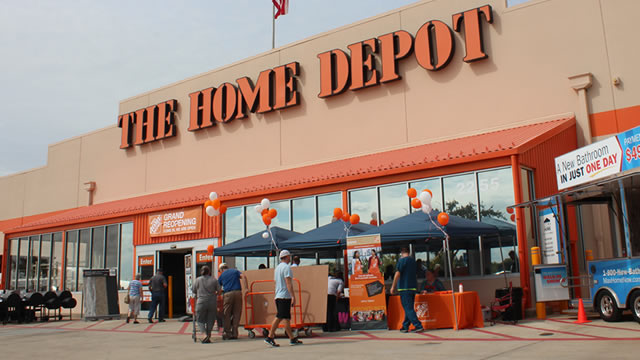
Core Insights - Home Depot is facing external pressures from high interest and mortgage rates, impacting sales in the home improvement sector, while inflation affects consumer spending [4][5] - The company reported a 9.4% year-over-year sales increase, but comparable sales decreased by 0.3%, indicating growth is driven by new stores and acquisitions [6] - Home Depot sources 50% of its merchandise in the U.S. and aims to ensure no single country accounts for more than 10% of its purchases within the next year [8] - The company maintains high profit margins compared to competitors like Walmart, which struggles with low margins [12] - Home Depot's management is focused on growth opportunities and efficiency, viewing current challenges as a chance to capture market share [15] Company Performance - Home Depot's first-quarter adjusted earnings per share (EPS) were $3.56, down from $3.67 the previous year and below analyst expectations by $0.04 [6] - The company is investing in digital platforms, store renovations, and technology to enhance consumer experience [10] - Home Depot's dividend yield is currently at 2.4%, which is reliable and growing, making it an attractive option for long-term investors [16] Market Position - Home Depot is well-positioned to benefit from consumer spending, especially as 55% of homes are at least 40 years old [10] - The company has an elastic supply model that allows it to avoid significant price increases, potentially increasing market share [11][14] - Home Depot's management is optimistic about capturing market opportunities, estimating a market potential of $1 trillion [15]