Toyota

Search documents
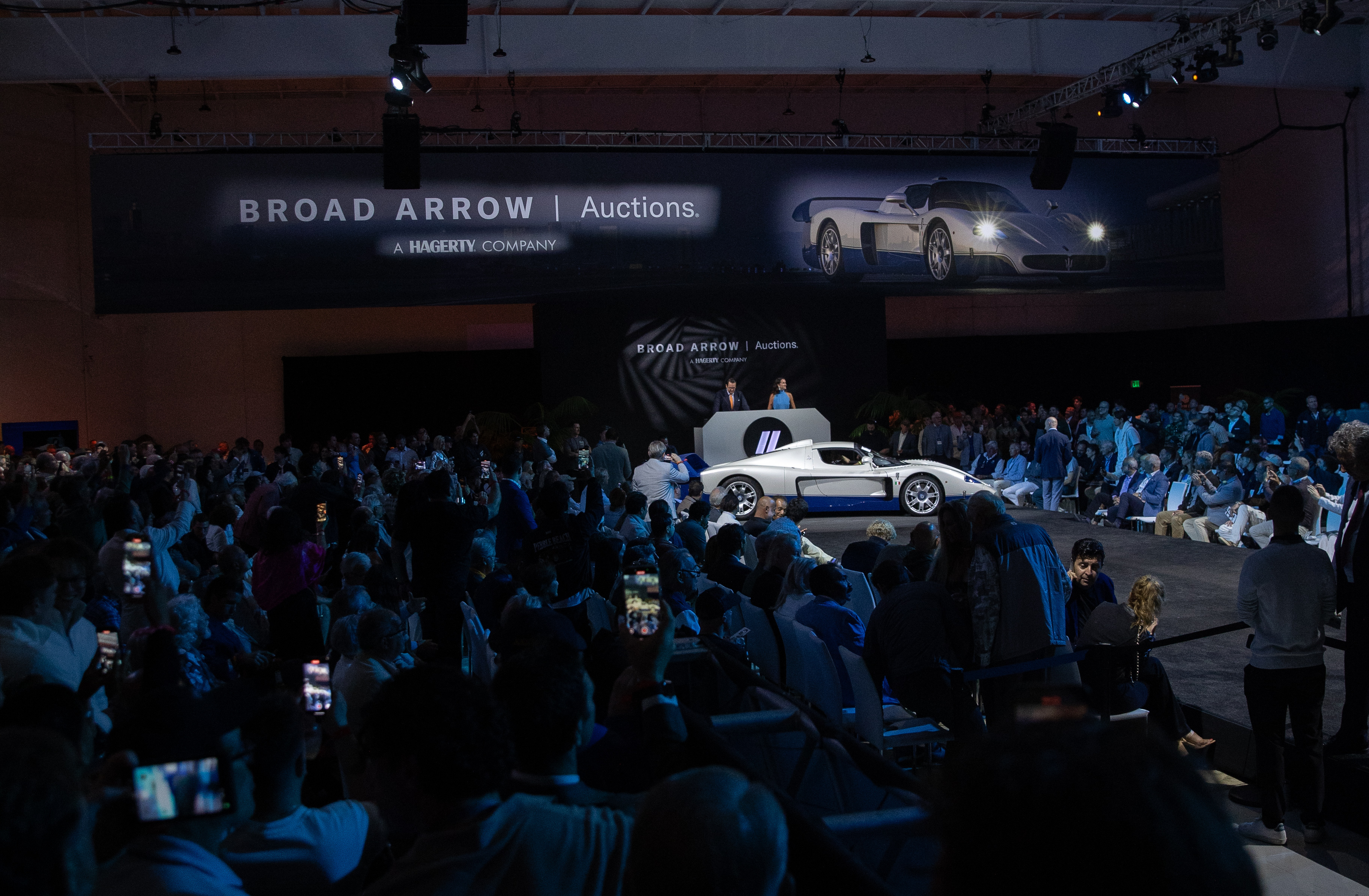
BROAD ARROW ACHIEVES NUMEROUS WORLD RECORD PRICES AT 2025 MONTEREY JET CENTER AUCTION
Globenewswire· 2025-08-18 20:36
Core Insights - Broad Arrow Auctions achieved a total sales figure of $57.4 million during its 2025 Monterey Jet Center auction, with 80% of all lots sold, marking a significant increase in bidder registration by over 20% compared to 2024 [1][3][4] Auction Highlights - The auction set at least eight new record prices, led by the sale of a 2005 Maserati MC12 Stradale for $5,202,500, surpassing the previous record of $3,800,000 for the model [2][4][7] - Other notable sales included a 2008 Koenigsegg CCXR at $3,222,500, a 1980 BMW M1 Procar at $1,600,000, and a 2009 Mercedes-Benz SLR McLaren Prototype "Stealth" at $1,022,500, all setting new records for their respective models [7][9] Market Trends - The auction results reflect a strong demand for modern collectibles, indicating a generational shift in the collector car market, with a notable interest in Japanese collector cars, including a 1999 Nissan Skyline CRS GT-R V-Spec sold for $692,500 [3][4][9] - The top 10 sales at the auction included iconic models such as a 1967 Ferrari 275 GTB/4 at $2,562,500 and a 1955 Mercedes-Benz 300 SL Gullwing Coupe at $1,902,500, demonstrating robust interest in both modern and classic vehicles [9][10] Future Events - Broad Arrow Auctions plans to expand its auction schedule with three new events in 2025, including the inaugural Zoute Concours Auction in Belgium and the debut Las Vegas Auction, indicating a strategic growth in its global footprint [15][18]


Southeast Toyota Finance Ranked Highest in Overall Dealer Satisfaction by J.D. Power
GlobeNewswire News Room· 2025-08-18 18:12
Company Overview - Southeast Toyota Finance (SET Finance) is a captive financial services company that has been providing financing to Toyota dealers and consumers since 1981 [3] - The company is part of World Omni Financial Corp and is headquartered in Deerfield Beach, Florida [5] - SET Finance serves 177 Toyota dealers across Alabama, Florida, Georgia, North Carolina, and South Carolina, offering a wide range of financing and leasing options [4] Industry Recognition - SET Finance has been ranked No. 1 in dealer satisfaction among Captive Mass Market-Prime Automotive Finance Lenders for three consecutive years by J.D. Power [1][2] - The 2025 U.S. Dealer Financing Satisfaction Study included responses from 5,035 auto dealer financial professionals and measured satisfaction across five lender segments [2] - SET Finance achieved an Overall Dealer Satisfaction score of 874, which is 120 points above the segment average [2] Strategic Initiatives - The company is focused on modernizing operations and enhancing dealer and customer experiences through its strategic initiative called SPARK [3] - SET Finance is committed to investing in its people and technology to align its programs and support with dealer goals [2] Financial Performance - JM Family Enterprises, Inc., the parent company of SET Finance, reported revenues of $22.8 billion and employs over 5,000 associates [5]


X @The Economist
The Economist· 2025-08-17 11:00
Cost Reduction & Revenue Enhancement - Toyota is implementing cost-cutting measures to mitigate the impact of US tariffs [1] - The company is focusing on marketing strategies to boost revenue [1] - Toyota aims to increase earnings through add-on services [1] Tariff Impact & Mitigation - US tariffs are negatively impacting Toyota's profitability [1] - The effectiveness of Toyota's strategies to counter tariffs is limited [1]
X @The Economist
The Economist· 2025-08-15 18:01
Trade Policy Impact - A 15% tariff imposed by Donald Trump on Japanese vehicles poses a significant challenge for companies such as Toyota [1] Production and Sales - Approximately 50% of Toyota's vehicle sales in America originate from vehicles manufactured within the country [1]
Toyota Q1 Earnings Miss Expectations, Revenues Rise Y/Y
ZACKS· 2025-08-15 15:30
Core Insights - Toyota reported fiscal first-quarter 2026 earnings per share of $4.47, missing the Zacks Consensus Estimate of $4.67 and declining from $6.35 in the same quarter last year [1][10] - Consolidated revenues reached $84.8 billion, surpassing the consensus mark of $82.6 billion and increasing from $75.9 billion year-over-year [1][10] Financial Position - As of June 30, 2025, Toyota had consolidated cash and cash equivalents of ¥8.21 trillion ($56.8 billion) and long-term debt of ¥22.94 trillion ($158 billion), slightly down from ¥22.96 trillion as of March 31, 2025 [2] - The company reported adjusted free cash flow of $2.83 billion for the quarter [11] Segment Performance - The Automotive segment's net revenues increased 2.6% year-over-year to ¥11.4 trillion ($78.9 billion), but operating profit declined 18.5% to ¥911.4 billion ($6.31 billion) [3] - The Financial Services segment's net revenues rose 13% year-over-year to ¥1.14 trillion ($7.9 billion), with operating income increasing 39.1% to ¥222.2 billion ($1.53 billion) [3] - Other businesses generated net revenues of ¥342.8 billion ($2.37 billion), an 8.6% increase year-over-year, but operating profit fell 8.1% to ¥37.4 billion ($258 million) [4] Fiscal Year 2026 Guidance - For fiscal 2026, Toyota projects total retail vehicle sales of 11.2 million units, up from 11.01 million units in fiscal 2025 [5] - Total sales are expected to reach ¥48.5 trillion, compared to ¥48.03 trillion in fiscal 2025, while operating income is projected to decline by 33.3% to ¥3.2 trillion [5][6] - Pretax profit is estimated at ¥3.87 trillion, down from ¥6.41 trillion in fiscal 2025, with R&D expenses expected to rise to ¥1.37 trillion [6]
Hesai Group Reports Second Quarter 2025 Unaudited Financial Results
Globenewswire· 2025-08-14 21:00
Financial Performance - Quarterly net revenues reached RMB 706.4 million (US$ 98.6 million), representing a year-over-year increase of 53.9% from RMB 458.9 million [6][9] - Quarterly net income was RMB 44.1 million (US$ 6.2 million), a significant improvement compared to a net loss of RMB 72.1 million in the same period last year [2][9] - For the first six months of 2025, total shipments surpassed those of the entire year of 2024, with net income reaching RMB 26.5 million (US$ 3.7 million) [2][9] Business Growth and Market Position - The second quarter saw a surge in growth momentum, with net revenues increasing over 50% year-over-year, driven by strong customer demand and operational execution [2] - The company secured numerous design wins for 20 models from 9 leading OEMs, including a platform win for multiple 2026 models with a top ADAS customer [2][3] - In the Robotics sector, the company ranked No. 1 in lidar shipments in China for the first half of 2025, indicating strong market leadership [2][7] Product and Technology Development - The company achieved the C-sample milestone for its long-range lidar sensor with a top European OEM, confirming product maturity and successful testing [3] - The long-range lidar debuted at the 2025 Shanghai Auto Show, showcasing its application in high-profile vehicles such as SAIC Audi's sports car and Cadillac VISTIQ SUV [3] - The company is positioned to capitalize on the growing demand for lidar technology in both automotive and robotics applications, leveraging its expertise and global scale [2][7] Operational Highlights - Total lidar shipments for the second quarter were 352,095 units, a remarkable increase of 306.9% from 86,526 units in the same period of 2024 [8] - ADAS lidar shipments reached 303,564 units, representing a 275.8% increase from 80,773 units in the corresponding period of 2024 [8] - The company reported a gross margin of 42.5% for the second quarter, slightly down from 45.1% in the same period last year, primarily due to a decrease in high-margin service revenues [9]

Hesai Secures New Lidar Design Win from Toyota
Prnewswire· 2025-08-14 21:00
Core Insights - Hesai Technology has secured a new design win from Toyota for its long-range automotive lidar ATX, set to enter mass production in 2026 [1] - The partnership signifies a strong endorsement of Hesai's market leadership in lidar technology and marks a new phase of collaboration with Japan's automotive industry [3] Company Developments - Hesai's ATX lidar integrates advanced technology, offering upgrades in optical-mechanical design and laser transceiver modules, making it a preferred choice among leading OEMs [4] - The ATX has already achieved design wins across multiple models, with several OEMs planning to include it as a standard feature in their 2025-2026 production lineups [4] Industry Trends - The joint venture between Toyota and Hesai is part of a broader trend towards electrification and intelligent driving solutions in the automotive industry, driven by local R&D and global engineering standards [2] - The collaboration aims to set a new benchmark for joint venture brands in the new energy vehicle market, focusing on enhancing driver-assistance systems for a safer and more intelligent driving experience [5]

Joby Vs. Archer: Two Air Taxi Rivals Race Toward 2026 — But Who Really Has Lift-Off?
Benzinga· 2025-08-14 18:21
Core Insights - The competition between Joby Aviation and Archer Aviation in the eVTOL market is intensifying, with both companies aiming for FAA certification and market dominance [1][7]. Joby Aviation - Joby is benefiting from the Trump administration's drone executive order, which has led to the establishment of a Federal Task Force and an eVTOL Integration Pilot Program [3]. - The company is optimistic about faster FAA response times but remains cautious about potential changes in certification timelines, targeting TIA testing by early 2026 [3]. - Toyota plays a crucial role in Joby's manufacturing scale-up, with the Marina facility currently capable of producing approximately 24 aircraft per year [4]. - Joby's acquisition of Blade's Passenger business provides exclusive terminal access in New York City and enhances customer booking integration [4]. - A partnership with L3Harris Technologies and plans for a hybrid demo aircraft this fall could serve as catalysts for growth into 2026 [4]. Archer Aviation - Archer is also energized by the drone executive order, aiming for demo deployments in 2026 and scaled operations by 2028, coinciding with the Los Angeles Olympics [5]. - The company is targeting FAA certification by 2027, utilizing dual CTOL and VTOL testing to attract both civil and defense clients [5]. - With Stellantis as a contract manufacturer and major shareholder, Archer aims for a production rate of 50 aircraft annually across Georgia and Silicon Valley [6]. - Unlike Joby, Archer plans to utilize publicly accessible heliports in New York City and collaborate with existing operators [6]. - Archer's partnerships with Anduril and acquisitions of MCC and Overair position it to deliver stealthier, longer-range hybrid VTOLs for government contracts [6]. Comparative Analysis - Joby's strategy focuses on acquisitions and a polished market entry, while Archer emphasizes flexible operations and manufacturing discipline [7]. - The future success of these companies may depend more on their ability to capture lasting market share rather than solely on FAA certification timelines [7].


Stratasys(SSYS) - 2025 Q2 - Earnings Call Transcript
2025-08-13 13:30
Financial Data and Key Metrics Changes - Consolidated revenue for Q2 2025 was $138.1 million, slightly higher than Q2 2024, reflecting ongoing customer deferral of major capital spending due to market uncertainty [21] - GAAP gross margin was 43.1%, down from 43.8% in the same period last year, while non-GAAP gross margin was 47.7%, down from 49% [22] - GAAP operating loss for the quarter was $16.6 million, an improvement from a loss of $26 million in the same period last year, while non-GAAP operating income was $1.1 million compared to a loss of $3.2 million [23][24] - Cash flow used in operating activities was $1.1 million, an improvement from $2.4 million in Q2 2024, with an expectation of positive operating cash flow for the full year 2025 [24] Business Line Data and Key Metrics Changes - Product revenue was $94.8 million, up from $93.6 million in the same period last year, while service revenue was $43.3 million, down from $44.4 million [21] - Within product revenue, system revenue increased to $30.6 million from $29 million, and consumables revenue was $64.2 million, slightly down from $64.6 million but up 2.6% sequentially [21] Market Data and Key Metrics Changes - Customer engagement remains strong despite macroeconomic challenges, with ongoing investment in R&D and new technology offerings [6][20] - The company launched the North American Stratasys Tooling Center to help manufacturers validate and scale additive manufacturing applications [9] Company Strategy and Development Direction - The long-term growth strategy focuses on capturing opportunities in high-growth sectors influenced by megatrends such as supply chain localization and sustainability [7][8] - The company emphasizes innovation and execution, aiming to solidify its leadership in digital manufacturing as market dynamics stabilize [6][30] Management's Comments on Operating Environment and Future Outlook - Management noted that customer spending remains challenged, impacting near-term business views, but the long-term outlook remains positive [19][20] - The return to normalized capital spending has been delayed, with expectations for significant opportunities in production applications to close potentially moving into 2026 [25][26] Other Important Information - The company ended the quarter with $254.6 million in cash and equivalents, bolstered by a $120 million investment [25] - New material offerings include P3 Silicon 25A, designed for the Stratasys Origin DLP platform, enhancing capabilities in industrial 3D printing [16] Q&A Session Summary Question: Can you clarify which specific verticals or regions are seeing the most pronounced slowdown or delays? - Management clarified that there is no slowdown, only delays, particularly in larger production application deals which have longer sales cycles [32][34] Question: What assumptions are baked into the fourth quarter adjusted EBITDA margin? - The guidance for Q4 is largely based on cost monitoring and reductions, with no large deals factored into the model [39][40] Question: What is impacting the gross margin? - Gross margin changes are attributed to sales mix changes, inventory absorption issues, and tariff impacts [43][46] Question: Can you elaborate on the Nexa asset acquisition? - The acquisition included valuable IP and R&D knowledge, positioning the company stronger in key use cases [56][59] Question: Do you anticipate additional partnerships with other vehicle OEMs? - Management expressed optimism about expanding partnerships, leveraging proven use cases from collaborations with GM and Toyota [72][74]

American Axle & Manufacturing (AXL) 2025 Conference Transcript
2025-08-12 15:20
Summary of American Axle & Manufacturing (AXL) Conference Call Company Overview - **Company**: American Axle & Manufacturing (AAM) - **Event**: 2025 Conference on August 12, 2025 - **Key Speakers**: Chris May (CFO), David Lim (Head of Investor Relations) Key Points Industry and Market Dynamics - AAM is experiencing strong operational performance, particularly in its Driveline and Metal Forming business units, with sequential and year-over-year margin growth [5][6] - The company is focused on the North American truck industry, particularly in electric vehicle (EV) products, showcasing strength in electric beam axles and electric drive units [7] - AAM is navigating the impact of tariffs by leveraging its USMCA compliance, with over 90% of finished goods compliant, which aids in mitigating tariff impacts [12][13] Acquisition of Dallet - The acquisition of Dallet is seen as transformative, with both companies' shareholders approving the transaction, expected to close in Q4 2025 [5][6] - Post-acquisition, AAM's revenue is projected to double, enhancing its competitive position in the global market [26][27] - The acquisition will diversify AAM's product offerings, particularly in sideshafts, which are agnostic to vehicle type (ICE, hybrid, EV) [28][29] Financial Performance and Projections - AAM reported strong free cash flow generation and is targeting $300 million in cost synergies from the Dallet acquisition, with half of this from purchasing efficiencies [31][33] - The company aims to maintain a leverage neutral position post-acquisition, with current leverage around 2.9x, targeting a reduction to approximately 2.5x [40][42] - AAM has paid down over $1.6 billion in debt since acquiring MPG and plans to continue prioritizing debt reduction while considering capital allocation for shareholder returns [45][47] Electric Vehicle (EV) Market Outlook - AAM has been selective in its EV investments, anticipating a slower adoption rate in North America due to regulatory changes and market dynamics [15][16] - The company views the current EV slowdown as a potential net positive, allowing for reduced R&D spending and solidifying its position in the ICE market, which is expected to remain strong for a longer period [57][59] Competitive Landscape - AAM is focused on maintaining commercial discipline while expanding its relationships with domestic Chinese automakers, which are seen as a growth opportunity [20][21] - The competitive environment remains robust, with AAM confident in its ability to compete effectively against peers like Dana, despite their recent strategic shifts [64] Operational Strategy - AAM is investing in automation to address labor availability challenges while continuing to prioritize its workforce as a key asset [83][84] - The company is evaluating its product portfolio continuously, with potential for divestitures if they align with strategic goals post-Dallet acquisition [72][75] Conclusion - AAM is positioned for growth through strategic acquisitions, operational efficiencies, and a focus on both traditional and electric vehicle markets, while navigating challenges such as tariffs and market dynamics. The company is committed to maintaining a strong financial profile and delivering shareholder value through disciplined capital allocation.