IKEA

Search documents
X @The Wall Street Journal
The Wall Street Journal· 2025-10-16 11:45
Business Strategy - IKEA, the world's largest furniture retailer, is raising prices on some products [1] - The price increase comes after years of price cuts aimed at attracting shoppers [1]
X @Bloomberg
Bloomberg· 2025-10-16 11:16
IKEA is looking to small towns as a new engine of growth https://t.co/cttZvUX6gl ...
IKEA's Low-Price Mantra Is Tested by Trump's Tariffs
WSJ· 2025-10-16 11:00
Core Viewpoint - The world's largest furniture retailer is increasing prices on certain products after a prolonged period of price reductions aimed at attracting customers [1] Group 1 - The company has implemented price hikes on select items, marking a shift from its previous strategy of lowering prices [1] - This decision comes after years of efforts to draw in shoppers through price cuts [1]


Okta CEO on the hidden dangers of AI agents in the workplace
Youtube· 2025-10-15 13:34
Core Insights - The podcast discusses the evolution of technology and its impact on businesses, particularly focusing on the identity security fabric and the agentic revolution in the context of cloud computing and AI [10][14][22]. Company Insights - Octa, co-founded by Todd McKinnon, aims to revolutionize identity management in the cloud, emphasizing the importance of a unified identity security fabric that consolidates various identity solutions [14][36][41]. - The company is experiencing momentum as it aligns with the latest technological shifts, particularly the integration of AI and automation in enterprise processes [20][46]. - Octa's strategy focuses on providing comprehensive identity solutions that enhance security and control while enabling innovation across organizations [22][27][39]. Industry Insights - The current technological landscape is characterized by rapid innovation, with AI and cloud computing being pivotal in transforming business operations [10][12][21]. - Companies are increasingly seeking integrated solutions that address security concerns while allowing flexibility in choosing innovative technologies from various vendors [24][25][27]. - The cybersecurity industry is investing heavily, with $200 billion spent annually, highlighting the ongoing challenges of identity-based attacks and the need for robust identity management systems [22][55][56].



Home Furniture Market to Reach USD 623.34 Billion by 2030 Driven by Rising Urban Housing Demand
Medium· 2025-10-15 13:22
Core Insights - The home furniture market is projected to grow from USD 508.59 billion in 2025 to USD 623.34 billion by 2030, reflecting a CAGR of 4.15% driven by urban housing demand and lifestyle changes [2][3]. Market Overview - The growth of the home furniture market is supported by increasing home improvement activities, rising residential construction, and changing consumer preferences that emphasize comfort and aesthetics [2]. - The market is influenced by evolving consumer behavior, the expansion of e-commerce platforms, and a preference for modular and space-saving designs [3]. Key Trends - **Home Office and Lifestyle Furniture**: There is a rising demand for home office furniture due to the adoption of hybrid work models, with consumers investing in ergonomic and multifunctional furniture [4]. - **Online Furniture Shopping**: E-commerce is becoming a significant sales channel, offering wider product selections and improved customer experiences through virtual tools and easy return policies [5]. - **Sustainable Materials**: Consumers are increasingly favoring furniture made from responsibly sourced and eco-friendly materials, prompting manufacturers to adopt sustainable practices [6][7]. - **New Business Models**: The market is expanding into tier-2 and tier-3 cities, with companies utilizing compact showrooms and local franchises. Mid-range furniture remains dominant, while rental and subscription services are emerging as flexible options [8]. Market Segmentation - The home furniture market can be segmented by product type, material, price range, distribution channel, and geography, including categories such as living room, bedroom, and home office furniture [9][10][11]. Key Players - Major companies in the home furniture market include IKEA, La-Z-Boy, Ashley Furniture Industries, Steinhoff International Holdings, and Herman Miller, each known for their unique offerings and market strategies [14]. Conclusion - The future of the home furniture market appears promising, driven by demand for functional, stylish, and sustainable products. Companies that adapt to changing consumer preferences and embrace new business models are likely to thrive [13].

Brands adapting to market challenges drives the total value of 2025’s Best Global Brands by $150 billion
Retail Times· 2025-10-15 09:53
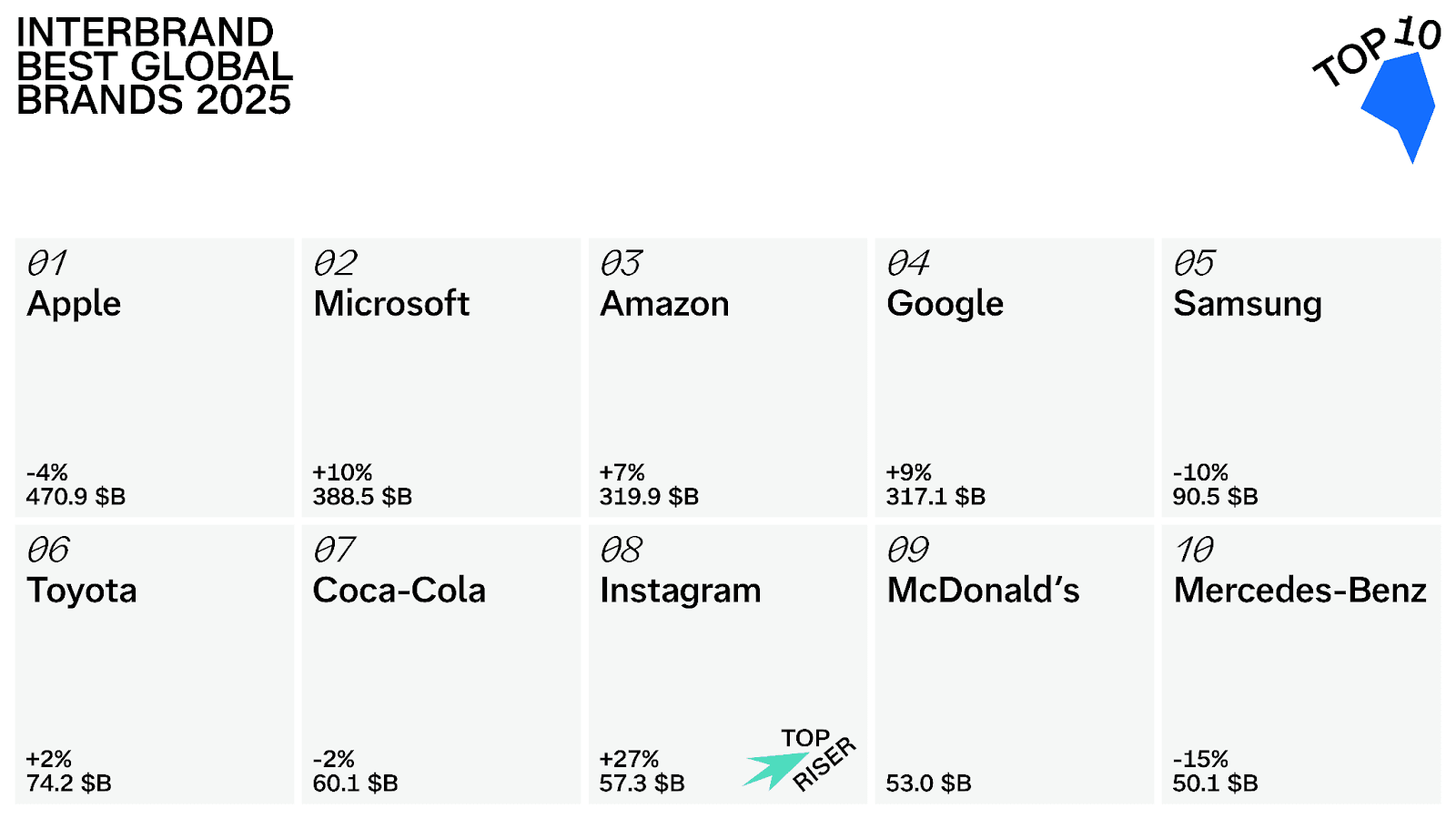
Core Insights - The total value of the Best Global Brands in 2025 is $3.6 trillion, reflecting a 4.4% increase from $3.4 trillion in 2024, with notable movements including 12 new entrants and significant declines for some brands [2][3] Brand Performance - Luxury brands show mixed results, with Hermès increasing by 18% to rank 21, while Louis Vuitton decreased by 5% to 12, and Gucci fell out of the top 50 with a 35% decline [3] - High-performing brands include Nvidia, which surged by 116% to $43.2 billion at 15, and YouTube, which grew by 61% to 13, while Netflix increased by 42% to 28 [4][5][11] - Uniqlo entered the rankings at 47 with a value of $17.7 billion, defying retail trends as most retailers faced declines [8] Sector Trends - The automotive sector is experiencing challenges with the shift to electric vehicles (EVs), with Toyota growing by 2% at 6, while Tesla saw a 35% decline to 25 [9] - Digital media and entertainment platforms are seeing significant brand value increases, with Instagram entering the Top 10 for the first time [5][6] New Entrants and Disruption - The report highlights the highest number of new entrants, including Blackrock (31), Booking.com (32), and Shopify (99), indicating a trend towards brands solving specific customer problems effectively [4][12] - Brands that view disruption as an opportunity, such as Instagram and Netflix, are successfully unlocking new revenue streams [13]

IKEA buys US logistics tech firm Locus in online growth push
Yahoo Finance· 2025-10-07 10:02
Core Insights - IKEA has acquired U.S. logistics technology firm Locus to enhance delivery efficiency and support online sales expansion [1][2][3] Group 1: Acquisition Details - The acquisition of Locus is part of a broader $2.2 billion investment by Ingka Group in the U.S. market, where IKEA faces competition from Wayfair and Walmart [2] - Locus was valued at $300 million during its last funding round in 2021, although IKEA did not disclose the acquisition value [2][5] - Under the acquisition, Locus will operate independently and continue to serve clients beyond IKEA [5] Group 2: Operational Benefits - The acquisition is expected to simplify IKEA's logistics and reduce delivery expenses by approximately 100 million euros ($117.41 million) annually [3] - Locus employs artificial intelligence to optimize order grouping and route prediction, which currently relies on manual processes by IKEA staff [3][4] - The technology will allow IKEA to provide more delivery options and real-time tracking for customers, enhancing the overall customer experience [4] Group 3: Market Strategy - IKEA has shifted focus to online sales, which accounted for 28% of total retail sales in the 2024 financial year, a significant increase from 11% in 2019 [6] - The company is investing in smaller city-center stores to attract younger, urban shoppers [6] - The acquisition follows a recent purchase of a Manhattan building for $213 million, indicating continued U.S. expansion despite higher tariffs on furniture imports [7]
X @Bloomberg
Bloomberg· 2025-10-01 09:42
Swedish furniture giant IKEA is expanding in Manhattan, undeterred by mounting Trump tariffs https://t.co/82lBP3Cr3Y ...
Wayfair Stock Is Back From the Dead and Up 339%. Can It Keep Soaring?
The Motley Fool· 2025-09-30 07:34
Core Insights - Wayfair's business and stock have shown a significant recovery after being heavily impacted by the post-pandemic shift, with the stock price increasing by 339% since its low in April [5][6]. Company Performance - During the pandemic, Wayfair experienced a surge in e-commerce sales due to increased demand for home furnishings as consumers shifted to online shopping [2]. - After the pandemic, Wayfair faced challenges due to overinvestment and a decline in demand, resulting in revenue remaining flat and well below pandemic peaks [3]. - The company reported flat revenue of $2.7 billion in the first quarter, but adjusted earnings per share improved to $0.10 from a loss of $0.32 year-over-year [7]. - In the second quarter, Wayfair achieved a 6% revenue increase to $3.3 billion, surpassing estimates, with adjusted earnings per share rising from $0.47 to $0.87 [8]. Market Strategy - Wayfair is gaining market share and expanding into brick-and-mortar retail by opening large-scale stores, with plans for additional locations [9][10]. - The company opened a new store in the Chicago suburbs and has three more planned, including a significant 140,000 square foot store in Denver [10]. Industry Context - The home furnishings sector has faced challenges due to a sluggish housing market, which typically affects furniture purchases [12]. - Investors are optimistic that potential interest rate cuts from the Federal Reserve could stimulate a recovery in the housing market and benefit companies like Wayfair [12]. Valuation and Future Outlook - Despite recent momentum, Wayfair still has a long way to go to regain pre-pandemic growth rates, facing competition from major players like Amazon and IKEA [11]. - The stock is currently trading at a forward P/E above 40, raising concerns about its valuation without faster revenue growth [13]. - The potential for stronger growth exists if the housing market improves, but the current rally may have limitations [13].

IKEA Has Lowered Prices, Amid Trade Chaos, Brodin Says
Bloomberg Television· 2025-09-22 13:40
The furniture industry facing global headwinds, yet consumers are remaining resilient. Yes, but Roland is the CEO of Inter Group, the largest IKEA franchisee operating most of the branch stores. Yes, but joins us now for more.Yes, but welcome to New York. It's good to see you. Wonderful to be here.How are things going. Because we heard from Restoration Hardware and the RH CEO was on the earnings call dropping F-bombs. And I imagine a lot of people are having similar issues at the moment, trying to sell furn ...