
Solvay

Search documents
Solvay integrates sustainability-linked features in all short-term liquidity reserves
Globenewswire· 2025-09-25 15:45
Core Points - Solvay has amended its €1.1 billion multilateral revolving credit facility and €0.3 billion bilateral revolving credit facilities to include sustainability-linked features, aligning with its For Generations roadmap and commitment to reducing greenhouse gas emissions [1][2] - The amendments link the company's borrowing costs to its climate goals, specifically targeting ambitious greenhouse gas emission reduction targets across Scope 1, 2, and 3 emissions [2] - The CFO of Solvay emphasized that integrating sustainability into the financing strategy enhances the company's focus on climate change, a key aspect of its For Generations strategy [3] Company Overview - Solvay is a pioneering chemical company with a history dating back to 1863, employing around 9,000 people and generating €4.7 billion in underlying net sales in 2024 [5] - The company is committed to delivering innovative and sustainable solutions that address essential global needs, including air and water purification, food preservation, health protection, and sustainable materials [5] - Solvay aims for a transition to a carbon-neutral future by 2050, highlighting its dedication to sustainability and a fair transition [5]

Solvay: A Complex Macro Environment Is Buffered By Elevated Cash Conversion
Seeking Alpha· 2025-09-22 12:25
Group 1 - Solvay is the world leader in soda ash and holds a strong market share in segments such as peroxides, bicarbonates, silica, and coatings [1] - The company is currently experiencing weaker performance [1] Group 2 - The investment focus is on growth companies, particularly in mid-cap segments, with an emphasis on sectors like biotechnologies, computer chips, cloud technology, energy, and commodities [1] - A systematic balance sheet analysis will be conducted, as growing businesses often face funding challenges [1] - Long-term capital appreciation is prioritized over short-term speculation [1]
Solvay strengthens its competitiveness in Germany through portfolio realignment and investments
Globenewswire· 2025-09-18 16:00
Core Insights - Solvay is implementing strategic measures to enhance its long-term competitiveness in Germany, focusing on the Bad Wimpfen site as a global hub for NocolokⓇ production and innovation [1][5] Group 1: Strategic Realignment - The company will discontinue certain product lines at the Bad Wimpfen site, including Trifluoroacetic Acid (TFA)-related organics by early 2026 and some inorganics like Hydrogen Fluoride by the end of 2026, resulting in a net reduction of approximately 100 positions [2] - A new state-of-the-art NocolokⓇ Paste & Paint facility will be established at Bad Wimpfen, consolidating operations and expertise from Garbsen, which is set to cease operations by 2028, leading to a net reduction of around 40 positions in Garbsen [3] Group 2: Financial Commitment - Solvay plans to allocate approximately €25 million for restructuring expenses and strategic investments, primarily in 2026, to support the transformation and long-term value creation [4] Group 3: Commitment to Employees - The company is committed to managing the impact of these changes on employees through close consultation with employee representatives, aiming for socially responsible solutions [4][5]
化工行业_北美投资者关注什么-Chemicals Sector_ What are North American investors focused on_
2026-01-29 10:59
Summary of Conference Call on Chemicals Sector Industry Overview - The focus of North American investors is on the Chemicals sector, particularly regarding earnings risk for fiscal years 2025 and 2026 EBITDA [1] - There is skepticism about the sector's ability to achieve top-line inflection and double-digit earnings growth in FY26 [1] Key Points Discussed 1. **Volume Development**: - Feedback from the Global Material Conference indicated that volumes in end markets and regions have not improved since the end of Q2 [1] - Order book visibility is approximately two weeks [1] 2. **Earnings Growth Concerns**: - Investors are worried about the consensus EBITDA growth of 10% year-on-year for FY26, especially in the absence of volume recovery in H2 2025 [1] - Potential drivers for earnings growth include the impact of German fiscal stimulus, the EU Chemical Action Plan, and petrochemical capacity [1] 3. **Path to Normalized Earnings**: - A tightening of upstream supply/demand is expected, likely by late 2027/28, which could be exacerbated by capacity closures [1] - Companies are expected to focus on self-help and portfolio improvement in the interim [1] 4. **Consolidation Potential**: - Investors inquired about the potential for consolidation in the sector due to liquidity decline for many companies over the past three years [1] - Concerns were raised about the sustainability of volume growth for Ingredients & Gases [1] Stocks of Focus - **Diversified and Specialty Subsector**: - Key stocks include Solvay (benefiting from Chinese capacity closures and rare earths), Syensqo (margin recovery and non-core asset disposals), and BASF (FY26 earnings risk and coatings disposal) [2] - Defensive nature and margin improvement potential of Gases were acknowledged, but concerns about over-ownership of Air Liquide and Linde by long-only investors were noted [2] - **Consumer Chemicals**: - Focus on DSM-Firmenich (ANH disposal announcement), Symrise (pet food OSG recovery), Croda (turnaround strategy), and Novonesis (sustaining ~7% OSG and margin expansion) [2] - Lack of investor interest in Akzo Nobel, Covestro, Givaudan, fertilizers, and most mid-cap names in the sector was observed [2] Financial Performance Insights - The Chemicals sector is down 1.8% year-to-date and down 8.3% on a 12-month basis [51] - Top performers year-to-date include Bayer (+49.3%), JMAT (+41.4%), and Umicore (+32.8%) [51] - Worst performers include Symrise (-20.9%), Victrex (-32.2%), and Synthomer (-62.7%) [51] Price Trends and Spreads - **Downstream Prices**: - pMDI prices remained flat, but spreads increased by 1% as Benzene prices decreased by 1% [44] - TDI prices are flat, with spreads up by 1% as Toluene prices decreased by 2% [44] - Polycarbonate prices and spreads remained flat, while acrylic acid prices and spreads also remained flat [45] - **Upstream Prices**: - Naphtha prices decreased by 1% in Asia and 14% in the US over the last week [47] - Ethylene prices increased by 1% in Asia but decreased by 1% in the US [47] - Propylene prices remained flat, while butadiene prices were also flat [48] Conclusion - The Chemicals sector faces significant challenges regarding earnings growth and volume recovery, with investor sentiment reflecting caution. Key stocks are under scrutiny, and the potential for consolidation may shape future dynamics in the industry.
行业聚焦:全球离子液体市场头部企业份额调研(附Top10 厂商名单)
QYResearch· 2025-09-15 04:17
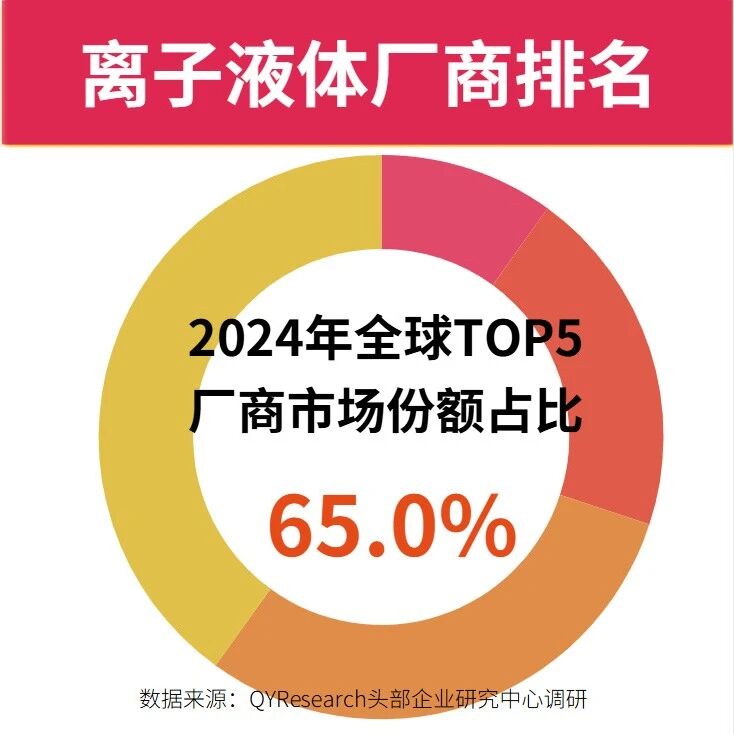
Core Viewpoint - Ionic liquids are gaining attention due to their unique properties such as low volatility, high thermal stability, and excellent solvation capabilities, with a projected global market size of $270 million by 2031 and a CAGR of 9.3% from 2025 to 2031 [1][9]. Market Overview - The global ionic liquid market is expected to reach $270 million by 2031, with a CAGR of 9.3% [1]. - The market is primarily driven by increasing regulatory pressure on hazardous solvents, advancements in production technology, and ongoing R&D efforts to explore new applications [9]. Key Players - Major manufacturers in the ionic liquid market include BASF, Evonik Industries, Solvay, Merck, KOEI Chemical, Sanyo Chemical, Proionic, Solvionic, IoLiTec, and Zhejiang Lande Energy Technology [6]. - The top five manufacturers are projected to hold approximately 65.0% of the market share in 2024 [6]. Market Segmentation - The ionic liquid market can be segmented by product type and application, with common applications including solvents, catalysts, and electrolytes in batteries and fuel cells [7][8]. Driving Factors - Regulatory pressure from agencies like the EPA is creating opportunities for ionic liquids as safer and more sustainable alternatives [9]. - Investment in research infrastructure and manufacturing processes is essential to support the commercialization of ionic liquids [9]. - Continuous R&D is expanding the potential applications and improving the performance of ionic liquids through tailored combinations of cations and anions [9]. Challenges - High synthesis costs and limited commercial availability of certain ionic liquids may hinder broader industrial applications [10]. - Existing technologies and solvents pose competition, making it challenging to persuade industries to switch to ionic liquids [10].
全球化工装置_更多供应关停之际,制造业或存下行风险_更多供应关停之际,制造业或存下行风险Global Chemicals Cracker_ Potential downside to manufacturing while more supply is being shut_ Potential downside to manufacturing while more supply is being shut
2025-08-31 16:21
Summary of Key Points from the Conference Call Industry Overview - The conference call primarily discusses the **Global Chemicals Cracker** industry, focusing on the dynamics of chemical demand and supply, particularly in relation to tariffs and manufacturing activity [1][2]. Core Insights and Arguments - **Chemical Demand Risks**: There is a potential downside to manufacturing as more supply is being shut down. The reversal of pre-emptive inventory builds due to tariffs could pose unexpected risks to chemical demand [1][2]. - **Supply Rationalization**: Despite announcements of supply rationalization, it appears insufficient to rebalance markets. The average spread in August remained flat, with a notable increase in EU TDI prices offset by declines in Asia [1][2]. - **Capacity Reductions**: Ten Korean companies are set to reduce naphtha cracking capacity by approximately 2.7-3.7 million tons, representing 18-25% of total capacity. Korea accounts for 6% of global ethylene/propylene capacity [2]. - **China's Supply Dynamics**: China's Ministry of Industry and Information Technology (MIIT) may phase out smaller refining and chemical facilities, but older crackers owned by Sinopec and PetroChina are expected to see upgrades, leading to net supply additions rather than closures [2]. - **Global Economic Indicators**: Citi's global economic surprise index increased in July but has since fallen in August, primarily due to China. Industrial production in China expanded by 6% YoY in July, but austerity measures are beginning to impact demand [2]. Margin and Performance Analysis - **Margin Trends**: The average spread was stable month-over-month in August, with lower spreads in Asia offset by TDI in Europe. BASF's average weighted spread decreased by approximately 1% month-over-month, indicating a potential EBITDA of around €7.3 billion, which is about 3% below consensus [3][10]. - **Sector Performance**: The chemical sector's weak performance in Q2 suggests that chemical demand has not significantly benefited from pre-buying. The outlook for September is critical to assess demand trends for the remainder of 2025 [2][3]. Company-Specific Developments - **BASF**: The company reported a marginal decline in its weighted average spread for chemicals and materials, translating to a negative net pricing impact of approximately €0.1 billion for the second half of the year [10]. - **Arkema**: European acrylic acid margins were flat month-over-month, but margins in China dropped by about 22% due to lower prices. Arkema is viewed positively for its long-term earnings resilience [10]. - **Clariant**: The company is favored for its defensive portfolio, which is less reliant on commodity pricing and more focused on higher quality end markets [10]. - **Dow Chemical**: Dow announced a 50% cut to its dividend due to a prolonged soft commodity cycle and missed Q2 earnings expectations [15]. - **LG Chem**: The company is focusing on high-value-added products amid industry oversupply, with a realistic outlook on cathode shipment guidance [14]. Additional Important Insights - **Market Sentiment**: The overall sentiment in the chemical industry remains cautious, with expectations of continued low margin conditions for the rest of the year [11][15]. - **Investment Recommendations**: Within diversified chemicals, companies such as AKE, CLN, EVK in Europe, and LG Chem, PChem, and Kumho in Asia are highlighted as favorable investment opportunities [4][10]. This summary encapsulates the key points discussed in the conference call, providing insights into the current state and future outlook of the global chemicals cracker industry.
Solvay second quarter 2025 results
Globenewswire· 2025-07-30 05:00
Core Insights - The company reported a continued solid EBITDA margin and free cash flow delivery despite a soft demand environment in the first half of 2025 [1][3] Financial Performance - In Q2 2025, net sales were €1,102 million, down 7.8% year-on-year and 3.8% organically [2] - EBITDA for Q2 2025 decreased to €230 million, a decline of 15.4% year-on-year and 12.4% organically [2] - The EBITDA margin was 20.9%, down from 22.8% in Q2 2024, reflecting a decrease of 1.9 percentage points [2] - Free Cash Flow (FCF) in Q2 2025 was €54 million, a significant drop of 54.8% compared to the previous year [2] - Underlying net profit from continuing operations was €99 million in Q2 2025, compared to €116 million in Q2 2024 [5] Market Conditions - The business activity in the first half of 2025 was affected by uncertainty surrounding tariff discussions and geopolitical tensions, leading to a soft market demand environment [3][4] - The company anticipates that market conditions will remain challenging throughout the second half of 2025 [4] Cost Management - Structural cost savings initiatives delivered €29 million in Q2 2025, with cumulative savings reaching €165 million since the start of 2024 [5] - The company now expects total cost savings to exceed the previous indication of €200 million by the end of 2025 [6] 2025 Outlook - The company has revised its 2025 underlying EBITDA outlook to between €880 million and €930 million, while confirming a Free Cash Flow target of around €300 million [5][8] - The maximum capital expenditure (Capex) is set at €300 million, reflecting a focus on cash generation and dividend cover [8]
工业化学品-中国会关闭老旧化工产能吗?Industrial Chemicals-China To Close Old Chemical Capacity
2025-07-25 07:15
Summary of Key Points from the Conference Call Industry Overview - **Industry**: Industrial Chemicals in Europe [1] - **Key Focus**: The call discusses the potential closure of old chemical capacity in China and its implications for the global chemical industry, particularly in Europe [2][3]. Core Insights - **China's Regulatory Actions**: The National Development and Reform Commission (NDRC) and other authorities in China are gathering data on petrochemical facilities over 20 years old, with plans to phase out 30-year-old capacity by 2030. This aims to alleviate overcapacity and promote industry consolidation [2]. - **Impact on Sentiment**: The prohibition of new capacity additions is viewed as a significant step to address oversupply, which is expected to positively influence market sentiment towards European chemical companies such as BASF, Wacker, Solvay, and Arkema [3]. - **Capacity Affected**: Approximately 25% of refining capacity and 14% of chemical capacity in China is expected to be impacted by the proposed regulations [4]. Company-Specific Insights - **BASF**: Upgraded to Overweight with a target price of €54, based on a DCF valuation and peer trading comparables [11]. The company is expected to benefit from improved market conditions due to regulatory changes in China [3]. - **Arkema**: Target price set at €97, indicating a favorable valuation with a 7% free cash flow yield based on 2025 estimates [8]. - **Solvay**: Target price of €30, with risks including a negative terminal growth rate and high costs for decarbonization [12]. - **Wacker Chemie**: Target price of €99, with significant upside potential if earnings expectations are met [15]. Risks and Considerations - **Upside Risks**: Include the maintenance of acrylic spreads, recovery in technical polymers, and favorable foreign exchange movements [9][13]. - **Downside Risks**: Potential liabilities related to PFAS in the US and failure to replace lost sales to Evonik [10][14]. - **Market Dynamics**: Geopolitical risks and fluctuations in commodity prices could impact feedstock costs and overall demand [14][17]. Conclusion - The regulatory changes in China are expected to have a ripple effect on the global chemical industry, particularly benefiting European companies by addressing overcapacity issues. The sentiment towards companies like BASF, Arkema, and Wacker Chemie is likely to improve as a result of these developments.
Syensqo Appoints Two New Board Members
Globenewswire· 2025-07-17 15:31
Syensqo Appoints Two New Board Members Brussels, Belgium – July 17, 2025 - 17:30 CEST New Directors Bring Industry, Innovation and Leadership Experience to Advance Syensqo’s Evolution to a Specialty Chemicals Company SYENSQO SA (“Syensqo” or “the Company”) is pleased to announce the appointment of Dr. Cynthia Arnold and Augusto Di Donfrancesco as new members of its Board of Directors, effective July 17, 2025. They replace Matti Lievonen and Nadine Leslie who are stepping down from the Board to pursue other ...

Solvay revises its 2025 underlying EBITDA outlook and confirms its Free cash flow guidance
Globenewswire· 2025-07-14 17:18
Group 1 - Solvay is facing a challenging market environment in Q2 2025, influenced by global tariff discussions and geopolitical tensions, leading to reduced demand and slower order books, particularly in soda ash end-markets and the Coatis business unit [1] - The company has updated its 2025 outlook, now expecting underlying EBITDA to be between €880 million and €930 million, down from a previous range of €1.0 billion to €1.1 billion [2] - Solvay anticipates Free Cash Flow from continued operations to be around €300 million, with a maximum of €300 million in capital expenditures, reflecting a focus on cash generation and dividend coverage [3] Group 2 - In Q2 2025, Solvay expects an underlying EBITDA of approximately €230 million, which includes a one-off revenue gain of around €20 million from the Special Chem business unit [3] - The company will not provide further comments ahead of the Q2 2025 earnings release scheduled for July 30 [4] - Solvay, a leading chemical company with a history dating back to 1863, reported underlying net sales of €4.7 billion in 2024 and is committed to sustainability and a carbon-neutral future by 2050 [4]