Xiaomi

Search documents
Canalys数据快闪:2024年,全球可穿戴腕带设备重点市场厂商排名
Canalys· 2025-03-07 03:10
Core Insights - The global wearable band device market is experiencing steady growth, with shipments reaching 193 million units in 2024, representing a 4% year-on-year increase. This marks two consecutive years of growth following a market adjustment in 2022, indicating a recovery trend driven primarily by strong demand in China and emerging markets, compensating for declines in mature markets like the US and India [1]. Regional Market Summaries Middle East - Xiaomi and Apple are tied for the top position with a 23% unit share each, with annual growth rates of 125% and 21% respectively. Huawei follows closely with a 19% share and a remarkable growth of 184% [2]. Central and Eastern Europe (CEE) - Xiaomi leads with a 33% unit share and a 34% annual growth rate. Huawei shows significant growth at 184%, while Apple has a 11% share but a decline of 15% [3]. Latin America - Xiaomi holds a 27% share with a 63% growth rate, indicating strong performance in this region [3]. Mainland China - Huawei dominates with a 37% unit share and a 42% growth rate, followed by Xiaomi at 24% with a 28% increase. Apple and HONOR have smaller shares of 6% and 2% respectively, with modest growth [5]. Spain - Xiaomi leads with a 39% share and a substantial growth of 117%, while Apple and Samsung follow with 19% and 8% shares, showing growth rates of 9% and 38% respectively [6]. Mexico - Xiaomi is the leader with a 24% share and a 15% growth rate, while Samsung and Apple follow with 20% and 9% shares, showing significant growth for Samsung at 162% [7]. Indonesia - Xiaomi leads with a 48% share and a remarkable growth of 129%, while Samsung also shows strong performance with a 19% share and a 213% growth rate [7]. Japan - Apple is the market leader with a 46% share and a 7% growth rate, followed by Google and Garmin, each with a 12% share and growth rates of 11% and 12% respectively [9].




Here's why Alibaba (BABA) stock price is soaring today
Finbold· 2025-03-06 14:56
Group 1 - Alibaba stock has experienced significant growth since the beginning of 2025, with a year-to-date return of 68.44% as of early March [2][4] - The release of the AI model DeepSeek in late January sparked renewed interest in Chinese tech stocks, followed by Alibaba's launch of Qwen 2.5 and a collaboration with Apple to enhance AI features on iPhones [1][2] - The company plans to invest more in AI and cloud computing over the next three years than it has in the past decade, indicating a strong commitment to these sectors [2] Group 2 - In March, Alibaba announced the release of QwQ-32B, a new AI model that reportedly meets or exceeds the performance of DeepSeek's leading model, R-1 [5] - The Chinese AI industry is currently experiencing a price war, with intense competition among startups and established companies, highlighting the rapid evolution of the sector [6] - Success in the domestic market is crucial for Chinese companies, as it provides a stable foundation for international expansion, as seen with companies like Xiaomi and BYD [7] Group 3 - Despite the impressive stock rally, Alibaba's stock price is still approximately 50% below its all-time high, reflecting ongoing market confidence [8] - Notably, Alibaba is the largest holding of investor Michael Burry, and Morgan Stanley has set a price target of $180 for BABA shares, suggesting a potential upside of 25.29% from current levels [9]


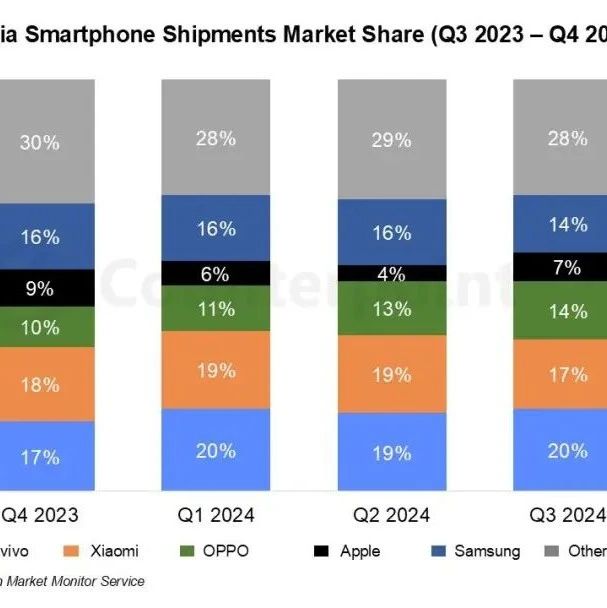
印度智能手机市场份额:季度数据(2023 Q3 - 2024 Q4)
Counterpoint Research· 2025-02-26 14:31
印度智能手机出货量市场份额(2023 Q3 - 2024 Q4) 媒体采访 数据来源:Counterpoint Research 市场监测服务 排名依据最新季度数据。vivo 包含 iQOO ,Xiaomi 包含 POCO 。 市场要点 折叠智能手机面板出货量 在 2024 Q4 ,vivo 以 21% 的市场份额领跑,主要受 Y28s 5G 和 T3 Lite 5G 机型推动。 尽管同比增长 24% ,小米仍下降至第二位。Redmi 13C 5G 依然是该品牌表现最好的机型。 三星在 2024 Q4的出货量同比下降 37% ,是前五大品牌中跌幅最大的,因此排名下滑至第五 位。 OPPO 以 41% 的同比增长成为前五大品牌中增速最快的品牌,其 A3 系列是当季最畅销的机 型。 苹果首次在印度单季度进入前五名。 | Brands | Q3 2023 | Q4 2023 | Q1 2024 | Q2 2024 | Q3 2024 | Q4 2024 | | --- | --- | --- | --- | --- | --- | --- | | vivo | 16% | 17% | 20% | 19% | 20% ...
Tesla Loses $1T Crown: What's to Blame & How Should You Play Now?
ZACKS· 2025-02-26 14:10
Core Viewpoint - Tesla's market capitalization has fallen below $1 trillion, with shares dropping over 8% to close at $302.80, marking a 16% decline in just four sessions, erasing $186 billion in market value [1][2]. Group 1: Sales Performance - Tesla's sales in January experienced significant declines across key markets, with European sales down 45% year over year, totaling 9,945 vehicles sold [3]. - In Germany, sales dropped to 1,277 units, the lowest since July 2021, while France saw a 63% plunge, marking the weakest performance since August 2022 [3]. - In China, January sales fell about 15% year over year, and in the U.S., sales were down 13% year over year, with approximately 42,000 vehicles sold [4]. Group 2: Market Challenges - The decline in sales highlights growing challenges for Tesla, which reported its first-ever annual dip in global vehicle deliveries in 2024, increasing pressure on the company to launch affordable models and accelerate autonomous driving initiatives [5]. - January is historically a slow month for car sales, and some analysts suggest that inventory shortages and the ongoing Model Y refresh may have contributed to the sales slump [6]. - Investor sentiment is becoming uneasy, leading to sell-offs rather than waiting for potential improvements from new models and self-driving features [7]. Group 3: Self-Driving Technology Issues - Tesla's anticipated self-driving update in China has disappointed local customers, with regulatory delays pushing the launch of advanced automation features into 2025 [8]. - A recent software upgrade introduced in-city navigation but still requires full driver attention, keeping Tesla's system at Level 2 automation, which raises concerns as competitors offer better features at lower costs [9][10]. Group 4: Leadership and Investor Sentiment - Elon Musk's involvement in various ventures, including his role in the government, is causing investor anxiety, as some fear it distracts him from Tesla during a critical time [12][13]. - Tesla's stock has underperformed compared to its peers, down 25% year to date, while the S&P 500 index has risen 1.5% in the same period [14]. - Tesla's forward P/E ratio stands at 112X, significantly higher than the group's average, indicating a stretched valuation amid slowing EV growth and execution risks [19]. Group 5: Future Outlook - Tesla is at a pivotal point, needing to deliver on promises of lower-cost models and expand its lineup to regain market share, especially in price-sensitive regions [22]. - The company plans to launch unsupervised Full Self-Driving as a paid service in Austin by June, with hopes of expanding to other markets by year-end, contingent on regulatory approval [23]. - Investors are advised to monitor Tesla's progress in autonomous vehicles, as FSD approvals and robotaxi developments will be critical for long-term growth [24].