Merck

Search documents
Here's How Alvotech is Expanding its Portfolio Beyond Immunology
ZACKS· 2025-09-30 14:15
Core Insights - Alvotech (ALVO) is rapidly expanding in the biosimilar/generic market through a partnership-driven model, focusing on development and manufacturing while partners manage marketing and sales [1] - The company's immunology biosimilars, particularly Simlandi and Selarsdi, have driven early momentum, with product revenues increasing over 200% year over year to nearly $205 million in the first half of 2025 [2][5] - Alvotech is diversifying its portfolio by entering ophthalmology with the EU approval of Mynzepli, a biosimilar to Regeneron's Eylea, and expanding partnerships to develop biosimilars in neurology and oncology [3][4][5] Company Strategy - Alvotech's alliance-driven model allows it to mitigate risks associated with biosimilar launches and accelerate market entry for multiple products simultaneously [1] - By leveraging established partners like Teva Pharmaceuticals and Stada, Alvotech has efficiently scaled adoption of its products without the financial burden of extensive sales infrastructure [2] - The company is strategically expanding its partnerships with Dr. Reddy's Laboratories and Advanz Pharma to develop biosimilars for key therapeutic areas, including oncology and neurology [4]



WINREVAIR™ (sotatercept-csrk) Reduced the Risk of Clinical Worsening Events by 76% Compared to Placebo in Patients Recently Diagnosed With PAH on Background Therapy in Phase 3 HYPERION Trial
Businesswire· 2025-09-30 07:39
Core Insights - Merck announced positive results from the Phase 3 HYPERION trial for WINREVAIR (sotatercept-csrk) in adults with pulmonary arterial hypertension (PAH) [1] Group 1 - The trial evaluated WINREVAIR versus placebo, both in combination with background therapy [1] - The study focused on recently diagnosed adults with PAH classified as WHO Group 1, functional class II or III, at intermediate or high risk of disease progression [1] - WINREVAIR demonstrated a reduction in the risk of clinical worsening in the trial participants [1]


Digital Asset Adoption Accelerates Alongside Distributed Ledger Technology Implementation, Broadridge DLT in the Real World Study Finds
Prnewswire· 2025-09-29 06:30
Core Insights - The 2025 DLT in the Real World report indicates a significant shift in the adoption of distributed ledger technology (DLT) and digital assets, moving from theoretical discussions to operational implementations [1][2][12] - Broadridge Financial Solutions is at the forefront of this transformation, processing over $280 billion in average daily repo transactions in August 2025, a substantial increase from $45 billion a year ago [2] Adoption Trends - 36% of respondents report active DLT initiatives, highlighting advancements in tokenization, settlement, and secure transaction processing [3] - North America leads in DLT adoption, with 50% of firms running live projects, marking a 72% increase from the previous year [4] - In the APAC region, 43% of respondents are live with DLT and digital assets, reflecting ongoing confidence and development [5] Buy-Side Engagement - 61% of buy-side firms are engaged in proof of concepts, pilots, or live digital asset initiatives, indicating strong investor participation [6] - Firms are leveraging DLT and digital assets to improve intraday liquidity (85%) and reduce transaction costs (79%) [6] Financial Investment - Budgets for DLT and digital assets have tripled since 2020, with average annual spending on digital assets reaching $2.2 million in 2025 and DLT investments averaging $1.8 million [7] - Over 40% of respondents are using DLT to drive new product revenues, doubling from the previous year [7] Industry Challenges - Despite progress, firms face challenges such as limited secondary market liquidity and legal clarity, yet nearly half indicate that political and market conditions have accelerated adoption [10] Future Outlook - Expectations for 2026 suggest a transition from pilot projects to fully integrated operations, with DLT becoming integral to capital markets infrastructure [11]

The Trump Market Rollercoaster: Tariffs, Tweets, and Tremors
Stock Market News· 2025-09-29 06:00
Group 1: Tariff Announcements - A new wave of tariffs will take effect on October 1, 2025, including a 100% levy on imported branded and patented pharmaceuticals, a 50% tariff on kitchen cabinets and bathroom vanities, a 30% tax on upholstered furniture, and a 25% duty on heavy trucks [2] - The rationale for these tariffs is to protect American businesses from foreign goods and for national security reasons [2] Group 2: Market Reactions - The immediate market reaction on September 26, 2025, was mixed, with the Dow Jones Industrial Average gaining 0.33% to close at 42,313.00, while the S&P 500 dipped 0.13% to 5,738.17, and the Nasdaq Composite fell 0.39% to 18,119.59 [3] - Home furnishings retailers and manufacturers, such as Wayfair and RH, experienced sharp declines, with RH dropping over 4%, while overseas pharmaceutical stocks also took a hit [4] Group 3: Economic Implications - Analysts warn of rekindled inflation concerns, particularly regarding healthcare expenses, as drug prices could potentially double due to the tariffs [6] - The Flash U.S. Manufacturing PMI fell to 52.0 in September from 53.0 in August, indicating supply chain disruptions and higher costs tied to the tariffs [6] Group 4: Historical Context - The current tariff situation is reminiscent of earlier tariffs imposed in April 2025, which led to significant market declines, including a 4.88% drop in the S&P 500 [7][8] - The S&P 500 had fallen about 12% within four days following the April tariffs, indicating the market's sensitivity to such announcements [9] Group 5: Broader Economic Concerns - The combination of aggressive trade policies, rising inflation, and a weakening labor market suggests a precarious economic environment, with Moody's Analytics indicating the U.S. economy may be closer to a recession than many investors realize [16] - Gold prices have shown a slight increase to around $3,789.80 per ounce, reflecting ongoing geopolitical tensions and economic uncertainties [17]

Merck Selects Broadridge to Transform Treasury Operations with Real-Time Account Visibility
Prnewswire· 2025-09-29 06:00
Core Insights - Broadridge Financial Solutions, Inc. has been selected by Merck to implement Swift's new Instant Cash Reporting service [1] - The service will utilize Broadridge's API orchestration capabilities for enhanced account visibility across over 400 accounts [1] Company Summary - Broadridge is recognized as a global Fintech leader, providing innovative solutions in financial services [1] - The collaboration with Merck highlights Broadridge's role in advancing financial reporting and account management through technology [1] Industry Summary - The integration of Swift's Instant Cash Reporting service represents a significant development in the financial technology sector, focusing on real-time account visibility [1] - The use of API orchestration in financial services is becoming increasingly important for companies seeking efficient and transparent financial operations [1]
President Trump reignites trade tensions with new tariffs
Youtube· 2025-09-28 15:01
Group 1: Tariff Implications - A new set of tariffs will take effect on October 1st, including a 100% tariff on some imported drugs, 50% on kitchen cabinets, 30% on upholstered furniture, and 25% on big trucks [1] - The pharmaceutical industry may benefit from a loophole allowing companies that invest in U.S. manufacturing to avoid the tariffs [6][10] - The impact of the tariffs on the furniture industry is significant, particularly for companies relying on foreign imports, while U.S.-based manufacturers may see stock gains [11][20] Group 2: Market Reactions - Stock reactions have been mixed across affected industries, with pharmaceutical companies like Eli Lilly and Johnson & Johnson seeing stock increases due to U.S. manufacturing investments [10] - Companies like Restoration Hardware and Wayfair are under pressure due to their reliance on foreign sourcing, while U.S.-based Ethan Allen is experiencing stock gains [11][12] - Overall, stock futures are up, indicating a different market reaction compared to past tariff announcements [13] Group 3: Economic Context - The tariffs are part of President Trump's broader strategy to bring manufacturing back to the U.S., which is politically significant, especially in key states like North Carolina [8][21] - The effectiveness of tariffs as a policy tool is debated, with concerns about labor shortages in manufacturing complicating the return of jobs to the U.S. [22][23] - The pharmaceutical tariffs specifically target branded drugs, which account for a smaller market share compared to generic drugs, potentially limiting their overall impact [16][17]
12 Most Undervalued Dow Stocks to Buy According to Analysts
Insider Monkey· 2025-09-27 20:21
Core Insights - The article discusses the 12 most undervalued Dow stocks recommended by analysts, highlighting the significance of the Dow Jones Industrial Average as a benchmark for the top 30 US firms [1][2] Economic Context - On September 26, 2025, the Dow Jones Industrial Average increased by 0.6%, ending a three-day decline, as inflation data met expectations, leading to optimism about potential rate cuts [3] - The core PCE index rose by 2.9% year-over-year and 0.2% month-over-month in August, remaining above the 2% target but easing concerns about tighter monetary policy [3] Company Highlights - **3M Company (NYSE:MMM)**: - Recognized as one of the most undervalued Dow stocks with a price target upside of 1.68% and a P/E ratio of 21.22 [10] - The company is implementing a "back to basics" strategy aimed at achieving a 25% margin expansion by 2027 and launching 1,000 new products over the next three years [11] - Financially, 3M reported strong Q2 2025 results with a 1.4% year-over-year organic revenue increase and a dividend yield of 1.9% [14] - **The Travelers Companies, Inc. (NYSE:TRV)**: - Showcasing resilience with a price target upside of 2.29% and a P/E ratio of 12.25 [15] - Q2 2025 results showed a 183% year-over-year net income increase to $1.51 billion, driven by improved operational efficiency [16] - The company is leveraging AI to automate claims processing, enhancing efficiency and customer satisfaction [17] - **The Boeing Company (NYSE:BA)**: - Recognized for its potential with a price target upside of 5.22% [19] - Recent regulatory changes allow Boeing to expedite production and delivery timelines for select aircraft, signaling renewed confidence from regulators [20] - Secured significant orders from Turkish Airlines and Norwegian Group, reinforcing strong global demand for its aircraft [21][22]


Trump finds new trade targets -- pharmaceuticals, kitchen cabinets and heavy trucks
ABC News· 2025-09-27 04:14
Core Viewpoint - The recent announcement of significant tariffs on various imported goods, including upholstered furniture, pharmaceuticals, and kitchen cabinets, has created uncertainty for companies like Naturepedic, which relies on imports for its products. The tariffs are part of a broader strategy by the Trump administration to reshape U.S. trade policy and protect domestic industries [1][2][4]. Group 1: Impact on Companies - Naturepedic is contemplating whether to proceed with the launch of its upscale upholstered headboard in light of a 30% tariff on imported upholstered furniture, which could affect pricing strategies and overall profitability [1]. - The tariffs on kitchen cabinets, bathroom vanities, and upholstered furniture are expected to impact major exporters like China and Vietnam, potentially increasing costs for U.S. consumers and affecting the housing market [11][12]. - The tariffs on pharmaceuticals, while initially causing stock prices of some drug companies to rise, are likely to lead to higher prices for consumers, particularly those without comprehensive health care plans [9][10]. Group 2: Economic Context - The U.S. Treasury has seen a significant increase in customs duties, collecting $172 billion since the start of fiscal year 2025, which is a 126% increase from the previous year, although tariffs still represent less than 4% of federal revenue [5]. - The price of living room, kitchen, and dining room furniture has already risen nearly 10% over the past year, indicating that the new tariffs may exacerbate existing inflationary pressures in the furniture market [12]. - The rapid implementation of these tariffs is causing disruptions in retail supply chains, making it difficult for companies to plan and adapt to the changing economic landscape [13].

Merck (MRK) Outperforms Broader Market: What You Need to Know
ZACKS· 2025-09-26 22:46
Company Performance - Merck (MRK) ended the recent trading session at $78.56, demonstrating a +1.24% change from the preceding day's closing price, outpacing the S&P 500's daily gain of 0.59% [1] - Prior to today's trading, shares of Merck had lost 6.74%, lagging the Medical sector's loss of 0.94% and the S&P 500's gain of 2.72% [1] Earnings Projections - The upcoming earnings report for Merck is projected to show earnings per share (EPS) of $2.37, reflecting a 50.96% increase from the same quarter last year, with revenue expected to be $17.19 billion, showing a 3.18% escalation compared to the year-ago quarter [2] - For the full year, the Zacks Consensus Estimates project earnings of $8.93 per share and revenue of $64.94 billion, representing changes of +16.73% and +1.21%, respectively, from the prior year [3] Analyst Estimates and Valuation - Recent adjustments to analyst estimates for Merck are important as they reflect short-term business trends, with positive revisions indicating analyst optimism about the business and profitability [3] - Merck currently has a Zacks Rank of 3 (Hold), with the Zacks Consensus EPS estimate remaining unchanged over the last 30 days [5] - From a valuation perspective, Merck has a Forward P/E ratio of 8.69, which is a discount relative to the industry average Forward P/E of 13.72, and a PEG ratio of 0.8 compared to the industry average of 1.5 [6] Industry Context - The Large Cap Pharmaceuticals industry, part of the Medical sector, has a Zacks Industry Rank of 85, placing it in the top 35% of all 250+ industries [7] - Research indicates that the top 50% rated industries outperform the bottom half by a factor of 2 to 1 [7]
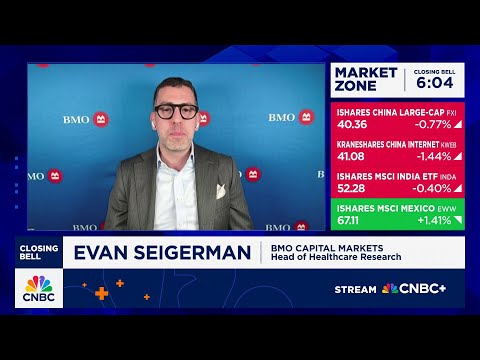
Every pharma company I cover has U.S. production so tariffs are more bark than bite: BMO's Seigerman
CNBC Television· 2025-09-26 20:20
Tariff Impact Analysis - President Trump's new 100% tariffs on the pharma sector may not be as severe as initially feared due to bilateral trade agreements and manufacturing presence in the United States [1][2] - The tariff impact is mitigated because many pharmaceutical manufacturers have operations or are building facilities in the United States [2] - Tariffs on materials used in drug manufacturing in the United States are a small portion of the overall cost, with gross margins on these products being 85-90% plus [4] - The API (Active Pharmaceutical Ingredient) component may only be 1-2% of the overall cost, so a 10-15% tariff on that component is not a major concern [5] Investment Recommendations - The industry is more focused on the IRA (Inflation Reduction Act) negotiated price list and potential drug pricing negotiations [5] - Gilead is viewed favorably due to its long-acting prep launch [6] - Fizer's recent deal is seen as a positive step, but execution is needed [7] - Other favored names include Vert [6]