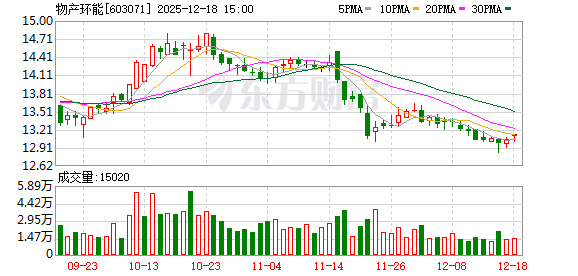
物产环能
Search documents
物产环能:2025年前三季度营收269.79亿元,净利润5.75亿元
Xin Lang Cai Jing· 2025-11-06 09:25
Core Viewpoint - The company announced its Q3 2025 performance, highlighting revenue growth in coal circulation but a decline in thermal power generation revenue, while also emphasizing its commitment to innovation and shareholder returns [1] Financial Performance - For the first three quarters of 2025, the company achieved a revenue of 26.979 billion yuan and a net profit of 0.575 billion yuan [1] - Coal circulation business generated revenue of 24.627 billion yuan with a physical sales volume of 47.1728 million tons, reflecting a year-on-year increase of 7.20% [1] - Thermal power generation business revenue was 2.14 billion yuan, showing a year-on-year decline of 8.27%, while net profit increased by 10.09% to 0.365 billion yuan [1] - The renewable energy business reported revenue of 0.212 billion yuan [1] Innovation and Development - From January to September, the company was granted 7 national invention patents [1] - The molten salt energy storage demonstration project is expected to be operational by 2025 [1] - The tire cracking technology is currently under contract performance [1] Shareholder Returns - The company plans to distribute cash dividends of no less than 40% of the net profit excluding non-recurring gains and losses for the years 2025-2026 [1]
申万公用环保周报(25/10/26~25/11/2):绿证价格大涨 9 月天然气消费增速回调-20251103
Shenwan Hongyuan Securities· 2025-11-03 11:15
Investment Rating - The report provides a positive investment outlook for the electricity and natural gas sectors, highlighting potential growth opportunities in renewable energy and natural gas consumption [4][8]. Core Insights - The green certificate market is experiencing a significant increase in both volume and price, with a 210% rise in average trading prices in Q3 compared to Q1. The total issuance of green power certificates reached 2.29 billion in September 2025, with 1.58 billion being tradable [7][8]. - Global natural gas prices are fluctuating, with the U.S. Henry Hub spot price reaching a six-month high of $3.57/mmBtu, while European prices are showing mixed trends [9][11]. - The report anticipates an increase in natural gas consumption in Q4 2025 due to low base effects and expected higher heating demand from a potential La Niña phenomenon [30][31]. Summary by Sections Electricity - The average trading price of green certificates increased by 210% in Q3 compared to Q1. The issuance of green certificates reached 2.29 billion in September 2025, with 1.58 billion being tradable, indicating a robust market growth [7][8]. - The report emphasizes the need for further development of the green certificate market and the introduction of regulations to enhance renewable energy consumption [4][7]. Natural Gas - As of October 31, 2025, the U.S. Henry Hub spot price was $3.57/mmBtu, marking an 11.16% increase week-on-week. In contrast, European gas prices showed a decline, with the TTF spot price at €30.35/MWh, down 5.42% [9][10]. - The report notes a decrease in China's apparent natural gas consumption in September 2025, but anticipates a rebound in Q4 2025 due to low base effects and increased heating demand [30][31]. - The LNG national ex-factory price in China rose to 4407 yuan/ton, reflecting a 3.11% increase week-on-week, driven by rising demand ahead of the heating season [28][30]. Investment Recommendations - The report recommends several companies based on their performance and market conditions: - Hydropower: Focus on Guotou Power, Chuan Investment Energy, and Yangtze Power due to favorable hydrological conditions [8]. - Green Power: Attention to New Energy, Funiu Co., Longyuan Power, and China Resources Power for their stable returns [8]. - Nuclear Power: Recommendations for China Nuclear Power and China General Nuclear Power due to ongoing approvals for new units [8]. - Thermal Power: Companies like Guodian Power and Huadian International are highlighted for improved profitability due to falling coal prices [8]. - Gas Power: Recommendations for Guangzhou Development and Shenzhen Energy based on expected stability in profitability [8].
申万公用环保周报:绿证价格大涨9月天然气消费增速回调-20251103
Shenwan Hongyuan Securities· 2025-11-03 07:46
Investment Rating - The report maintains a "Buy" rating for various sectors including hydropower, green electricity, nuclear power, thermal power, and gas power [4][9][44]. Core Insights - The green certificate market is experiencing a significant increase in both volume and price, with a 210% rise in average trading price in Q3 compared to Q1 [8]. - Global natural gas prices are fluctuating, with the US Henry Hub spot price reaching a near six-month high of $3.57/mmBtu, while European prices are showing mixed trends [11][12]. - The report anticipates a potential increase in gas consumption growth in Q4 2025 due to low base effects and high demand expectations, despite a 1.6% year-on-year decline in September gas consumption [32][33]. Summary by Sections 1. Electricity - In September 2025, 229 million green electricity certificates were issued, with 68.86% being tradable [4][8]. - The report highlights the improvement in market mechanisms and the growing demand for renewable energy consumption [8]. 2. Natural Gas - As of October 31, 2025, the US Henry Hub spot price increased by 11.16% week-on-week, while European prices showed a decline [11][12]. - The report notes a 1.6% year-on-year decrease in national gas consumption in September, with expectations for growth in Q4 2025 due to favorable weather conditions [32][33]. 3. Investment Recommendations - Recommendations include hydropower companies such as Guotou Power and Chuanwei Energy, green electricity firms like Xintian Green Energy and Longyuan Power, and gas companies including Kunlun Energy and New Hope Energy [9][44]. - The report emphasizes the potential for improved profitability in the gas sector due to declining costs and rising demand [33][44].
贵州茅台目标价涨幅超42% 物产环能评级被调低
2 1 Shi Ji Jing Ji Bao Dao· 2025-10-31 04:26
Core Insights - On October 30, brokerages issued target prices for listed companies a total of 76 times, with notable increases in target prices for Baoli Food, Shaanxi Coal, and Kweichow Moutai, showing increases of 46.86%, 44.52%, and 42.98% respectively, across the seasoning, coal mining, and liquor industries [1][3]. Group 1: Target Price Increases - Baoli Food received a target price increase to 21.53 yuan, representing a 46.86% increase [3]. - Shaanxi Coal's target price was raised to 33.11 yuan, reflecting a 44.52% increase [3]. - Kweichow Moutai's target price was set at 2040.00 yuan, indicating a 42.98% increase [3]. Group 2: Brokerage Recommendations - A total of 114 listed companies received brokerage recommendations on October 30, with Changshu Bank receiving 5 recommendations, Shaanxi Coal 4, and China Merchants Bank 3 [4][5]. - Changshu Bank's closing price was 7.04 yuan, with 5 brokerage ratings [5]. - Shaanxi Coal's closing price was 22.91 yuan, with 4 brokerage ratings [5]. - Kweichow Moutai's closing price was 1426.74 yuan, with 3 brokerage ratings [5]. Group 3: Rating Adjustments - On October 30, one company had its rating downgraded, with Zhongyou Securities lowering the rating for Wuchan Huaneng from "Buy" to "Hold" [5]. Group 4: First Coverage - Two companies received initial coverage on October 30, with Zhongke Meiling rated "Hold" by Jianghai Securities and Junsheng Electronics rated "Buy" by Changjiang Securities [6][7].
贵州茅台目标价涨幅超42%,物产环能评级被调低|券商评级观察
2 1 Shi Ji Jing Ji Bao Dao· 2025-10-31 01:04
Core Insights - The article highlights significant target price increases for several companies, with Guizhou Moutai's target price rising by approximately 42.98% [1] - It also notes a downgrade in the rating of a specific company, indicating a shift in market sentiment [1] Target Price Increases - Guizhou Moutai's target price increased by 42.98%, ranking among the top companies with notable price hikes [1] - Other companies with significant target price increases include Baoli Food at 46.86% and Shaanxi Coal at 44.52%, representing the seasoning and fermentation, coal mining, and liquor industries respectively [1] Broker Recommendations - On October 30, a total of 114 companies received broker recommendations, with Changshu Bank receiving the highest number at 5 recommendations [1] - Shaanxi Coal followed with 4 recommendations, and China Merchants Bank received 3 recommendations [1] Rating Downgrades - Only one company experienced a rating downgrade on October 30, with Zhongyou Securities lowering the rating of Wucai Huaneng from "Buy" to "Hold" [1] First-Time Coverage - Two companies received first-time coverage on October 30, with Zhongke Meiling rated "Hold" by Jianghai Securities and Jingsheng Electronics rated "Buy" by Changjiang Securities [1]
公用事业行业央企ESG评价体系:绿色安全+能源转型是核心社会责任担当是基石:公用事业行业央企ESG评价体系
Shenwan Hongyuan Securities· 2025-10-30 11:23
Investment Rating - The report assigns a "Buy" rating for several key companies in the public utility sector, including China Resources Power, Guodian Power, and Inner Mongolia Huadian [28]. Core Insights - The public utility sector is crucial for achieving national "dual carbon" goals, with a strong emphasis on environmental and social issues in the ESG evaluation framework [5][4]. - The ESG evaluation system for public utilities includes four categories of positive indicators and one category of negative indicators, focusing on objective assessment metrics [8][23]. - Recent policies from various government departments emphasize the need for green transformation, pollution prevention, and social welfare in the public utility sector [5][4]. Summary by Sections 1. ESG Policy in Public Utilities - The public utility sector is a major contributor to energy consumption and carbon emissions, making its green transformation essential for national goals [5]. - Key policies include the "14th Five-Year" energy conservation and emission reduction plan, which outlines specific requirements for green transformation and public service stability [5][4]. 2. ESG Evaluation System Construction - The ESG evaluation system consists of four positive categories: General Indicators, Environmental Indicators, Social Indicators, and Governance Indicators, with a total of 18 primary indicators and 35 secondary indicators [8][23]. - The negative category focuses on violations and penalties, with specific metrics for environmental, social, and governance aspects [23]. 3. General Indicators - General indicators assess the authenticity and standardization of ESG reports, including the basis for report preparation, third-party verification, and the publication of ESG-specific reports [10][9]. 4. Environmental Indicators - Environmental indicators are based on energy conservation, low carbon, and circular economy principles, with a total of four primary indicators focusing on emissions management, ecological compliance, resource utilization, and climate strategy [11][12]. 5. Social Indicators - Social indicators highlight the public utility sector's role in community development and social stability, with six primary indicators covering community contributions, employee development, innovation, supply chain responsibility, product safety, and core operational responsibilities [15][16][17]. 6. Governance Indicators - Governance indicators aim to enhance corporate governance and decision-making, with five primary indicators focusing on party leadership, industry reform, compliance risk management, governance structure, and information transparency [19][20][21]. 7. Negative Indicators - The negative indicators focus on compliance issues, with penalties for violations in environmental, social, and governance areas, deducting points for each violation [23][25].
公用事业行业央企ESG评价体系:绿色安全+能源转型是核心,社会责任担当是基石
Shenwan Hongyuan Securities· 2025-10-30 08:48
Investment Rating - The report maintains a positive outlook on the public utility sector's central enterprises with a focus on the ESG evaluation system [1]. Core Insights - The establishment of the ESG evaluation system for public utilities is based on a balanced emphasis on environmental and social issues, crucial for achieving national carbon neutrality goals [3][9]. - The evaluation system consists of four categories of positive indicators and one category of negative indicators, with a total of 18 primary indicators and 35 secondary indicators [12][28]. - Key policies guiding the sector include promoting renewable energy, enhancing energy efficiency, and ensuring equitable public services [9][11]. Summary by Sections 1. ESG Policy: Balancing Environmental and Social Issues - The public utility sector is a major contributor to energy consumption and carbon emissions, making its green transition vital for national carbon goals [3][9]. - Recent policies emphasize the development of clean energy and pollution control, with specific directives from various government bodies [9][11]. 2. Constructing the ESG Evaluation System: Multi-Dimensional Assessment - The ESG evaluation system is structured with four positive categories: General Indicators, Environmental Indicators, Social Indicators, and Governance Indicators, along with one negative category for violations [12][28]. - Each category has specific indicators designed to objectively assess the performance of enterprises in the public utility sector [12][28]. 3. General Indicators - General indicators assess the authenticity and standardization of ESG reports, including the basis for report preparation, third-party verification, and the publication of ESG-specific reports [12][14]. 4. Environmental Indicators - Environmental indicators focus on energy efficiency and circular economy principles, with metrics for emissions management, ecological compliance, resource utilization, and climate strategy [15][17]. 5. Social Indicators - Social indicators highlight the sector's role in public service, with metrics for community contributions, employee development, innovation, supply chain responsibility, and customer rights [19][21]. 6. Governance Indicators - Governance indicators aim to enhance corporate governance standards, focusing on party leadership, industry reform, compliance risk management, governance structure, and information transparency [23][26]. 7. Negative Indicators - The negative category includes penalties for violations, with specific metrics for environmental, social, and governance infractions, where each violation results in a deduction of points [28][31]. 8. Valuation of Key Companies - The report includes a valuation table for key companies in the public utility sector, indicating ratings and projected earnings per share (EPS) for the years 2025 to 2027 [34].
物产环能(603071):业绩略低于预期,积极布局新能源业务
China Post Securities· 2025-10-30 02:49
Investment Rating - The report assigns a "Buy" rating to the company, indicating a positive outlook for its stock performance in the near term [5][11]. Core Insights - The company reported a revenue of 26.98 billion yuan for the first three quarters of 2025, a year-on-year decrease of 12.8%, and a net profit attributable to shareholders of 450 million yuan, down 15.1% year-on-year. The decline in performance was primarily due to lower coal prices and reduced sales volume [3][5]. - The company is actively expanding its renewable energy business, participating in various industry standards and projects, including a 200MW/400MWh shared energy storage project in Yunnan [4][5]. - The earnings forecast for 2025-2027 has been adjusted downward due to low coal prices, with projected revenues of 40.55 billion yuan, 41.78 billion yuan, and 43.20 billion yuan respectively, and net profits of 720 million yuan, 790 million yuan, and 850 million yuan [5][7]. Summary by Sections Company Overview - The latest closing price is 14.29 yuan, with a total market capitalization of 8 billion yuan. The company has a debt-to-asset ratio of 44.0% and a price-to-earnings ratio of 10.83 [2]. Financial Performance - For Q3 2025, the company reported a revenue of 8.56 billion yuan, with a year-on-year decline of 22.4% and a quarter-on-quarter increase of 1.0%. The net profit for the same period was 150 million yuan, reflecting a year-on-year decrease of 13.3% but a quarter-on-quarter increase of 1.7% [3][5]. Profitability Metrics - The gross margin and net margin for the first three quarters of 2025 were 5.0% and 2.1%, respectively, showing slight improvements year-on-year. However, the overall expense ratio increased by 0.2 percentage points, which slightly impacted profitability [3]. Future Projections - The company’s revenue and net profit forecasts for 2025-2027 have been revised downwards due to the impact of low coal prices. The projected earnings per share (EPS) for 2025 is 1.29 yuan, with a price-to-earnings ratio of 11.05 [5][7].
研判2025!中国城市集中供热行业市场政策、产业链、供热能力、供热面积、竞争格局及发展趋势分析:行业正逐步向绿色、低碳方向转型[图]
Chan Ye Xin Xi Wang· 2025-10-28 01:40
Core Viewpoint - The urban centralized heating industry in China is experiencing rapid growth due to increasing urbanization, rising population, and heightened demand for comfortable living environments, with significant improvements in heating supply capabilities and areas served in 2024 compared to previous years [1][4][8]. Market Policy - The Chinese government has issued multiple policies to support the development of the urban centralized heating industry, creating a favorable environment for growth, including initiatives aimed at energy efficiency, carbon reduction, and infrastructure improvement [7][8]. Industry Chain - The urban centralized heating industry consists of an upstream sector that includes energy suppliers and equipment manufacturers, and a downstream sector that serves residential, commercial, and industrial users, with residential users being a significant consumer group [8][9]. Current Development - In 2024, China's urban hot water supply capacity is projected to reach 648,933 MW, with a year-on-year growth of 2.81%. The total area of centralized heating is expected to reach 1,209,414.51 million square meters, marking a 4.72% increase, with Shandong leading in heating area [1][8]. Competitive Landscape - The market for urban centralized heating in China is fragmented, with a CR5 market share of only 7.34%. Major state-owned enterprises like Huaneng International and Huadian International dominate the market due to their financial strength and resource advantages [9][11]. Development Trends - The industry is shifting towards cleaner energy sources in response to carbon reduction goals, with an increasing application of natural gas, geothermal energy, and solar energy. Southern cities are also beginning to invest more in heating infrastructure, indicating potential growth in these regions [11][12].
申万公用环保周报:第二产业用电回暖,冷冬预期有望提升销气增速-20251026
Shenwan Hongyuan Securities· 2025-10-26 13:13
Investment Rating - The report maintains a positive outlook on the power and gas sectors, indicating a "Buy" recommendation for several companies within these industries [3][4]. Core Insights - The second industry is the main driver of electricity consumption growth, with a notable increase in electricity demand due to seasonal factors and high temperatures in Q3 [4][9]. - Global gas prices are rebounding, and expectations of a cold winter may enhance gas sales growth [18][19]. - The report highlights various investment opportunities across different energy sectors, including hydropower, green energy, nuclear power, thermal power, and gas [16][40]. Summary by Sections 1. Electricity: Q3 Second Industry Drives National Electricity Consumption - In September, total electricity consumption reached 888.6 billion kWh, a year-on-year increase of 4.5% [10]. - The second industry contributed significantly to this growth, with a 5.1% increase in electricity consumption, accounting for 51% of the total growth [4][9]. - The cumulative electricity consumption from January to September was 7767.5 billion kWh, reflecting a 4.6% year-on-year growth [13]. 2. Gas: Global Gas Price Rebound and Cold Winter Expectations - As of October 24, the Henry Hub spot price was $3.21/mmBtu, showing a weekly increase of 13.96% [19][20]. - The report notes a seasonal demand increase and geopolitical factors supporting gas prices, particularly in Europe [25][37]. - The anticipated La Niña phenomenon may lead to colder winter conditions, potentially boosting gas consumption [37]. 3. Weekly Market Review - The report indicates that the power equipment sector outperformed the Shanghai and Shenzhen 300 index, while the public utility, gas, and environmental protection sectors lagged [42]. 4. Company and Industry Dynamics - The report discusses significant developments in the energy sector, including the launch of innovative products in wind energy and updates on national energy policies [50][51]. - It highlights the performance of major companies, such as Huadian International, which reported a decrease in electricity generation due to increased renewable energy capacity [57].