IMF

Search documents
X @Bloomberg
Bloomberg· 2025-10-16 22:09
Fiscal Outlook Concerns - IMF 计算得出塞内加尔的债务高于之前的估计,引发对其财政前景的担忧 [1] Program Negotiation - 塞内加尔正与 IMF 就一项新计划进行正式谈判 [1]
万喆:金价飙涨,全球货币体系迎来变革
Sou Hu Cai Jing· 2025-10-15 23:00
Core Insights - The surge in gold prices, surpassing $4000 per ounce, reflects significant changes in the global economic and political landscape, driven by short-term risk aversion, medium-term monetary policy expectations, and structural shifts in the global monetary system [1][4] Short-term Factors - Immediate catalysts for the gold price increase include geopolitical uncertainties, the recent U.S. government "shutdown" crisis, and global trade tensions, which have heightened market risk aversion [1] - The Federal Reserve's initiation of a rate-cutting cycle has reduced the opportunity cost of holding gold, directly contributing to the price surge [1] Medium-term Drivers - Continuous gold purchases by global central banks, particularly in emerging markets, are expected to be a primary driver for sustained high gold prices [2] - Data from the IMF indicates a 14.16 percentage point decline in the share of foreign exchange reserves in total global reserves over the past decade, while the proportion of gold reserves has increased by 8.4 percentage points, providing structural support for gold prices [2] Central Bank Actions - Central banks, including the People's Bank of China and those in emerging markets like Saudi Arabia and Poland, have been increasing their gold holdings, with 43% of central banks planning to continue this trend in the next 12 months [3] - The influx of private sector funds into gold, particularly through Western market gold ETFs, is accelerating as investors seek to hedge against dollar credit risks [3] Long-term Trends - The fundamental support for the current surge in gold prices stems from deep-seated concerns regarding the credibility of the U.S. dollar and ongoing structural changes in the global monetary system [4] - The historical breakthrough in gold prices signifies a decline in trust in the dollar-centric monetary system, exacerbated by the U.S. government's debt crisis and a significant drop in the dollar index [4] - The transition from a dollar-dominated system to a multi-currency framework is becoming evident, with gold serving as a key strategic asset in this evolving landscape [4]
X @Bloomberg
Bloomberg· 2025-10-15 20:52
The IMF's chief plans to travel to Ukraine in a show of support for the war-battered nation, bolstering Kyiv’s ambition to secure a new loan package in the fourth year of Russia’s war https://t.co/BncYCNMFFX ...
US Could Double Aid for Argentina to $40 Billion, According to Media Reports
Bloomberg Television· 2025-10-15 18:59
There are media outlets reporting that Scott Bessant, the U.S. Treasury secretary, has outlined financial aid to that country that would total $40 billion. For more, let's bring in bloomberg's mike McKee. Mike.From what we understand, are there are conditions tied to this or there was strings attached to up to $40 billion of aid from the United States or Argentina. Well, the administration hasn't made a whole lot clear about any of this yet, Scarlett. We don't even know about the original $20 billion, wheth ...

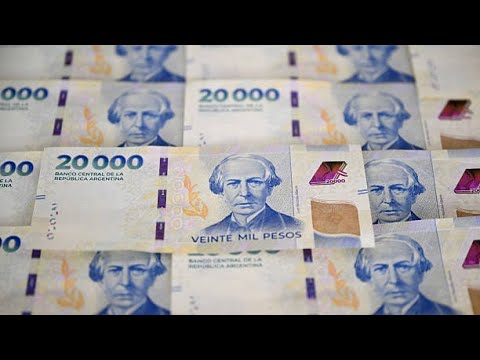
US rescue of Argentina is “unconventional,” Summers says #shorts #argentina #milei #trump
Bloomberg Television· 2025-10-15 17:26
as we've seen now Secretary of Treasury Bessant first create a swap arrangement of $20 billion and then actually intervene in the currency markets uh last week. Uh you actually were there uh during the Mexican peso crisis back in 1994. Uh what can you tell us about when that makes sense and when it does not.I'm somebody who's a strong believer that the United States has to support global financial stability, that when countries face uh crisis involving a sudden loss of liquidity that there needs often to be ...

Tariffs, inflation and other threats such as eroding central-bank independence are all clouding the world economic outlook, the IMF said in its latest round of projections
WSJ· 2025-10-14 13:00
The lender expects world growth to slow to 2.6% this year from 3.6% last year, while it upgraded its U.S. outlook. ...

X @The Economist
The Economist· 2025-10-11 23:20
Industrial Policy Spending - The Centre for Strategic and International Studies previously estimated China's industrial policy spending at 17% of GDP in 2019 [1] - A new IMF study suggests China's industrial policy spending was much higher than the previous estimate [1]
X @The Economist
The Economist· 2025-10-11 08:40
The IMF forecasts that India’s economy will be worth $6.8trn by 2030. So Narendra Modi’s goal of $10trn by 2047 should be a doddle https://t.co/sfBqKJ0pvO ...
X @The Economist
The Economist· 2025-10-11 00:20
A new paper by researchers at the IMF suggests that the scale—and the associated costs—of China’s industrial policies are far bigger than previously estimated https://t.co/MDCVDLKKRp ...
A market correction? We're in stage 3 out of 5, strategist says
Youtube· 2025-10-09 08:58
Core Viewpoint - The Bank of England and the IMF have raised concerns about AI valuations, suggesting a potential market correction may be on the horizon due to high valuations and investment patterns in the AI sector [1][2][4]. Group 1: AI Valuations and Market Risks - Significant investments in AI have led to doubts regarding profitability, indicating a potential bubble forming in the market [2][6]. - The IMF frequently warns about global economic risks, and the simultaneous warnings from both the IMF and the Bank of England highlight a growing concern about AI valuations [3][4]. - Current valuations of major US tech companies are high, particularly on a trailing earnings basis, which raises questions about the sustainability of these valuations [5][6]. Group 2: Potential Market Correction - There is speculation that the market may be approaching a correction, especially if the projected earnings growth does not materialize [4][9]. - The US market is identified as the biggest risk, with potential spillover effects on European stocks, reminiscent of the dotcom bubble in 2000 [9][10]. - The current boom in AI investments has not been heavily financed by bank debt, suggesting that the broader economic impact may be limited compared to past financial crises [10][11].