Leapmotor

Search documents
MoonFox Data | Leapmotor Financial Report Analysis: Strong Momentum Sustained, Q2 Revenue Expected to Surge 156.6% YoY
GlobeNewswire News Room· 2025-08-12 09:00
Core Viewpoint - Leapmotor aims to achieve a sales target of 500,000 units for 2025, having delivered 221,664 vehicles in the first half of the year, which is 44.33% of its annual goal [1][2]. Sales Performance - Leapmotor has shown strong sales momentum, leading the new energy vehicle (NEV) market in China with 221,664 units sold in H1 2025, maintaining the top position for four consecutive months [6][8]. - The company is well-positioned to meet its full-year sales target due to the upcoming traditional sales peak season and the launch of new models [2]. Financial Performance - Leapmotor's revenue for full-year 2024 increased by 92.0%, while Q1 2025 revenue surged by 187.1% year-over-year [3]. - The gross profit margin improved from 8.4% in 2024 to 14.9% in Q1 2025, driven by rapid volume growth and product structure optimization [3]. Net Profit and R&D Investment - In Q1 2025, Leapmotor reported a net loss of RMB 130 million, a significant reduction from the RMB 1.13 billion net loss in the same period of 2024 [5]. - R&D expenditure reached RMB 800 million in Q1 2025, up 53.8% from RMB 520 million in 2024, focusing primarily on intelligent driving technologies [5]. Product Portfolio - Leapmotor offers a diverse product range priced between RMB 60,000 and RMB 300,000, catering to various consumer segments [10]. - The A Series targets price-sensitive consumers, while the B Series serves as the core product line with advanced features at competitive prices [11][12]. - The C Series includes models like the C11, which competes with traditional automakers' products priced around RMB 300,000 [14]. - The D Series is set to introduce ultra-luxury features at affordable prices, targeting the premium segment [15]. Market Dynamics - The NEV market in China is experiencing increasing consolidation, with leading manufacturers capturing a larger market share [19][20]. - Leapmotor's full-stack independent R&D strategy covers six key technology domains, allowing for rapid technological iteration and reduced reliance on third-party suppliers [21][22]. Future Projections - Q2 2025 revenue is projected to reach RMB 13.8 billion, representing a 156.61% year-over-year increase [24].


MoonFox Data | Leapmotor Financial Report Analysis: Strong Momentum Sustained, Q2 Revenue Expected to Surge 156.6% YoY
Globenewswire· 2025-08-12 09:00
Core Insights - Leapmotor has achieved significant sales growth in the NEV sector, leading H1 2025 with 221,664 units delivered and maintaining the No.1 ranking for four consecutive months [1][7][8] - The company is projected to see a revenue surge of 156.6% YoY in Q2 2025, reaching RMB 13.8 billion, driven by robust product innovation and a full-stack independent R&D strategy [1][27] - Leapmotor's gross profit margin improved from 8.4% in 2024 to 14.9% in Q1 2025, indicating operational strength [4][6] Sales Performance - Leapmotor set a sales target of 500,000 units for 2025, achieving 44.33% of this goal in the first half of the year [2] - The company has demonstrated strong sales momentum, with multiple months in H1 2025 posting record-breaking volumes [2][3] Financial Performance - Leapmotor's revenue for full-year 2024 increased by 92.0%, with Q1 2025 revenue rising by 187.1% YoY [4] - The net loss in Q1 2025 was RMB 130 million, a significant narrowing from RMB 1.13 billion in the same period of 2024 [6] Product Strategy - Leapmotor offers a diverse product portfolio across various price segments, with models priced between RMB 60,000 and RMB 300,000 [11] - The A Series targets price-sensitive consumers, while the B Series serves as the core product line featuring advanced technology [12][13] - The C Series and upcoming D Series aim to capture higher-end markets with competitive pricing and features [15][16][17] R&D and Market Position - Leapmotor's full-stack independent R&D strategy encompasses six key technology domains, enhancing its competitive edge and reducing reliance on third-party suppliers [23] - The NEV market in China is consolidating, with leading manufacturers like Leapmotor benefiting from economies of scale [21][22]


中国汽车业_反内卷及其潜在受益者_将广州汽车和中升集团评级上调至增持-China Autos_ Anti-involution and its potential beneficiaries_ Upgrade Guangzhou Auto and Zhongsheng Auto to OW
2025-08-05 03:19
Summary of Key Points from the Conference Call Industry Overview - **Industry**: China Autos - **Key Focus**: The impact of the Chinese government's "anti-involution" initiatives aimed at curbing irrational competition and addressing overcapacity in the automotive sector, particularly in New Energy Vehicles (NEVs) [2][8][12] Core Insights - **Challenging Pricing Environment**: - The average industry capacity utilization rate was around 70% in 2024, with significant variance among OEMs [6][15] - The top 10 brands accounted for only 55% of the market share in 1H25, indicating a lack of market concentration [6][18] - The pricing environment worsened in 2Q25 due to price cuts initiated by key OEMs like BYD and Nissan [14] - **Government Initiatives**: - The government is implementing measures to stabilize pricing and improve margins by phasing out outdated capacity [12][14] - Initial signs of a stabilizing pricing environment are emerging, supported by government actions and company-level restructuring [6][12][37] - **Consolidation Trends**: - A two-phase consolidation is expected, with the first phase involving the exit of smaller OEMs and the second phase seeing Chinese brands gaining market share from foreign brands [6][23][32] Company-Specific Insights - **Guangzhou Auto (GAC)**: - Upgraded from Underweight (UW) to Overweight (OW) with a price target of Rmb11.00, implying a potential upside of 42% [40][58] - GAC is undergoing a comprehensive restructuring aimed at improving profitability, with expected benefits starting in 2026 [41][61] - The company plans to launch new NEV models and enhance its product offerings, focusing on technology and connectivity [44][46] - **Zhongsheng Auto**: - Upgraded to Overweight (OW) due to expected benefits from Mercedes-Benz's restructuring and a strong model cycle [2][40] Financial Projections - **Guangzhou Auto Financials**: - Revenue is projected to grow from Rmb107.78 billion in FY24 to Rmb139.34 billion in FY27 [57] - Adjusted net income is expected to improve significantly, with a forecast of Rmb1.33 billion in FY26 [57] - The company is currently trading at a low price-to-book (P/B) ratio of 0.2x for FY25E and FY26E, indicating favorable risk-reward dynamics [40][41] Risks and Considerations - **Downside Risks**: - Potential risks include worse-than-expected sales volume and profitability at major joint ventures, as well as slower-than-anticipated growth for GAC's own-brand operations [63] Conclusion - The Chinese automotive sector is poised for a turnaround driven by government initiatives and company-level restructuring, with specific companies like Guangzhou Auto and Zhongsheng Auto positioned to benefit significantly from these changes [2][8][40][58]

金十图示:2025年08月01日(周五)全球汽车制造商市值变化
news flash· 2025-08-01 03:09
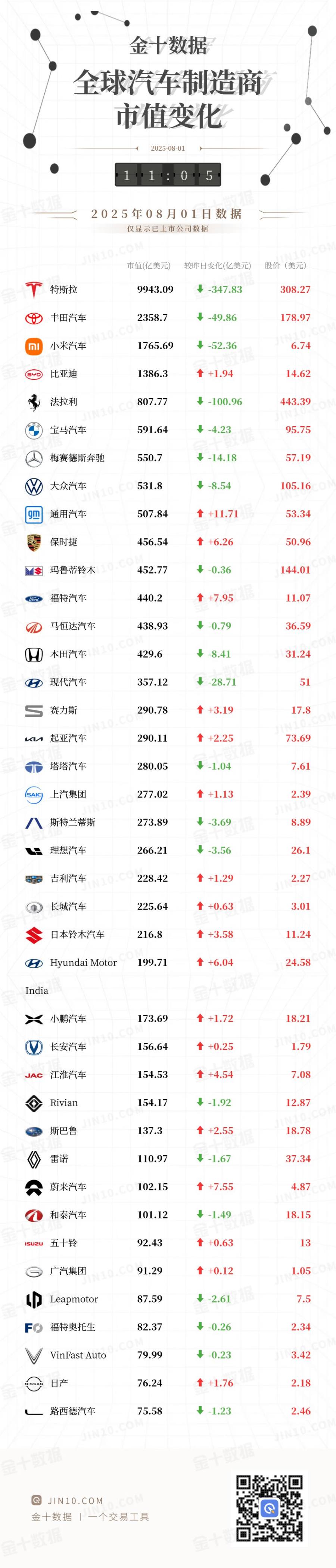
Core Insights - The global automotive manufacturers' market capitalization has shown significant fluctuations as of August 1, 2025, with various companies experiencing both gains and losses in their valuations [1]. Group 1: Market Capitalization Changes - BYD leads with a market capitalization of 1386.3 billion, reflecting an increase of 1.94% [3]. - Ferrari's market capitalization stands at 807.77 billion, with a notable decrease of 100.96 billion [3]. - BMW's market capitalization is 591.64 billion, down by 4.23 billion [3]. - Mercedes-Benz has a market capitalization of 550.7 billion, decreasing by 14.18 billion [3]. - Volkswagen's market capitalization is 531.8 billion, down by 8.54 billion [4]. - General Motors shows a market capitalization of 507.84 billion, with an increase of 11.71 billion [4]. - Ford's market capitalization is 440.2 billion, reflecting an increase of 7.95 billion [4]. Group 2: Notable Performers - Tesla's market capitalization is not explicitly mentioned, but it is implied to be significant within the context of the automotive industry [1]. - Rivian's market capitalization is 154.17 billion, with a decrease of 1.92 billion [5]. - NIO's market capitalization is 102.15 billion, reflecting an increase of 7.55 billion [5]. - Xpeng's market capitalization is 173.69 billion, with an increase of 1.72 billion [5]. - Tata Motors has a market capitalization of 280.05 billion, down by 1.04 billion [4].





Lear(LEA) - 2025 Q2 - Earnings Call Presentation
2025-07-25 13:00
Financial Performance - Q2 2025 - Sales remained flat at $6 billion compared to Q2 2024[9] - Core operating earnings decreased to $292 million from $302 million in Q2 2024[9] - Adjusted earnings per share decreased to $3.47 from $3.60 in Q2 2024[9] - Operating cash flow increased to $296 million from $291 million in Q2 2024[9] Full Year 2025 Outlook - Revenue is expected to be between $22470 million and $23070 million[12] - Core operating earnings are projected to be between $955 million and $1095 million[12] Segment Performance - Q2 2025 - Seating sales increased slightly to $4474 million from $4447 million in Q2 2024[30] - E-Systems sales decreased to $1557 million from $1565 million in Q2 2024[35] Tariff Impact - Approximately $63 million in tariff recovery was achieved in H1 2025[46] - Gross tariff exposure is approximately $210 million[46]
Lear Reports Second Quarter 2025 Results
Prnewswire· 2025-07-25 10:30
Core Insights - Lear Corporation reported strong operating performance in Q2 2025, with solid margins across both business segments, driven by investments in automation and restructuring [3][4][5] - The company restored its full-year financial guidance, expecting revenue between $22.47 billion and $23.07 billion, and core operating earnings between $955 million and $1.095 billion [11][14] Financial Performance - Q2 2025 sales were $6.03 billion, slightly up from $6.01 billion in Q2 2024, while net income decreased to $165.2 million from $173.1 million year-over-year [4][5][26] - Adjusted net income for Q2 2025 was $187.8 million, down from $205.8 million in Q2 2024, with adjusted earnings per share at $3.47 compared to $3.60 [5][29] - Core operating earnings were $291.8 million, or 4.8% of sales, compared to $302 million, or 5.0% of sales in the previous year [6][29] Segment Performance - In the Seating segment, margins were 6.4% of sales, while adjusted margins were 6.7% [7][33] - The E-Systems segment reported margins of 3.5% and adjusted margins of 4.9% [7][33] Cash Flow and Liquidity - Net cash provided by operating activities was $296 million, with free cash flow at $171 million, compared to $291 million and $170 million, respectively, in Q2 2024 [5][7] - At the end of Q2 2025, cash and cash equivalents totaled $888 million, with total liquidity of $2.9 billion [5][7] Shareholder Returns - The company repurchased $25 million worth of shares during Q2 2025 and paid $41 million in dividends [5][9] - Since the initiation of the share repurchase program in 2011, Lear has repurchased 59.6 million shares for a total of $5.6 billion [10] Market Outlook - Global vehicle production increased by 3% year-over-year, with North America down 3%, Europe down 2%, and China up 9% [4][5] - Lear's financial outlook assumes a 2% decrease in global industry production compared to 2024 on a sales-weighted basis [11][14]

金十图示:2025年07月24日(周四)全球汽车制造商市值变化
news flash· 2025-07-24 03:10
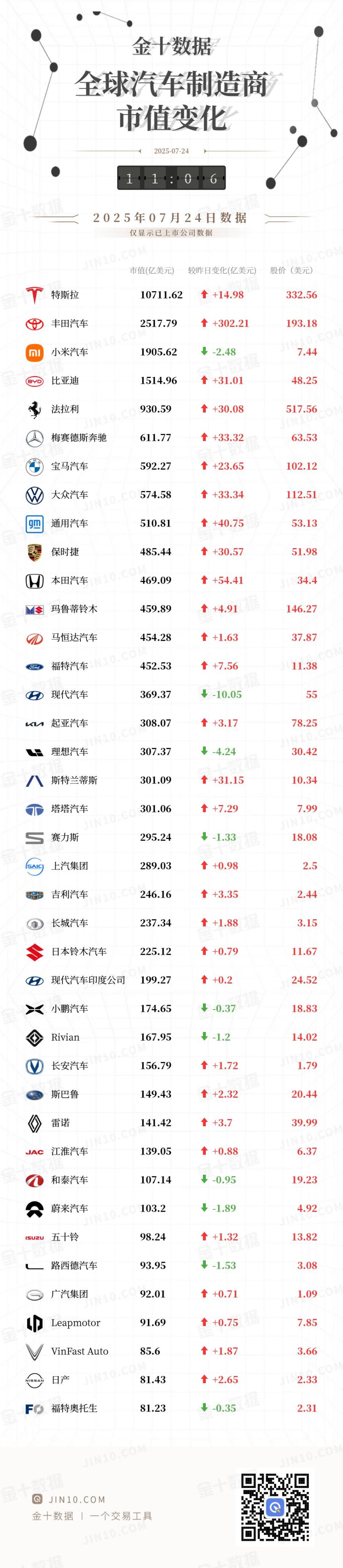
Core Insights - The article presents the market capitalization changes of global automotive manufacturers as of July 24, 2025, highlighting significant fluctuations in their valuations [1]. Market Capitalization Summary - Volkswagen has a market capitalization of $574.58 billion, with an increase of $33.34 billion [3]. - General Motors (GM) stands at $510.81 billion, up by $40.75 billion [3]. - Porsche's market value is $485.44 billion, reflecting an increase of $30.57 billion [3]. - Honda's market capitalization is $469.09 billion, with a notable rise of $54.41 billion [3]. - Maruti Suzuki's valuation is $459.89 billion, increasing by $4.91 billion [3]. - Mahindra & Mahindra's market cap is $454.28 billion, up by $1.63 billion [3]. - Ford's market capitalization is $452.53 billion, with an increase of $7.56 billion [3]. - Hyundai's market value is $369.37 billion, showing a decrease of $10.05 billion [3]. - Li Auto's valuation is $307.37 billion, down by $4.24 billion [3]. - Stellantis has a market capitalization of $301.09 billion, increasing by $31.15 billion [3]. - Tata Motors' market cap is $301.06 billion, up by $7.29 billion [3]. - SAIC Motor's valuation is $289.03 billion, with a slight increase of $0.98 billion [3]. - Geely's market capitalization is $246.16 billion, up by $3.35 billion [3]. - Great Wall Motors stands at $237.34 billion, increasing by $1.88 billion [3]. - Suzuki's market value is $225.12 billion, with a rise of $0.79 billion [3]. - Xpeng Motors has a market capitalization of $174.65 billion [4]. - Rivian's valuation is $167.95 billion, down by $1.20 billion [4]. - Changan Automobile's market cap is $156.79 billion, increasing by $1.72 billion [4]. - Subaru's market value is $149.43 billion, up by $2.32 billion [4]. - Renault's market capitalization is $141.42 billion, with an increase of $3.70 billion [4]. - JAC Motors stands at $139.05 billion, up by $0.88 billion [4]. - NIO's market cap is $103.20 billion, down by $1.89 billion [4].



金十图示:2025年07月23日(周三)全球汽车制造商市值变化
news flash· 2025-07-23 03:07
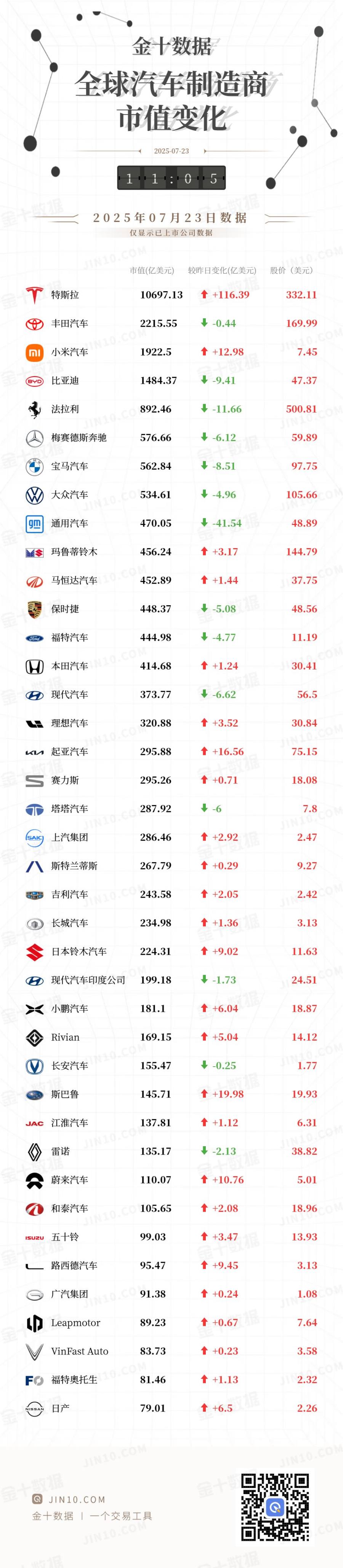
Core Insights - The article presents the market capitalization changes of global automotive manufacturers as of July 23, 2025, highlighting significant fluctuations in values among various companies [1]. Group 1: Market Capitalization Changes - Volkswagen's market capitalization is reported at $534.61 billion, experiencing a decrease of $4.96 billion [3]. - General Motors shows a market cap of $470.05 billion, with a notable increase of $41.54 billion [3]. - Maruti Suzuki's market value stands at $456.24 billion, reflecting an increase of $3.17 billion [3]. - Mahindra & Mahindra has a market cap of $452.89 billion, with a slight increase of $1.44 billion [3]. - Porsche's market capitalization is $448.37 billion, down by $5.08 billion [3]. - Ford's market value is $444.98 billion, decreasing by $4.77 billion [3]. - Honda's market cap is $414.68 billion, with an increase of $1.24 billion [3]. - Hyundai's market capitalization is $373.77 billion, down by $6.62 billion [3]. - Li Auto's market value is $320.88 billion, reflecting an increase of $3.52 billion [3]. - Kia's market cap is $295.88 billion, with a significant increase of $16.56 billion [3]. - SAIC Motor's market capitalization is $286.46 billion, up by $2.92 billion [3]. - Geely's market value stands at $243.58 billion, with an increase of $2.05 billion [3]. - Great Wall Motors has a market cap of $234.98 billion, reflecting an increase of $1.36 billion [3]. Group 2: Emerging Players - Xpeng Motors has a market capitalization of $181.1 billion [4]. - Rivian's market value is reported at $169.15 billion, with an increase of $5.04 billion [4]. - NIO's market cap stands at $110.07 billion, reflecting an increase of $10.76 billion [4]. - Leapmotor's market value is $89.23 billion, with a slight increase of $0.67 billion [4]. - VinFast Auto has a market capitalization of $83.73 billion, showing a minor increase of $0.23 billion [4].

野村:中国汽车市场再迎两位数同比增长,展望中期电动汽车市场存部分担忧
野村· 2025-07-15 01:58
Investment Rating - The report assigns a "Buy" rating to BYD (1211 HK), Desay SV (002920 CH), and Contemporary Amperex Technology (300750 CH) [54][60][65]. Core Insights - The China auto market has shown another double-digit year-on-year growth, with wholesale unit deliveries reaching 2.5 million units in June, marking a 14.5% increase year-on-year and a 7.8% increase month-on-month [1][7]. - The electric vehicle (EV) market is experiencing suboptimal growth, with EV penetration at 52.7% in June, which is below expectations and historical highs [1][7]. - Concerns are raised regarding the slowing growth of EV penetration, potentially due to aggressive pricing strategies from internal combustion engine (ICE) car manufacturers and the upcoming 50% cut to EV purchase tax exemptions starting next year [2][7]. Summary by Sections China Auto Market Performance - In 1H25, the China auto market reported a total of 13.5 million wholesale shipments, reflecting a 12.9% year-on-year growth, while retail sales (excluding minivans) reached 10.9 million units, up 10.8% year-on-year [8]. - The overall growth momentum in 1H25 was slightly above expectations, supported by government subsidies for scrapping and trade-in programs [8]. Electric Vehicle Market - Monthly retail sales of PV EVs reached 1.1 million units in June, representing a 30.2% year-on-year increase [1][9]. - The report highlights that BEVs outperformed PHEVs/EREVs in terms of growth, with BEVs showing 45% year-on-year growth in wholesale shipments during 1H25 [9]. OEM Strategies and Market Dynamics - OEMs are currently preparing their strategies for 2H25, with expectations of model launches and adjustments in response to government policies against over-competition [3]. - BYD remains a top pick due to its strategies aimed at regaining market share, including reducing SKUs and improving model features without price increases [4]. Battery Market Insights - EV battery installations grew by 35.9% year-on-year to 58.2 GWh in June, with total installations for 1H25 reaching 300 GWh, a 47.3% increase year-on-year [5]. - CATL and BYD maintained their market leadership in the battery sector, holding 43.7% and 21.5% market shares, respectively [5]. Lithium Market Trends - The price of lithium carbonate in China rebounded from a low of CNY 60,000 per tonne in late June to CNY 63,000 per tonne in early July [5][48]. - The report anticipates potential downside risks to lithium production in July due to weakened demand and government interventions [5][48].

高盛:中国汽车_2025 年下半年展望管理层电话会议_预计补贴持续,竞争加剧
Goldman Sachs· 2025-07-14 00:36
Investment Ratings - BYD: Buy [7][18] - XPeng: Buy [8][20] - Nio: Neutral [10][21] - Hesai: Buy [15][22] - Zhongsheng: Neutral [17][23] Core Insights - Demand & Stimulus: Management across the industry believes that government support will continue, and effective per vehicle purchase costs will not rise for consumers. Alternative forms of stimulus may emerge if trade-in programs diminish [1][14] - Industry Competition: Competition is expected to persist over the next 2-3 years, shifting focus from pricing to value. OEMs will launch new models with higher configurations at attractive prices, with market dynamics playing a larger role in pricing than government regulations [2][10] - Overseas Operations: OEMs with international exposure have reported strong overseas sales, with localized production capacities being developed to mitigate geopolitical trade tensions [3][7] - Autopilot Development: Autopilot technology is gaining traction, with improvements in functions and hardware. LiDAR adoption is increasing, and some OEMs are equipping multiple LiDARs per vehicle as they progress towards Level 3 capabilities [4][11] Summary by Company BYD - Sales Volume: BYD achieved total sales of 2.1 million units in 1H25, a 33% year-over-year increase. Inventory months decreased from 3 months in April to 2.2 months in June [8] - Overseas Expansion: BYD's overseas sales reached 464,000 units in 1H25, a 128% year-over-year increase, with multiple factories set to begin mass production [8] - Autopilot Features: The "God's Eye" autopilot system was launched, with plans for city memory autopilot capabilities by year-end [8] XPeng - Profitability Goals: XPeng aims for non-GAAP net profit break-even in 4Q25, with expectations of improved vehicle gross margins [11] - New Product Launches: XPeng plans to launch several new models, including a large EREV SUV in 4Q25, and has recently launched the G7 featuring advanced AI technology [8][11] - Sales Performance: XPeng's management is optimistic about maintaining competitive pricing while focusing on value [11] Nio - Sales Growth: Nio reported a total sales volume of 72,000 units in 2Q25, a 26% year-over-year increase, driven by new model launches [10] - Gross Margin Targets: Nio aims for a blended vehicle gross margin of over 15% by the end of 2025 [12] - Operational Efficiency: Nio is implementing operational expense reductions to improve R&D efficiency and overall profitability [10][12] Leapmotor - Sales Volume: Leapmotor achieved 222,000 units in sales volume in 1H25, a 156% year-over-year increase, with ambitious targets for future launches [14] - New Model Pipeline: The company plans to launch multiple new models in 2H25 and 2026, targeting a total delivery of 1 million units by 2026 [14] Hesai - Revenue Guidance: Hesai expects 2025 revenue between RMB 3-3.5 billion, with a gross margin around 40% [16] - Market Recognition: The company is gaining recognition from both domestic and global OEMs, with increased LiDAR adoption in the industry [16] - Production Capacity: Hesai targets an annual production capacity of 2 million units by the end of 2025 [16] Zhongsheng - Sales Performance: Zhongsheng maintains an annual sales volume target of 480,000-500,000 units, with a focus on AITO brand operations [19] - After-sales Services: The company anticipates growth in revenue from after-sales services, driven by adjustments in store operations [19]