
Pfizer

Search documents
X @Nick Szabo
Nick Szabo· 2026-02-07 08:44
RT Rich Baris THE PEOPLE'S PUNDIT (@Peoples_Pundit)Bottom Line: Popular or not, truth is that Pam Bondi is dirty, and she is friends with Trump's chief of staff who worked for the same corporate clients, including Pfizer.They have redacted the predators and exposed victims in these documents.I answer to the Lord.It's gross. ...
Morgan Stanley Maintains "Underweight" Rating for Bristol-Myers Squibb (NYSE: BMY)
Financial Modeling Prep· 2026-02-06 21:12
Core Viewpoint - Morgan Stanley maintains an "Underweight" rating for Bristol-Myers Squibb, advising investors to hold the stock, which is priced around $61.46 [1][6] Company Strategy - Bristol-Myers Squibb's "focused execution" strategy in 2025 has positively influenced its outlook for 2026, emphasizing newer brands and late-stage pipeline catalysts while managing costs to counteract loss-of-exclusivity challenges [2] Financial Performance - In Q4 2025, Bristol-Myers Squibb reported a strong performance with a growth portfolio increase of 15% year-over-year, which nearly offset a $4 billion revenue decline from its legacy portfolio [3][6] - The total revenue for Q4 remained stable at approximately $12.5 billion, with a stock price increase of 3.44% to $61.57 [4][6] Market Data - The stock has fluctuated between $59.77 and $61.86, with a market capitalization of about $125.34 billion, and has seen a 52-week high of $63.33 and a low of $42.52 [4][5] - Trading volume stands at 5.4 million shares, indicating active market participation despite the "Underweight" rating [5]


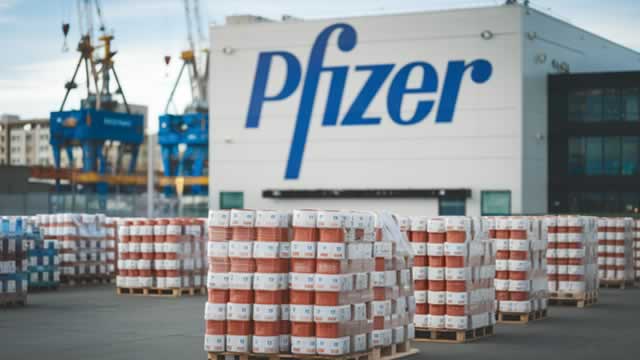
Healthy Returns: Pfizer execs chart out obesity strategy after encouraging drug data
CNBC· 2026-02-06 19:55
Core Viewpoint - Pfizer is re-entering the obesity treatment market with a focus on its acquisition of Metsera and the development of the injection PF′3944, which shows promising results in weight loss trials [2][3]. Group 1: Drug Development and Trials - Pfizer's PF′3944 injection demonstrated significant weight loss of up to 12.3% compared to placebo at week 28 in a phase two trial, with no plateau observed, indicating potential for continued weight loss [4]. - The company plans to initiate 10 phase three studies for PF′3944, aiming for potential approvals starting in 2028 [5]. - Pfizer's modeling predicts that a higher dose in phase three trials could lead to a weight loss of 16% at week 28 [6]. Group 2: Competitive Positioning - The monthly dosing of PF′3944 offers a competitive advantage over existing weekly injections from competitors like Eli Lilly and Novo Nordisk, potentially appealing to patients seeking more convenient treatment options [3][7]. - Pfizer aims to position PF′3944 as a "best-in-class" product in terms of efficacy and tolerability, with a focus on providing patients with more flexible dosing options [6][9]. Group 3: Combination Therapies - Pfizer is exploring a combination therapy that includes an amylin-targeting drug, which is expected to enhance weight loss beyond what is achieved with GLP-1 alone [10]. - Early data indicates that the combination of PF′3944 and the amylin drug resulted in an additive weight loss of 5% compared to placebo at day 8, with amylin alone showing an 8.4% weight loss at day 36 [11]. Group 4: Future Innovations - Pfizer is also developing a quarterly GLP-1 injection, which would be administered once every three months, aiming for ultra-long-acting properties [13]. - The company believes that the majority of patients will prefer injection options, with quarterly dosing potentially being more favorable than monthly [14].


Pfizer Bets Big on Obesity and Oncology With 2026 Pipeline Push
ZACKS· 2026-02-06 17:11
Core Insights - Pfizer is focusing on rebuilding its pipeline through acquisitions, investing approximately $9 billion in M&A deals in 2025, including the acquisition of Metsera and a licensing deal with 3SBio to enhance its obesity and oncology pipeline [1][4]. Obesity Pipeline - The acquisition of Metsera has re-entered Pfizer into the obesity market, adding four novel clinical-stage GLP-1 and amylin programs, which have the potential to generate billions in peak sales if successful [4]. - Pfizer plans to initiate or advance over 20 pivotal studies in 2026, including 10 pivotal studies for PF-08653944, a dual PD-1/VEGF inhibitor, and other obesity candidates [2][8]. - The VESPER-3 study showed that PF-08653944 delivered significant weight loss without plateauing at week 28, maintaining competitive tolerability when switching to a monthly dose [5][6]. - Pfizer's obesity portfolio is strengthened by the in-licensing of YP05002 from YaoPharma, alongside other candidates, creating a diverse pipeline [7]. Oncology Pipeline - Pfizer is advancing its oncology pipeline with several candidates in late-stage development, including atirmociclib for metastatic breast cancer and sigvotatug vedotin for non-small cell lung cancer [9]. - The company is also working on expanding the labels of existing cancer products and expects key data readouts for various oncology candidates in 2026 [12]. - PF-08634404, a dual PD-1/VEGF inhibitor, is currently in two large global phase III studies for metastatic colorectal cancer, aiming to overcome limitations of existing therapies [11]. Market Position and Valuation - The obesity market presents a significant opportunity exceeding $100 billion, but Pfizer faces strong competition from established players like Novo Nordisk and Eli Lilly [13]. - Pfizer's stock has increased by 2.9% over the past year, compared to a 17.2% increase in the industry, and is trading at a forward P/E ratio of 8.98, below the industry average of 18.85 [17][18]. - The Zacks Consensus Estimate for 2026 earnings has slightly declined from $2.97 to $2.96 per share, indicating a stable outlook for 2027 at $2.83 per share [20].
Roivant Sciences(ROIV) - 2026 Q3 - Earnings Call Transcript
2026-02-06 14:02
Financial Data and Key Metrics Changes - The company reported a non-GAAP net loss of $167 million for the quarter, with R&D expenses at $165 million and G&A expenses at $175 million [30] - The company maintains a strong cash position with $4.5 billion in consolidated cash, providing ample capital to reach profitability [30] Business Line Data and Key Metrics Changes - The NDA for brepocitinib in dermatomyositis has been submitted, and the phase 2b study for 1402 in D2T-RA has fully enrolled [6][7] - The phase 2 study for mosliciguat in PH-ILD has also fully enrolled, with top-line data expected in the second half of the year [7][8] Market Data and Key Metrics Changes - The company is targeting a large addressable patient population for brepocitinib, particularly in orphan inflammatory diseases with high unmet needs [25][36] - The potential market for cutaneous sarcoidosis is estimated to be slightly smaller than dermatomyositis, with around 40,000 eligible patients [79] Company Strategy and Development Direction - The company is focused on expanding the development of brepocitinib into additional indications, emphasizing its potential as a first-in-class therapy for sarcoidosis [35][36] - The company plans to leverage insights from the phase 2 study to inform the design of the phase 3 trial, aiming for a similar size and endpoint duration [79] Management's Comments on Operating Environment and Future Outlook - Management expressed enthusiasm about the strong phase 2 data for brepocitinib, highlighting its potential to address significant patient needs [25][36] - The company anticipates a busy year ahead with multiple pivotal study readouts and potential commercial launches [30][31] Other Important Information - The jury trial against Moderna is scheduled for March 9, with recent favorable decisions regarding summary judgment [29] - The company is exploring further development opportunities for brepocitinib, including other forms of sarcoidosis and related conditions [35][36] Q&A Session Summary Question: What are the further development opportunities for brepocitinib? - Management is enthusiastic about expanding brepocitinib's development, particularly in large orphan markets with high unmet needs [35][36] Question: Can you provide more details on the baseline characteristics of the CSAMI numbers? - There were significant differences in baseline characteristics, including disease duration and morphology, which may have influenced the results [42][43] Question: What is the pricing strategy for brepocitinib? - Pricing has not been finalized, but it is expected to be positioned within the orphan drug pricing envelope [48][50] Question: What are the expectations for the phase 3 trial design? - The phase 3 trial is expected to be similar in size to the phase 2 trial, with final details to be discussed with the FDA [58][79] Question: What percentage of patients in the Beacon study had organ involvement? - Approximately 60% of patients had pulmonary involvement, and exploratory endpoints related to organ involvement were collected but not analyzed yet [83][84]

Immunovant(IMVT) - 2026 Q3 - Earnings Call Transcript
2026-02-06 14:00
Financial Data and Key Metrics Changes - The company reported a non-GAAP net loss of $167 million for the quarter, with R&D expenses at $165 million and G&A expenses at $175 million [28][29] - The company maintains a strong cash position with $4.5 billion in consolidated cash, providing ample capital to reach profitability and pursue additional opportunities [28][29] Business Line Data and Key Metrics Changes - The NDA for BREPA in dermatomyositis has been submitted, and the phase 2B study for IMVT-1402 in dermatomyositis has fully enrolled [5][25] - The phase 2 study for Moseley and PHLD has also fully enrolled, indicating strong progress across multiple programs [5][25] Market Data and Key Metrics Changes - The company highlighted a significant unmet need in the sarcoidosis market, with no approved therapies currently available for cutaneous sarcoidosis [10][11] - The potential market opportunity for BREPA in cutaneous sarcoidosis is estimated at around 40,000 eligible patients, although it may be slightly smaller than the dermatomyositis opportunity [76] Company Strategy and Development Direction - The company is focused on expanding the development of BREPA into additional indications, emphasizing the strong efficacy demonstrated in current studies [34][94] - The strategic direction includes pursuing first-in-class therapies for orphan inflammatory diseases, addressing high unmet needs in the market [24][25] Management's Comments on Operating Environment and Future Outlook - Management expressed enthusiasm about the strong phase 2 data for BREPA, indicating a robust pipeline and a busy year ahead with multiple pivotal readouts expected [6][24] - The company is optimistic about the upcoming jury trial against Moderna, with favorable developments in the case [27][28] Other Important Information - The company is preparing for multiple commercial launches in the coming years, with BREPA and dermatomyositis being the first expected [30] - The company has a strong focus on patient-centric outcomes, with 100% of patients in the BREPA 45 mg arm reporting improvement in their symptoms [19][20] Q&A Session Summary Question: What are the further development opportunities for brepocitinib? - Management expressed enthusiasm for further development, highlighting the strong efficacy data and the potential for brepocitinib to address high unmet needs in various patient populations [34][35] Question: Can you provide more details on the baseline characteristics of the CSAMI numbers? - Management noted that there were significant differences in baseline characteristics, including disease duration and morphology, which may have influenced the results [42][43] Question: What is the expected pricing strategy for BREPA? - Management indicated that pricing has not yet been finalized but will likely be positioned as an orphan-priced drug, considering the existing market prices for similar therapies [48][49] Question: How broad is the opportunity for brepocitinib? - Management stated that there are many indications with high unmet needs where TYK2 and JAK1 inhibition could be beneficial, indicating a broad exploration of potential opportunities [94][95] Question: What percentage of patients in the Beacon study had organ involvement? - Approximately 60% of patients had pulmonary involvement, and exploratory endpoints related to organ involvement were collected but not yet analyzed [82][83]

FDA Grants Priority Review for HYMPAVZI® (marstacimab) sBLA for the Treatment of Two Hemophilia A or B Patient Populations with Significant Medical Need
Businesswire· 2026-02-06 11:45
Core Viewpoint - Pfizer Inc. has received Priority Review from the U.S. FDA for its supplemental Biologics License Application for HYMPAVZI® (marstacimab), aiming to expand its indication for treating hemophilia A or B patients aged 6 years and older with inhibitors, as well as pediatric patients aged 6 to 11 with hemophilia A or B without inhibitors [1] Group 1 - The FDA has accepted Pfizer's supplemental Biologics License Application for HYMPAVZI® [1] - The application seeks to expand the treatment indication to include hemophilia A or B patients aged 6 years and older with inhibitors [1] - The application also targets pediatric patients aged 6 to 11 with hemophilia A or B without inhibitors [1]

Pfizer Launches Cost Savings Program on TrumpRx Lowering Drug Costs for Millions of Americans
Businesswire· 2026-02-06 00:09
NEW YORK--(BUSINESS WIRE)--Pfizer Inc. (NYSE: PFE) today announced the launch of its program on TrumpRx, making innovative medicines more affordable and accessible to millions of Americans. Starting today, the program provides Americans a wide range of more than 30 medicines at a significant discount off list prices. This effort is part of Pfizer's broader landmark Most Favored Nation (MFN) agreement with the U.S. government enabling patients to pay lower prices for their prescription medicines. ...

Can Pfizer Crash the Lilly and Novo Nordisk Weight-Loss Party?
The Motley Fool· 2026-02-05 08:45
Core Insights - Eli Lilly and Novo Nordisk currently dominate the obesity drug market, with Eli Lilly's Zepbound generating $13.5 billion in sales in 2025 and Mounjaro bringing in nearly $23 billion, while Novo Nordisk's obesity franchise earned approximately $13 billion [1] - Pfizer, despite not generating revenue in the obesity drug market last year, is positioning itself to compete with Lilly and Novo Nordisk through strategic acquisitions and innovative product development [2][4] Pfizer's Strategy - Pfizer's acquisition of Metsera for $7 billion, potentially rising to $10 billion, aims to re-enter the GLP-1 market after previous setbacks with danuglipron [4] - The company is optimistic about its PF'3944 drug, with encouraging Phase 2b clinical study results, and plans to initiate a Phase 3 study later this year [5] - Pfizer's Chief U.S. Commercial Officer highlighted that PF'3944's efficacy, combined with a monthly injection regimen, could appeal to patients and healthcare providers, differentiating it from competitors' weekly injections [6] Market Potential - Pfizer plans to conduct over 20 clinical trials for obesity drugs in 2026, including 10 late-stage studies for PF'3944, indicating a strong commitment to capturing market share [7] - The collaboration with YaoPharma for the oral GLP-1 agonist YP05002 demonstrates Pfizer's intention to compete in both injectable and oral therapy markets [8] - The obesity drug market is projected to reach $150 billion, presenting significant growth opportunities for Pfizer as it develops its pipeline [9] Investment Outlook - Pfizer is considered an attractive high-yield dividend stock with a forward dividend yield of 6.4%, providing investors with returns while waiting for product approvals [10] - The competitive landscape may shift as Pfizer prepares to enter the market, suggesting that Lilly and Novo Nordisk should capitalize on their current advantages while they last [10]

辉瑞:肥胖领域风险降低推动重估潜力-20260205
Zhao Yin Guo Ji· 2026-02-05 03:24
Investment Rating - The report maintains a "Buy" rating for Pfizer Inc. (PFE US) with a target price of $35.46, down from the previous target of $36.16, reflecting a potential upside of 32.4% from the current price of $26.78 [5][7]. Core Insights - Pfizer reported strong Q4 2025 results with revenues of $17.6 billion, aligning closely with the forecast of $18 billion. Adjusted net income was $3.8 billion, exceeding the estimate of $3.3 billion. Excluding COVID-19 products, operational revenue grew by 6% year-over-year, indicating a robust business foundation [3]. - The management reiterated revenue guidance for 2026 at $59.5 billion to $62.5 billion, with adjusted EPS projected between $2.80 and $3.00. Anticipated catalysts for 2026 include key data releases for long-acting GLP-1 and insulin projects, as well as positive clinical progress for obesity products and PF'4404 [3][5]. - The VESPER-3 study results for PF'3944 showed a 12.3% weight reduction at the medium dose, with expectations for the high dose to achieve a 15.8% reduction, positioning it competitively against alternatives [4]. - Pfizer is rapidly advancing the integration of PF'4404 (PD-1/VEGF) with its leading ADC product portfolio, aiming to establish a dominant position in the oncology market [5]. Financial Summary - For FY2026, revenue is projected at $60.7 billion, with a year-over-year decline of 2.9%. Adjusted net income is expected to be $16.34 billion, reflecting an 8.8% decrease from the previous year [6][16]. - The report outlines a decrease in P/E ratios, with FY2026 expected at 14.1x, down from 19.6x in FY2024, indicating a shift in valuation metrics [6][17]. - The DCF valuation estimates a share value of $35.46, based on a WACC of 9.95% and a terminal growth rate of 2.0% [13][14].