Infosys

Search documents
TCS shares crash 44% from peak to hit over 5-year low. More pain left for IT bellwether?
The Economic Times· 2026-02-13 07:04
Market Overview - Tata Consultancy Services (TCS) shares have plunged to a five-and-a-half-year low of Rs 2,585, marking a significant decline in the IT sector amid fears of AI-led disruption [9][10] - The market capitalization of TCS has dropped to Rs 9.60 lakh crore, a multi-year low, falling below the previous low of Rs 9.77 lakh crore [9][10] - The stock is down 44% from its all-time high of Rs 4,592, reached in August 2024 [9][10] - The Nifty IT index has experienced a crash of 19% in a short span, with Rs 5.7 lakh crore evaporating from the sector in just eight trading sessions [7][10] AI Disruption Concerns - There is growing concern that AI could fundamentally reshape the competitive landscape for software and IT services companies, potentially eroding profitability and market positioning [4][10] - Industries previously considered insulated from AI disruption, such as legal services, data analytics, and customer support, now appear vulnerable to automation [5][10] - The introduction of AI tools, like the Claude chatbot by Anthropic, which can automate various legal tasks, has intensified these concerns [3][10] Investment Insights - Global brokerage JPMorgan has identified "deep value" buying opportunities in major IT firms like Infosys and TCS, despite the current market turmoil [6][7][10] - JPMorgan emphasizes that IT services firms are essential "plumbers of the tech world," and their dividend yields have reached levels not seen since the global financial crisis and COVID-19 [6][10] - Analysts recommend a "barbell approach" to investing, focusing on large caps with overweight ratings on Infosys and TCS, alongside growth champions like Persistent Systems [8][10] - The current valuations in the sector are comparable to those during major market crises, suggesting limited further downside risk, while any recovery in growth could lead to significant upside [8][10]


TCS, Infy, HCL, Wipro, Coforge stocks crashes 5% as AI concerns lead IT sell-off
BusinessLine· 2026-02-13 04:46
Market Overview - Indian equity markets opened sharply lower, with the Sensex falling 790.71 points to 82,884.21 and Nifty declining 254.95 points to 25,552.25, influenced by a global tech sell-off due to concerns over AI disruption to traditional business models [1][5] IT Sector Performance - The Nifty IT index experienced a significant decline of 4.72 percent, dropping to 31,594.70, marking its sharpest single-day decline in ten months [2] - Major IT companies faced substantial losses, with Infosys down 6.11 percent to ₹1,301.30, TCS down 4.59 percent to ₹2,624.00, HCL Technologies down 4.38 percent to ₹1,411.50, and Wipro down 3.55 percent to ₹211.31 [2][6] - The sell-off in IT stocks was attributed to a sharp decline in US technology stocks, with the Nasdaq falling 2.03 percent as investors reassessed the impact of AI startups on established tech companies [2] Broader Market Trends - The broader market showed mixed signals, with select financial stocks like Bajaj Finance and SBI Life Insurance witnessing buying interest, while Hindalco faced significant selling pressure, declining 5.78 percent to ₹908.70 [7][8] - Foreign Institutional Investors continued to buy equities worth ₹108 crore, while Domestic Institutional Investors invested over ₹276 crore, providing some support to the markets [9] Investor Sentiment - Concerns over AI-led disruption and fading optimism regarding near-term global rate cuts are expected to weigh on market sentiment [5] - Experts advised caution, suggesting that panic selling in IT stocks may not be prudent and that investors should consider accumulating high-quality growth stocks, especially those with strong Q3 results [8]

Friday the 13th effect? D-St investors suffer Rs 4L cr shock as Sensex sinks over 800 points
The Economic Times· 2026-02-13 04:07
Market Overview - The BSE Sensex opened 800 points lower at 82,903, a decline of 1%, while the Nifty 50 fell 236 points to 25,571, down 0.9% [1][13] - The sell-off in IT stocks has deepened, with the Nifty IT index slumping more than 4%, extending its two-day fall to nearly 10% [1][13] IT Sector Impact - ADRs of Infosys and Wipro plunged nearly 10% overnight, contributing to the decline in IT stocks [1][13] - Heavyweights such as TCS, Infosys, Wipro, Tech Mahindra, HCLTech, and Mphasis saw declines of 4-6%, indicating broad-based weakness in the sector [1][13] AI Disruption Concerns - The bearish sentiment intensified after AI startup Anthropic introduced a new tool for corporate legal teams, raising concerns about the long-term demand for traditional IT services [4][5][13] Global Market Influence - Wall Street experienced a sharp decline, with the tech-heavy Nasdaq dropping about 2%, as investors expressed concerns over AI's impact on earnings visibility and sector margins [6][7][13] - Asian markets followed suit, with MSCI's index of Asia-Pacific shares outside Japan falling 0.6%, although it remained up 4.1% for the week [8][13] Currency and Economic Factors - A strengthening U.S. dollar, now at 96.93, and a weaker rupee, which opened at 90.67 per U.S. dollar, are negatively impacting equities and could lead to foreign fund outflows from emerging markets like India [9][13] Technical Analysis - The Nifty has broken out of its recent consolidation band, forming a short-term lower high-lower low sequence, with immediate support shifting to 25,700 [10][11][13] - Momentum indicators are signaling caution, with a potential decline towards 25,600 if a decisive breakdown below 25,700 occurs [11][14] Geopolitical Tensions - Rising tensions in the Middle East, particularly regarding Iran, are contributing to market uncertainty, as U.S. President Trump warned of possible actions if a nuclear agreement is not reached [12][14]

Infosys ADRs plunge over 7%, Wipro down 5% as tech turbulence deepens on Wall Street
The Economic Times· 2026-02-12 16:28
Market Overview - The broader US tech sector experienced significant pressure, with the Nasdaq Composite dropping over 300 points, or more than 1%, trading at 22,764.90 [1] - The S&P 500 decreased by 0.6% to 6,902.80, while the Dow Jones Industrial Average fell by 249.27 points, or 0.50%, to 49,872.10 [1] Company Performance - Cisco's stock plummeted by 11%, while major companies such as Apple, Nvidia, and IBM saw declines of up to 6% [2] - Indian IT stocks faced a steep sell-off, with Infosys' American Depositary Receipts (ADRs) dropping more than 7% to an intraday low of $14.59, and Wipro's ADRs falling by 5.4% to $2.26 [3] - The Nifty IT index in India settled 5.5% lower, with all 10 stocks in the index slipping into negative territory [3]

Ahead of Market: 10 things that will decide stock market action on Friday
The Economic Times· 2026-02-12 16:22
Market Overview - Indian benchmark indices experienced declines, with Nifty closing at 25,807.20, down 146.65 points or 0.57%, and BSE Sensex falling by 558.72 points or 0.66% to 83,674.92, primarily due to heavy selling in IT stocks [13] - The volatility gauge India VIX ended at 11.73, down 1.53% from the last closing [13] Analyst Insights - Ajit Mishra from Religare Broking noted that market sentiment weakened due to significant selling in IT stocks and mixed global developments, with strong U.S. jobs data reducing expectations for imminent Federal Reserve rate cuts [2][13] - Mishra suggested that the downside risk may be limited due to strength in other sectors, with Nifty expected to hold the 25,600–25,700 zone, while the 26,000 level remains a key resistance [2][13] Technical Analysis - Bajaj Broking indicated that the index formed a bearish candle, signaling profit booking at higher levels around 26,000, and stock-specific movements are likely to remain in focus as the quarterly earnings season concludes [9][10] - The index is projected to consolidate in the range of 25,500-26,000, with a move above 26,000 potentially opening up upside towards the 26,200–26,300 resistance area [10][14] Stock Activity - Among the most active stocks by turnover were State Bank of India (SBI, Rs 842 crore), Bajaj Finance (Rs 434 crore), and ICICI Bank (Rs 357 crore) [14] - In terms of volume, Vodafone Idea (4.17 crore shares), SpiceJet (1.24 crore shares), and SBI (70.64 lakh shares) were among the most actively traded stocks [14] - 140 stocks reached their 52-week highs, while 111 stocks hit their 52-week lows, indicating mixed market performance [14]

Sensex tumbles 558 points on sell-off in IT shares
Rediff· 2026-02-12 12:01
Market Overview - The benchmark BSE Sensex fell by 558.72 points, or 0.66 percent, closing at 83,674.92, with an intraday low of 83,516.67, down 716.97 points or 0.85 percent [3][6] - The NSE Nifty declined by 146.65 points, or 0.57 percent, ending at 25,807.20 [6] Sector Performance - Technology stocks were the major laggards, with Tech Mahindra, Infosys, and TCS each tumbling nearly 6 percent [6] - The Focussed IT sector slumped by 5.40 percent, while the broader IT sector fell by 5.29 percent [8] Investor Sentiment - Concerns over AI-led disruptions and low expectations of a US Federal Reserve rate cut due to strong US economic data negatively impacted investor sentiment [9][10] - Analysts noted that the IT index's decline was driven by fears of margin compression in service-intensive sectors due to AI advancements [9] Global Context - In global markets, AI is reshaping industries, leading to increased volatility and challenges to traditional outsourcing models [10] - Geopolitical tensions, particularly between the US and Iran, may further influence investor caution in the IT sector [10] Institutional Activity - Foreign institutional investors purchased equities worth Rs 943.81 crore, while domestic institutional investors sold stocks worth Rs 125.36 crore [11]
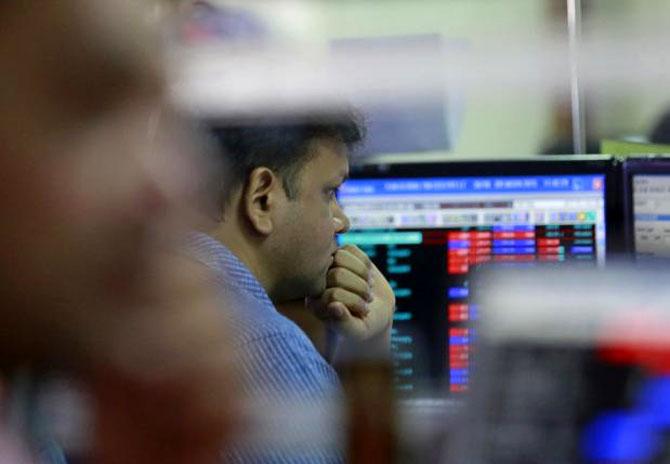
Stock market today: Which are top 10 gainers and losers on NSE & BSE on February 12? Check list
The Times Of India· 2026-02-12 11:13
Core Insights - The benchmark equity indices in India experienced a decline, primarily driven by a significant sell-off in technology stocks due to global uncertainties and concerns regarding AI-led disruptions in IT services [9][8] - The BSE Sensex fell by 558.72 points, or 0.66%, closing at 83,674.92, while the NSE Nifty dropped by 146.65 points, or 0.57%, ending at 25,807.20 [9] - Major technology companies such as Tech Mahindra, Infosys, and Tata Consultancy Services (TCS) saw declines of nearly 6% each, marking them as significant laggards on the Sensex [9][7] Company Performance - Tech Mahindra experienced a decline of 5.99%, Infosys fell by 5.84%, and TCS decreased by 5.49% [9][7] - Other companies that ended in the red include HCL Technologies (-4.87%), Wipro (-4.67%), Mahindra & Mahindra (-2.23%), and Hindustan Unilever (-2.17%) [9][7] - In contrast, Bajaj Finance was among the top gainers, increasing by 3.12%, followed by Shriram Finance (2.47%) and Eicher Motors (2.22%) [9][7] Sectoral Analysis - The Focussed IT sector saw the most significant decline, dropping by 5.40%, followed closely by the broader IT sector, which fell by 5.29% [9][8] - Broader market indices also reflected negative sentiment, with the BSE MidCap Select Index decreasing by 0.48% and the SmallCap Select Index slipping by 0.28% [9][8] Market Sentiment - Investor sentiment was dampened by concerns over AI's impact on service-intensive sectors, leading to a structural transformation in IT services that may challenge traditional outsourcing models [8][9] - Geopolitical tensions, particularly between the US and Iran, are contributing to a cautious approach among investors in the near term [8][9]
European Enterprises Adopt Robust Sustainability Practices
Businesswire· 2026-02-12 09:00
Core Insights - The focus of sustainability efforts by European enterprises is shifting from regulatory compliance to achieving measurable financial and operational outcomes [1] - European firms are aligning their strategies with the renewable energy transition to manage energy exposure, support decarbonization, and capture new growth opportunities [1] Group 1: Sustainability Practices - Enterprises are investing in integrated environmental, social, and governance (ESG) data architectures that connect sustainability information across various functions such as finance, procurement, HR, and operations [1] - Organizations are seeking solutions for supply chain and product-level transparency to gain deeper insights into carbon emissions and workforce practices [1] - Digital sustainability solutions are being adopted as the region's energy mix shifts toward renewables and emissions decline [1] Group 2: Market Trends and Provider Insights - The digital sustainability market in Europe is maturing, with providers focusing on clear, outcome-driven use cases [1] - Enterprises are looking for providers that can deliver concrete environmental, social, and economic outcomes through transparent, data-driven models [1] - The report evaluates 70 unique providers across three quadrants, naming leaders such as Accenture, Capgemini, and IBM in multiple categories [1] Group 3: Technology and Data Integration - By integrating sustainability data with real-time decision-support tools, organizations are gaining visibility into industrial processes, which supports cost control and reduces environmental impact [1] - Providers are facilitating this shift with data-driven blueprints and operating models that clarify roles and responsibilities across various functions [1] - The deployment of GenAI is noted for producing qualitative narratives for corporate sustainability reporting [1]


US visa fee hike to cost $100-250 million for IT companies: Moody's
The Economic Times· 2026-02-12 06:51
Core Insights - The increase in US visa fees is projected to raise operating expenses for Indian IT services firms by $100 million to $250 million, which is about 1% of their revenues [1][12] - Despite the higher costs, most large Indian IT firms can absorb these expenses without significant deterioration in their financial profiles due to their high profitability and robust financial positions [1][12] Financial Impact - The immediate margin impact on top-tier IT firms is expected to be modest, with the increase in operating expenses constituting around 1% of revenues and EBITA margin hit limited to around 100 basis points [5][12] - Indian IT majors have EBITA margins of 19%-26%, which exceed global peers' margins of 10%-17%, and many maintain substantial net cash positions, such as $7 billion at TCS and $4 billion at Infosys as of December 31, 2025 [6][12] Industry Dependency on H-1B Visas - The business model of the Indian IT industry relies heavily on H-1B visas, with the computer-related technology sector accounting for approximately 70% of such visas issued over the last five years [2][12] - Leading Indian IT companies like Tata Consultancy Services and Infosys are among the top H-1B sponsors, indicating their reliance on this visa category [2][12] Challenges for Smaller Firms - Small and mid-sized companies may struggle to absorb the increased visa costs due to lower margins and limited liquidity, potentially compromising profitability or delaying investments in growth areas like AI and cloud [7][12] - This situation could lead to accelerated industry consolidation, as scale and financial strength become critical differentiators [7][12] Talent Shortages and Demand - Structural talent shortages in the US are expected to sustain demand for Indian IT services, with an estimated annual shortfall of around 200,000 workers in the US computer and IT sector [8][12] - Indian nationals account for 70%-75% of all H-1B visa approvals since 2020, and India produces about 2.5 million STEM graduates annually compared to 850,000 in the US [9][12] Investments in Automation and AI - Indian IT firms are increasing investments in automation and artificial intelligence to mitigate visa-related risks and improve efficiency, with many embedding generative AI to automate routine tasks [10][12] - This shift towards AI comes with near-term costs, as capital spending on AI infrastructure and employee training is expected to grow, putting pressure on free cash flow over the next 1 to 2 years [11][12]

IT stocks drag markets lower as Nifty, Sensex open in red; banking stocks provide support
BusinessLine· 2026-02-12 04:53
Market Overview - Indian equity markets opened on a weak note, with benchmark indices trading lower due to heavy selling pressure in IT stocks. The Sensex opened at 83,968.43, down 293.40 points or 0.35%, while the Nifty 50 opened at 25,906.70, down 86.80 points or 0.33% [1] IT Sector Performance - Technology stocks led the decline, with significant drops: Infosys down 4.72% to ₹1,402.40, Tech Mahindra down 4.24% to ₹1,565.10, Wipro down 4.23% to ₹220.10, TCS down 3.96% to ₹2,794.60, and HCL Technologies down 3.62% to ₹1,495.50. This decline was attributed to concerns over AI-driven disruption in the technology sector [2] Financial Sector Support - Financial stocks provided some support, with Shriram Finance rising 1.33% to ₹1,070.90, ICICI Bank gaining 1.27% to ₹1,424.00, State Bank of India up 1.19% to ₹1,197.00, Bharat Electronics Limited climbing 1.09% to ₹442.30, and Eicher Motors gaining 0.98% to ₹7,847.00 [3] Market Sentiment and Institutional Activity - Despite the weakness in IT stocks, the underlying liquidity remains supportive, with foreign institutional investors continuing as net buyers. They purchased equities worth ₹943 crore on February 11, marking their fourth consecutive session of net buying. In contrast, domestic institutional investors sold equities worth more than ₹125 crore [4][5] Technical Analysis - Analysts expressed caution regarding near-term market direction, identifying crucial support zones at 25,900/84,200 and immediate resistance areas at 26,000/84,500. The Nifty continues to hold its uptrend above key moving averages, with immediate resistance seen near 26,000, potentially extending towards a fresh all-time high of 26,373 [6]