
Babbel

Search documents
Midoo.AI 发布:AI Agent 能否破解教育行业千亿美金的「无解方程」?
Founder Park· 2025-09-03 08:24
Core Insights - The article discusses the challenges and opportunities in the language learning sector, particularly focusing on the limitations of traditional AI language learning tools and the emergence of Midoo.AI as a potential solution [2][3][4]. Group 1: Industry Challenges - Traditional AI language learning tools have gained popularity among beginners but often fail to provide substantial skill improvement due to issues like content rigidity and lack of real-world application [2][4]. - The education industry faces a core dilemma regarding the delivery of "learning outcomes," which is subjective and difficult to standardize, leading to a fragmented market with diverse needs [4][5]. - The reliance on human resources for personalized education services has resulted in high costs and inefficiencies, creating a vicious cycle that hampers scalability [6][5]. Group 2: Market Potential - The global language learning market is projected to grow from approximately $61.5 billion in 2023 to over $200 billion by 2032, with a compound annual growth rate (CAGR) of 15-20% [9]. - There is a significant acceptance of subscription models among overseas users, which enhances the potential for new products in this space [9]. Group 3: Technological Advancements - The advent of large language models (LLMs) and agent technology presents a breakthrough opportunity for the education sector, particularly in language learning, which aligns well with market demands [8][10]. - AI's capabilities in communication and emotional intelligence are well-suited for language learning, allowing for a more effective and engaging learning experience [10]. Group 4: Midoo.AI's Approach - Midoo.AI aims to address the challenges in the education sector by offering a dynamic and personalized learning experience through its AI language learning agent [13][14]. - The platform utilizes a MultiAgent+Workflow system to create immersive learning environments, allowing users to interact in realistic scenarios, thus enhancing engagement and learning outcomes [17][19]. - Midoo.AI's team comprises experienced professionals from leading tech companies, positioning it well to innovate in the language learning space [19]. Group 5: Future Outlook - Midoo.AI's strategy focuses on expanding into the Japanese, Korean, and North American markets before reaching a global audience, aiming to redefine personalized education through AI [20]. - The company envisions a future where AI agents can provide personalized learning experiences at a fraction of the cost of traditional methods, potentially transforming the education landscape [21][22].


GPT会冲击多邻国吗?大摩:语言学习最大的挑战是“动机”,AI不是竞争者而是加速器!
美股IPO· 2025-08-08 05:14
Core Viewpoint - Investors are concerned that the rise of large models like GPT-5 will undermine Duolingo's competitive edge, but Morgan Stanley argues that this concern is misplaced, emphasizing that the main barrier to language learning is motivation rather than technology [1][3]. Group 1: Language Learning Challenges - The biggest challenge in language learning is maintaining motivation, which significantly impacts user retention [5]. - Duolingo's core advantage lies in its gamification, social features, and engaging character design, which differentiate it from competitors [6]. Group 2: Competitive Landscape - Despite being perceived as catering to "casual" learners, Duolingo's monthly usage time and session frequency are over three times that of its closest mobile competitor, Babbel [6]. - The DAU/MAU ratio for Duolingo has doubled since 2019, indicating strong user engagement [6]. Group 3: AI as an Accelerator - Morgan Stanley believes that advancements in AI will benefit Duolingo, as it has already integrated generative AI tools into its operations, enhancing learning outcomes, internal efficiency, and commercialization [7]. - Stronger AI models are expected to accelerate Duolingo's growth, improving key performance indicators and deepening its competitive moat [7]. Group 4: AI-Driven Achievements - Duolingo has doubled its available courses to over 275 and increased the total level count by more than four times in less than two years, showcasing significant content expansion through generative AI [9]. - The "Vibe Coding" model allows rapid product prototyping at low costs, exemplified by a chess course that attracted over 1 million DAU within a year, created by two non-programmers [9]. - The DuoRadio feature, utilizing AI-generated content, expanded its DAU from 100,000 to 5.5 million while reducing costs by 99%, enabling previously unscalable functionalities [9].


GPT会冲击多邻国吗?大摩:语言学习最大的挑战是“动机”,AI不是竞争者而是加速器!
Hua Er Jie Jian Wen· 2025-08-08 04:12
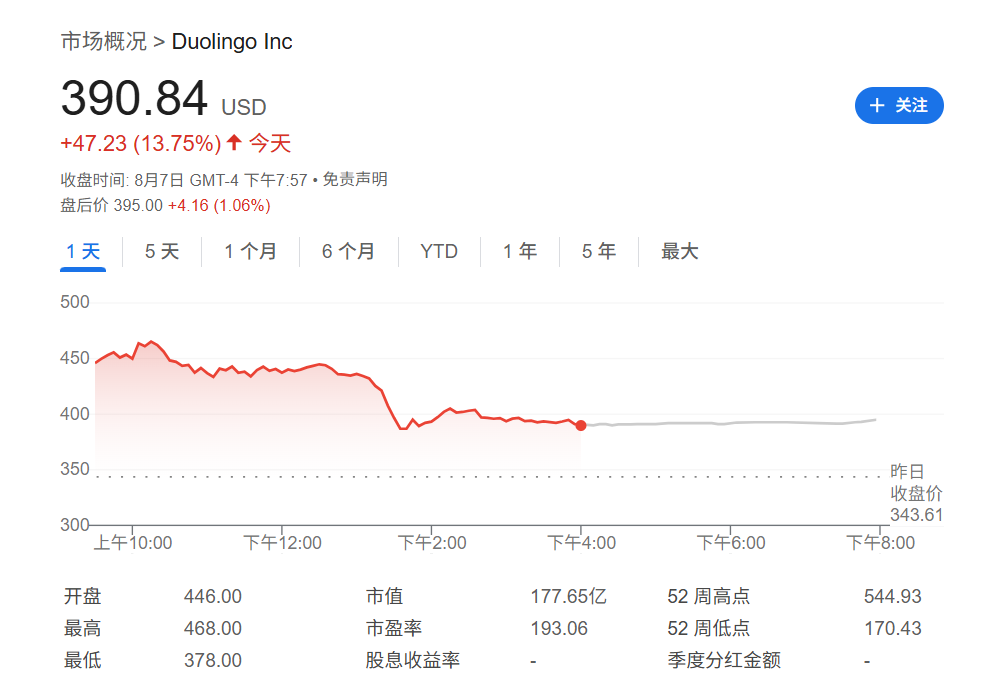
Core Viewpoint - The market's concerns regarding Duolingo's competitive position in light of OpenAI's GPT-5 are misplaced, as advancements in AI are seen as beneficial for Duolingo rather than detrimental [1][5]. Group 1: Market Concerns and Analyst Insights - Investors are worried that the rise of general artificial intelligence will undermine Duolingo's competitive edge [1]. - Morgan Stanley's report argues that the focus should be on Duolingo's core business strengths rather than the perceived threats from AI [1][5]. - Following the report, Duolingo's stock rose nearly 14% overnight, indicating a positive market reaction [1]. Group 2: Duolingo's Competitive Advantages - The primary challenge in language learning is maintaining "motivation," which is crucial for user retention [3]. - Duolingo's gamification approach and social features differentiate it from competitors, leading to significantly higher user engagement metrics compared to Babbel [3]. - Duolingo's daily active users to monthly active users ratio has doubled since 2019, showcasing strong user stickiness [3]. Group 3: AI as an Accelerator - Morgan Stanley posits that AI will serve as an "accelerator" for Duolingo, enhancing its growth rather than disrupting it [4]. - The report highlights that Duolingo has effectively integrated generative AI tools into its operations, improving learning outcomes, internal efficiency, and commercialization [4]. - Analysts expect that advancements in AI will enhance Duolingo's key performance indicators and strengthen its competitive moat [4]. Group 4: Achievements from AI Integration - Duolingo has doubled its available courses to over 275 in less than two years, significantly expanding content breadth and depth through generative AI [6]. - The "Vibe Coding" model allows rapid product prototyping at low costs, exemplified by a chess course that attracted over 1 million daily active users within a year [6]. - The DuoRadio feature, utilizing AI-generated content, increased daily active users from 100,000 to 5.5 million while reducing costs by 99%, enabling previously unscalable functionalities [6].
X @Bloomberg
Bloomberg· 2025-06-27 07:36
Babbel’s new CEO says he’s focused on expanding the company’s language-learning product to include emerging AI tools, and he doesn’t intend to revive its IPO https://t.co/KxaqUUuf5k ...