Evonik Industries

Search documents
Glycerin Market Projected at USD 6.46 Billion by 2033, Fueled by Expanding Pharmaceutical and Personal Care Demand | SNS Insider
Globenewswire· 2026-02-19 04:00
Market Overview - The Glycerin Market is valued at USD 4.00 Billion in 2025E and projected to reach USD 6.46 Billion by 2033, growing at a CAGR of 6.24% from 2026 to 2033 [1] - The U.S. glycerin market is valued at USD 0.77 Billion in 2025E and expected to reach USD 1.29 Billion by 2033, with a CAGR of 6.60% during the forecast period [3] Demand Drivers - Rising demand for natural and bio-based glycerin across multiple industries, including food, cosmetics, personal care, and medicinal applications [4] - Consumer preference for sustainable, plant-based, and eco-friendly products is driving the increase in vegetable and by-product glycerin usage [4] Market Segmentation By Source - Vegetable glycerin holds a 55.24% market share in 2025, driven by its strong penetration in food, pharmaceutical, and personal care industries [5] - Synthetic glycerin is growing at the fastest pace due to increasing industrial applications [5] By Application - Pharmaceuticals and Personal Care dominate with a 45.39% market share in 2025, attributed to wide applications in skincare, cosmetics, and medicinal preparations [7] - Industrial applications are rapidly expanding in biofuels, resins, and lubricants [7] By Purity - USP Grade leads with a 51.28% market share in 2025, driven by demand from pharmaceutical, personal care, and food industries [8] - Industrial grade glycerin is expected to witness the highest growth due to rising application scope in chemical, biofuel, and industrial manufacturing [8] By Form - Liquid form held a 60.75% market share in 2025, due to various applications in food, personal care, and pharmaceuticals [9] - Powder form of glycerin is the fastest growing due to ease of handling and formulation stability [9] Regional Insights - Asia-Pacific dominated the glycerin market in 2025, accounting for 39.25% of revenue share, driven by rising pharmaceutical, personal care, and food industries [10] - North America is expected to witness the fastest growth from 2026 to 2033, with a projected CAGR of 6.94% due to advanced chemical processing and large-scale glycerin use [11] Recent Developments - In October 2024, KLK OLEO launched a new line of pharmaceutical- and food-grade glycerin under the "Olebased PureGlyc" brand, derived from sustainable vegetable oils [13] - In February 2025, Emery Oleochemicals expanded technical-grade glycerin production at its Cincinnati facility to meet rising industrial demand [15]


全球与中国离子液体市场现状及未来发展趋势
QYResearch· 2025-10-24 02:22
Core Viewpoint - The ionic liquid market is experiencing steady growth driven by increasing demand for environmentally friendly alternatives, with a projected market size of $156 million by 2025 and a compound annual growth rate (CAGR) of approximately 9.39% over the next five years [2][7]. Group 1: Product Definition and Scope - Ionic liquids are liquid salts formed by organic cations and inorganic or organic anions, characterized by their ionic composition and low melting points [1]. Group 2: Current Industry Status - The ionic liquid market is expanding due to the global demand for eco-friendly alternatives, with the Asia-Pacific region being the fastest-growing market due to strong manufacturing bases and increased research investment [2]. - By 2024, the global ionic liquid market is expected to reach $142 million, with a forecasted growth to $267 million by 2031 [7]. Group 3: Technological Advances and Innovations - Advances in synthesis methods are leading to greener and more scalable production of ionic liquids, reducing costs and improving purity [3]. - The development of functionalized ionic liquids is enhancing their catalytic properties and adaptability for specific applications, such as magnetic and bio-based ionic liquids [3]. Group 4: Expansion of Application Areas - Ionic liquids are increasingly being used in high-growth sectors such as environmental protection, electrochemical energy storage, materials preparation, and biomedicine [4]. - In environmental applications, ionic liquids are utilized for CO2 capture, wastewater treatment, and heavy metal recovery, aligning with global carbon neutrality goals [4]. Group 5: Future Development Trends - The diversification of ionic liquid products is driven by technological innovations, with new types such as magnetic and responsive ionic liquids emerging for various applications [5]. - The rapid development of the electrochemical and energy sectors is making ionic liquids key materials for energy storage and conversion devices, enhancing energy density and cycle life [5]. - The push for green chemistry is leading to the replacement of traditional organic solvents with low-volatility, low-toxicity ionic liquids, which significantly reduce harmful emissions [5]. Group 6: Global Market Analysis - Major producers of ionic liquids include BASF, Evonik Industries, Solvay, Merck, and KOEI Chemical, with the top five companies holding nearly 65% of the market share [7][11]. - The primary consumption regions for ionic liquids are Europe, North America, China, and Japan, with Southeast Asian countries showing significant market potential due to rapid economic growth [7]. Group 7: Policy and Regulatory Environment - The Chinese government is promoting the ionic liquid industry through various policies aimed at green manufacturing and sustainable development, encouraging the adoption of ionic liquids in multiple sectors [8]. - Policies supporting green chemistry and carbon neutrality are expected to drive market demand for ionic liquids, facilitating their transition from laboratory-scale to industrial-scale applications [8].
行业聚焦:全球离子液体市场头部企业份额调研(附Top10 厂商名单)
QYResearch· 2025-09-15 04:17
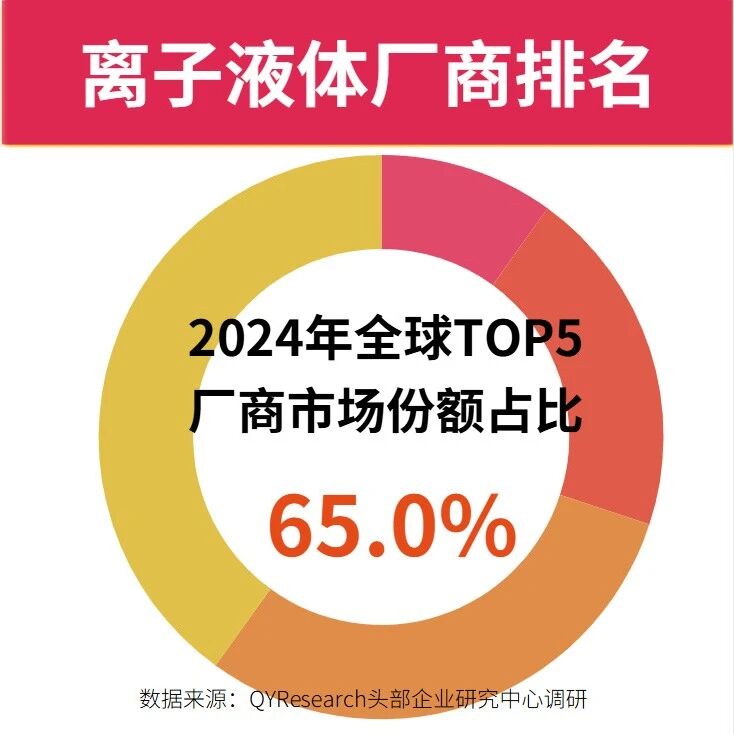
Core Viewpoint - Ionic liquids are gaining attention due to their unique properties such as low volatility, high thermal stability, and excellent solvation capabilities, with a projected global market size of $270 million by 2031 and a CAGR of 9.3% from 2025 to 2031 [1][9]. Market Overview - The global ionic liquid market is expected to reach $270 million by 2031, with a CAGR of 9.3% [1]. - The market is primarily driven by increasing regulatory pressure on hazardous solvents, advancements in production technology, and ongoing R&D efforts to explore new applications [9]. Key Players - Major manufacturers in the ionic liquid market include BASF, Evonik Industries, Solvay, Merck, KOEI Chemical, Sanyo Chemical, Proionic, Solvionic, IoLiTec, and Zhejiang Lande Energy Technology [6]. - The top five manufacturers are projected to hold approximately 65.0% of the market share in 2024 [6]. Market Segmentation - The ionic liquid market can be segmented by product type and application, with common applications including solvents, catalysts, and electrolytes in batteries and fuel cells [7][8]. Driving Factors - Regulatory pressure from agencies like the EPA is creating opportunities for ionic liquids as safer and more sustainable alternatives [9]. - Investment in research infrastructure and manufacturing processes is essential to support the commercialization of ionic liquids [9]. - Continuous R&D is expanding the potential applications and improving the performance of ionic liquids through tailored combinations of cations and anions [9]. Challenges - High synthesis costs and limited commercial availability of certain ionic liquids may hinder broader industrial applications [10]. - Existing technologies and solvents pose competition, making it challenging to persuade industries to switch to ionic liquids [10].
中国特种丙烯酸甲酯市场深度评估及投资趋势预测报告2025-2031年
Sou Hu Cai Jing· 2025-06-09 05:05
Group 1 - The special methacrylate market is categorized into various product types and applications, with growth trends projected from 2021 to 2031 [1][2] - Key product types include methyl methacrylate and 1,4-butanediol dimethyl methacrylate, among others [1][2] - Major applications of special methacrylate include automotive and transportation, construction, chemical and plastics industry, paper and packaging, coatings, adhesives, advertising, communication, and electronics [1][2] Group 2 - The overall development status of the special methacrylate industry indicates significant growth potential, driven by various factors [2][3] - Key characteristics of the industry include increasing demand across multiple sectors and technological advancements [2][3] - Barriers to entry in the special methacrylate industry are identified, impacting new market entrants [2][3] Group 3 - Global supply and demand dynamics for special methacrylate are analyzed, with forecasts extending to 2031 [2][3] - Production capacity, output, and utilization rates are expected to evolve significantly over the next decade [2][3] - The market share of special methacrylate production in China is projected to increase, reflecting its growing importance in the global landscape [2][3] Group 4 - The competitive landscape of the special methacrylate market reveals key players and their market shares [3][4] - Major manufacturers are analyzed based on production capacity, sales volume, and revenue from 2021 to 2025 [3][4] - The industry concentration and competitive intensity are assessed, highlighting the top manufacturers and their market positions [4][5] Group 5 - Different product types of special methacrylate are examined, with sales and revenue forecasts provided for 2021 to 2031 [5][6] - The pricing trends for various product types are also analyzed, indicating market dynamics [5][6] - The Chinese market for special methacrylate is expected to show significant growth in both sales volume and revenue across different product types [5][6] Group 6 - The analysis of different applications for special methacrylate includes sales and revenue projections from 2021 to 2031 [6][7] - The market share of various applications is expected to shift, reflecting changing industry demands [6][7] - Price trends for special methacrylate across different applications are also forecasted [6][7] Group 7 - The development environment for the special methacrylate industry includes trends, driving factors, and a SWOT analysis of Chinese enterprises [7][8] - Regulatory frameworks and policy trends affecting the industry are discussed, providing insights into the operational landscape [7][8] - The supply chain analysis highlights key raw materials and major downstream customers in the special methacrylate industry [8][9] Group 8 - Profiles of major global manufacturers of special methacrylate are provided, detailing their production bases, market positions, and product specifications [9][10] - Key players include Evonik Industries, BASF, Mitsubishi Chemical Holdings, and others, with their respective market dynamics analyzed [9][10] - The competitive positioning of these manufacturers is assessed based on sales volume, revenue, and market share from 2021 to 2025 [9][10]
全球消费电子产品塑料涂层行业深度监测及发展动态规划报告2025-2031年
Sou Hu Cai Jing· 2025-06-06 14:22
全球消费电子产品塑料涂层行业深度监测及发展动态规划报告2025-2031年 【全新修订】:2025年6月 【出版机构】:中智信投研究网 【内容部分有删减·详细可参中智信投研究网出版完整信息!】 【免费售后 服务一年,具体内容及订购流程欢迎咨询客服人员 】 报告目录 1 统计范围及所属行业 1.1 产品定义 1.2 所属行业 1.3 产品分类,按产品类型 1.3.1 按产品类型细分,全球消费电子产品塑料涂层市场规模2020 VS 2024 VS 2031 1.3.2 闪光砂涂料 1.3.3 哑光涂料 1.4.1 按应用细分,全球消费电子产品塑料涂层市场规模2020 VS 2024 VS 2031 1.3.4 其他 1.4 产品分类,按应用 1.4.2 手机 1.4.3 平板电脑 1.4.4 笔记本电脑 1.4.5 其他 1.5 行业发展现状分析 1.5.1 消费电子产品塑料涂层行业发展总体概况 1.5.2 消费电子产品塑料涂层行业发展主要特点 1.5.3 消费电子产品塑料涂层行业发展影响因素 1.5.3.1 消费电子产品塑料涂层有利因素 1.5.3.2 消费电子产品塑料涂层不利因素 1.5.4 进入行业壁垒 2 ...