IMAX Corporation

Search documents
IMAX全球:春节档或更多受“排期”影响,2026中国电影票房分布将更均衡
3 6 Ke· 2026-02-27 02:56
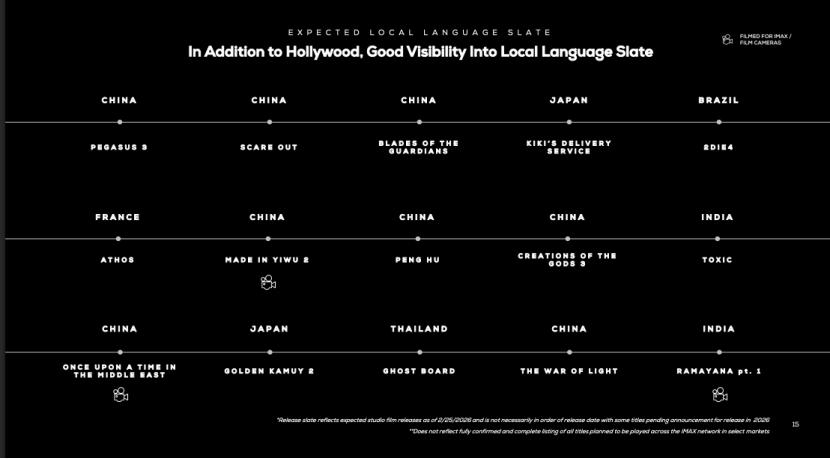
针对刚刚过去的春节档表现,IMAX中国首席执行官Richard Gelfond在2025 年第四季度及全年业绩电话会议上解释: 春节档档期票房更多受"排期"影响,并不完全反映"市场趋势"。 他指出,多部国产大片如《欢迎来到龙餐厅》、《澎湖海战》因制作周期未完成而没有赶上春节档,这也意味着2026 年中国市场的票房分布将比2025年更为均衡。"电影原本计划春节档上映,但因为制作还没完成,所以推迟到了暑期 档。" 放眼全球,2026年IMAX将迎来史上最强片单,全球预计至少有12部IMAX巨制上映,包括诺兰的《奥德赛》、专为 IMAX拍摄的《沙丘3》,以及《超级马里奥兄弟大电影》、《玩具总动员5》等游戏IP改编及家庭向内容。 与此同时,本土语言影片成为重要增长极:日本续集《哥斯拉:零度》、印度史诗《罗摩衍那》、中国影片《澎湖海 战》都将在2026年上映。IMAX还与Apple达成协议,将直播F1赛事,并独家上映猫王纪录片,进一步拓展内容边界。 虽然全球电影市场遇到挑战,作为电影市场的风向标,IMAX依然传递出极大的市场信心,"我们相信,我们远未达到 巅峰,而是处于发展和成长的阶段。"而从这场电话会议,也可以清晰看 ...



Live Nation (LYV) Reports Q4 Loss, Beats Revenue Estimates
ZACKS· 2026-02-19 23:16
分组1 - Live Nation reported a quarterly loss of $1.06 per share, slightly better than the Zacks Consensus Estimate of a loss of $1.08, compared to earnings of $0.56 per share a year ago, indicating an earnings surprise of +2.20% [1] - The company posted revenues of $6.31 billion for the quarter ended December 2025, surpassing the Zacks Consensus Estimate by 3.97%, and showing an increase from $5.68 billion in the same quarter last year [2] - Live Nation shares have increased by approximately 9.3% since the beginning of the year, outperforming the S&P 500's gain of 0.5% [3] 分组2 - The current consensus EPS estimate for the upcoming quarter is -$0.23 on revenues of $3.62 billion, and for the current fiscal year, it is $2.05 on revenues of $27.21 billion [7] - The Zacks Industry Rank for Film and Television Production and Distribution is currently in the bottom 20% of over 250 Zacks industries, indicating potential underperformance compared to higher-ranked industries [8]


Cinemark Holdings (CNK) Q4 Earnings Lag Estimates
ZACKS· 2026-02-18 13:40
Core Viewpoint - Cinemark Holdings reported quarterly earnings of $0.16 per share, missing the Zacks Consensus Estimate of $0.24 per share, and showing a decline from $0.33 per share a year ago, indicating an earnings surprise of -33.33% [1] Group 1: Earnings Performance - The company has not surpassed consensus EPS estimates over the last four quarters [2] - Cinemark's revenues for the quarter ended December 2025 were $776.3 million, exceeding the Zacks Consensus Estimate by 0.83%, but down from $814.3 million year-over-year [2] - The company has topped consensus revenue estimates three times in the last four quarters [2] Group 2: Stock Performance and Outlook - Cinemark shares have increased by approximately 9.1% since the beginning of the year, contrasting with the S&P 500's zero return [3] - The future stock price movement will largely depend on management's commentary during the earnings call [3] - The current consensus EPS estimate for the upcoming quarter is -$0.22 on revenues of $589.91 million, and for the current fiscal year, it is $2.07 on revenues of $3.38 billion [7] Group 3: Industry Context - The Film and Television Production and Distribution industry, to which Cinemark belongs, is currently ranked in the bottom 17% of over 250 Zacks industries, indicating potential challenges ahead [8] - Empirical research suggests a strong correlation between near-term stock movements and earnings estimate revisions, which could impact Cinemark's stock performance [5]


Cineverse Reports Third Quarter Fiscal Year 2026 Results
Prnewswire· 2026-02-17 21:00
Core Insights - Cineverse Corp reported a total revenue of $16.3 million for Q3 FY 2026, a 60% decrease compared to $40.7 million in the prior year quarter, primarily due to a significant theatrical revenue from "Terrifier 3" in the previous year [1][2] - The company achieved a direct operating margin of 69%, up from 48% in the prior year, indicating improved cost management [1][2] - Adjusted EBITDA for the quarter was $2.4 million, a decrease from $10.9 million year-over-year, but an improvement of $6.0 million from the previous sequential quarter [1][2] Financial Performance - Revenue for Q3 FY 2026 was $16.3 million, down from $40.7 million in Q3 FY 2025, reflecting a 60% decline [1][2] - Direct operating margin increased to 69% from 48% year-over-year, showcasing effective cost management strategies [1][2] - SG&A expenses rose by 14% to $10.7 million, attributed to increased marketing and professional service costs [1][2] - Net loss attributable to common stockholders was $(1.0) million, or $(0.05) per share, compared to a net profit of $7.0 million, or $0.34 per share, in the prior year [1][2] - Adjusted EBITDA was $2.4 million, down from $10.9 million year-over-year, but improved by $6.0 million sequentially [1][2] Acquisitions and Future Guidance - Cineverse completed two acquisitions expected to add approximately $53 million in annual revenue and $10 million in Adjusted EBITDA for FY 2027 [1][2] - The acquisition of Giant Worldwide is anticipated to contribute $15 to $17 million in revenue and $3.5 to $4 million in Adjusted EBITDA for FY 2027 [1][2] - The acquisition of IndiCue, Inc. for $22 million is expected to generate approximately $38 million in revenue and $7 million in Adjusted EBITDA for FY 2027 [1][2] - The company provided guidance for FY 2027, projecting revenue between $115 to $120 million and Adjusted EBITDA between $10 to $20 million [1][2] Operational Developments - Cineverse launched a new streaming network, JoySauce, and expanded its international streaming channels [2] - Total streaming viewers increased by approximately 10% year-over-year to 149 million, with total minutes streamed up 33% to over 3.4 billion [2] - SVOD subscribers grew approximately 15% year-over-year to 1.55 million, driven by the flagship Cineverse channel [2] - The company announced the launch of Matchpoint™ 3.0, an AI-driven media supply chain platform with advanced features [2] Management Commentary - Management emphasized the focus on improving operating results and the positive impact of the Giant and IndiCue acquisitions on revenue and EBITDA [2] - The CEO highlighted the favorable valuations and accretive nature of the acquisitions, strengthening Cineverse's market position [2] - The company aims to maintain cost discipline while enhancing its subscription business and achieving targeted cost reductions [2]

Cineverse Acquires Profitable Connected TV Monetization Platform IndiCue in Transformational Deal, Expanding High-Margin Infrastructure that Powers Modern Content Distribution
Prnewswire· 2026-02-13 14:00
Core Insights - Cineverse Corp. has acquired IndiCue, a profitable connected TV monetization platform, marking a significant step in its transformation into a streaming infrastructure company [1][2] - The acquisition is expected to generate $115-$120 million in revenue and $10-$20 million in adjusted EBITDA for fiscal year 2027, starting April 1, 2026 [1][2] - This deal enhances Cineverse's technology revenue, moving towards a majority technology revenue model through scalable, recurring infrastructure economics [1] Financial Impact - IndiCue is projected to generate approximately $38 million in revenue and $9.6 million in EBITDA in calendar year 2026, reflecting a 25% EBITDA margin [1][2] - The acquisition is expected to contribute to Cineverse's adjusted EBITDA of $10-$20 million in fiscal year 2027, indicating the accretive nature of the transaction [1][2] - Revenue for fiscal year 2027 is anticipated to exceed $115 million, with technology platforms accounting for over 50% of total revenue [1][2] Strategic Rationale - The integration of IndiCue into Cineverse's Matchpoint ecosystem completes a critical component of its platform strategy, allowing for a unified solution that connects distribution, data, and monetization [1][2] - The combined platform enables real-time analytics and automated workflows, essential for competitiveness in the rapidly evolving ad-supported streaming market [2] - This acquisition positions Cineverse as the only independent, full-stack white-label solution for content delivery and ad monetization, simplifying operations for studios and streaming operators [2] Transaction Financing - The acquisition was financed through a mix of cash, deferred consideration, and performance-based earnouts, with total potential consideration reaching up to $40 million [2] - Cineverse raised $13 million in convertible notes to support the transaction and working capital needs, reflecting strong shareholder confidence in the company's strategy [2] Integration and Team - IndiCue's leadership team has joined Cineverse in newly appointed roles, enhancing the combined organization's expertise in CTV advertising technology and content operations [2] - The integration aims to leverage advanced monetization capabilities within a scalable platform, allowing for improved content distribution and advertising efficiency [2]

Understanding Netflix's Position In Entertainment Industry Compared To Competitors - Netflix (NASDAQ:NFLX)
Benzinga· 2026-01-27 15:01
Core Insights - The article provides a comprehensive comparison of Netflix against its key competitors in the Entertainment industry, focusing on financial metrics, market position, and growth prospects to offer insights for investors [1] Company Overview - Netflix operates a single business model centered on its streaming service, boasting over 300 million subscribers globally, making it the largest television entertainment subscriber base in the U.S. and internationally [2] - The company has expanded its revenue streams by introducing ad-supported subscription plans in 2022, diversifying beyond traditional subscription fees [2] Financial Metrics - Netflix's Price to Earnings (P/E) ratio stands at 33.87, which is lower than the industry average by 0.53x, indicating potential value [5] - The Price to Book (P/B) ratio of 13.60 is higher than the industry average by 1.11x, suggesting possible overvaluation based on book value [5] - The Price to Sales (P/S) ratio of 8.24 is 1.9x the industry average, indicating potential overvaluation in relation to sales performance [5] - The Return on Equity (ROE) of 9.2% is 0.44% above the industry average, reflecting efficient use of equity to generate profits [5] - Netflix's EBITDA of $7.85 billion is 7.27x above the industry average, indicating stronger profitability and cash flow generation [5] - The gross profit of $5.53 billion is 2.97x above that of its industry peers, highlighting superior earnings from core operations [5] - The company is experiencing significant revenue growth at a rate of 17.61%, outperforming the industry average of 1.07% [5] Debt-to-Equity Ratio - Netflix has a debt-to-equity (D/E) ratio of 0.54, which is lower than that of its top four peers, indicating a stronger financial position and a favorable balance between debt and equity [8] Key Takeaways - The P/E ratio suggests potential undervaluation for Netflix compared to peers, while the high P/B and P/S ratios indicate overvaluation relative to industry standards [9] - In terms of ROE, EBITDA, gross profit, and revenue growth, Netflix shows strong performance compared to competitors in the Entertainment sector [9]


Inquiry Into Netflix's Competitor Dynamics In Entertainment Industry - Netflix (NASDAQ:NFLX)
Benzinga· 2026-01-26 15:00
Core Insights - The article provides a comprehensive comparison of Netflix against its key competitors in the Entertainment industry, focusing on financial metrics, market position, and growth prospects to offer valuable insights for investors [1] Company Overview - Netflix operates a straightforward business model centered on its streaming service, boasting over 300 million subscribers globally and the largest television entertainment subscriber base in the U.S. and internationally [2] - The company has expanded its revenue streams by introducing ad-supported subscription plans in 2022, diversifying its income beyond traditional subscription fees [2] Financial Metrics Comparison - Netflix's Price to Earnings (P/E) ratio is 34.04, which is 0.53x lower than the industry average, indicating potential for growth at a reasonable price [5] - The Price to Book (P/B) ratio stands at 13.73, 1.12x above the industry average, suggesting that Netflix may be overvalued in terms of book value [5] - The Price to Sales (P/S) ratio is 8.28, exceeding the industry average by 1.9x, which may also indicate overvaluation in sales performance [5] - The Return on Equity (ROE) is 9.2%, 0.44% above the industry average, reflecting efficient use of equity to generate profits [5] - Netflix's EBITDA is $7.37 billion, which is 6.82x above the industry average, indicating stronger profitability and cash flow generation [5] - The gross profit of $5.35 billion is 2.88x above the industry average, highlighting superior profitability from core operations [5] - Revenue growth for Netflix is 4.7%, surpassing the industry average of 1.07%, demonstrating robust sales expansion and market share gain [5] Debt to Equity Ratio - Netflix has a lower debt-to-equity (D/E) ratio of 0.54 compared to its top four peers, indicating a stronger financial position and less reliance on debt financing [9]

Evaluating Netflix Against Peers In Entertainment Industry - Netflix (NASDAQ:NFLX)
Benzinga· 2026-01-23 15:00
Core Insights - The article provides a comprehensive evaluation of Netflix in comparison to its competitors in the Entertainment industry, focusing on financial indicators, market positioning, and growth potential [1] Company Overview - Netflix operates a single business model centered around its streaming service, boasting over 300 million subscribers globally and the largest television entertainment subscriber base in the U.S. and internationally [2] - The company has expanded its revenue streams by introducing ad-supported subscription plans in 2022, diversifying its income beyond traditional subscription fees [2] Financial Performance - Netflix's Price to Earnings (P/E) ratio stands at 33.02, which is 0.52x lower than the industry average, suggesting potential for growth at a reasonable price [5] - The Price to Book (P/B) ratio is 13.31, indicating that Netflix may be overvalued in terms of book value compared to its peers [5] - The Price to Sales (P/S) ratio of 8.03 is 1.86x higher than the industry average, which may also suggest overvaluation in sales performance [5] - The Return on Equity (ROE) is 9.2%, slightly above the industry average, indicating efficient use of equity to generate profits [5] - Netflix's EBITDA is $7.37 billion, which is 6.82x above the industry average, highlighting strong profitability and cash flow generation [5] - The gross profit of $5.35 billion is 2.88x above the industry average, indicating robust earnings from core operations [5] - Revenue growth of 4.7% is significantly higher than the industry average of 1.07%, showcasing strong demand for Netflix's offerings [5] Debt Management - Netflix has a debt-to-equity (D/E) ratio of 0.54, which is lower than that of its top four peers, indicating a stronger financial position and a favorable balance between debt and equity [9]





Strong Theater Demand Drives IMAX Corporation (IMAX) Stock Momentum
Yahoo Finance· 2026-01-23 14:55
Group 1 - Orbis Investment Management reported a positive year in 2025, with returns driven by stock-specific research rather than post-pandemic valuation rebounds [1] - The strategy emphasizes disciplined bottom-up investing and improved execution across several portfolio holdings [1] - Rising global government debt supports equities as core real assets, with non-US markets offering attractive valuations [1] - Orbis suggests a potential shift from the long period of US market dominance, focusing on fundamentally undervalued businesses [1] Group 2 - IMAX Corporation is highlighted as a key entertainment holding benefiting from renewed strength in theatrical releases [2] - IMAX shares experienced a one-month return of approximately -5.61% but gained about 50.98% over the last 52 weeks, closing at approximately $35.39 per share with a market capitalization of about $1.9 billion [2] - The recent bidding war for Warner Bros Discovery between Paramount and Netflix underscores the value placed on scarce content and platforms for developing high-value Intellectual Property [3] - The theatrical window is identified as crucial for maximizing the value of IP, generating significant cash flow and marketing benefits [3]
Assessing Netflix's Performance Against Competitors In Entertainment Industry - Netflix (NASDAQ:NFLX)
Benzinga· 2026-01-15 15:01
Core Insights - The article provides a comprehensive analysis of Netflix and its competitors in the Entertainment industry, focusing on financial metrics, market position, and growth prospects to offer insights for investors [1] Company Overview - Netflix operates a straightforward business model centered on its streaming service, boasting over 300 million subscribers globally, making it the largest television entertainment subscriber base [2] - The company has expanded into ad-supported subscription plans since 2022, diversifying its revenue streams beyond traditional subscription fees [2] Financial Metrics Comparison - Netflix's Price to Earnings (P/E) ratio is 36.99, which is 0.49x lower than the industry average, indicating potential undervaluation [5] - The Price to Book (P/B) ratio of 14.47 is 1.16x the industry average, suggesting that Netflix may be overvalued in terms of book value [5] - The Price to Sales (P/S) ratio of 8.90 is 1.89x the industry average, indicating potential overvaluation relative to sales performance [5] - Netflix's Return on Equity (ROE) stands at 10.01%, which is 1.6% above the industry average, reflecting efficient use of equity to generate profits [5] - The company reports an EBITDA of $7.37 billion, which is 5.46x above the industry average, showcasing stronger profitability and cash flow generation [5] - With a gross profit of $5.35 billion, Netflix's profitability is 2.29x above the industry average, indicating robust earnings from core operations [5] - Revenue growth for Netflix is at 17.16%, significantly exceeding the industry average of 2.15%, highlighting strong sales performance [5] Debt-to-Equity Ratio - Netflix has a debt-to-equity (D/E) ratio of 0.56, which is lower than that of its top four peers, indicating a stronger financial position and a favorable balance between debt and equity [8] Key Takeaways - The low P/E ratio suggests potential undervaluation for Netflix, while high P/B and P/S ratios reflect strong market sentiment [9] - Netflix demonstrates high performance in ROE, EBITDA, gross profit, and revenue growth relative to industry peers, indicating strong profitability and growth potential in the Entertainment sector [9]